
BuddhistCatholicContemplativeEvangelicalGeneral ChristianHinduJewishLatter-day SaintMuslimNew VisionsProgressive Christian
Beliefs
- Buddhist
- Catholic
- Contemplative
- Evangelical
- General Christian
- Hindu
- Jewish
- Latter-day Saint
- More Voices
- Muslim
- New Visions
- Pagan
- Progressive Christian
Topics
- Religion News
- Food and Religion
- Sports and Religion
- Religious Art
- Religious Music and Entertainment
- Religious Events
- History and Religion
- Style and Religion
- Politics and Religion
- Women in Religion
- Recreation Outdoors and Religion
- Business Finance and Religion
- Careers Workplace and Religion
- Education and Religion
- Family Parenting and Religion
- Health Fitness and Religion
- Home and Religion
- Relationships and Religion
- Technology and Religion
- Travel and Religion
Columnists
- Buddhist Columnists
- Business Finance and Religion Columnists
- Careers Workplace and Religion Columnists
- Catholic Columnists
- Contemplative Columnists
- Education and Religion Columnists
- Evangelists Columnists
- Family Parenting and Religion Columnists
- General Christian Columnists
- Health Fitness and Religion Columnists
- Hindu Columnists
- History and Religion Columnists
- Home and Religion Columnists
- Jewish Columnists
- More Voices Columnists
- Latter Day Columnists
- Muslim Columnists
- New Visions Columnists
- Nonreligious Columnists
- Pagan Columnists
- Politics and Religion Columnists
- Progressive Columnists
- Recreation Outdoors and Religion Columnists
- Relationships and Religion Columnists
- Religion News Columnists
- Religious Art Columnists
- Religious Events Columnists
- Religious Music and Entertainment Columnists
- Sports and Religion Columnists
- Style and Religion Columnists
- Technology and Religion Columnists
- Travel and Religion Columnists
- Women in Religion Columnists
Resource Library
- 2026 Calendar
- Library of World Religions
- The 100 Most Holy Places on Earth
- Patheos Answers
- Podcasts
- Videos
- Faith Leaders Database
- Anglican Episcopalian
- Bahai
- Baptist
- Buddhism
- Christianity
- Confucianism
- Eastern Orthodoxy
- Hinduism
- Holiness and Pentecostal
- ISKCON
- Islam
- Judaism
- Lutheran
- Methodist
- The Church of Jesus Christ of Latter-day Saints
- New Age
- Paganism
- Presbytarian and Reformed
- Protestantism
- Religion Behind the Scenes
- Roman Catholic
- Scientology
- Shia Islam
- Sikhism
- Sufism
- Sunni Islam
- Taoism
- Zen
- See all religions
Research Tools
 Ad-Free & Subscriber Log-In Subscription Support
Ad-Free & Subscriber Log-In Subscription Support
Follow Patheos 

- Trending:
- Forgiveness
- |
- Marriage
- |
- Consciousness
- |
- Death Penalty
- |
- Election
- |
- Halloween
 American Buddhist Perspectives
- Home
- Buddhist
- Religion News
- Buddhists and Christians share a Saint: Barlaam & Josaphat
Buddhists and Christians share a Saint: Barlaam & Josaphat
Last updated on: December 7, 2017 at 10:39 am by Justin Whitaker
Buddhists and Christians share a Saint: Barlaam & Josaphat 2017-12-07T10:39:33-07:00 Justin Whitaker
Patheos Explore the world's faith through different perspectives on religion and spirituality! Patheos has the views of the prevalent religions and spiritualities of the world.
This was the proclamation made on June 3, 1870 by F. Max Muller, described by Donald Lopez as “the most famous scholar of Asian Religion in the 19th century.” In a 2012 lecture at Harvard, Lopez offers a portion of Muller’s full quote:
St. Josaphat is the Buddha of the Buddhist canon. It follows that Buddha has become a saint in the roman [Catholic] Church; it follows that, though under a different name, the sage of Kapilavastu, the founder of a religion which, whatever we may think of its dogma, is, in the purity of its morals, nearer to Christianity than any other religion, and which counts even now, after an existence of 2,400 years, more believers than any other creed, has received the highest honours that the Christian Church can bestow. And whatever we may think of the sanctity of saints, let those who doubt the right of Buddha to a place among them, read the story of his life as it is told in the Buddhistical canon. If he lived the life which is there described, few saints have a better claim to the title than Buddha; and no one either in the Greek or in the Roman Church need be ashamed of having paid to his memory the honor that was intended for St. Josaphat, the prince, and the saint. (Selected Essays…)
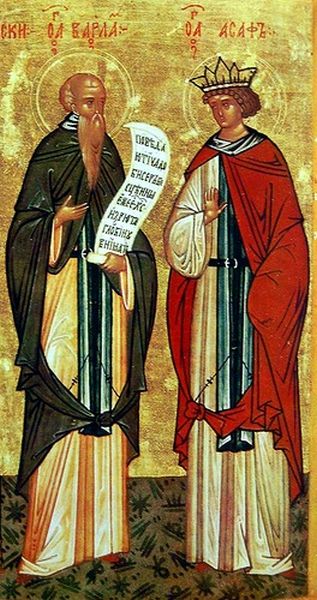
Barlaam & Josaphat via wikimedia commons

However, as James Ford rightly points out today:
In the liturgical calendar of the Roman Catholic church as well as for those of the Eastern Churches who follow the revised Julian calendar, today, the 27th of November is the feast of Sts Barlaam and Josaphat. The Orthodox who continue to use the Julian calendar observe this feast on 26th of August.
Or, used to. Actually, for the most part this holiday is no longer observed.
So a bit of Buddhism has been around in Christianity for centuries, in fact first appearing in Greek in the work of John of Damascus; Josaphat being a translation/corruption of the Arabic Yūdasatf, itself a translation/corruption of Bodhisattva (“awakening-being” or “one en route to awakening”), a common designation of the Buddha in the early texts. A fuller account can be found at the Encyclopedia Britannica.
However, it wasn’t the pure teachings of the Buddha that entered into Christianity of the time. Just as there aren’t any pure teachings of the Buddha entering into Western culture (an increasingly meaningless designation) today. It was a story, held and passed on by people, corrupted, we might say, or translated by each succeeding story-teller.
This is not to say that there are “pure teachings” to be found; though most Buddhist thinkers have tended toward that kind of rhetoric: “we’ve got the real deal here, this is the stuff!” Similarly, when scholars present Buddhism, we too have to pick out what we take to be the most important portions. Our goal is to set aside our own personal proclivities and state what is/was most important to followers themselves: was it the 4 noble truths, or chants or charms believed to protect one from evil spirits and snake bites?
With 2500 years of history now, there is precious little that hasn’t found its way to “centrality” in one formulation of Buddhism or another. Though I worry and caution against any kind of “flattening” relativism where anything and everything is Buddhist if someone says it is. As is often the case, the middle way is best, somewhere between essentialism and relativism.
And though I don’t often praise Postmodern philosophy, I find a conceptual middle way here with the help of Theodor Adorno in the idea of constellations:
On the conceptual side, we can construct interlinked ranges of concepts that illuminate the uniqueness of an object without pretending to gain exhaustive insight into it. On the object side, each unique thing is a constellation of its historical relations with other things. Hence a constellation of concepts can “‘gather around’ the unique history of the object where this history makes the object the unique thing that it is…” (review of “Theodor Adorno: Key Concepts“)
In Buddhisty English, we can see that “things” exist due to causes and conditions and our mental imputations (“history makes the object the unique thing that it is”), realizing that these are in flux. Seeing “each unique thing [as] a constellation” means seeing it as we do the Big Dipper or Aries, realizing that what we actually see are just points of light in the sky and that we construct the object out of them. To the extent that we share that object with others who accept it is the extent to which it is real. As with constellations in the sky, different social groups and different temporal periods will create different “objects” out of the constellations out there.
In our constellation today, the Josaphat of these old tales has faded from the traditional Christian constellation of saints. But the Buddha of many other strands of history is becoming evermore present in the world presently dominated by Christian thought and practice. That can be seen in folks like James Ford, who bridge the Christianity-Buddhism divide, as a retired UU minister and a Zen priest as well as countless others including:
- Father Robert Kennedy, a Jesuit priest and Zen teacher;
- Chung Hyun Kyung, Professor of Ecumenical Theology and Interfaith Engagement at Union Theological Seminary and a Buddhist Dharma teacher; and
- Paul Knitter, Professor of Theology, World Religions and Culture at Union Theological Seminary.
(as discussed in my review of Jesus & Buddha: Practicing Across Traditions.) My own trajectory takes me through the windings of Christianity and Buddhism as well; born and raised a Catholic, abandoning that faith for atheism and humanism before stumbling upon Buddhism, then winding the course(s) of the many Buddhist traditions (still) and resting in the warm waters of Unitarian Universalism and Zen practice, with a side of Vipassana and modern mindfulness.
For me, and for others who partake in the interfaith conversation, the story of Barlaam and Josaphat can serve as a reminder of our long heritage of sharing. It can also serve as a story of failure and misunderstanding, a warning to stay awake to the realities of change that beset every story, no matter how well told.
Support independent coverage of Buddhism by joining a community of fellow learners/practitioners at Patreon.
‘Like’ American Buddhist Perspectives on facebook.
Previous Post
November 15, 2017
A Storm is Coming: Tibetan Buddhism in the West
Next Post
December 4, 2017 The Buddha on Prayer and other Secular Buddhist talks
Browse Our Archives
Select a Category Academia Activism American Buddhism Art Book review Buddhism Buddhism Today Buddhist Ethics Burma/Myanmar China Christianity Commodification Environment Gender Happiness Health Humor India Interfaith Islam Japanese Buddhism Kant Media / News Meditation mindfulness Photography Poetry Politics quicktakes Running Teaching Technology Thailand Theism/Atheism Theravada Tibet Tibetan Buddhism Travels Uncategorized Unitarian Universalism video Western Philosophy Zen
Select a Month June 2021 January 2021 November 2020 August 2020 July 2020 March 2020 January 2020 October 2019 August 2019 June 2019 May 2019 March 2019 February 2019 January 2019 December 2018 November 2018 October 2018 September 2018 August 2018 July 2018 June 2018 May 2018 April 2018 March 2018 February 2018 January 2018 December 2017 November 2017 October 2017 September 2017 August 2017 July 2017 June 2017 May 2017 April 2017 March 2017 February 2017 January 2017 December 2016 November 2016 October 2016 September 2016 August 2016 July 2016 June 2016 May 2016 April 2016 March 2016 February 2016 January 2016 December 2015 November 2015 October 2015 September 2015 August 2015 July 2015 June 2015 May 2015 April 2015 March 2015 February 2015 January 2015 December 2014 November 2014 October 2014 September 2014 August 2014 July 2014 June 2014 May 2014 April 2014 March 2014 February 2014 January 2014 December 2013 November 2013 October 2013 September 2013 August 2013 July 2013 June 2013 May 2013 April 2013 March 2013 February 2013 January 2013 December 2012 November 2012 October 2012 September 2012 August 2012 July 2012 June 2012 May 2012 April 2012 March 2012 February 2012 January 2012 December 2011 November 2011 October 2011 September 2011 August 2011 July 2011 June 2011 May 2011 April 2011 March 2011 February 2011 January 2011 December 2010 November 2010 October 2010 September 2010 August 2010 July 2010 June 2010 May 2010 April 2010 March 2010 February 2010 January 2010 December 2009 November 2009 October 2009 September 2009 August 2009 July 2009 June 2009 May 2009 April 2009 March 2009 February 2009 January 2009 December 2008 November 2008 October 2008 September 2008 August 2008 July 2008 June 2008 May 2008 April 2008 March 2008 September 2007 August 2007 July 2007 June 2007 May 2007 April 2007 March 2007 February 2007 January 2007 December 2006 November 2006 October 2006 September 2006 August 2006 July 2006 June 2006 May 2006 April 2006 March 2006 February 2006 January 2006 December 2005 November 2005 October 2005 September 2005 November 2004 September 2004 August 2004
Follow Us!
TAKE THE
Religious Wisdom Quiz
According to James, what happens when sin is full-grown?
Select your answer to see how you score.
It gives birth to death It separates from God It hardens the heart It destroys faith
Support this
Column


Related posts from American Buddhist Perspectives

For Pride Month: Our 2015 Interview with La...
American Buddhist Perspectives

In strife and uncertainty: let us remember loving-kindness
American Buddhist Perspectives

In the rush to return to normal, can...
American Buddhist Perspectives

The Coronavirus is coming - Some thoughts from...
American Buddhist Perspectives
TRENDING AT PATHEOS Buddhist

On Taking Refuge in the Dharma
(Here I continue the feature of sharing talks and essays by teachers...

(Continuing my intention to share talks and essays by other members of Empty...
The Subtle Art of Bowing: A Dharma Discourse
(This presentation was first offered by my dear friend Dharma Holder Tom...

Internal Family Systems Can Heal you Mentally &...
How IFS Helped Me Stop Fighting Myself Internal Family Systems (IFS) is...

The Bible No One Spoke About: A Family’s...
A mysterious family Bible, unspoken faith, and a journey from curiosity to...

How Uncertainty Can Transform Your Life in 2025
Embracing Uncertainty: A New Year’s Resolution for the Brave As 2025 approaches,...
view all Buddhist blogs
Ad-Free & Subscriber Log-In Subscription Support
- About Us
- 2026 Calendar
- Videos
- Podcasts
- Library of World Religions
- Faith In Media Tracker
- Advertise With Us
- Write for Us
- Privacy Policy
- Terms of Service
- Do Not Sell My Data
- Contact Us
- Radiant Digital
- Manage Newsletter Subscriptions
- Unsubscribe From Notifications
- Sitemap
Copyright 2008-2026, Patheos. All rights reserved.
Subscription Support Ad-Free & Subscriber Log-In
Follow Patheos