
BuddhistCatholicContemplativeEvangelicalGeneral ChristianHinduJewishLatter-day SaintMuslimNew VisionsProgressive Christian
Beliefs
- Buddhist
- Catholic
- Contemplative
- Evangelical
- General Christian
- Hindu
- Jewish
- Latter-day Saint
- More Voices
- Muslim
- New Visions
- Pagan
- Progressive Christian
Topics
- Religion News
- Food and Religion
- Sports and Religion
- Religious Art
- Religious Music and Entertainment
- Religious Events
- History and Religion
- Style and Religion
- Politics and Religion
- Women in Religion
- Recreation Outdoors and Religion
- Business Finance and Religion
- Careers Workplace and Religion
- Education and Religion
- Family Parenting and Religion
- Health Fitness and Religion
- Home and Religion
- Relationships and Religion
- Technology and Religion
- Travel and Religion
Columnists
- Buddhist Columnists
- Business Finance and Religion Columnists
- Careers Workplace and Religion Columnists
- Catholic Columnists
- Contemplative Columnists
- Education and Religion Columnists
- Evangelists Columnists
- Family Parenting and Religion Columnists
- General Christian Columnists
- Health Fitness and Religion Columnists
- Hindu Columnists
- History and Religion Columnists
- Home and Religion Columnists
- Jewish Columnists
- More Voices Columnists
- Latter Day Columnists
- Muslim Columnists
- New Visions Columnists
- Nonreligious Columnists
- Pagan Columnists
- Politics and Religion Columnists
- Progressive Columnists
- Recreation Outdoors and Religion Columnists
- Relationships and Religion Columnists
- Religion News Columnists
- Religious Art Columnists
- Religious Events Columnists
- Religious Music and Entertainment Columnists
- Sports and Religion Columnists
- Style and Religion Columnists
- Technology and Religion Columnists
- Travel and Religion Columnists
- Women in Religion Columnists
Resource Library
- 2026 Calendar
- Library of World Religions
- The 100 Most Holy Places on Earth
- Patheos Answers
- Podcasts
- Videos
- Faith Leaders Database
- Anglican Episcopalian
- Bahai
- Baptist
- Buddhism
- Christianity
- Confucianism
- Eastern Orthodoxy
- Hinduism
- Holiness and Pentecostal
- ISKCON
- Islam
- Judaism
- Lutheran
- Methodist
- The Church of Jesus Christ of Latter-day Saints
- New Age
- Paganism
- Presbytarian and Reformed
- Protestantism
- Religion Behind the Scenes
- Roman Catholic
- Scientology
- Shia Islam
- Sikhism
- Sufism
- Sunni Islam
- Taoism
- Zen
- See all religions
Research Tools
 Ad-Free & Subscriber Log-In Subscription Support
Ad-Free & Subscriber Log-In Subscription Support
Follow Patheos 

- Trending:
- Forgiveness
- |
- Marriage
- |
- Consciousness
- |
- Death Penalty
- |
- Election
- |
- Halloween
 American Buddhist Perspectives
- Home
- Buddhist
- Religion News
- Buddhist Ethics Today – or can we all be a little more enlightened?
Buddhist Ethics Today – or can we all be a little more enlightened?
Last updated on: January 7, 2017 at 5:00 pm by Justin Whitaker
Buddhist Ethics Today – or can we all be a little more enlightened? 2017-01-07T17:00:30-07:00 Justin Whitaker
Patheos Explore the world's faith through different perspectives on religion and spirituality! Patheos has the views of the prevalent religions and spiritualities of the world.
Seth Zuiho Segall has a lengthy and thoughtful piece in the latest Tricycle Magazine, titled, “A More Enlightened Way of Being.” The topic is ethics, specifically Buddhist ethics in the contemporary world.
Segall’s writing is wide-reaching and wonderfully fluid. He mentions Aristotle, Kant, Hume, Kierkegaard, and other luminaries of the West. He also surveys the long history of Buddhism and its developments and encounters with Bon (Tibet), Daoism (China) and Kami worship (Japan).

Tibetan man with a prayer wheel, Bodhgaya, India (2010, photo by author)
Buddhism Today
The central thesis is that today in modern Western culture, Buddhism’s predominant encounter is with materialism and naturalism. This is leading to 1) skepticism about metaphysical doctrines such as rebirth and, 2) a quest for happiness, which Segall traces to Aristotle’s concept of eudaimonia (literally “good-soul-ness”). The result, a “more enlightened way of being”, is “a melding of Aristotelian practical judgment with Buddhist mindfulness and discernment“ which:
requires that when we decide to cause a certain degree of harm in the pursuit of what we discern to be the wisest good, that we do so with full awareness—without minimization or disengagement—of the extent of the suffering we’re about to become the cause of. It requires that we listen fully and openly to each moment as it speaks to us in all of its intricate complexity. Like the famed Zen monk who carries the young woman across the stream in violation of the Vinaya rules, it sometimes involves breaking one precept to honor another. It recognizes precepts as koans rather than inviolate rules, and that we must struggle with them as Jacob wrestled with his angel, discerning what each moment calls for as we continue our endless journey toward an enlightenment we only dimly understand.
So far in the blogosphere I’ve seen only one response, that of Theravadin meditation teacher Christopher Titmuss. Titmuss is critical of Segall’s piece, supplying an analogous case in which he hadn’t “done enough homework” before writing. In particular, Titmuss worries about the reductionism of Buddhism into one simple “Buddhism is…” view.
Reductionism
Segall is indeed guilty of this at times, as when he writes, “Buddhism is, at its core, an optimistic philosophy that posits the fourth noble truth, a path out of suffering. Buddhism claims that it’s possible to achieve a state of ultimate well-being and peace” or that “The foremost principle of Buddhism is that everything changes.”
As a scholar, I know we sometimes need to stand back and simply accept these as truth claims by a member of the religion. As a teacher, I would put this forth as our point of departure and then caution students about any such reductions or essentialism. Buddhism for many Buddhists is not a philosophy (optimistic or otherwise), it is a worldview, a set of rituals, a guide to life which points toward better rebirths, a community, a refuge. Buddhism is diverse, and Segall clearly knows this, remarking near the end of his piece that:
the coexistence of a plurality of Buddhisms—both traditionalist and modern—is evidence of Buddhism’s vibrant health, offering different dharma doors for people with diverse needs. Just as genetic diversity is healthy for breeding populations, ideological diversity helps Buddhism thrive through the cross-fertilization of ideas.
To that end, Titmuss’s response, pulling out a few passages and responding to them, further shows the strength and health of Buddhism today.
Segall is cognizant of the struggle at hand as Buddhism enters modern Western culture – and as such it is with finesse that he offers the “Buddhism as philosophy” claim.
It is a claim I have made with Douglass Smith in an academic context as well; though not that Buddhism is a philosophy, simply that Buddhism, or more specifically the Buddha, can be (profitably) read as philosophy (access here via National Taiwan University). This too is contentious (see this piece from last May on getting Buddhist philosophy into the academy), with many Western philosophers denying that non-Westerners could fit into their esteemed club, as well as some Western scholars of religion arguing that Buddhism cannot exist outside their club.
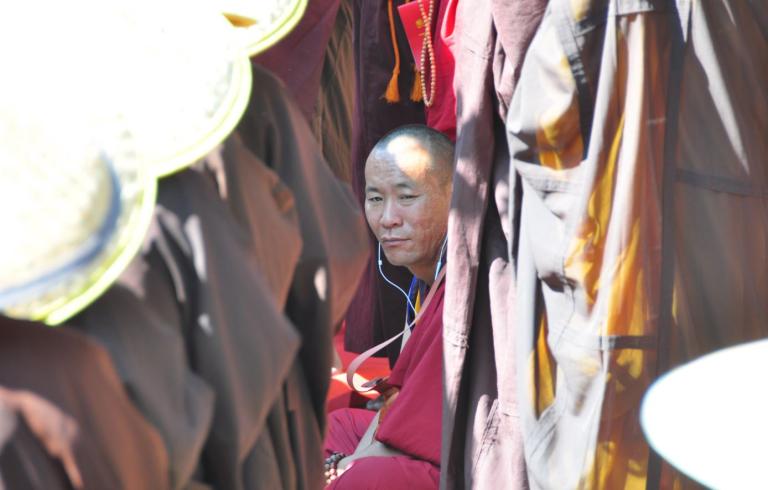
Tibetan monk in China with earphones (photo by author 2016)
An Unsuccessful Conclusion?
My bit of criticism comes not on the Buddhist but the Western side of Segall’s piece. In it he rather dismissively states that “The long-term Western philosophical project of seeking a logical basis for ethics—the one best exemplified by the philosophies of Spinoza, Kant, and Mill—came to an unsuccessful conclusion, unable to withstand the scrutiny and objections of Hume, Nietzsche, and Kierkegaard.”
I’m not sure from where this claim derives, and it doesn’t seem particularly necessary in the piece, but it really has no place in a thoughtful discussion of ethics. The philosophies of Kant (as deontology and otherwise) and Mill are 1) much more complex than this suggests, and 2) the idea that there might be a logical or rational basis for much of our ethics is alive and well in countless recent and contemporary authors including John Rawls, Derek Parfit, Peter Singer, Onora O’Neill, Christine Korsgaard, and others.
Some Buddhist Philosophers, such as Charles Goodman and Mark Siderits have borrowed from the philosophical project of Mill in their reconstructions of Buddhist ethics. I myself draw greatly from Kant’s insights in my reading of early Buddhism. And Segall’s own suggestion of “moral cause and effect” certainly draws in logic as part of his basis for ethics. So I urge us all to be wary of declaring such projects to have had an “unsuccessful conclusion.”
But again it is a minor quibble, and Segall’s piece is no worse for those who gloss over that point.
Buddhist Modernist Ethics
What Segall’s piece provides is an admirably broad and careful exposition of what a Buddhist Modernist ethics might look like today. He is quite right that Buddhism has always been in flux, and that it would be naive to arbitrarily exclude Buddhist Modernist versions that are emerging today as inauthentic because they borrow from the existing culture(s) of Western modernity.
Some will lean more heavily on the Western wing (think about the groups growing out of podcasts, phone apps, and facebook groups) others on the Eastern wing (groups recreating Gompas and Zendos in traditional Asian architecture, practicing in Asian dress and Asian languages). The arguably unique thing about American Buddhism is the proximity of these practices and practitioners – both in their spaces of worship and in daily lives. Both have roughly the same degree of access to Antigone and Aristotle alongside Avelokiteshvara and Atisha alongside Asics and Air Jordans.
Circumstances and momentum will keep many traditional ‘lines’ strong. But other lines will fade or disappear. Just which ones those are will depend on the vitality and applicability of the various traditions, concepts, and practices here in the 21st century.
Previous Post

January 5, 2017
Buddhist Gladness for a Trump Victory
Next Post
January 19, 2017 Buddhists in a Democracy: Be Political, But Not Partisan
Browse Our Archives
Select a Category Academia Activism American Buddhism Art Book review Buddhism Buddhism Today Buddhist Ethics Burma/Myanmar China Christianity Commodification Environment Gender Happiness Health Humor India Interfaith Islam Japanese Buddhism Kant Media / News Meditation mindfulness Photography Poetry Politics quicktakes Running Teaching Technology Thailand Theism/Atheism Theravada Tibet Tibetan Buddhism Travels Uncategorized Unitarian Universalism video Western Philosophy Zen
Select a Month June 2021 January 2021 November 2020 August 2020 July 2020 March 2020 January 2020 October 2019 August 2019 June 2019 May 2019 March 2019 February 2019 January 2019 December 2018 November 2018 October 2018 September 2018 August 2018 July 2018 June 2018 May 2018 April 2018 March 2018 February 2018 January 2018 December 2017 November 2017 October 2017 September 2017 August 2017 July 2017 June 2017 May 2017 April 2017 March 2017 February 2017 January 2017 December 2016 November 2016 October 2016 September 2016 August 2016 July 2016 June 2016 May 2016 April 2016 March 2016 February 2016 January 2016 December 2015 November 2015 October 2015 September 2015 August 2015 July 2015 June 2015 May 2015 April 2015 March 2015 February 2015 January 2015 December 2014 November 2014 October 2014 September 2014 August 2014 July 2014 June 2014 May 2014 April 2014 March 2014 February 2014 January 2014 December 2013 November 2013 October 2013 September 2013 August 2013 July 2013 June 2013 May 2013 April 2013 March 2013 February 2013 January 2013 December 2012 November 2012 October 2012 September 2012 August 2012 July 2012 June 2012 May 2012 April 2012 March 2012 February 2012 January 2012 December 2011 November 2011 October 2011 September 2011 August 2011 July 2011 June 2011 May 2011 April 2011 March 2011 February 2011 January 2011 December 2010 November 2010 October 2010 September 2010 August 2010 July 2010 June 2010 May 2010 April 2010 March 2010 February 2010 January 2010 December 2009 November 2009 October 2009 September 2009 August 2009 July 2009 June 2009 May 2009 April 2009 March 2009 February 2009 January 2009 December 2008 November 2008 October 2008 September 2008 August 2008 July 2008 June 2008 May 2008 April 2008 March 2008 September 2007 August 2007 July 2007 June 2007 May 2007 April 2007 March 2007 February 2007 January 2007 December 2006 November 2006 October 2006 September 2006 August 2006 July 2006 June 2006 May 2006 April 2006 March 2006 February 2006 January 2006 December 2005 November 2005 October 2005 September 2005 November 2004 September 2004 August 2004
Follow Us!
TAKE THE
Religious Wisdom Quiz
Who said, “Follow me, and I will make you fishers of men”?
Select your answer to see how you score.
Jesus Moses Paul Peter
Support this
Column


Related posts from American Buddhist Perspectives

For Pride Month: Our 2015 Interview with La...
American Buddhist Perspectives

In strife and uncertainty: let us remember loving-kindness
American Buddhist Perspectives

In the rush to return to normal, can...
American Buddhist Perspectives

A Festival of Radical Awakening: Socially Engaged Buddhism...
American Buddhist Perspectives
TRENDING AT PATHEOS Buddhist

On Taking Refuge in the Dharma
(Here I continue the feature of sharing talks and essays by teachers...

(Continuing my intention to share talks and essays by other members of Empty...
The Subtle Art of Bowing: A Dharma Discourse
(This presentation was first offered by my dear friend Dharma Holder Tom...

Internal Family Systems Can Heal you Mentally &...
How IFS Helped Me Stop Fighting Myself Internal Family Systems (IFS) is...

The Bible No One Spoke About: A Family’s...
A mysterious family Bible, unspoken faith, and a journey from curiosity to...

How Uncertainty Can Transform Your Life in 2025
Embracing Uncertainty: A New Year’s Resolution for the Brave As 2025 approaches,...
view all Buddhist blogs
Ad-Free & Subscriber Log-In Subscription Support
- About Us
- 2026 Calendar
- Videos
- Podcasts
- Library of World Religions
- Faith In Media Tracker
- Advertise With Us
- Write for Us
- Privacy Policy
- Terms of Service
- Do Not Sell My Data
- Contact Us
- Radiant Digital
- Manage Newsletter Subscriptions
- Unsubscribe From Notifications
- Sitemap
Copyright 2008-2026, Patheos. All rights reserved.
Subscription Support Ad-Free & Subscriber Log-In
Follow Patheos