
BuddhistCatholicContemplativeEvangelicalGeneral ChristianHinduJewishLatter-day SaintMuslimNew VisionsProgressive Christian
Beliefs
- Buddhist
- Catholic
- Contemplative
- Evangelical
- General Christian
- Hindu
- Jewish
- Latter-day Saint
- More Voices
- Muslim
- New Visions
- Pagan
- Progressive Christian
Topics
- Religion News
- Food and Religion
- Sports and Religion
- Religious Art
- Religious Music and Entertainment
- Religious Events
- History and Religion
- Style and Religion
- Politics and Religion
- Women in Religion
- Recreation Outdoors and Religion
- Business Finance and Religion
- Careers Workplace and Religion
- Education and Religion
- Family Parenting and Religion
- Health Fitness and Religion
- Home and Religion
- Relationships and Religion
- Technology and Religion
- Travel and Religion
Columnists
- Buddhist Columnists
- Business Finance and Religion Columnists
- Careers Workplace and Religion Columnists
- Catholic Columnists
- Contemplative Columnists
- Education and Religion Columnists
- Evangelists Columnists
- Family Parenting and Religion Columnists
- General Christian Columnists
- Health Fitness and Religion Columnists
- Hindu Columnists
- History and Religion Columnists
- Home and Religion Columnists
- Jewish Columnists
- More Voices Columnists
- Latter Day Columnists
- Muslim Columnists
- New Visions Columnists
- Nonreligious Columnists
- Pagan Columnists
- Politics and Religion Columnists
- Progressive Columnists
- Recreation Outdoors and Religion Columnists
- Relationships and Religion Columnists
- Religion News Columnists
- Religious Art Columnists
- Religious Events Columnists
- Religious Music and Entertainment Columnists
- Sports and Religion Columnists
- Style and Religion Columnists
- Technology and Religion Columnists
- Travel and Religion Columnists
- Women in Religion Columnists
Resource Library
- 2026 Calendar
- Library of World Religions
- The 100 Most Holy Places on Earth
- Patheos Answers
- Podcasts
- Videos
- Faith Leaders Database
- Anglican Episcopalian
- Bahai
- Baptist
- Buddhism
- Christianity
- Confucianism
- Eastern Orthodoxy
- Hinduism
- Holiness and Pentecostal
- ISKCON
- Islam
- Judaism
- Lutheran
- Methodist
- The Church of Jesus Christ of Latter-day Saints
- New Age
- Paganism
- Presbytarian and Reformed
- Protestantism
- Religion Behind the Scenes
- Roman Catholic
- Scientology
- Shia Islam
- Sikhism
- Sufism
- Sunni Islam
- Taoism
- Zen
- See all religions
Research Tools
 Ad-Free & Subscriber Log-In Subscription Support
Ad-Free & Subscriber Log-In Subscription Support
Follow Patheos 

- Trending:
- Forgiveness
- |
- Marriage
- |
- Consciousness
- |
- Death Penalty
- |
- Election
- |
- Halloween
 American Buddhist Perspectives
- Home
- Buddhist
- Religion News
- Atheist engagement with Buddhism: denying (or redefining) awakening
Atheist engagement with Buddhism: denying (or redefining) awakening
Last updated on: October 3, 2016 at 9:48 pm by Justin Whitaker
Atheist engagement with Buddhism: denying (or redefining) awakening 2016-10-03T21:48:54-06:00 Justin Whitaker
Patheos Explore the world's faith through different perspectives on religion and spirituality! Patheos has the views of the prevalent religions and spiritualities of the world.
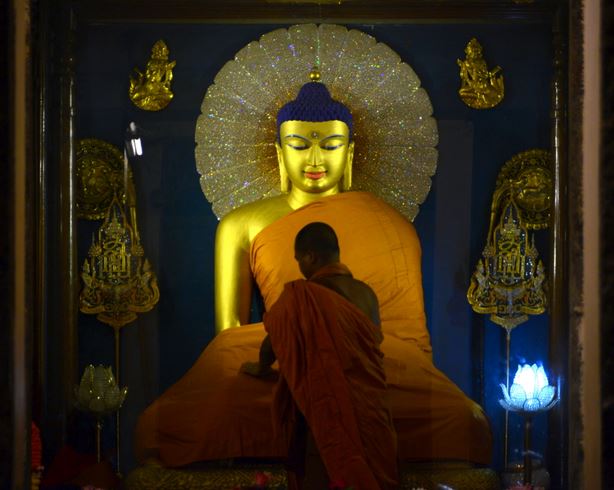
Redressing the Buddha inside the Mahabodhi stupa, Bodhgaya, India (photo by the author, 2014)
I have long believed that positions, religious or otherwise, can be strengthened or (wisely) abandoned when met with careful argumentation. Do your claims to “X” hold up? If not, why not let them go?
So I was pleased to read a post today on the Atheist Channel here at Patheos asking “Was the Buddha enlightened?”
There, Eric Sotnak presents a well-reasoned case against the Buddha’s enlightenment (or awakening) based on the doctrine’s connection to rebirth and the lack of evidence for rebirth. As he lays out: No rebirth, no enlightenment:
- If the Buddha was enlightened, then he was liberated from karmic rebirth.
- If anyone is liberated from karmic rebirth, then karmic rebirth is real.
- Karmic rebirth is not real.
- Therefore, the Buddha was not enlightened.
The key, Eric rightly points out, is the third premise. Based on modus tollens, if we can deny the consequent of premise two (as is done in premise three) then we can deny the antecedent: that someone (the Buddha) is liberated from karmic rebirth.
Again rightly stated by Eric:
In the context within which Buddhism developed, acceptance of karmic rebirth was so widespread that there was no real need for Buddhists to defend extensively a belief in its reality. Their starting point was, effectively, “Given that we all know karmic rebirth is real, and that escaping it is the supreme goal of religious practice, here’s the solution the Buddha has found…” Early Buddhism simply takes the reality of karmic rebirth as not standing in need of positive evidence. But in the absence of both compelling evidence for its reality and in the absence of an account of the means by which it is alleged to occur, we have good reason to accept premise 3 of the above argument.
Without convincing evidence of rebirth (Eric notes Ian Stevenson’s work in this area), we cannot accept a kind of awakening (my preferred term) from the rounds of rebirth.
The most common response I have seen from Buddhists today is a kind of agnosticism with regards to such questions: rebirth is outside our experience and the Buddha did not demand blind faith in such things. But it is still possibly out there and with reach to those who put in the time.
Another approach would be to say that rebirth is see-able (as the Buddha and later Buddhists claimed) but this requires one to do the work in meditation, etc, to reach a state of mental purity wherein even such a concept would make sense. This is different from the agnostic stance because it begins with an affirmation rather than a claim of not-knowing.
Either approach might be likened to our scientific understanding of the atom and the use of a model depicting a blob in the middle with swirling blobs in circular orbits around it:

Image via pixabay
That’s the Rutherford Model. But then we got Schrodinger’s “Electron Cloud” model (1926) which recognized that electrons could be observed as either particles or waves and with that things get weird enough to be well beyond my college “philosophy of science” class memory and my desire to google videos on “What does an atom REALLY look like?”
In any case, we use this (incorrect) model as a means to get simpletons (like me) interested in looking deeper (we hope), or at least accepting that there are things knowable out there – to those who try – that we do not fully understand. An agnostic might say that we don’t know what an atom really looks like, but we all can understand it with the proper time and effort. The second defender of atomic theory would say that we do know what atoms look like, it just takes a step or two to get people to get it.
The problem with this, or any analogy with science for claims about rebirth, is that rebirth claims are not testable. There are no experiments we can use to test it and no awakened being has stepped forward in the age of science and volunteered to, upon death, reincarnate and as quickly as possible make his (or her) way to a lab to describe the whole process to awaiting scientists. The hallmark of scientific theory, such as that of the atom, is that experiments can be replicated again and again. And to my knowledge that is exactly what scientists have been doing for the last 90+ years, digging deeper and deeper into the nature of reality on the very small scale.
A third approach is that of redefining awakening so that rebirth is not necessary, essentially naturalizing it to mean a sort of complete acceptance of impermanence and abandonment of psychological agony with regard to life’s inescapable sufferings. Here, no rebirth is needed; the stories of past Buddhas and past lives of others are all just fodder to encourage helpless beings to get on the path, to do the work, to work toward their own awakening. Yes, telling them that it may take many lifetimes to attain it is technically false in this line of reasoning, but it may be a necessary expedient – a “skill in means” to get them moving toward the goal.
I don’t see any reasonable fourth way forward for Buddhists. Do you?
Previous Post

October 2, 2016
Humans and Bonobos: Violence and a Thyroid Hormone
Next Post
October 7, 2016 King’s College London - Buddhist Studies Research Seminars
Browse Our Archives
Select a Category Academia Activism American Buddhism Art Book review Buddhism Buddhism Today Buddhist Ethics Burma/Myanmar China Christianity Commodification Environment Gender Happiness Health Humor India Interfaith Islam Japanese Buddhism Kant Media / News Meditation mindfulness Photography Poetry Politics quicktakes Running Teaching Technology Thailand Theism/Atheism Theravada Tibet Tibetan Buddhism Travels Uncategorized Unitarian Universalism video Western Philosophy Zen
Select a Month June 2021 January 2021 November 2020 August 2020 July 2020 March 2020 January 2020 October 2019 August 2019 June 2019 May 2019 March 2019 February 2019 January 2019 December 2018 November 2018 October 2018 September 2018 August 2018 July 2018 June 2018 May 2018 April 2018 March 2018 February 2018 January 2018 December 2017 November 2017 October 2017 September 2017 August 2017 July 2017 June 2017 May 2017 April 2017 March 2017 February 2017 January 2017 December 2016 November 2016 October 2016 September 2016 August 2016 July 2016 June 2016 May 2016 April 2016 March 2016 February 2016 January 2016 December 2015 November 2015 October 2015 September 2015 August 2015 July 2015 June 2015 May 2015 April 2015 March 2015 February 2015 January 2015 December 2014 November 2014 October 2014 September 2014 August 2014 July 2014 June 2014 May 2014 April 2014 March 2014 February 2014 January 2014 December 2013 November 2013 October 2013 September 2013 August 2013 July 2013 June 2013 May 2013 April 2013 March 2013 February 2013 January 2013 December 2012 November 2012 October 2012 September 2012 August 2012 July 2012 June 2012 May 2012 April 2012 March 2012 February 2012 January 2012 December 2011 November 2011 October 2011 September 2011 August 2011 July 2011 June 2011 May 2011 April 2011 March 2011 February 2011 January 2011 December 2010 November 2010 October 2010 September 2010 August 2010 July 2010 June 2010 May 2010 April 2010 March 2010 February 2010 January 2010 December 2009 November 2009 October 2009 September 2009 August 2009 July 2009 June 2009 May 2009 April 2009 March 2009 February 2009 January 2009 December 2008 November 2008 October 2008 September 2008 August 2008 July 2008 June 2008 May 2008 April 2008 March 2008 September 2007 August 2007 July 2007 June 2007 May 2007 April 2007 March 2007 February 2007 January 2007 December 2006 November 2006 October 2006 September 2006 August 2006 July 2006 June 2006 May 2006 April 2006 March 2006 February 2006 January 2006 December 2005 November 2005 October 2005 September 2005 November 2004 September 2004 August 2004
Follow Us!
TAKE THE
Religious Wisdom Quiz
Who killed Goliath?
Select your answer to see how you score.
Jonathan David Saul Samson
Support this
Column


Related posts from American Buddhist Perspectives

For Pride Month: Our 2015 Interview with La...
American Buddhist Perspectives

In strife and uncertainty: let us remember loving-kindness
American Buddhist Perspectives

In the rush to return to normal, can...
American Buddhist Perspectives

A Festival of Radical Awakening: Socially Engaged Buddhism...
American Buddhist Perspectives
TRENDING AT PATHEOS Buddhist

On Taking Refuge in the Dharma
(Here I continue the feature of sharing talks and essays by teachers...

(Continuing my intention to share talks and essays by other members of Empty...
The Subtle Art of Bowing: A Dharma Discourse
(This presentation was first offered by my dear friend Dharma Holder Tom...

Internal Family Systems Can Heal you Mentally &...
How IFS Helped Me Stop Fighting Myself Internal Family Systems (IFS) is...

The Bible No One Spoke About: A Family’s...
A mysterious family Bible, unspoken faith, and a journey from curiosity to...

How Uncertainty Can Transform Your Life in 2025
Embracing Uncertainty: A New Year’s Resolution for the Brave As 2025 approaches,...
view all Buddhist blogs
Ad-Free & Subscriber Log-In Subscription Support
- About Us
- 2026 Calendar
- Videos
- Podcasts
- Library of World Religions
- Faith In Media Tracker
- Advertise With Us
- Write for Us
- Privacy Policy
- Terms of Service
- Do Not Sell My Data
- Contact Us
- Radiant Digital
- Manage Newsletter Subscriptions
- Unsubscribe From Notifications
- Sitemap
Copyright 2008-2026, Patheos. All rights reserved.
Subscription Support Ad-Free & Subscriber Log-In
Follow Patheos