
BuddhistCatholicContemplativeEvangelicalGeneral ChristianHinduJewishLatter-day SaintMuslimNew VisionsProgressive Christian
Beliefs
- Buddhist
- Catholic
- Contemplative
- Evangelical
- General Christian
- Hindu
- Jewish
- Latter-day Saint
- More Voices
- Muslim
- New Visions
- Pagan
- Progressive Christian
Topics
- Religion News
- Food and Religion
- Sports and Religion
- Religious Art
- Religious Music and Entertainment
- Religious Events
- History and Religion
- Style and Religion
- Politics and Religion
- Women in Religion
- Recreation Outdoors and Religion
- Business Finance and Religion
- Careers Workplace and Religion
- Education and Religion
- Family Parenting and Religion
- Health Fitness and Religion
- Home and Religion
- Relationships and Religion
- Technology and Religion
- Travel and Religion
Columnists
- Buddhist Columnists
- Business Finance and Religion Columnists
- Careers Workplace and Religion Columnists
- Catholic Columnists
- Contemplative Columnists
- Education and Religion Columnists
- Evangelists Columnists
- Family Parenting and Religion Columnists
- General Christian Columnists
- Health Fitness and Religion Columnists
- Hindu Columnists
- History and Religion Columnists
- Home and Religion Columnists
- Jewish Columnists
- More Voices Columnists
- Latter Day Columnists
- Muslim Columnists
- New Visions Columnists
- Nonreligious Columnists
- Pagan Columnists
- Politics and Religion Columnists
- Progressive Columnists
- Recreation Outdoors and Religion Columnists
- Relationships and Religion Columnists
- Religion News Columnists
- Religious Art Columnists
- Religious Events Columnists
- Religious Music and Entertainment Columnists
- Sports and Religion Columnists
- Style and Religion Columnists
- Technology and Religion Columnists
- Travel and Religion Columnists
- Women in Religion Columnists
Resource Library
- 2026 Calendar
- Library of World Religions
- The 100 Most Holy Places on Earth
- Patheos Answers
- Podcasts
- Videos
- Faith Leaders Database
- Anglican Episcopalian
- Bahai
- Baptist
- Buddhism
- Christianity
- Confucianism
- Eastern Orthodoxy
- Hinduism
- Holiness and Pentecostal
- ISKCON
- Islam
- Judaism
- Lutheran
- Methodist
- The Church of Jesus Christ of Latter-day Saints
- New Age
- Paganism
- Presbytarian and Reformed
- Protestantism
- Religion Behind the Scenes
- Roman Catholic
- Scientology
- Shia Islam
- Sikhism
- Sufism
- Sunni Islam
- Taoism
- Zen
- See all religions
Research Tools
 Ad-Free & Subscriber Log-In Subscription Support
Ad-Free & Subscriber Log-In Subscription Support
Follow Patheos 

- Trending:
- Forgiveness
- |
- Marriage
- |
- Consciousness
- |
- Death Penalty
- |
- Election
- |
- Halloween
 American Buddhist Perspectives
- Home
- Buddhist
- Religion News
- Returning, or “5 meditations on the desert”
Returning, or “5 meditations on the desert”
Last updated on: June 21, 2016 at 3:28 pm by Justin Whitaker
Returning, or “5 meditations on the desert” 2016-06-21T15:28:15-06:00 Justin Whitaker
Patheos Explore the world's faith through different perspectives on religion and spirituality! Patheos has the views of the prevalent religions and spiritualities of the world.
A little over a week ago, I packed my bags, spent a night in Missoula, MT, picked up 3 (and then 4) fellow travelers, and headed into the wilds of Utah where we met two more friends. I’m not a seasoned backpacker or hiker, having spent usually only a day or two in the “back country” and six days last year hiking 80+ miles of the Wind River National Wilderness Area with two good friends who are much more knowledgeable than I probably ever will be.
However, I am a long-time meditator (over 15 years now), and a firm believer in the power of wild nature to enhance and sustain states of meditation. “But what exactly does that mean?” the picky academic in me asks.
1) In nature, one forgets oneself in order to remember oneself.
In your familiar surroundings, everything has its own story. The computer before me that I bought at such and such a time. The radio beside me that I could choose to turn on. The headphones, stapler, and other miscellany that I could or should clean up. The place from which I’m supposed to do work of this or that kind. Stories. Inescapable stories in everything.
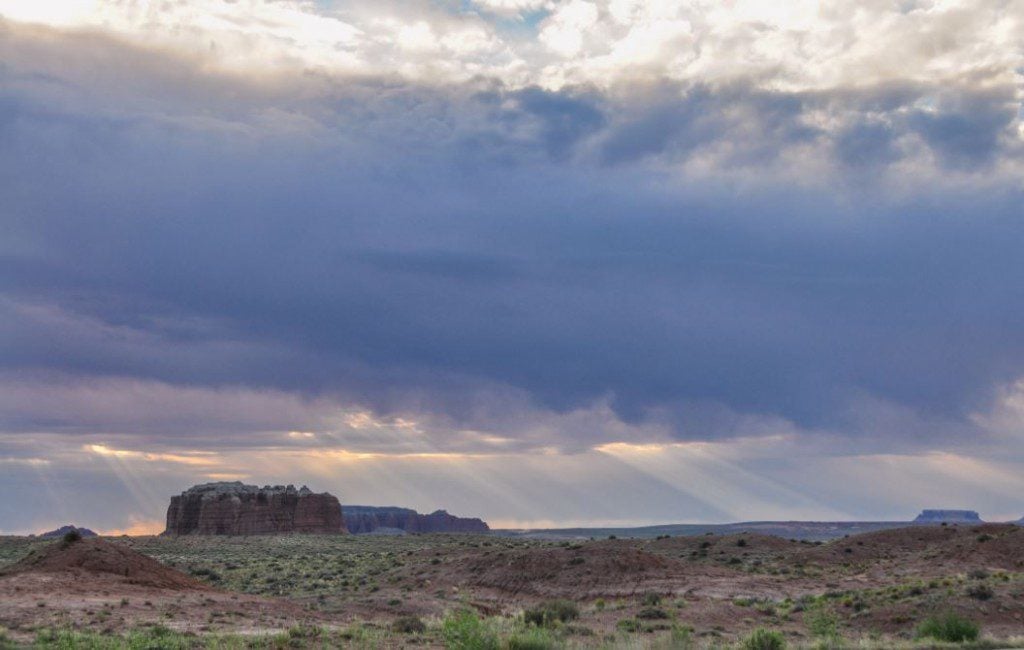
Utah – Goblin Valley Sunrise (photo © the author, 2016)
But in nature, things just are. If there’s a story to be told, it’s not one about me. It’s a story of creation, in the naturalist sense. It’s a story of awe and abundance. And it’s a story that folks like me don’t often try to tell. For the words needed are those of poets, not philosophers. Even photos like this one of sunrise in Goblin Valley, which bring me instantly into the scene and all the beauty it held, may simply be flat and “pretty” to a reader or viewer who has never been to such a place.
A great poet could act as a vessel for the story of that sunrise, letting its story be told. But even that poet forgets him or herself in order to let that story flow forth. The rest of us just stand, sit, lie down, or walk in awe.
In that act you find no place for the ego (it can always come back, and it does). In awe the ego is replaced by the plenitude of reality in all its vastness, complexity, and impermanence. Soon enough, the sun rose, the clouds closed in, and just a regular day settled in upon us. Well, not just any regular day. We were, after all, headed deeper into the wilds.
2) Connectedness is measured by openness + time / distractions.
How many times have you been distracted since clicking on this post? Hopefully fewer times than I’ve been distracted in writing it. Setting aside, or getting away from, distractions is essential to connecting. This is true in everything from our studies to nature to relationships near and far.
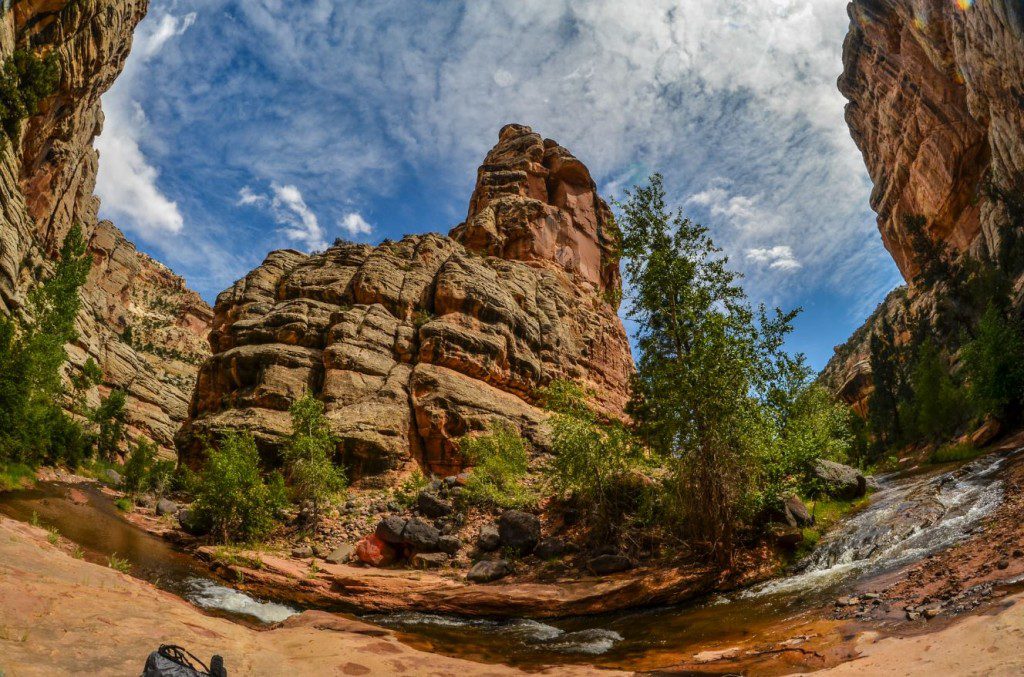
Utah – Pleasant Creek bend in Capitol Reef National Park (photo © the author, 2016)
In Buddhism, right view is the first step of the eightfold noble path. While one can cultivate the other steps, getting this right is essential to meaningful progress. Luckily for us, right view can be understood with two very basic truths: 1) nothing is eternal, and 2) nothing really disappears.
Instead what is, is a state of constant change, what in the West we call process philosophy. The Buddha explained this truth and its resulting actions in the knower thus:
“By & large, Kaccayana, this world is supported by (takes as its object) a polarity, that of existence & non-existence. But when one sees the origination of the world as it actually is with right discernment, ‘non-existence’ with reference to the world does not occur to one. When one sees the cessation of the world as it actually is with right discernment, ‘existence’ with reference to the world does not occur to one.
“By & large, Kaccayana, this world is in bondage to attachments, clingings (sustenances), & biases. But one such as this does not get involved with or cling to these attachments, clingings, fixations of awareness, biases, or obsessions; nor is he resolved on ‘my self.’ He has no uncertainty or doubt that, when there is arising, only stress is arising; and that when there is passing away, only stress is passing away. In this, one’s knowledge is independent of others. It is to this extent, Kaccayana, that there is right view.”
— SN 12.15 (via Access to Insight)
Imagine the very idea of “‘existence’ with reference to the world” not occurring to you. Imagine seeing all as arising and falling away. Understanding this intellectually is a start. Understanding it in the very bones of one’s body is the goal.
You can look at a stream flowing alongside a cliff face and see that this little flow of water, over millions of years, cut every inch out of that cliff. At one time, this canyon was just a depression, a stream bed. Then it deepened, bit by bit. And it will continue long after you and I are gone. All of humanity’s existence can be measured here, in probably a few feet of the cliff. And your life: probably a couple millimeters.
And yet here you are, at the center of all of this, taking in the scene of history in this moment. No attachments, clingings, fixations, biases, or obsessions. Just this.
3) Live in the moment, knowing it may be your last.
It has been widely observed that we today sanitize and hide death like no other time in human history. We embalm the deceased, put make-up and nice clothes on them, encase them in caskets that cost as much as a good used car and “lay them to rest” six feet underground. We don’t “lay them to return to the earth,” to dissolve, to decay – but this is what they do. Our actions and our words obscure the truth of death.
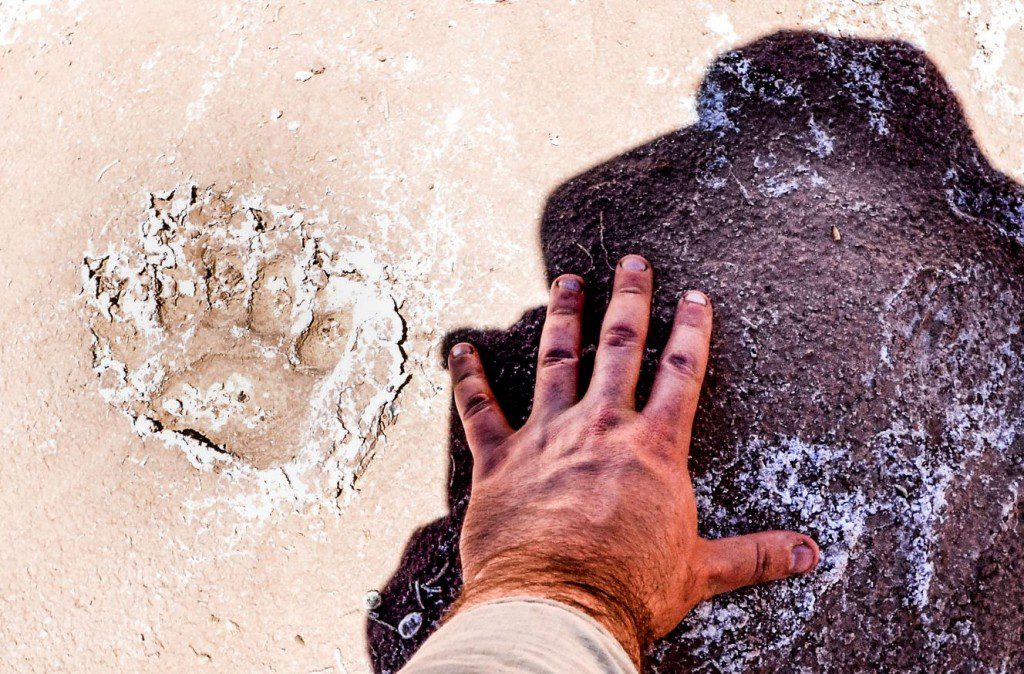
Utah – five-toed mountain lion print in Sheets Gulch (photo © the author, 2016)
There is a Tibetan meditation on death that goes something like:
- Death is inescapable
- The time of death is uncertain
- The only thing that can help at the time of death is our mental/spiritual practice
While moments like sitting alongside the above stream and cliff face can bring one “out of oneself” and into the long geological history of the earth, spotting mountain lion tracks along the path is a quick way to return to the immediacy of the present moment. But again the story of “you” is transformed. Gone are the narratives chosen from the menu society has provided: job duties piling up, husband or wife, 1.8 kids, suburban house, 401k, etc.
Now the story is simple, if there even is one: I am an organism, typically at the top of the food chain, but not immune to predators. In fact, though, for me the sighting of the tracks baked into the desert sand simply triggered awareness. Awareness that I should scour the cliffs a little more closely, take heed of sounds more carefully, take heed of my own body for signs of overheating, dehydration, and so on.
4) Life is a flow of phenomena, the labels we put on them are not reality.
One of the most dangerous activities we all participate in is reifying labels, setting our judgments in stone and deeming those judgments to be reality. For much of life, this is actually important: drinking unclean water will make you sick, drinking too little water will lead to dehydration, backpacking with little preparation will lead to sore feet and legs. All of these can be judged, in a sense, as bad or wrong. However, rigidity here can be an obstacle to life (I broke this third axiom and managed okay).
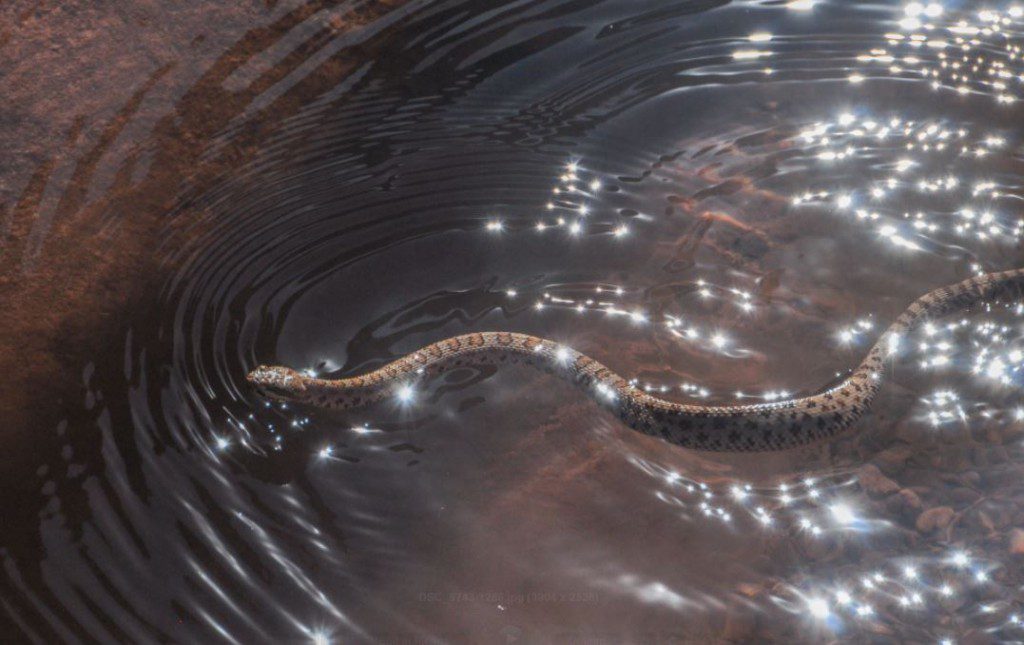
Utah – rattlesnake in Sheets Gulch (photo © the author, 2016)
As I made my way back out of Sheets Gulch with my companion I saw a movement in the rocks and dust in front of me and then heard the tell-tale sound of an unhappy rattlesnake. I had come within 2 feet of the slithering animal and had leaped backward a good 3 or 4 feet all before my brain had brought any of this to my conscious attention. Only from this safe distance, with my heart rate doubled, did the labels “snake” and soon “rattlesnake” come clearly to my mind.
This is saññā, or recognition. It is the cognitive labeling of an aspect of experience and is always necessarily “after” and non-identical to the experience itself. Luckily, an evolutionary aversion to slithery/rattly creatures and relatively quick reflexes were allowed to act, taking me to safety before higher order processing was needed. Luckily, I wasn’t “carried away by” the rich conversation leading up to the snake encounter or “lost in thought” or otherwise “oblivious to my surroundings” (today, obliviousness has become the norm even when walking, as cellphones seem as though surgically attached to palms in front of people chests, necks craning downward as LEDs consume modern attention spans).
Being present allowed some very basic part of my mind to signal the need for temporary “flight.”
5) Community of the heart runs through everything; be grateful for it.
Sometimes we just want to go it alone in life, adverse to the challenges brought by relationships. And yet it is impossible to say just how impoverished this makes life. Yet this impoverishment cannot be measured in individual actions. After all, the very nature of this trip with my six friends into the desert was a sort of “getting away” from some of the chaotic social structures and chaotic people back home.
There is an unspeakable grace in the stillness and solitude of the desert.
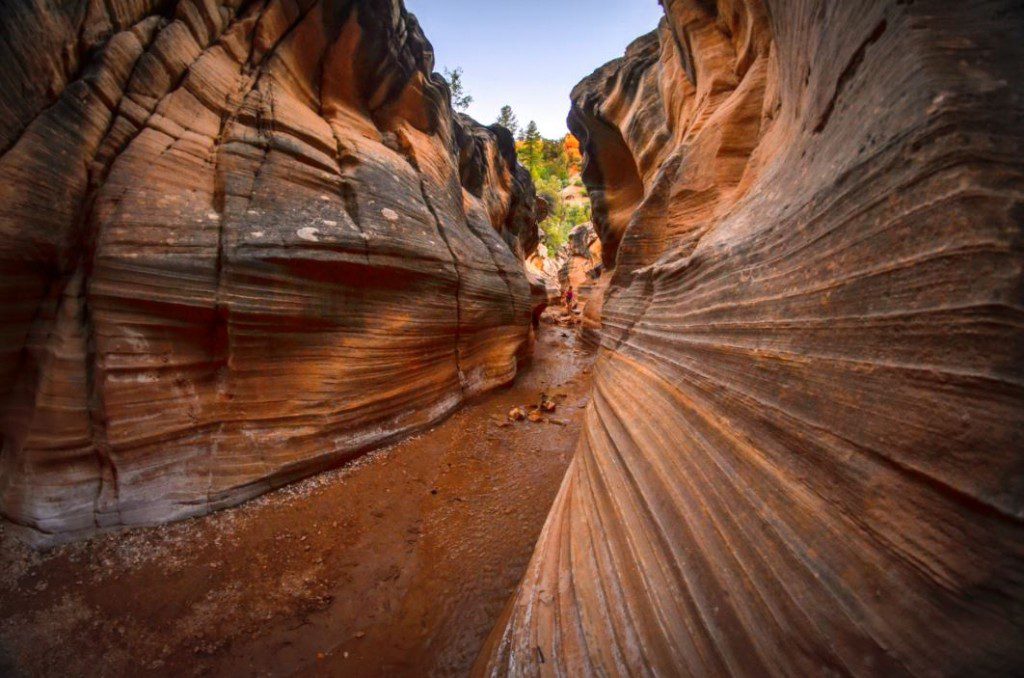
Utah – Kodachrome Basin slot canyon (photo © the author, 2016)
And yet I, for one, could not have experienced any of it without the kind invitation of our trip leaders. Nor would the experience have had the depth it did without the rest of my fellow travelers, one in particular…
If I think of the web of connections that brought me to each of these people, flowing like a river backward in time, I get lost in the collection of faces and smiles. It brings humility to the “go your own way” lifestyle so prevalent in the American West. It brings a wealth of knowledge immensely beyond what one 30-something could have accumulated, especially one with limited time backpacking. It brings shared experiences, from the smiles of dawn’s first light to the groans of that last mile at dusk. It brings joy. It brings gratitude.
And all of these must be brought back to the world, in some form or another. If we can be altered by the solitude, beauty, awe, and simplicity of some aspects of life, so can others. If you believe that this is the change needed in the world, then be it and bring it forth.
Previous Post

June 10, 2016
Unplugging, or "practicing mindfulness in the desert"
Next Post

June 21, 2016 3 shirts, 4 pairs of pants, 150 total belongings: inspired by Zen philosophy
Browse Our Archives
Select a Category Academia Activism American Buddhism Art Book review Buddhism Buddhism Today Buddhist Ethics Burma/Myanmar China Christianity Commodification Environment Gender Happiness Health Humor India Interfaith Islam Japanese Buddhism Kant Media / News Meditation mindfulness Photography Poetry Politics quicktakes Running Teaching Technology Thailand Theism/Atheism Theravada Tibet Tibetan Buddhism Travels Uncategorized Unitarian Universalism video Western Philosophy Zen
Select a Month June 2021 January 2021 November 2020 August 2020 July 2020 March 2020 January 2020 October 2019 August 2019 June 2019 May 2019 March 2019 February 2019 January 2019 December 2018 November 2018 October 2018 September 2018 August 2018 July 2018 June 2018 May 2018 April 2018 March 2018 February 2018 January 2018 December 2017 November 2017 October 2017 September 2017 August 2017 July 2017 June 2017 May 2017 April 2017 March 2017 February 2017 January 2017 December 2016 November 2016 October 2016 September 2016 August 2016 July 2016 June 2016 May 2016 April 2016 March 2016 February 2016 January 2016 December 2015 November 2015 October 2015 September 2015 August 2015 July 2015 June 2015 May 2015 April 2015 March 2015 February 2015 January 2015 December 2014 November 2014 October 2014 September 2014 August 2014 July 2014 June 2014 May 2014 April 2014 March 2014 February 2014 January 2014 December 2013 November 2013 October 2013 September 2013 August 2013 July 2013 June 2013 May 2013 April 2013 March 2013 February 2013 January 2013 December 2012 November 2012 October 2012 September 2012 August 2012 July 2012 June 2012 May 2012 April 2012 March 2012 February 2012 January 2012 December 2011 November 2011 October 2011 September 2011 August 2011 July 2011 June 2011 May 2011 April 2011 March 2011 February 2011 January 2011 December 2010 November 2010 October 2010 September 2010 August 2010 July 2010 June 2010 May 2010 April 2010 March 2010 February 2010 January 2010 December 2009 November 2009 October 2009 September 2009 August 2009 July 2009 June 2009 May 2009 April 2009 March 2009 February 2009 January 2009 December 2008 November 2008 October 2008 September 2008 August 2008 July 2008 June 2008 May 2008 April 2008 March 2008 September 2007 August 2007 July 2007 June 2007 May 2007 April 2007 March 2007 February 2007 January 2007 December 2006 November 2006 October 2006 September 2006 August 2006 July 2006 June 2006 May 2006 April 2006 March 2006 February 2006 January 2006 December 2005 November 2005 October 2005 September 2005 November 2004 September 2004 August 2004
Follow Us!
TAKE THE
Religious Wisdom Quiz
What was rolled away from Jesus’ tomb?
Select your answer to see how you score.
A stone A fence A wall A door
Support this
Column


Related posts from American Buddhist Perspectives

For Pride Month: Our 2015 Interview with La...
American Buddhist Perspectives

In strife and uncertainty: let us remember loving-kindness
American Buddhist Perspectives

A Festival of Radical Awakening: Socially Engaged Buddhism...
American Buddhist Perspectives

The Coronavirus is coming - Some thoughts from...
American Buddhist Perspectives
TRENDING AT PATHEOS Buddhist

On Taking Refuge in the Dharma
(Here I continue the feature of sharing talks and essays by teachers...

(Continuing my intention to share talks and essays by other members of Empty...
The Subtle Art of Bowing: A Dharma Discourse
(This presentation was first offered by my dear friend Dharma Holder Tom...

Internal Family Systems Can Heal you Mentally &...
How IFS Helped Me Stop Fighting Myself Internal Family Systems (IFS) is...

The Bible No One Spoke About: A Family’s...
A mysterious family Bible, unspoken faith, and a journey from curiosity to...

How Uncertainty Can Transform Your Life in 2025
Embracing Uncertainty: A New Year’s Resolution for the Brave As 2025 approaches,...
view all Buddhist blogs
Ad-Free & Subscriber Log-In Subscription Support
- About Us
- 2026 Calendar
- Videos
- Podcasts
- Library of World Religions
- Faith In Media Tracker
- Advertise With Us
- Write for Us
- Privacy Policy
- Terms of Service
- Do Not Sell My Data
- Contact Us
- Radiant Digital
- Manage Newsletter Subscriptions
- Unsubscribe From Notifications
- Sitemap
Copyright 2008-2026, Patheos. All rights reserved.
Subscription Support Ad-Free & Subscriber Log-In
Follow Patheos