
BuddhistCatholicContemplativeEvangelicalGeneral ChristianHinduJewishLatter-day SaintMuslimNew VisionsProgressive Christian
Beliefs
- Buddhist
- Catholic
- Contemplative
- Evangelical
- General Christian
- Hindu
- Jewish
- Latter-day Saint
- More Voices
- Muslim
- New Visions
- Pagan
- Progressive Christian
Topics
- Religion News
- Food and Religion
- Sports and Religion
- Religious Art
- Religious Music and Entertainment
- Religious Events
- History and Religion
- Style and Religion
- Politics and Religion
- Women in Religion
- Recreation Outdoors and Religion
- Business Finance and Religion
- Careers Workplace and Religion
- Education and Religion
- Family Parenting and Religion
- Health Fitness and Religion
- Home and Religion
- Relationships and Religion
- Technology and Religion
- Travel and Religion
Columnists
- Buddhist Columnists
- Business Finance and Religion Columnists
- Careers Workplace and Religion Columnists
- Catholic Columnists
- Contemplative Columnists
- Education and Religion Columnists
- Evangelists Columnists
- Family Parenting and Religion Columnists
- General Christian Columnists
- Health Fitness and Religion Columnists
- Hindu Columnists
- History and Religion Columnists
- Home and Religion Columnists
- Jewish Columnists
- More Voices Columnists
- Latter Day Columnists
- Muslim Columnists
- New Visions Columnists
- Nonreligious Columnists
- Pagan Columnists
- Politics and Religion Columnists
- Progressive Columnists
- Recreation Outdoors and Religion Columnists
- Relationships and Religion Columnists
- Religion News Columnists
- Religious Art Columnists
- Religious Events Columnists
- Religious Music and Entertainment Columnists
- Sports and Religion Columnists
- Style and Religion Columnists
- Technology and Religion Columnists
- Travel and Religion Columnists
- Women in Religion Columnists
Resource Library
- 2026 Calendar
- Library of World Religions
- The 100 Most Holy Places on Earth
- Patheos Answers
- Podcasts
- Videos
- Faith Leaders Database
- Anglican Episcopalian
- Bahai
- Baptist
- Buddhism
- Christianity
- Confucianism
- Eastern Orthodoxy
- Hinduism
- Holiness and Pentecostal
- ISKCON
- Islam
- Judaism
- Lutheran
- Methodist
- The Church of Jesus Christ of Latter-day Saints
- New Age
- Paganism
- Presbytarian and Reformed
- Protestantism
- Religion Behind the Scenes
- Roman Catholic
- Scientology
- Shia Islam
- Sikhism
- Sufism
- Sunni Islam
- Taoism
- Zen
- See all religions
Research Tools
 Ad-Free & Subscriber Log-In Subscription Support
Follow Patheos 

- Trending:
- Advent
- |
- Forgiveness
- |
- Thanksgiving
- |
- Election
- |
- Seasonal Holidays
- |
- Marriage
 American Buddhist Perspectives
- Home
- Buddhist
- Religion News
- “The Story of God” – Do Buddhists Believe in Miracles?
“The Story of God” – Do Buddhists Believe in Miracles?
Last updated on: May 4, 2016 at 10:59 pm by Justin Whitaker
“The Story of God” – Do Buddhists Believe in Miracles? 2016-05-04T22:59:04-06:00 Justin Whitaker
Patheos Explore the world's faith through different perspectives on religion and spirituality! Patheos has the views of the prevalent religions and spiritualities of the world.
This is, once again, one of those questions that requires some clarification before an answer can be given. And even then, the answer will come with caveats. First, for Buddhists, the concept of ‘miracle’ wouldn’t involve the intervention of a Creator God. If we were to use the term for Buddhists, we would make clear that what some Buddhists might consider ‘miracles’ could also be called ‘supernormal’, as opposed to ‘supernatural’. This is because Buddhist cosmology does not split the natural realm of humans from a supernatural one; instead six (sometimes five) realms of being are described which include gods, titans, humans, animals, hungry ghosts, and hell denizens.
While one doesn’t normally encounter beings from other realms (except animals, of course) in day to day life, a realized being such as the Buddha indeed could encounter such beings and, according to Pali scriptures, regularly did, leading to one of his titles being, “teacher of gods and men.”
So the cosmos is a bit more fluid. Spirits, sometimes pleasant, sometimes demonic in nature, could appear at any time. Are these miracles? I’d lean toward saying no. They are supernormal from a Buddhist view, and probably supernatural, or just superstitious from a Westerner’s point of view. As these two (Buddhist vs Western) viewpoints intersected over the past two hundred years or so, the belief in supernormal generally lost out to a more naturalistic worldview. However, that’s not to say that no modern Buddhists believe in the supernormal.
So, that brings us to this week’s “The Story of God” (airing May 8 on National Geographic). Morgan Freeman begins as he has so often, with a personal story about surviving severe pneumonia in his teens. Was it youthful vigor, some luck, and modern medicine that saved him? Or was it God/a miracle?
We hear the story of Alcides Moreno, a window washer who plunged 47 stories in NY City and survived to tell the tale. Usually 10 stories is not survivable. Falling 47 stories and surviving, barely: the only word that could fully describe him for many was “Miracle.” When asked about this, Alcides has difficulty though. This is because his younger brother was with him in the fall, and he died on impact. Pondering the event, Freeman asks if there is some entity that makes the choice – one brother and not the other – or “do we live with randomness just pure mindless randomness?
Freeman’s next visit is to a Jewish family in Jerusalem celebrating Passover. There he meets Rabbi Maya Leibovich, Israel’s first native-born female rabbi. There, rather than taking the Bible as a literal book of history, Rabbi Leibovich tells us that “the Bible is a book of ideas. The question is, what can we learn from it? What can we take into our own life?”
Our Buddhist content this week begins with a quick segment of footage showing Buddhists in Hong Kong who light incense before a statue of Guanyin, “who they hope will grant them medical cures, a spouse, or good grades.”
The science segment brings us to Danny Oppenheimer, a psychology professor who says many of our so called “miracles” are just random chance. Freeman suggests that something happening only about 1 in a billion times (or having 1 in a billion odds) is what he’d classify as a miracle. Oppenheimer flips six cards from a deck, explaining that THIS set of six only comes up about one in 14 billion times, thus making it even rarer than a 1 in a billion scenario. Is it a miracle, or just another random assortment that we can give meaning to as special?
Spanning a long history of Roman religion, Freeman takes us from ancient Mithraism to modern Catholicism before consulting a Taoist fate calculator and traveling to Cairo’s Qalawun complex, a hospital founded in the 1280s.
We are then taken to Tom Renfro a physician and cancer survivor who attributes his recovery to his faith and the prayers of his community. You can see his story on youtube here:
Hemant Mehta over at the Friendly Atheist wrote about his “miracle” recovery back in 2014:
Dr. Tom Renfro nearly died from cancer 17 years ago. He took drugs. He had chemotherapy. And then… his tumors were gone.
Time to thank the doct–wait, what?
“I think it’s a gift of God. I think it’s a miracle that God did in my life. How else can you explain it?” asked Dr. Renfro.
Umm… Doctors? Drugs? Chemo? Something you haven’t figured out yet? In any case, God doesn’t poof away anyone’s tumors.
He was back in church just two weeks later.
“They carried me. I had to learn to walk again. I was very weak still, physically weak.” “I stood up in front of the congregation and I told them, I said, what you’re looking at, is what you’ve been praying for.” “You wanted a miracle of God and this is what He’s done. And I am here today because of the prayers that you prayed.”
Also, because of the doctors, drugs, and chemo.
It was great to see Candy Gunther Brown, an Indiana University professor, in the segment. She and I were on a panel last fall looking at questions of ethics in mindfulness at the American Academy of Religion conference. Her appearance is short, and limited to a few good questions, echoing a bit of what Hemant wrote: “do you ever wonder, did the chemotherapy just work better than the doctors expected it to work?” And Freeman concludes the segment by suggesting that what we call miracles tend to start in the mind, seguing nicely into a return to Buddhism and Bodhgaya.
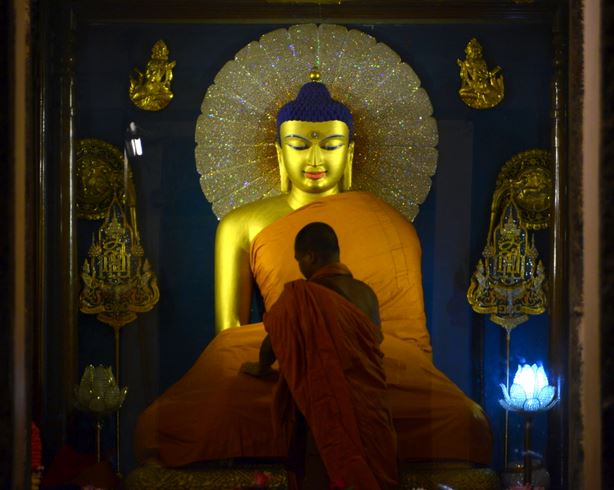
Redressing the Buddha inside the Mahabodhi stupa, Bodhgaya, India (photo by the author, 2014)
There he meets Tibetan monk Losang Tenpa (aka Ven. Kabir Saxena), who spends time each year at the Antioch Buddhist Studies in India program I taught on in 2010 and 2014. Last time I was there he offered a wonderfully down-to-earth, and much appreciated by the students, explanation of the wisdom chapter of Shantideva’s “Guide to the Bodhisattva Path“.
Kabir explains to Freeman that the “miracles” of the Buddha were achieved through the power of exercising his mind, a power available to any of us should we take up the practice. Freeman notes, “For Buddhists, years of mental training, and showing love and compassion to others, can free them from suffering. Walking around this temple, you feel like a miracle really could happen. The miracle of people being content with their lives; people getting along together.”
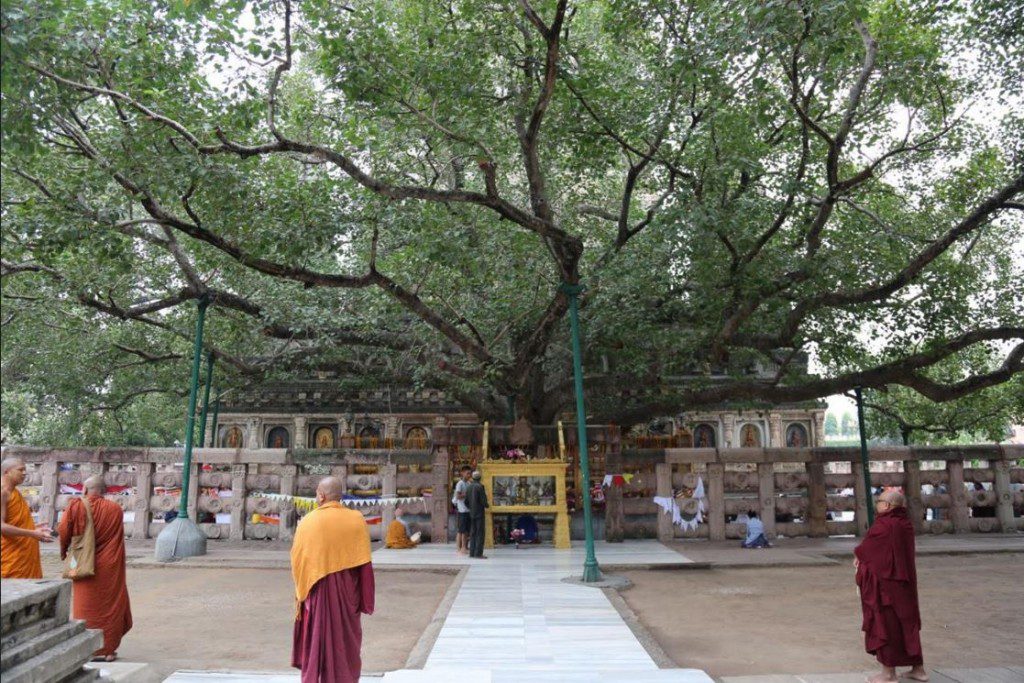
A view of the Bodhi tree where the Buddha gained awakening (courtesy National Geographic)
Kabir then takes Freeman to Chökyi Nyima Rinpoche, who is sat among the latest group of Antioch students. Rinpoche gives him the “shortcut” teaching: “we all need to care and love and respect each other. That is the source of happiness. Whoever has that, their journey is good. Whoever does not keep that in their heart, journey is not good.”
In summing up, Freeman, walking with Kabir around the Mahabodhi temple, says, “a lot of religions are miracle based… ah, you don’t do miracles?”
Kabir responds, “What’s a miracle? I mean, flying in the sky? Is that a miracle? Bugs do it.”
“We tend to think of miracles as some sort of divine thing; something that gives us proof of God.”
Kabir’s response, in his delightful and usual common sense way, is that if you ask mystics from any tradition, they’ll tell you that God really is in here; so if we want a miracle, let’s not fixate on “people levitating 3 inches off their butts – which is stupid” but instead “let’s stick to the real miracle, which is to transform the human mind, really.”
This seems to satisfy Freeman. And I think it is the view of most Buddhists in the West today. You want a miracle? Focus your mind.

Theravadin monks at the Mahabodhi Stupa (photo by the author, 2010).
But scholars should rightly note that the history of Buddhism is filled with stories, from the Buddha to the present day, of beings taming dragons, flying through the sky, calming wild animals with loving kindness, communing with gods from India to Japan, and finding blessings or luck in everything from the relics of revered teachers to dolls.
As I wrote in my discussion of Buddhism and creation, the story coming from Buddhism can be read at many levels, from literalism to Kabir’s description of the mystic, where the ultimate teaching is found within. Such a variety of readings and flexibility of interpretation is part of what keeps Buddhism, like other religions, alive in a changing world and vibrant in varying cultures. And, it is what allows for comparisons of religions as well as borrowing and sharing of ideas. And it is only in ignorance of this breadth of interpretation that allows many to claim possession of the one true understanding or practice in a religion.
This series has been eye-opening and a joy to watch because it hasn’t given any one true interpretation, but has instead invited us into the hearts and minds of a few living versions of the world’s great religions, sparking – I hope – a journey that will last a lifetime.
(You can also read my discussions of evil and apocalypse from the series.)


Browse Our Archives
Select a Category Academia Activism American Buddhism Art Book review Buddhism Buddhism Today Buddhist Ethics Burma/Myanmar China Christianity Commodification Environment Gender Happiness Health Humor India Interfaith Islam Japanese Buddhism Kant Media / News Meditation mindfulness Photography Poetry Politics quicktakes Running Teaching Technology Thailand Theism/Atheism Theravada Tibet Tibetan Buddhism Travels Uncategorized Unitarian Universalism video Western Philosophy Zen
Select a Month June 2021 January 2021 November 2020 August 2020 July 2020 March 2020 January 2020 October 2019 August 2019 June 2019 May 2019 March 2019 February 2019 January 2019 December 2018 November 2018 October 2018 September 2018 August 2018 July 2018 June 2018 May 2018 April 2018 March 2018 February 2018 January 2018 December 2017 November 2017 October 2017 September 2017 August 2017 July 2017 June 2017 May 2017 April 2017 March 2017 February 2017 January 2017 December 2016 November 2016 October 2016 September 2016 August 2016 July 2016 June 2016 May 2016 April 2016 March 2016 February 2016 January 2016 December 2015 November 2015 October 2015 September 2015 August 2015 July 2015 June 2015 May 2015 April 2015 March 2015 February 2015 January 2015 December 2014 November 2014 October 2014 September 2014 August 2014 July 2014 June 2014 May 2014 April 2014 March 2014 February 2014 January 2014 December 2013 November 2013 October 2013 September 2013 August 2013 July 2013 June 2013 May 2013 April 2013 March 2013 February 2013 January 2013 December 2012 November 2012 October 2012 September 2012 August 2012 July 2012 June 2012 May 2012 April 2012 March 2012 February 2012 January 2012 December 2011 November 2011 October 2011 September 2011 August 2011 July 2011 June 2011 May 2011 April 2011 March 2011 February 2011 January 2011 December 2010 November 2010 October 2010 September 2010 August 2010 July 2010 June 2010 May 2010 April 2010 March 2010 February 2010 January 2010 December 2009 November 2009 October 2009 September 2009 August 2009 July 2009 June 2009 May 2009 April 2009 March 2009 February 2009 January 2009 December 2008 November 2008 October 2008 September 2008 August 2008 July 2008 June 2008 May 2008 April 2008 March 2008 September 2007 August 2007 July 2007 June 2007 May 2007 April 2007 March 2007 February 2007 January 2007 December 2006 November 2006 October 2006 September 2006 August 2006 July 2006 June 2006 May 2006 April 2006 March 2006 February 2006 January 2006 December 2005 November 2005 October 2005 September 2005 November 2004 September 2004 August 2004
Follow Us!
TAKE THE
Religious Wisdom Quiz
In what town did Jesus grow up?
Select your answer to see how you score.
Nazareth Jerusalem Bethlehem Jericho
Support this
Column


Related posts from American Buddhist Perspectives

For Pride Month: Our 2015 Interview with La...
American Buddhist Perspectives

In strife and uncertainty: let us remember loving-kindness
American Buddhist Perspectives

In the rush to return to normal, can...
American Buddhist Perspectives

A Festival of Radical Awakening: Socially Engaged Buddhism...
American Buddhist Perspectives
TRENDING AT PATHEOS Buddhist
On Taking Refuge in the Dharma
(Here I continue the feature of sharing talks and essays by teachers...
(Continuing my intention to share talks and essays by other members of Empty...
The Subtle Art of Bowing: A Dharma Discourse
(This presentation was first offered by my dear friend Dharma Holder Tom...

Internal Family Systems Can Heal you Mentally &...
How IFS Helped Me Stop Fighting Myself Internal Family Systems (IFS) is...

The Bible No One Spoke About: A Family’s...
A mysterious family Bible, unspoken faith, and a journey from curiosity to...

How Uncertainty Can Transform Your Life in 2025
Embracing Uncertainty: A New Year’s Resolution for the Brave As 2025 approaches,...
view all Buddhist blogs
Ad-Free & Subscriber Log-In Subscription Support
- About Us
- 2026 Calendar
- Videos
- Podcasts
- Library of World Religions
- Faith In Media Tracker
- Advertise With Us
- Write for Us
- Privacy Policy
- Terms of Service
- Do Not Sell My Data
- Contact Us
- Radiant Digital
- Manage Newsletter Subscriptions
- Unsubscribe From Notifications
- Sitemap
Copyright 2008-2026, Patheos, part of the Radiant Digital network of media brands. All rights reserved.
Subscription Support Ad-Free & Subscriber Log-In
Follow Patheos