
BuddhistCatholicContemplativeEvangelicalGeneral ChristianHinduJewishLatter-day SaintMuslimNew VisionsProgressive Christian
Beliefs
- Buddhist
- Catholic
- Contemplative
- Evangelical
- General Christian
- Hindu
- Jewish
- Latter-day Saint
- More Voices
- Muslim
- New Visions
- Pagan
- Progressive Christian
Topics
- Religion News
- Food and Religion
- Sports and Religion
- Religious Art
- Religious Music and Entertainment
- Religious Events
- History and Religion
- Style and Religion
- Politics and Religion
- Women in Religion
- Recreation Outdoors and Religion
- Business Finance and Religion
- Careers Workplace and Religion
- Education and Religion
- Family Parenting and Religion
- Health Fitness and Religion
- Home and Religion
- Relationships and Religion
- Technology and Religion
- Travel and Religion
Columnists
- Buddhist Columnists
- Business Finance and Religion Columnists
- Careers Workplace and Religion Columnists
- Catholic Columnists
- Contemplative Columnists
- Education and Religion Columnists
- Evangelists Columnists
- Family Parenting and Religion Columnists
- General Christian Columnists
- Health Fitness and Religion Columnists
- Hindu Columnists
- History and Religion Columnists
- Home and Religion Columnists
- Jewish Columnists
- More Voices Columnists
- Latter Day Columnists
- Muslim Columnists
- New Visions Columnists
- Nonreligious Columnists
- Pagan Columnists
- Politics and Religion Columnists
- Progressive Columnists
- Recreation Outdoors and Religion Columnists
- Relationships and Religion Columnists
- Religion News Columnists
- Religious Art Columnists
- Religious Events Columnists
- Religious Music and Entertainment Columnists
- Sports and Religion Columnists
- Style and Religion Columnists
- Technology and Religion Columnists
- Travel and Religion Columnists
- Women in Religion Columnists
Resource Library
- 2026 Calendar
- Library of World Religions
- The 100 Most Holy Places on Earth
- Patheos Answers
- Podcasts
- Videos
- Faith Leaders Database
- Anglican Episcopalian
- Bahai
- Baptist
- Buddhism
- Christianity
- Confucianism
- Eastern Orthodoxy
- Hinduism
- Holiness and Pentecostal
- ISKCON
- Islam
- Judaism
- Lutheran
- Methodist
- The Church of Jesus Christ of Latter-day Saints
- New Age
- Paganism
- Presbytarian and Reformed
- Protestantism
- Religion Behind the Scenes
- Roman Catholic
- Scientology
- Shia Islam
- Sikhism
- Sufism
- Sunni Islam
- Taoism
- Zen
- See all religions
Research Tools
 Ad-Free & Subscriber Log-In Subscription Support
Ad-Free & Subscriber Log-In Subscription Support
Follow Patheos 

- Trending:
- Forgiveness
- |
- Marriage
- |
- Consciousness
- |
- Death Penalty
- |
- Election
- |
- Halloween
 American Buddhist Perspectives
- Home
- Buddhist
- Religion News
- “The Story of God” – A Buddhist Perspective on Creation
“The Story of God” – A Buddhist Perspective on Creation
Last updated on: April 20, 2016 at 10:31 pm by Justin Whitaker
“The Story of God” – A Buddhist Perspective on Creation 2016-04-20T22:31:52-06:00 Justin Whitaker
Patheos Explore the world's faith through different perspectives on religion and spirituality! Patheos has the views of the prevalent religions and spiritualities of the world.
This week’s episode (airing Sunday the 24th), brings us face to face with the question of creation. As Morgan Freeman muses at the beginning, walking through his own history in Mississippi, “You can’t understand me without understanding where I was created.”
“Every religion has a creation story,” he continues.
But is that true?
The episode doesn’t cover my area of specialization, Buddhism, but it does cover Hinduism. And the other religious stories of creation, including those of Islam, Australian Aboriginals, Catholics, and Mayans, all tend to inspire at least some sense of awe in this modern skeptical Buddhist. The fact that so many people looked in wonder at the stars in humanity’s past, deriving from these stars and their experiences of them such incredible and intricate tales brings, I hope, a sense of connectedness and humility to the modern viewer.
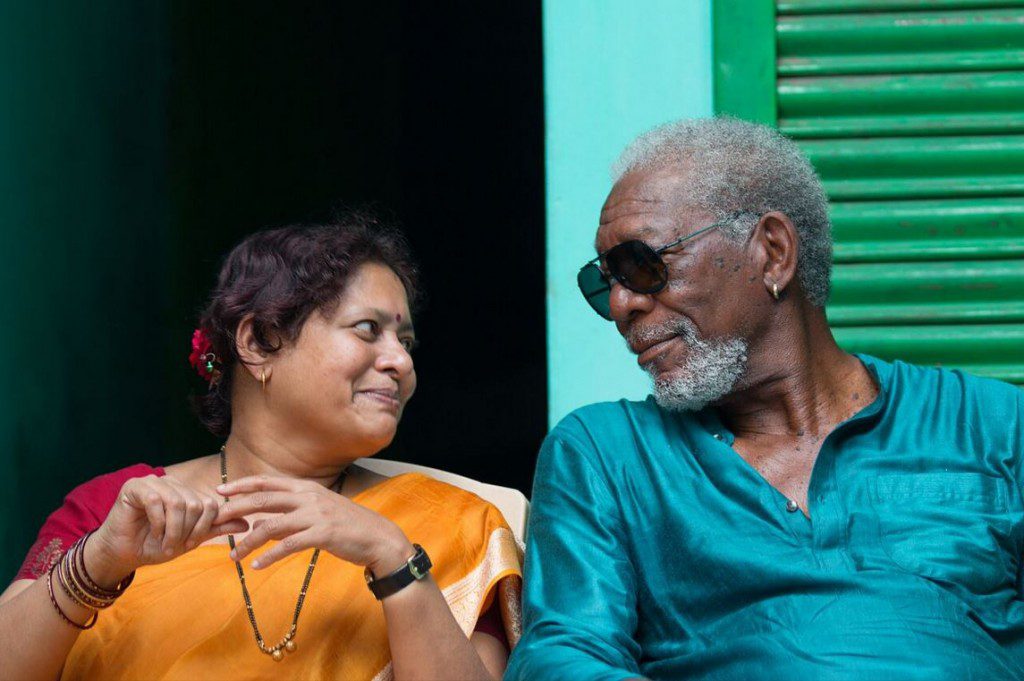
From this week’s “The Story of God” (courtesy National Geographic, see the trailer here)
In Hinduism we find the Rig Veda, in which there are numerous hymns of creation. As Wendy Doniger writes:
The Rig Veda refers glancingly to many different theories of creation. Several of these regard creation as the result – often apparently a mere by-product – of a cosmic battle, such as those mentioned in the hymns to Indra, or as a result of the apparently unmotivated act of separating heaven and earth, an act attributed to several different gods. These aspects of creation are woven in and out of the hymns in the older parts of the Rig Veda, books 2 through 9. But in the subsequent tenth book we encounter for the first time hymns that are entirely devoted to speculations on the origins of the cosmos.
Some of these hymns seek the origins of the existence of existence itself (10.129) or of the creator himself (10.121). Others speculate upon the sacrifice as the origin of the earth and the people in it (10.90), or upon the origins of the sacrifice (10.130, 10.190). Sacrifice is central to many concepts of creation, particularly to those explicitly linked to sacrificial gods or instruments, but it also appears as a supplement to other forms of creation such as sculpture (10.81-2) or anthropomorphic birth (10.72).
The most famous hymn is probably 10.129, which reads (emphasis added):
1 There was neither non-existence nor existence then; there was neither the realm of space nor the sky which is beyond. What stirred? Where? In whose protection? Was there water, bottomlessly deep?
2 There was neither death nor immortality then. There was no distinguishing sign of night nor of day. That one breathed, windless, by its own impulse. Other than that there was nothing beyond.
3 Darkness was hidden by darkness in the beginning; with no distinguishing sign, all this was water. The life force that was covered with emptiness, that one arose through the power of heat.
4 Desire came upon that one in the beginning ; that was the first seed of mind. Poets seeking in their heart with wisdom found the bond of existence in non-existence.
5 Their cord was extended across. Was there below? Was there above? There were seed-placers; there were powers. There was impulse beneath; there was giving-forth above.
6 Who really knows? Who will here proclaim it? Whence was it produced? Whence is this creation? The gods came afterwards, with the creation of this universe. Who then knows whence it has arisen?
7 Whence this creation has arisen – perhaps it formed itself, or perhaps it did not – the one who looks down on it, in the highest heaven, only he knows – or perhaps he does not know.
Perhaps creation created itself, perhaps it didn’t. Perhaps God knows. Eh, maybe not.

Buddhism has it’s own sort of creation story, the Aggañña sutta, or “Discourse on the Origins.”
However, the Aggañña sutta follows Hinduisms use of creation myths to tell moral stories; though this time not around themes of sacrifice or intellectual humility, but instead about the dangers of greed. The Discourse has all of the ingredients of a creation myth though, and no doubt many Buddhists over history have interpreted it as simply this. It begins with a world-contraction; apparently out of a vast, ethereal state in which beings were mind-made, feeding on joy, self-radiant, etc.
Eventually this contraction leads to a watery, dark mass, in which there is no moon or sun and beings without gender. However, a sweet substance coats the water and the beings take a taste of this substance. Craving arises.
Craving (or thirst – Pali: taṇhā) is the first of the three roots of immorality in Buddhism, along with aversion and ignorance.
Out of this new activity, day and night begin, as well as the seasons; and beings’ bodies become coarser and individuated – there is beauty and ugliness and with them pride and arrogance.
The story continues until beings resemble us, with all of our negative traits including our societies and social structures meant to curb or at least direct cravings and aversions. All beings fall into place, all caught up in ignorance and needing the education and eventual awakening offered only by a Buddha.
The story contrasts the beings of and in society, right up to the secular king, to the Awakened one himself, setting his awakened wisdom above that of even the greatest king. As I wrote in my Ph.D. thesis, “The sutta is a morality tale wrapped in a cosmogony.”
Yes, it’s a creation myth. But it’s really something bigger than that. I’m sure this is true of other religious myths as well. There is always the “kid” level of interpretation, then the “teenager” level, the “adult” level, and finally something a bit beyond that, something a little esoteric, perhaps mystical, something, as Stanley Tambiah wrote of this sutta, “larger in scope and superior” to all that has come before.
Check your listings for air times on the National Geographic Channel or visit their website.

Next Post

April 23, 2016 The Souse Family and Buddhism's Fifth Precept
Browse Our Archives
Select a Category Academia Activism American Buddhism Art Book review Buddhism Buddhism Today Buddhist Ethics Burma/Myanmar China Christianity Commodification Environment Gender Happiness Health Humor India Interfaith Islam Japanese Buddhism Kant Media / News Meditation mindfulness Photography Poetry Politics quicktakes Running Teaching Technology Thailand Theism/Atheism Theravada Tibet Tibetan Buddhism Travels Uncategorized Unitarian Universalism video Western Philosophy Zen
Select a Month June 2021 January 2021 November 2020 August 2020 July 2020 March 2020 January 2020 October 2019 August 2019 June 2019 May 2019 March 2019 February 2019 January 2019 December 2018 November 2018 October 2018 September 2018 August 2018 July 2018 June 2018 May 2018 April 2018 March 2018 February 2018 January 2018 December 2017 November 2017 October 2017 September 2017 August 2017 July 2017 June 2017 May 2017 April 2017 March 2017 February 2017 January 2017 December 2016 November 2016 October 2016 September 2016 August 2016 July 2016 June 2016 May 2016 April 2016 March 2016 February 2016 January 2016 December 2015 November 2015 October 2015 September 2015 August 2015 July 2015 June 2015 May 2015 April 2015 March 2015 February 2015 January 2015 December 2014 November 2014 October 2014 September 2014 August 2014 July 2014 June 2014 May 2014 April 2014 March 2014 February 2014 January 2014 December 2013 November 2013 October 2013 September 2013 August 2013 July 2013 June 2013 May 2013 April 2013 March 2013 February 2013 January 2013 December 2012 November 2012 October 2012 September 2012 August 2012 July 2012 June 2012 May 2012 April 2012 March 2012 February 2012 January 2012 December 2011 November 2011 October 2011 September 2011 August 2011 July 2011 June 2011 May 2011 April 2011 March 2011 February 2011 January 2011 December 2010 November 2010 October 2010 September 2010 August 2010 July 2010 June 2010 May 2010 April 2010 March 2010 February 2010 January 2010 December 2009 November 2009 October 2009 September 2009 August 2009 July 2009 June 2009 May 2009 April 2009 March 2009 February 2009 January 2009 December 2008 November 2008 October 2008 September 2008 August 2008 July 2008 June 2008 May 2008 April 2008 March 2008 September 2007 August 2007 July 2007 June 2007 May 2007 April 2007 March 2007 February 2007 January 2007 December 2006 November 2006 October 2006 September 2006 August 2006 July 2006 June 2006 May 2006 April 2006 March 2006 February 2006 January 2006 December 2005 November 2005 October 2005 September 2005 November 2004 September 2004 August 2004
Follow Us!
TAKE THE
Religious Wisdom Quiz
Who was Isaac's wife?
Select your answer to see how you score.
Leah Sarah Rebekah Rachel
Support this
Column


Related posts from American Buddhist Perspectives

In strife and uncertainty: let us remember loving-kindness
American Buddhist Perspectives

A Festival of Radical Awakening: Socially Engaged Buddhism...
American Buddhist Perspectives

The Coronavirus is coming - Some thoughts from...
American Buddhist Perspectives

Shambhala Buddhist Community Faces New Allegations in Chapman...
American Buddhist Perspectives
TRENDING AT PATHEOS Buddhist

On Taking Refuge in the Dharma
(Here I continue the feature of sharing talks and essays by teachers...

(Continuing my intention to share talks and essays by other members of Empty...
The Subtle Art of Bowing: A Dharma Discourse
(This presentation was first offered by my dear friend Dharma Holder Tom...

Internal Family Systems Can Heal you Mentally &...
How IFS Helped Me Stop Fighting Myself Internal Family Systems (IFS) is...

The Bible No One Spoke About: A Family’s...
A mysterious family Bible, unspoken faith, and a journey from curiosity to...

How Uncertainty Can Transform Your Life in 2025
Embracing Uncertainty: A New Year’s Resolution for the Brave As 2025 approaches,...
view all Buddhist blogs
Ad-Free & Subscriber Log-In Subscription Support
- About Us
- 2026 Calendar
- Videos
- Podcasts
- Library of World Religions
- Faith In Media Tracker
- Advertise With Us
- Write for Us
- Privacy Policy
- Terms of Service
- Do Not Sell My Data
- Contact Us
- Radiant Digital
- Manage Newsletter Subscriptions
- Unsubscribe From Notifications
- Sitemap
Copyright 2008-2026, Patheos. All rights reserved.
Subscription Support Ad-Free & Subscriber Log-In
Follow Patheos