
BuddhistCatholicContemplativeEvangelicalGeneral ChristianHinduJewishLatter-day SaintMuslimNew VisionsProgressive Christian
Beliefs
- Buddhist
- Catholic
- Contemplative
- Evangelical
- General Christian
- Hindu
- Jewish
- Latter-day Saint
- More Voices
- Muslim
- New Visions
- Pagan
- Progressive Christian
Topics
- Religion News
- Food and Religion
- Sports and Religion
- Religious Art
- Religious Music and Entertainment
- Religious Events
- History and Religion
- Style and Religion
- Politics and Religion
- Women in Religion
- Recreation Outdoors and Religion
- Business Finance and Religion
- Careers Workplace and Religion
- Education and Religion
- Family Parenting and Religion
- Health Fitness and Religion
- Home and Religion
- Relationships and Religion
- Technology and Religion
- Travel and Religion
Columnists
- Buddhist Columnists
- Business Finance and Religion Columnists
- Careers Workplace and Religion Columnists
- Catholic Columnists
- Contemplative Columnists
- Education and Religion Columnists
- Evangelists Columnists
- Family Parenting and Religion Columnists
- General Christian Columnists
- Health Fitness and Religion Columnists
- Hindu Columnists
- History and Religion Columnists
- Home and Religion Columnists
- Jewish Columnists
- More Voices Columnists
- Latter Day Columnists
- Muslim Columnists
- New Visions Columnists
- Nonreligious Columnists
- Pagan Columnists
- Politics and Religion Columnists
- Progressive Columnists
- Recreation Outdoors and Religion Columnists
- Relationships and Religion Columnists
- Religion News Columnists
- Religious Art Columnists
- Religious Events Columnists
- Religious Music and Entertainment Columnists
- Sports and Religion Columnists
- Style and Religion Columnists
- Technology and Religion Columnists
- Travel and Religion Columnists
- Women in Religion Columnists
Resource Library
- 2026 Calendar
- Library of World Religions
- The 100 Most Holy Places on Earth
- Patheos Answers
- Podcasts
- Videos
- Faith Leaders Database
- Anglican Episcopalian
- Bahai
- Baptist
- Buddhism
- Christianity
- Confucianism
- Eastern Orthodoxy
- Hinduism
- Holiness and Pentecostal
- ISKCON
- Islam
- Judaism
- Lutheran
- Methodist
- The Church of Jesus Christ of Latter-day Saints
- New Age
- Paganism
- Presbytarian and Reformed
- Protestantism
- Religion Behind the Scenes
- Roman Catholic
- Scientology
- Shia Islam
- Sikhism
- Sufism
- Sunni Islam
- Taoism
- Zen
- See all religions
Research Tools
 Ad-Free & Subscriber Log-In Subscription Support
Ad-Free & Subscriber Log-In Subscription Support
Follow Patheos 

- Trending:
- Forgiveness
- |
- Marriage
- |
- Consciousness
- |
- Death Penalty
- |
- Election
- |
- Halloween
 American Buddhist Perspectives
- Home
- Buddhist
- Religion News
- Buddhist Ethics has a good day: on Philosophy, East and West
Buddhist Ethics has a good day: on Philosophy, East and West
Last updated on: April 16, 2016 at 1:37 pm by Justin Whitaker
Buddhist Ethics has a good day: on Philosophy, East and West 2016-04-16T13:37:09-06:00 Justin Whitaker
Patheos Explore the world's faith through different perspectives on religion and spirituality! Patheos has the views of the prevalent religions and spiritualities of the world.
Almost 3 years ago exactly, 3 AM Magazine interviewed Jay Garfield, one of the best-known Buddhist philosophers in academia today. I wrote about that interview and still look back fondly on the comments and conversations that ensued.
So it was with great joy that I saw 3 AM Magazine’s latest interview with a Buddhist philosopher: Nicolas Bommarito, who teaches at NYU and the University of Buffalo. It was a great reminder that great thought within the academy is still being devoted to Buddhist ethics (and Buddhist philosophy more broadly) and that there is still a long ways to go – a point also highlighted in the interview with Jay Garfield. It was also a good reminder that I should be finishing up my thesis edits and getting more work out there in publication.
Approaching Buddhist thought
After discussing his path into philosophy, which is always interesting to read for parallels and dissimilarities from one’s own, Bommarito dives into Owen Flanagan’s work (see him discussing Buddhism without Superstition here), wherein three approaches to Buddhist philosophy are taken:
- a comparative approach;
- a fusion approach ( where we try and unify them) and
- a cosmopolitan one (where we are ironically poised to accept whichever comes through as best).*
To be honest, I don’t understand the use of the word “ironically” here, and perhaps Bommarito doesn’t either, as he responds, “Of the options, I suppose I’m closest to the cosmopolitan approach (though I’m not sure I’d describe myself as ‘ironically’ positioned).”
Much of my own work, I think, lies at the comparative level – and perhaps it’s simply a truism that comparative work is necessarily the first work to be done. However, I appreciate the term “fusion” here, as unifying disparate philosophies is so often dismissed as pernicious perennialism or naive ahistoricism these days. It makes me wonder, though, who is doing “fusion” work in Asian philosophies? Lastly, I’d take the cosmopolitan approach to be my own as well, after all of the heavy lifting of simply understanding, contextualizing, and comparing… It should be obvious that one cannot “accept whichever comes through as best” without rigorous comparison, right? Yet as Bommarito points out, part of what makes us philosophers is that we go beyond “just comparing.”
Buddhism: Religion or Philosophy?
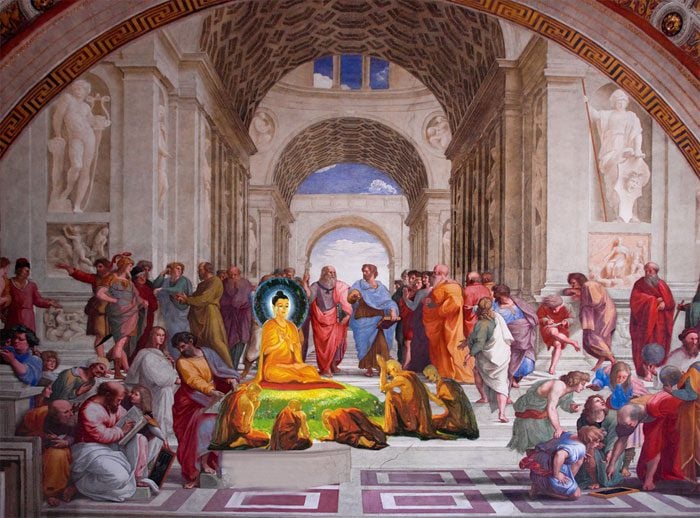
A second point raised by 3 AM’s interviewer (Richard Marshal) is our bias regarding the distinction between “religious content” in Western and “other” forms of philosophy. Bommarito’s response is again excellent, saying that one can direct one’s interest to the philosophical elements of Buddhist thought just as easily as one does Plato or Descartes – and perhaps even more easily.
I’ve written about this a few times (such as here) and agree with Bommarito that I’m also not in the business of arbitrating what “real” Buddhism is – though watching arguments about this by Buddhists can be at times enlightening and/or frustrating.
Buddhism and metaphysics
Getting down to ethics, and raising another issue of Western bias against Buddhist philosophy, Marshal asks, “Is it fair to say that the philosopher of Buddhism is working in the field of applied ethics rather than metaphysics or epistemology or are there metaphysical and epistemological commitments that you have to have to get to the ethics?”
I would be interested in tracing the evolution of this idea, often quoted, that “the Buddha eschewed metaphysics.” My guess is that it arose around the early 20th century when much of the vanguard of Western philosophy also sought to eschew metaphysics. So Buddhism was read and promoted as – unsurprisingly – perfectly in line with cutting edge Western thought.
But Bommarito rightly responds that in Buddhist philosophy “you can find things relevant for ethics (not just applied, but normative theory and metaethics too), metaphysics, and epistemology.” He mentions Śāntideva and Dōgen specifically, but concepts from the Buddha such as Dhamma, kamma, anattā (not-self), and nibbāna all convey broad abstraction and universality characteristic of Western metaphysics. Bommarito elucidates the connection between ethics and metaphysics and epistemology thus, “many Buddhist thinkers share the assumption that living well involves seeing things as they really are and that the way to reduce suffering is to get rid of mistaken ways of experiencing the world.”
Returning to comparative philosophy, Bommarito notes that strong ties between metaphysics and epistemology and ethics can be found in thinkers like Spinoza and Kant as well as the more recent work of Derek Parfit (Reasons and Persons). He continues that he agrees with Jay Garfield (as do I) that:
I don’t find the project of trying to fit so-called “Buddhist ethics” into one of our theoretical categories to be very interesting. Partly because I’m skeptical that there is one theoretical view that is Buddhist ethics; it seems implausible that a tradition spanning thousands of years and multiple cultures will have a single ethical theory. It’s also partly because I’m not sure what they payoff of such a project is; I’m less interested in making a case that a particular philosopher or tradition is virtue ethical or consequentialst than I am in what new ideas I can learn from them.
So for me, the more exciting projects in Buddhist ethics are those that take Buddhist thinkers on their own terms and try to build on what’s useful in them. Some that come to mind are Jay’s work on the role of experience in ethics, work by Bronwyn Finnigan on the role of fear and how we should think of spontaneous action, and work by Emily McRae on the place of emotions like anger in ethics.
Ultimately, I would say that Buddhist ethics is it’s own category and indeed it morphs and twists and bends and shifts through time. However, I think great comparative work can be (and is being) done to highlight certain themes in Buddhist ethics, such as its consequentialist, virtue ethics, or deontological aspects. I tell people this is no different than the work of the men in the pan-Indian story of the four blind men and the elephant. We all in the West are somewhat blindly feeling-out Buddhist ethics, but the better a description we can give of the “tree/leg” part and the “rope/trunk” part, etc, the better we will understand the elephant when we bring the pieces together. In other words, really good comparisons of Buddhist ethics in terms of Western categories, such as Charles Goodman’s Consequences of Compassion, or Damien Keown’s The Nature of Buddhist Ethics (for a Virtues approach), bring to light key features of Buddhist ethics as a whole for us all to recognize, utilize, and debate.
There is plenty more in the 3 AM Magazine interview, including particulars of Bommarito’s research, worth clicking over to read. In any case, it’s great to see some thoughtful discussion of a topic so dear to my own heart.
- Owen Flanagan writes in The Bodhisattva’s Brain (p.2):
Finally, there is cosmopolitan. Think of the exercise of reading and living and speaking across different traditions as open, non-committal, energized by an ironic or skeptical attitude about all the forms of life being expressed, embodied, and discussed, including one’s own, but sensitive also to the demands of one’s own way of being and living given its utterly contingent but nonetheless identity-constitutive role in making one who he or she is. The cosmopolitan is a listener and a speaker, an anachronistic and ethnocentric one, he or she compares and contrasts, is willing to try fusings of silly and safe sorts, but mostly likes living at the intersection of multiple spaces of meaning, waiting and seeing and watching whatever happens happen.
Previous Post

April 11, 2016
Letting identity arise unimpeded: Buddhism confronting racism
Next Post

April 18, 2016 Your Summer in a Chinese Buddhist Monastery - Woodenfish HBMLP in China
Browse Our Archives
Select a Category Academia Activism American Buddhism Art Book review Buddhism Buddhism Today Buddhist Ethics Burma/Myanmar China Christianity Commodification Environment Gender Happiness Health Humor India Interfaith Islam Japanese Buddhism Kant Media / News Meditation mindfulness Photography Poetry Politics quicktakes Running Teaching Technology Thailand Theism/Atheism Theravada Tibet Tibetan Buddhism Travels Uncategorized Unitarian Universalism video Western Philosophy Zen
Select a Month June 2021 January 2021 November 2020 August 2020 July 2020 March 2020 January 2020 October 2019 August 2019 June 2019 May 2019 March 2019 February 2019 January 2019 December 2018 November 2018 October 2018 September 2018 August 2018 July 2018 June 2018 May 2018 April 2018 March 2018 February 2018 January 2018 December 2017 November 2017 October 2017 September 2017 August 2017 July 2017 June 2017 May 2017 April 2017 March 2017 February 2017 January 2017 December 2016 November 2016 October 2016 September 2016 August 2016 July 2016 June 2016 May 2016 April 2016 March 2016 February 2016 January 2016 December 2015 November 2015 October 2015 September 2015 August 2015 July 2015 June 2015 May 2015 April 2015 March 2015 February 2015 January 2015 December 2014 November 2014 October 2014 September 2014 August 2014 July 2014 June 2014 May 2014 April 2014 March 2014 February 2014 January 2014 December 2013 November 2013 October 2013 September 2013 August 2013 July 2013 June 2013 May 2013 April 2013 March 2013 February 2013 January 2013 December 2012 November 2012 October 2012 September 2012 August 2012 July 2012 June 2012 May 2012 April 2012 March 2012 February 2012 January 2012 December 2011 November 2011 October 2011 September 2011 August 2011 July 2011 June 2011 May 2011 April 2011 March 2011 February 2011 January 2011 December 2010 November 2010 October 2010 September 2010 August 2010 July 2010 June 2010 May 2010 April 2010 March 2010 February 2010 January 2010 December 2009 November 2009 October 2009 September 2009 August 2009 July 2009 June 2009 May 2009 April 2009 March 2009 February 2009 January 2009 December 2008 November 2008 October 2008 September 2008 August 2008 July 2008 June 2008 May 2008 April 2008 March 2008 September 2007 August 2007 July 2007 June 2007 May 2007 April 2007 March 2007 February 2007 January 2007 December 2006 November 2006 October 2006 September 2006 August 2006 July 2006 June 2006 May 2006 April 2006 March 2006 February 2006 January 2006 December 2005 November 2005 October 2005 September 2005 November 2004 September 2004 August 2004
Follow Us!
TAKE THE
Religious Wisdom Quiz
What is the Christian holy day typically observed with rest and worship?
Select your answer to see how you score.
Monday Saturday Sunday Friday
Support this
Column


Related posts from American Buddhist Perspectives

For Pride Month: Our 2015 Interview with La...
American Buddhist Perspectives

Standing up to Lies: Can America Emerge from...
American Buddhist Perspectives

In strife and uncertainty: let us remember loving-kindness
American Buddhist Perspectives

In the rush to return to normal, can...
American Buddhist Perspectives
TRENDING AT PATHEOS Buddhist

On Taking Refuge in the Dharma
(Here I continue the feature of sharing talks and essays by teachers...

(Continuing my intention to share talks and essays by other members of Empty...
The Subtle Art of Bowing: A Dharma Discourse
(This presentation was first offered by my dear friend Dharma Holder Tom...

Internal Family Systems Can Heal you Mentally &...
How IFS Helped Me Stop Fighting Myself Internal Family Systems (IFS) is...

The Bible No One Spoke About: A Family’s...
A mysterious family Bible, unspoken faith, and a journey from curiosity to...

How Uncertainty Can Transform Your Life in 2025
Embracing Uncertainty: A New Year’s Resolution for the Brave As 2025 approaches,...
view all Buddhist blogs
Ad-Free & Subscriber Log-In Subscription Support
- About Us
- 2026 Calendar
- Videos
- Podcasts
- Library of World Religions
- Faith In Media Tracker
- Advertise With Us
- Write for Us
- Privacy Policy
- Terms of Service
- Do Not Sell My Data
- Contact Us
- Radiant Digital
- Manage Newsletter Subscriptions
- Unsubscribe From Notifications
- Sitemap
Copyright 2008-2026, Patheos. All rights reserved.
Subscription Support Ad-Free & Subscriber Log-In
Follow Patheos