
BuddhistCatholicContemplativeEvangelicalGeneral ChristianHinduJewishLatter-day SaintMuslimNew VisionsProgressive Christian
Beliefs
- Buddhist
- Catholic
- Contemplative
- Evangelical
- General Christian
- Hindu
- Jewish
- Latter-day Saint
- More Voices
- Muslim
- New Visions
- Pagan
- Progressive Christian
Topics
- Religion News
- Food and Religion
- Sports and Religion
- Religious Art
- Religious Music and Entertainment
- Religious Events
- History and Religion
- Style and Religion
- Politics and Religion
- Women in Religion
- Recreation Outdoors and Religion
- Business Finance and Religion
- Careers Workplace and Religion
- Education and Religion
- Family Parenting and Religion
- Health Fitness and Religion
- Home and Religion
- Relationships and Religion
- Technology and Religion
- Travel and Religion
Columnists
- Buddhist Columnists
- Business Finance and Religion Columnists
- Careers Workplace and Religion Columnists
- Catholic Columnists
- Contemplative Columnists
- Education and Religion Columnists
- Evangelists Columnists
- Family Parenting and Religion Columnists
- General Christian Columnists
- Health Fitness and Religion Columnists
- Hindu Columnists
- History and Religion Columnists
- Home and Religion Columnists
- Jewish Columnists
- More Voices Columnists
- Latter Day Columnists
- Muslim Columnists
- New Visions Columnists
- Nonreligious Columnists
- Pagan Columnists
- Politics and Religion Columnists
- Progressive Columnists
- Recreation Outdoors and Religion Columnists
- Relationships and Religion Columnists
- Religion News Columnists
- Religious Art Columnists
- Religious Events Columnists
- Religious Music and Entertainment Columnists
- Sports and Religion Columnists
- Style and Religion Columnists
- Technology and Religion Columnists
- Travel and Religion Columnists
- Women in Religion Columnists
Resource Library
- 2026 Calendar
- Library of World Religions
- The 100 Most Holy Places on Earth
- Patheos Answers
- Podcasts
- Videos
- Faith Leaders Database
- Anglican Episcopalian
- Bahai
- Baptist
- Buddhism
- Christianity
- Confucianism
- Eastern Orthodoxy
- Hinduism
- Holiness and Pentecostal
- ISKCON
- Islam
- Judaism
- Lutheran
- Methodist
- The Church of Jesus Christ of Latter-day Saints
- New Age
- Paganism
- Presbytarian and Reformed
- Protestantism
- Religion Behind the Scenes
- Roman Catholic
- Scientology
- Shia Islam
- Sikhism
- Sufism
- Sunni Islam
- Taoism
- Zen
- See all religions
Research Tools
 Ad-Free & Subscriber Log-In Subscription Support
Ad-Free & Subscriber Log-In Subscription Support
Follow Patheos 

- Trending:
- Forgiveness
- |
- Marriage
- |
- Consciousness
- |
- Death Penalty
- |
- Election
- |
- Halloween
 American Buddhist Perspectives
- Home
- Buddhist
- Religion News
- Mutuality at the Limits of Race – A Buddhist Perspective
Mutuality at the Limits of Race – A Buddhist Perspective
Last updated on: April 3, 2016 at 3:44 pm by Justin Whitaker
Mutuality at the Limits of Race – A Buddhist Perspective 2016-04-03T15:44:31-06:00 Justin Whitaker
Patheos Explore the world's faith through different perspectives on religion and spirituality! Patheos has the views of the prevalent religions and spiritualities of the world.
A guest post by Doshin Nathan Woods
“A Black Man is a person who must ride ‘Jim Crow’ in Georgia…”
–W.E.B Du Bois
As I walked to the Zendo the helicopters droned distantly overhead. The muffled announcement reverberating through the neighborhood: “White or Hispanic male….wearing a white t-shirt…..” Indistinct, my attention turned to the matter at hand, where, upon stepping into the Zendo, I was about my business: “Hi, excuse me, sorry to interrupt, but the Zendo is closed right now, would you mind sitting….” The man looked up from arranging his cushion: “I can’t meditate?” “Yes,” I replied, you can, but it would be best if you came back this evening to sit on the schedule, or if we went to another building…” “You’re kicking me out—would you kick me out if I was a white woman? This…you…you’re racist…” “No, listen, that’s not the issue. We have been locking the Zendo in the afternoons because…” “Its because I’m Black!” Shocked that things escalated so rapidly, I replied, “No, no…look I’m Black too…” “Your black?” “Yes, look, we can go sit in the auxiliary hall…” “Well, you don’t look Black…no one would ever know.” Anger and heated argument gives way to discussion and a tenuous seed of spiritual friendship. Just another day in an urban American Buddhist temple.
Yet several months after this conversation took place —this scene of cultural misrecognition–I continue to reflect on the interaction. Once again the topic of race is back in the national spotlight, although for many of us it never left. For Buddhists in the U.S. it has sparked anew a continued conversation, and with the rest of U.S. society many Buddhists have joined the national conversation, moving from advocating diversity to a demand for racial justice. Both concern a demand for inclusion: folding diversity into our communities, and encouraging the Buddhists in the U.S. to participate in a searching examination of racism.
My journey to the Buddhadharma has been intimately tied up with race in the United States. It was the pain of growing up what some would call multi-racial—and hence ambiguously brown—that led me to my first meditation session, and it was the promise of release and fellowship that brought me back over and over again. Yet while the topic of racial diversity and inclusion is currently an urgent topic in Buddhist circles, I can’t help but pause to ask, what are we including?
In another recent conversation, this time regarding the importance of myth in our contemporary spirituality, I took note of a curious and insightful remark: “we live in a culture devoid of myth.” I was immediately struck by this insight—how compelling, and yet how remarkably untrue. As Americans our greatest, most prevalent civic and secular myth is the ‘myth of race’—the notion that there are durable human races, that racial differences are biological, or somehow natural, and that these biological differences relate to individual and group propensities in important ways.
The notion of a myth may be defined equally as an important didactic story as well a widely held but false ideal or belief, covering both the mythical, or magical elements in our shared cultural life, as well as, in our secular way, dispelling the mythic through appeal to fact. Here the notion of race, and its appeal in the U.S. fits both definitions of the mythical: it is an instructive falsehood, untrue as a body of biological fact but definitively true for what it makes possible. The differences we acknowledge as indicative of race—differences in body type, in hair texture, facial feature or skin color—hold social and historical meaning, but are devoid of biological reality. Rather, as Alan Goodman notes, race is “not based on biology, but rather…on ideas we ascribe to biology.” It is the great myth that frames our lessons about cultural recognition, belonging, and equality.
The lessons of this myth run deep. Although human attributes such as language, religion, and class were durable distinctions for ancient peoples, it was only in the 16th C. that these features were increasingly organized according to physical characteristics, or race. The immediate outcome of this re-organization was the creation of brutal systems of colonization, slavery and genocide, and remains with us today in durable systems of racism, racial inequality, class oppression, gendered hostilities, social privileges, and hard won racial identities. In the U.S. we are awash in the great myth of race, its subtle rituals, overt ceremonies, and cultural cognates, where we have constructed over time a grand racial mythology.
As many recent commentators have noted, communities of ‘Western Buddhism’ remain unexceptional in this regard**.** Indeed, one could argue that the very notion of ‘Western’ or ‘American’ Buddhism is complicit in this mythology, as shaped by the search to distinguish itself from ‘Asian Buddhism,’ and hence from the so called ‘ethnic’ Buddhist traditions in the U.S., and the influence of Asian national Buddhist traditions more generally. Sadly, as many have pointed out, this effort is often predicated upon the exclusion of Immigrant and Asian American Buddhist communities, and discrimination against People of Color.
We find this myth in the grand stories we tell about Buddhism. As a cultural project I have always been suspicious of the notion of ‘American Buddhism,’ or its more sophisticated cousin, ‘Western Buddhism.’ Less a neutral term of historical geography, the concept of ‘the West’ connotes, at best, a Western European cultural project within Europe, and at worst a geo-political project, intimately tied to the Euro-American Colonial projects. By contrast, the concept of American Buddhism, while often used to denote Buddhism in the United States, or North America, has taken on a type of searching, nationalist waiting for the Buddhism to come. When will American Buddhism arrive? How will it be recognized? How must we translate American Buddhism to American Audiences? Who is an American Buddhist?
Efforts to answer these questions often serve as implicit vehicles for American exceptionalism. In this search the promise of American Buddhism—once it finally arrives—rests not only in its difference from Asian cultural traditions, but also in its redemption of the Buddhist tradition’s problematic faults as expressed in Asian cultural settings. Witness Gary Snyder’s now classic articulation: “The mercy of the West has been social revolution; the mercy of the East…individual insight into basic self/void.” David Loy interprets Snyder’s sentiment to mean, “the highest ideal of Western tradition has been to restructure our societies so that they are socially just.” This contrast in effect erases social history, mischaracterizing the diversity of Asian cultures while obscuring the coercive dimensions of Euro-American egalitarianism. While it is true that the societies of ‘the West’—by which we mean Europe and the United States—have enshrined liberty and equality as political ideals, they largely did so on the basis of exploitation, stratification and colonialism. The contradictory political and spiritual edifice of the ‘the West’ was in fact built upon the ‘myth of race,’ at one and the same time supportive of our political ideals of equality, and deeply enmeshed in the construction of a system of racial stratification.
In many ways I feel these are the wrong questions. American Buddhism already exists in the efforts to articulate a shared mutuality amongst practitioners, traditions and cultures. In my view Buddhism is best seen less as ethno-national tradition than, as Robert Thurman suggests, a type of intercultural educational movement with a religious dimension.
In less dramatic ways we find the myth appropriately honored in a vast array of social rituals and ceremonies: in our rituals of schooling, consumption and labor, our rituals of recognition, and ceremonies of distinction. For Buddhists in the U.S., racial concepts remain intimately woven in to the intimate geography of ‘Western Buddhism.‘ A sample from my everyday life turns up several anecdotal examples. After my ordination I received a message from a friend in Kyoto—“You look more Japanese every day!” Another day a friend complains, “ I just can’t get into American Zen—all these white people dressed up playing Japanese—its all very Orientalist to me.” And, by contrast, although from a similar perspective: “I feel really uncomfortable with traditional Zen—with the forms—I mean, I’m not Japanese. I’m American—let’s be Americans—chant in English, get rid of the robes and the bowing etc.”
On a different day, while giving meditation instruction to a distinguished older gentleman from Tijuana, he asked, “Are you Chinese? I like Chinese meditation the best.” I include ethnicity as a ritual cognate of race where, although now used to denote group membership or identity, it did not take on this meaning until the 1950s, but concerned rather the physical characteristics of national origin or cultural ancestry. In the early debates over immigrants from China, and later Eastern and Southern Europe, ‘ethnic’ referred to nonwhite, colonized or indigenous peoples, as well as working class whites, and Jews. After WWII, and the effort to repudiate scientific racism in the aftermath of the Holocaust, the notion of ethnicity was reformed to replace race.
From this perspective the great question of the moment—of how race matters—is both an urgent question, and a distraction. Urgent because it stabs at the heart of spiritual friendship (kalyana-mittata), the very basis of this movement, and a distraction from the questions of power and inequality that the notion of race mystifies, despite our best, most critical intentions. Current sentiments track closely with the limits of race in our national conversation: an appeal to race neutrality—or color blindness—and urgent demand to pay attention to how race matters—differentially and disproportionately impacting some populations at the expense of others–and thus the proliferation of strategies of racial awareness.
But what are we talking about when we talk about race or racism? For many, the two are now linked in a formula that combines cultural and ethnic difference with power. We see this in the current conceptual formulations of antiracism, and the pitched preoccupation with ‘Whiteness’ or ‘White privilege,’ where racism refers to a form of oppression in which one racial group dominates another. ‘Whiteness’ at once consecrates the notion of race and obscures the contradictory historical exercise of racism responsible for the consolidation of durable racial groups–the intersecting legacy of the American slave state, and the expansion of the settler-colonial state administered in racial terms. The legacy of each was subsequently combined in the importation of ‘ethnic’ workers in the late 19th and early 20th century, and their subsequent racialization.
Here I adopt Fields and Fields suggestion that we see racism not as an effect of race—a move that in effect naturalizes the non-existent—but rather to view race itself as a product of the application of racism. Racism, on this account, is usefully defined as the “theory and practice of applying a social, civic, or legal double standard based on ancestry.” In this sense racism is primarily a practice, both “an action and a rational for action,” transforming racism—something that is done—to ‘race,’ something that a person is by dint of an imposed criteria. Nothing exemplifies this ‘race craft’ more potently than the deceptive history of slavery in the U.S., where we encounter at once a history of forced labor, and thus class, cultural extermination, and domination. As an example we might consider a popular suggestion that Africans in the United States were enslaved—dominated–because of their race, rather than for the labor that they were forced to provide, “as though the chief business of slavery were the production of white supremacy rather than the production of cotton, sugar, and tobacco” (117). The issue is not race per se, but racism, the exercise of which is made possible by capitalizing on and extending existent conditions of inequality.
Racism is the rejection of our natural given equality through the obliteration of human distinctiveness. From this angle the act of inclusion means nothing if it does not include the shadows of race. Not race, but rather domination, imprisonment, historical trauma and its intergenerational legacy, stigmatization, revilement, and the struggle against spiritual starvation. Not simply what we now call our ‘racial identities’—hard won, to be sure—but the political act of identification through the ritualized myth of race. While racial inclusion remains an important topic, the pressing question for Buddhist communities in this context is how to participate in the transformation of this myth of race, and the conditions of inequality that continue to make it relevant. Inclusion of racial difference in our communities does not mean opening to race as we would like it to be, but to the pervasiveness of racism as a widespread practice of inequality, giving rise to othering, domination, exclusion, and dehumanization.
Since the 1970’s—in Buddhist communities, and in society more generally—we have engaged innumerable strategies and tactics of racial awareness: race sensitivity training, consciousness raising, diversity training, anti-racism training, anti-oppression training, and even support in recovery from the dominant culture. Here we have placed much emphasis on the power of cognitive-emotional change—that we might change our minds to unlearn racism, and now, in this time—when Black Lives Matter—it is imperative to support these endeavors. And yet I continue to ask under what conditions do we practice equality through being in relationship—of being equal to one another—not as a given, but as a mutual and embodied accomplishment?
Last summer I joined the Zen Peacemakers’ Native American Bearing Witness Retreat, where with some 200 others I traveled to South Dakota to bear witness to the genocide and ongoing historical struggle of Native peoples linked to the founding of the U.S. During the retreat we had the great privilege to receive teachings from Grandmother Beatrice Long Visitor Holy Dance, a member of the Oglala Lakota, and International Council of 13 Indigenous Grandmothers. I was greatly moved by her prayers and her emphasis on the important need for spaces of reciprocity, where people come together to deeply listen and share in their cultural distinctiveness, as well as in their historical sorrows and traumas. Her teaching helped frame what was for me a major theme of the retreat: cultivating reciprocity in the face of cultural domination and giving up dominion to share in mutuality.
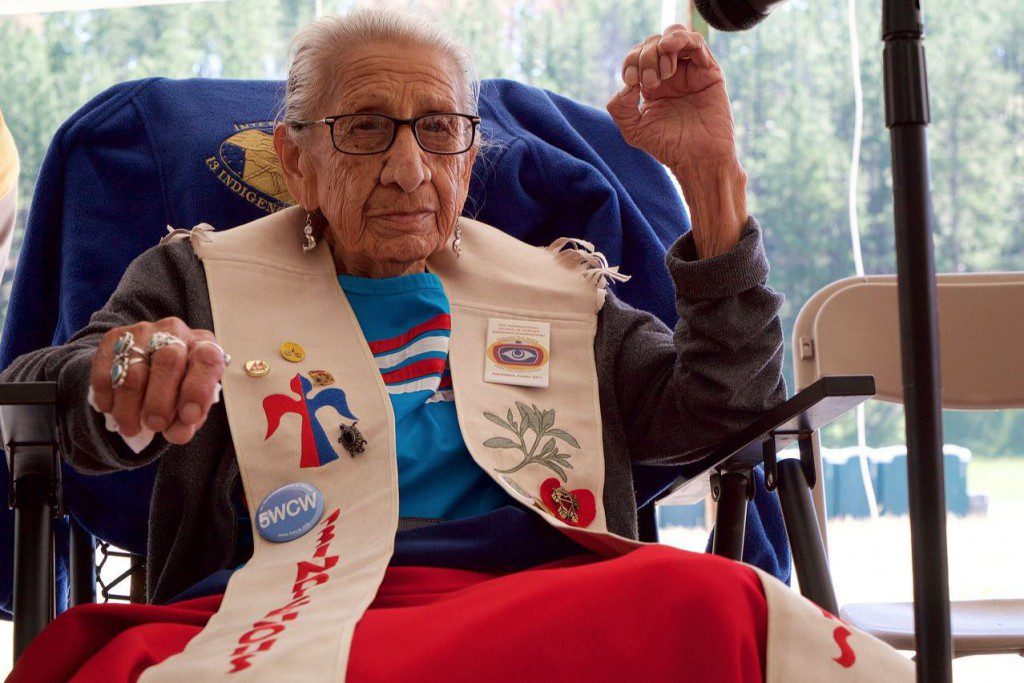
Photo credit: Shizuka/Darrell, ‘2015 Zen Peacemaker Order Native American Bearing Witness Retreat’ www.zenpeacemakers.org
Carrying this home to my community, and in my own practice, I find myself asking: How do we harmonize distinctiveness and equality in our communities, where harmony is defined as mutual recognition? We hear echoes of this in the Ambattha Sutta, where during a particularly contentious moment of co-inquiry, the Buddha suggests:
“In the supreme perfection of wisdom and righteousness…there is no reference to either the question of birth, or of lineage, or of the pride which says you are held as worthy as I, or you are not held as worthy as I, for who so ever…is enslaved, or in bondage to the notion of birth, or lineage, or the pride of social position, or of family connections, they are far from the best wisdom and righteousness. It is only having got rid of all such bondage that one can realize for oneself the unexcelled perfection of wisdom and conduct…”
It is not race that is at issue here —with its logic of sameness and difference– but rather distinctiveness seen through the lens of equality. Human distinctiveness and ancestry are not natural equivalents to the notions of racial difference. Rather race provides a justification for their distortion, as produced through the practice of inequality, a feature of which is domination, exclusion, otherness.
Can we extend our spiritual friendship beyond the meditation hall and beyond the protest to enter into long-term relationships of accompaniment—a spirituality of solidarity partnerships–with others around common issues of inequality and justice? For those that believe themselves to be ‘white,’ can we pursue relationships of accountability with POC groups? As for example, as is now practiced in the Native led Rapid City Community Conversations initiative in South Dakota, or the Society of Friends support of the Maine Wabanaki-State Child Welfare Truth and Reconciliation Commission. For people that identify as POC—can we enter into intergroup relationships of support across cultures or for those in our communities of different class standing? Such as the Tamejavi project–PanValley Institute, or Causa Justa, Just Cause, or the UCCRO. In mixed communities can we institutionalize engagement with tangible issues of inequality, such as in the Mennonite Central Committee’s Indigenous Visioning Circle’s work on dismantling the Doctrine of Discovery. Finally—with full embrace of our diverse identities—can we support broad projects, such as Interfaith Worker Justice, or the Center for the Working Poor, or the Right to the City, that seek Justice for the poor and the Working Class. Where are our new ceremonies of mutuality? Rituals beyond the color line, or the ‘ethnic division’ in American Buddhism that celebrates being in relationship. Where, as Ven. Dr. Pannavati Bhikkuni states: “there is not one that sees you, but when one sees you, he sees himself, and when you see one, then you also see yourself through that one….” How can we celebrate and honor the dignity of the common regenerative future at hand?
~
 Doshin Nathan Woods (Ph.D., Anthropology, CUNY Graduate Center, NYC, 2015) is a writer, scholar and novice Zen Buddhist Priest under the spiritual direction of Seisen Anne Saunders, Roshi. He specializes in the Historical Anthropology of North America, and his research agenda focuses on the organization of knowledge, expertise and education, with a particular focus on institution building and institutionalization in the fields of higher education, science, the environment and religion. His current research program concerns the history of Buddhist-based institution building in North America. He lives in community at the Sweetwater Zen Center in National City, CA, in the Tijuana-San Diego Border Region.


Browse Our Archives
Select a Category Academia Activism American Buddhism Art Book review Buddhism Buddhism Today Buddhist Ethics Burma/Myanmar China Christianity Commodification Environment Gender Happiness Health Humor India Interfaith Islam Japanese Buddhism Kant Media / News Meditation mindfulness Photography Poetry Politics quicktakes Running Teaching Technology Thailand Theism/Atheism Theravada Tibet Tibetan Buddhism Travels Uncategorized Unitarian Universalism video Western Philosophy Zen
Select a Month June 2021 January 2021 November 2020 August 2020 July 2020 March 2020 January 2020 October 2019 August 2019 June 2019 May 2019 March 2019 February 2019 January 2019 December 2018 November 2018 October 2018 September 2018 August 2018 July 2018 June 2018 May 2018 April 2018 March 2018 February 2018 January 2018 December 2017 November 2017 October 2017 September 2017 August 2017 July 2017 June 2017 May 2017 April 2017 March 2017 February 2017 January 2017 December 2016 November 2016 October 2016 September 2016 August 2016 July 2016 June 2016 May 2016 April 2016 March 2016 February 2016 January 2016 December 2015 November 2015 October 2015 September 2015 August 2015 July 2015 June 2015 May 2015 April 2015 March 2015 February 2015 January 2015 December 2014 November 2014 October 2014 September 2014 August 2014 July 2014 June 2014 May 2014 April 2014 March 2014 February 2014 January 2014 December 2013 November 2013 October 2013 September 2013 August 2013 July 2013 June 2013 May 2013 April 2013 March 2013 February 2013 January 2013 December 2012 November 2012 October 2012 September 2012 August 2012 July 2012 June 2012 May 2012 April 2012 March 2012 February 2012 January 2012 December 2011 November 2011 October 2011 September 2011 August 2011 July 2011 June 2011 May 2011 April 2011 March 2011 February 2011 January 2011 December 2010 November 2010 October 2010 September 2010 August 2010 July 2010 June 2010 May 2010 April 2010 March 2010 February 2010 January 2010 December 2009 November 2009 October 2009 September 2009 August 2009 July 2009 June 2009 May 2009 April 2009 March 2009 February 2009 January 2009 December 2008 November 2008 October 2008 September 2008 August 2008 July 2008 June 2008 May 2008 April 2008 March 2008 September 2007 August 2007 July 2007 June 2007 May 2007 April 2007 March 2007 February 2007 January 2007 December 2006 November 2006 October 2006 September 2006 August 2006 July 2006 June 2006 May 2006 April 2006 March 2006 February 2006 January 2006 December 2005 November 2005 October 2005 September 2005 November 2004 September 2004 August 2004
Follow Us!
TAKE THE
Religious Wisdom Quiz
What is the Christian view about material possessions?
Select your answer to see how you score.
They are the most important thing Seek them after righteousness Riches guarantee happiness They are temporary
Support this
Column


Related posts from American Buddhist Perspectives

For Pride Month: Our 2015 Interview with La...
American Buddhist Perspectives

In the rush to return to normal, can...
American Buddhist Perspectives

A Festival of Radical Awakening: Socially Engaged Buddhism...
American Buddhist Perspectives

Shambhala Buddhist Community Faces New Allegations in Chapman...
American Buddhist Perspectives
TRENDING AT PATHEOS Buddhist

On Taking Refuge in the Dharma
(Here I continue the feature of sharing talks and essays by teachers...

(Continuing my intention to share talks and essays by other members of Empty...
The Subtle Art of Bowing: A Dharma Discourse
(This presentation was first offered by my dear friend Dharma Holder Tom...

Internal Family Systems Can Heal you Mentally &...
How IFS Helped Me Stop Fighting Myself Internal Family Systems (IFS) is...

The Bible No One Spoke About: A Family’s...
A mysterious family Bible, unspoken faith, and a journey from curiosity to...

How Uncertainty Can Transform Your Life in 2025
Embracing Uncertainty: A New Year’s Resolution for the Brave As 2025 approaches,...
view all Buddhist blogs
Ad-Free & Subscriber Log-In Subscription Support
- About Us
- 2026 Calendar
- Videos
- Podcasts
- Library of World Religions
- Faith In Media Tracker
- Advertise With Us
- Write for Us
- Privacy Policy
- Terms of Service
- Do Not Sell My Data
- Contact Us
- Radiant Digital
- Manage Newsletter Subscriptions
- Unsubscribe From Notifications
- Sitemap
Copyright 2008-2026, Patheos. All rights reserved.
Subscription Support Ad-Free & Subscriber Log-In
Follow Patheos