
BuddhistCatholicContemplativeEvangelicalGeneral ChristianHinduJewishLatter-day SaintMuslimNew VisionsProgressive Christian
Beliefs
- Buddhist
- Catholic
- Contemplative
- Evangelical
- General Christian
- Hindu
- Jewish
- Latter-day Saint
- More Voices
- Muslim
- New Visions
- Pagan
- Progressive Christian
Topics
- Religion News
- Food and Religion
- Sports and Religion
- Religious Art
- Religious Music and Entertainment
- Religious Events
- History and Religion
- Style and Religion
- Politics and Religion
- Women in Religion
- Recreation Outdoors and Religion
- Business Finance and Religion
- Careers Workplace and Religion
- Education and Religion
- Family Parenting and Religion
- Health Fitness and Religion
- Home and Religion
- Relationships and Religion
- Technology and Religion
- Travel and Religion
Columnists
- Buddhist Columnists
- Business Finance and Religion Columnists
- Careers Workplace and Religion Columnists
- Catholic Columnists
- Contemplative Columnists
- Education and Religion Columnists
- Evangelists Columnists
- Family Parenting and Religion Columnists
- General Christian Columnists
- Health Fitness and Religion Columnists
- Hindu Columnists
- History and Religion Columnists
- Home and Religion Columnists
- Jewish Columnists
- More Voices Columnists
- Latter Day Columnists
- Muslim Columnists
- New Visions Columnists
- Nonreligious Columnists
- Pagan Columnists
- Politics and Religion Columnists
- Progressive Columnists
- Recreation Outdoors and Religion Columnists
- Relationships and Religion Columnists
- Religion News Columnists
- Religious Art Columnists
- Religious Events Columnists
- Religious Music and Entertainment Columnists
- Sports and Religion Columnists
- Style and Religion Columnists
- Technology and Religion Columnists
- Travel and Religion Columnists
- Women in Religion Columnists
Resource Library
- 2026 Calendar
- Library of World Religions
- The 100 Most Holy Places on Earth
- Patheos Answers
- Podcasts
- Videos
- Faith Leaders Database
- Anglican Episcopalian
- Bahai
- Baptist
- Buddhism
- Christianity
- Confucianism
- Eastern Orthodoxy
- Hinduism
- Holiness and Pentecostal
- ISKCON
- Islam
- Judaism
- Lutheran
- Methodist
- The Church of Jesus Christ of Latter-day Saints
- New Age
- Paganism
- Presbytarian and Reformed
- Protestantism
- Religion Behind the Scenes
- Roman Catholic
- Scientology
- Shia Islam
- Sikhism
- Sufism
- Sunni Islam
- Taoism
- Zen
- See all religions
Research Tools
 Ad-Free & Subscriber Log-In Subscription Support
Ad-Free & Subscriber Log-In Subscription Support
Follow Patheos 

- Trending:
- Forgiveness
- |
- Marriage
- |
- Consciousness
- |
- Death Penalty
- |
- Election
- |
- Halloween
 American Buddhist Perspectives
- Home
- Buddhist
- Religion News
- Building Bridges of Loving-kindness: Mongolia’s Rich History and Culture of Buddhism
Building Bridges of Loving-kindness: Mongolia’s Rich History and Culture of Buddhism
Last updated on: March 23, 2016 at 11:46 am by Justin Whitaker
Building Bridges of Loving-kindness: Mongolia’s Rich History and Culture of Buddhism 2016-03-23T11:46:55-06:00 Justin Whitaker
Patheos Explore the world's faith through different perspectives on religion and spirituality! Patheos has the views of the prevalent religions and spiritualities of the world.
A guest post by Michael Fouts, Executive Director of the Grand Maitreya Project West
In today’s world the majority of new construction projects and monuments are created with a commercial interest in mind. There seems to be fewer symbols of love and peace being created these days, especially in the west. With the current state of the world and the real need for peace on Earth, creating more universal symbols of love and peace seems to be more important than ever before.
In 1924 Mongolia became a victim of occupation followed by a revolution from soviet communists. By 1939 most all of their 1,000 Buddhist monasteries perished along with most of Mongolia’s Buddha statues and other symbols of love, only one monastery was left standing. More than 30,000 Buddhist monks lost their lives in the struggle. During this time most all of the Mongolian people were moved away from their spiritual heritage of Tibetan Buddhism.
Now, new hope arises in the hearts of the Mongolian people as Mongolia is currently experiencing the joy and excitement of a nationwide cultural re-connection with their spiritual roots of Loving – Kindness. After many years of occupation, 200 brave Mongolian people staged a peaceful protest in 1989 that eventually sparked into a nationwide cultural revolution. By 1990 the occupying forces retreated and Mongolia once again re-gained their spiritual freedoms. Aiming to re-build and re-connect fully with their ancient culture of Tibetan Buddhism the Mongolian people have largely turned to HH Dalai Lama for guidance during this time of great transition.
Both the Dalai Lama and Maitreya Buddha have special connections and a wonderful history with the people of Mongolia. In 1577 the country leader Altan Khan, with the goal of uniting the Mongolian people, invited the head of the Gelug tradition Sonam Gyatso to visit. While living in a famous Mongolian Maitreya Temple Sonam Gyatso successfully spread the teachings of Buddhism to numerous people throughout Mongolia. Altan Khan bestowed the name Dalai Lama (Ocean Lama) upon Sonam Gyatso automatically making him the 3rd Dalai Lama. The 4th Dalai Lama was born inside of Mongolia as the great grandson of Altan Khan and ever since the Dalai Lamas have played a key role in the Buddhist culture of Mongolia.
Maitreya’s connection with the Dalai Lama line and the Mongolian people is depicted in famous Buddhist Mongol art, where it showcases the spreading of the Buddhist tradition outside of Tibet. Long have Maitreya statues and regular rituals been commonplace in Mongolia’s daily life and up until the cultural revolution of the 20th century there were many Maitreya statues for the people to visit.
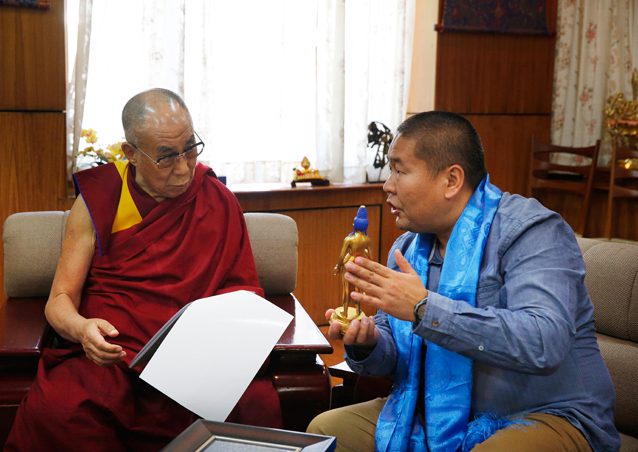
His Holiness the Dalai Lama and M.BATAA, Project Board of Trustee member and former Tibetan Buddhist monk
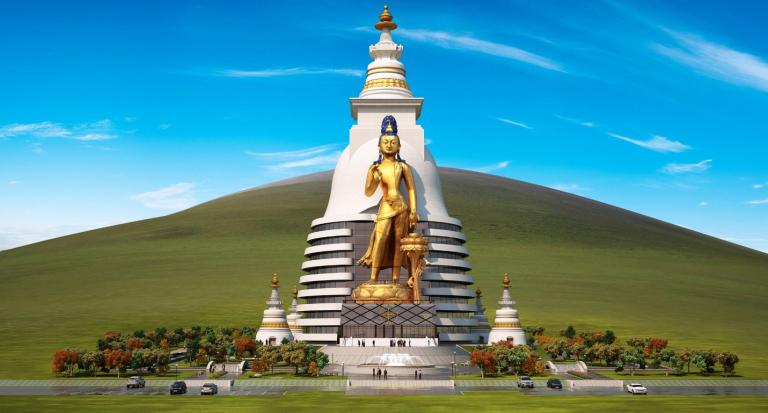
At the heart of the Mongolian people’s spiritual re-connection and under the spiritual guidance of HH Dalai Lama is the Grand Maitreya Project. The Project aims to help further Mongolia’s cultural revival by building the world’s largest beacon of Loving – Kindness. At the projects center will be a 177 foot tall statue of the standing Maitreya Bodhisattva. Maitreya is the Buddha, or Bodhisattva of Loving – Kindness. Connected to the statue will be a Kadampa stupa designed in the likeness of Lama Atisha’s own personal stupa. The stupa will house several interior teaching and meditation levels along with holy relics and other artifacts of the historical Buddha.
According to a text by Kaching Yeshe Gyaltsen, one of the tutors to the 8th Dalai Lama, by building Maitreya Buddha statues now, we can shorten the period of darkness and suffering in the world.
Building large statues of Maitreya was an ancient spiritual tradition for many of the high Mongolian and Tibetan Buddhist lamas of the past. Many of the Lamas teach that the larger and more beautiful the statue of love is, the more people will learn about it, come into contact and benefit from this. The historical Buddha explained that when one sees an image of love and peace it makes one think of peace. At that time a positive seed is planted. The Project’s intention is that the size and beauty of this Grand Maitreya statue will bring this sacred symbol of Loving-Kindness back to the beautiful people of Mongolia and at the same time to the attention of many people throughout the entire planet. Helping to create the needed conditions for peace on Earth.
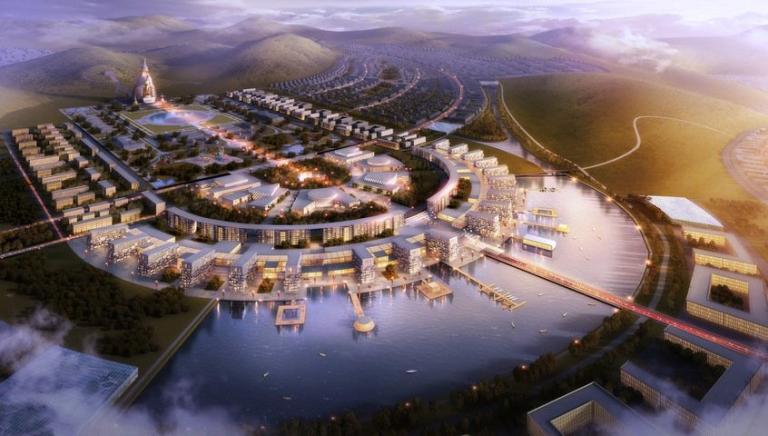
The statue site is located in a place Mongolian people affectionately call Heart Hill, just outside of the Mongolian capital city of Ulaanbaatar. The statue site will be home to a new holy place for the Dalai Lama and will serve as an educational, spiritual and cultural center for the world. The statue site will also feature non-sectarian & international Buddhist centers representing many different lineages and traditions from around the world. Making the Project a unique place for all spiritual traditions to come together in peace.
The Project is a non-profit, non-government organization with offices in Mongolia and Santa Fe, New Mexico. The Project is being conducted under a spiritual advisory board led by the Dalai Lama, leader of Mongolian Buddhism HE Khamba Lama Gyabje Choijamts Demberel, Lama Jhado Rinpoche and Venerable Thupten Ngodup State Oracle of Tibet. Board of Trustee advisers include Professor Robert Thurman of NY City.
Elbegdorj Tsakhiagiin, the President of Mongolia, declared on February 8th, 2013 that he considered the project to be part of the nation’s re-development. He considered creating the highest statue of Maitreya Buddha along with a Stupa of Buddha’s speech and bliss, an important step. He spoke of the value and significance of the project for the re-balancing of the entire country and for the world.
Once the statue and stupa are complete, the project will then work to help create a culture of Loving-Kindness for the world. One of the goals of the project is to offer free meditation training and many other educational services for people of all faiths and backgrounds.
“I am pleased and happy to know that the main part of the Grand Maitreya Project will be dedicated for supporting education.” ~ HH Dalai Lama
 The Project is currently conducting a Fundly campaign to complete the statue construction, with Maitreya Bodhisattva statues and other special gifts for contributors. To find out more and support the Grand Maitreya Project visit: https://fundly.com/grand-maitreya-project-west
Previous Post

March 21, 2016
Tibetans for Trump and other unintended consequences

Browse Our Archives
Select a Category Academia Activism American Buddhism Art Book review Buddhism Buddhism Today Buddhist Ethics Burma/Myanmar China Christianity Commodification Environment Gender Happiness Health Humor India Interfaith Islam Japanese Buddhism Kant Media / News Meditation mindfulness Photography Poetry Politics quicktakes Running Teaching Technology Thailand Theism/Atheism Theravada Tibet Tibetan Buddhism Travels Uncategorized Unitarian Universalism video Western Philosophy Zen
Select a Month June 2021 January 2021 November 2020 August 2020 July 2020 March 2020 January 2020 October 2019 August 2019 June 2019 May 2019 March 2019 February 2019 January 2019 December 2018 November 2018 October 2018 September 2018 August 2018 July 2018 June 2018 May 2018 April 2018 March 2018 February 2018 January 2018 December 2017 November 2017 October 2017 September 2017 August 2017 July 2017 June 2017 May 2017 April 2017 March 2017 February 2017 January 2017 December 2016 November 2016 October 2016 September 2016 August 2016 July 2016 June 2016 May 2016 April 2016 March 2016 February 2016 January 2016 December 2015 November 2015 October 2015 September 2015 August 2015 July 2015 June 2015 May 2015 April 2015 March 2015 February 2015 January 2015 December 2014 November 2014 October 2014 September 2014 August 2014 July 2014 June 2014 May 2014 April 2014 March 2014 February 2014 January 2014 December 2013 November 2013 October 2013 September 2013 August 2013 July 2013 June 2013 May 2013 April 2013 March 2013 February 2013 January 2013 December 2012 November 2012 October 2012 September 2012 August 2012 July 2012 June 2012 May 2012 April 2012 March 2012 February 2012 January 2012 December 2011 November 2011 October 2011 September 2011 August 2011 July 2011 June 2011 May 2011 April 2011 March 2011 February 2011 January 2011 December 2010 November 2010 October 2010 September 2010 August 2010 July 2010 June 2010 May 2010 April 2010 March 2010 February 2010 January 2010 December 2009 November 2009 October 2009 September 2009 August 2009 July 2009 June 2009 May 2009 April 2009 March 2009 February 2009 January 2009 December 2008 November 2008 October 2008 September 2008 August 2008 July 2008 June 2008 May 2008 April 2008 March 2008 September 2007 August 2007 July 2007 June 2007 May 2007 April 2007 March 2007 February 2007 January 2007 December 2006 November 2006 October 2006 September 2006 August 2006 July 2006 June 2006 May 2006 April 2006 March 2006 February 2006 January 2006 December 2005 November 2005 October 2005 September 2005 November 2004 September 2004 August 2004
Follow Us!
TAKE THE
Religious Wisdom Quiz
What was the primary construction in Biblical times?
Select your answer to see how you score.
Wooden mallet Stone hammer Iron hammer Bronze chisel
Support this
Column


Related posts from American Buddhist Perspectives

For Pride Month: Our 2015 Interview with La...
American Buddhist Perspectives

In strife and uncertainty: let us remember loving-kindness
American Buddhist Perspectives

A Festival of Radical Awakening: Socially Engaged Buddhism...
American Buddhist Perspectives

The Coronavirus is coming - Some thoughts from...
American Buddhist Perspectives
TRENDING AT PATHEOS Buddhist

On Taking Refuge in the Dharma
(Here I continue the feature of sharing talks and essays by teachers...

(Continuing my intention to share talks and essays by other members of Empty...
The Subtle Art of Bowing: A Dharma Discourse
(This presentation was first offered by my dear friend Dharma Holder Tom...

Internal Family Systems Can Heal you Mentally &...
How IFS Helped Me Stop Fighting Myself Internal Family Systems (IFS) is...

The Bible No One Spoke About: A Family’s...
A mysterious family Bible, unspoken faith, and a journey from curiosity to...

How Uncertainty Can Transform Your Life in 2025
Embracing Uncertainty: A New Year’s Resolution for the Brave As 2025 approaches,...
view all Buddhist blogs
Ad-Free & Subscriber Log-In Subscription Support
- About Us
- 2026 Calendar
- Videos
- Podcasts
- Library of World Religions
- Faith In Media Tracker
- Advertise With Us
- Write for Us
- Privacy Policy
- Terms of Service
- Do Not Sell My Data
- Contact Us
- Radiant Digital
- Manage Newsletter Subscriptions
- Unsubscribe From Notifications
- Sitemap
Copyright 2008-2026, Patheos. All rights reserved.
Subscription Support Ad-Free & Subscriber Log-In
Follow Patheos