
BuddhistCatholicContemplativeEvangelicalGeneral ChristianHinduJewishLatter-day SaintMuslimNew VisionsProgressive Christian
Beliefs
- Buddhist
- Catholic
- Contemplative
- Evangelical
- General Christian
- Hindu
- Jewish
- Latter-day Saint
- More Voices
- Muslim
- New Visions
- Pagan
- Progressive Christian
Topics
- Religion News
- Food and Religion
- Sports and Religion
- Religious Art
- Religious Music and Entertainment
- Religious Events
- History and Religion
- Style and Religion
- Politics and Religion
- Women in Religion
- Recreation Outdoors and Religion
- Business Finance and Religion
- Careers Workplace and Religion
- Education and Religion
- Family Parenting and Religion
- Health Fitness and Religion
- Home and Religion
- Relationships and Religion
- Technology and Religion
- Travel and Religion
Columnists
- Buddhist Columnists
- Business Finance and Religion Columnists
- Careers Workplace and Religion Columnists
- Catholic Columnists
- Contemplative Columnists
- Education and Religion Columnists
- Evangelists Columnists
- Family Parenting and Religion Columnists
- General Christian Columnists
- Health Fitness and Religion Columnists
- Hindu Columnists
- History and Religion Columnists
- Home and Religion Columnists
- Jewish Columnists
- More Voices Columnists
- Latter Day Columnists
- Muslim Columnists
- New Visions Columnists
- Nonreligious Columnists
- Pagan Columnists
- Politics and Religion Columnists
- Progressive Columnists
- Recreation Outdoors and Religion Columnists
- Relationships and Religion Columnists
- Religion News Columnists
- Religious Art Columnists
- Religious Events Columnists
- Religious Music and Entertainment Columnists
- Sports and Religion Columnists
- Style and Religion Columnists
- Technology and Religion Columnists
- Travel and Religion Columnists
- Women in Religion Columnists
Resource Library
- 2026 Calendar
- Library of World Religions
- The 100 Most Holy Places on Earth
- Patheos Answers
- Podcasts
- Videos
- Faith Leaders Database
- Anglican Episcopalian
- Bahai
- Baptist
- Buddhism
- Christianity
- Confucianism
- Eastern Orthodoxy
- Hinduism
- Holiness and Pentecostal
- ISKCON
- Islam
- Judaism
- Lutheran
- Methodist
- The Church of Jesus Christ of Latter-day Saints
- New Age
- Paganism
- Presbytarian and Reformed
- Protestantism
- Religion Behind the Scenes
- Roman Catholic
- Scientology
- Shia Islam
- Sikhism
- Sufism
- Sunni Islam
- Taoism
- Zen
- See all religions
Research Tools
 Ad-Free & Subscriber Log-In Subscription Support
Ad-Free & Subscriber Log-In Subscription Support
Follow Patheos 

- Trending:
- Forgiveness
- |
- Marriage
- |
- Consciousness
- |
- Death Penalty
- |
- Election
- |
- Halloween
 American Buddhist Perspectives
- Home
- Buddhist
- Religion News
- Buddhist political leanings in the American Presidential Race 2016 (Continued)
Buddhist political leanings in the American Presidential Race 2016 (Continued)
Last updated on: March 2, 2016 at 12:36 pm by Justin Whitaker
Buddhist political leanings in the American Presidential Race 2016 (Continued) 2016-03-02T12:36:23-07:00 Justin Whitaker
Patheos Explore the world's faith through different perspectives on religion and spirituality! Patheos has the views of the prevalent religions and spiritualities of the world.
Yesterday we looked at a basic breakdown of the 350+ responses to a poll of Buddhists on the 2016 US Presidential Race. Today we’ll look at some of the breakdowns coming from deeper analysis. As mentioned, due to a change in platforms, I could only export and analyse data from the final 269 submissions made on the Google Form. Those make up the basis for the analysis below.
The first of these is race/ethnicity, based on self-identification.
Is race a significant factor for Buddhists in the upcoming election? For an excellent background on the topic, we can turn to a short article by Jeff Wilson from 2008. There he notes that the major Buddhist magazines overwhelmingly lean left, noting their largely white convert editorial staff and authorship. Meanwhile:
Here in North America, there are large numbers of registered Republican Buddhists. Many of them are Asian-Americans, immigrants or the descendants of immigrants who fled left-wing violence in their native countries. One can only believe that Buddhists are naturally aligned with liberalism if no time has been spent among Vietnamese, Cambodian, Thai, Chinese, or other Asian-Americans. Anti-Communism drives many such Buddhists into the Republican Party, as does similar views on traditional values, economic policy, patriotism, and other issues.
One of the greatest disconnects with the Democrats is over abortion, which the Democratic Party supports and the Republican Party opposes. The belief that life begins at conception is nearly universal across Buddhist Asia, and the overwhelming majority of Buddhist monks, nuns, and priests believe abortion to be a violation of the first precept. This has led many Buddhist leaders in Asian-American communities to endorse Republican candidates. At the same time, we have to be careful about stereotyping Asian-American Buddhism, a diverse phenomenon that also includes many Democrats and other liberals.
Wilson cites a then-recent Pew Forum survey on the U.S. Religious Landscape which showed that 18% of Buddhists were Republican and 44% considered themselves to be moderates or conservatives. While that poll, like the one conducted here, over-represented white Buddhists, it did show that many political voices on the right exist in Buddhism even if major media outlets and popular blogs representing them cannot be found.
Race/Ethnicity
In designing the survey, no accepted set of race/ethnicity options existed in the SurveyMonkey database. The only question they had “certified” was one that left the question open to the user to fill in.
This allowed for obvious inclusivity, but posed the new challenge of grouping similar responses. For instance it makes little sense to see who “Caucasians” support vs people who described their race/ethnicity as “White” or “European.” In a small survey such as this, it also made little sense to contrast those with the one or two people who gave country-specific answers such as “Irish/German” or “Dutch”. So for reporting purposes, all of these have been put under the category of “White.”
Similarly, we reduced, as well as we could, various Asian individuals into that single category (while recognizing Wilson’s caution above). There were also two Black respondents, five Latino, seven Mixed, and two Native American, along with dozens who left the question blank or entered “human”. As we will see, the poll’s respondents are overwhelmingly white, which does not represent the American Buddhist population as a whole, which is by most estimates between 75 and 80 percent Asian American (see Prebish, Looking West: A Primer for American Buddhism, 2011).
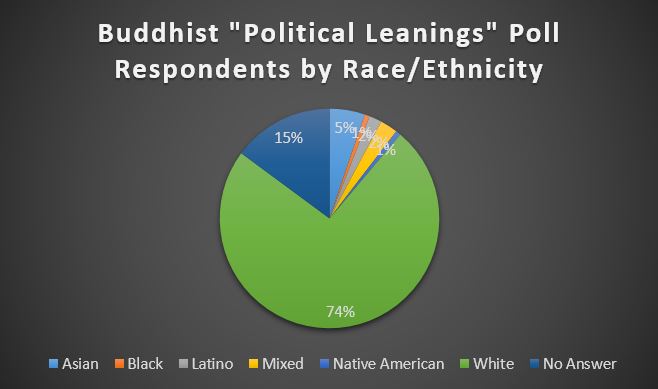
So the results might be more accurately reported as (Mostly White) Buddhist political leanings in the American Presidential Race 2016. I plan to run near-identical polls each month with the hope that friends/readers can assist in reaching out to non-white Buddhists for a fuller and more accurate report.
But now, for the numbers.
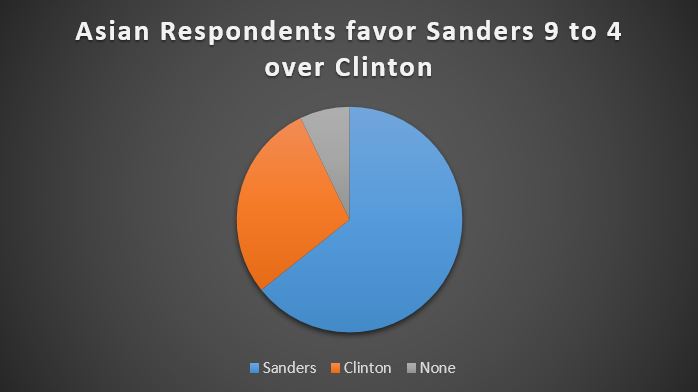
Of the Asian group (14 total),
- 4 selected Hillary Clinton, (28.6%)
- 9 chose Bernie Sanders, (64.3%)
- and one chose none.
From our two Black respondents: both selected Bernie Sanders.
From the five Latino respondents: 4 selected Bernie Sanders; one wrote in Jill Stein.
From the seven Mixed race/ethnicity respondents: 5 selected Hillary Clinton, 2 selected Bernie Sanders.
From the Native American respondents: one chose Donald Trump, the other selected Bernie Sanders.
And lastly, from the White respondents:
- 2 wrote in Anarchist/Radical
- 2 chose Ben Carson
- 127 selected Bernie Sanders (63.8%)
- 4 selected Donald Trump
- 48 selected Hillary Clinton (24%)
- 3 selected Jill Stein
- 1 selected John Kasich
- 6 chose Marco Rubio
- 2 were for Ted Cruz
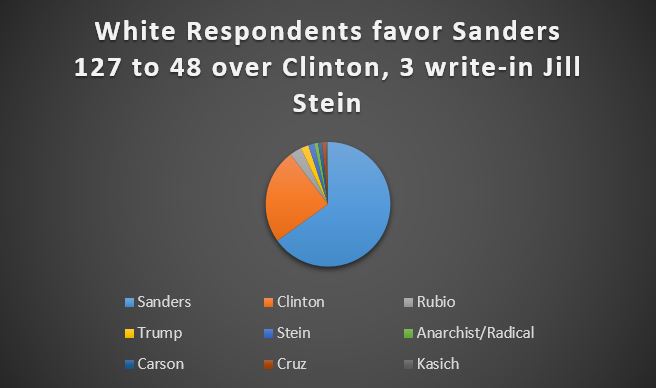
While the sample of Asian respondents is obviously too small (I can’t fathom what the margin of error would be – statisticians?), for now it seems that race plays little roll in the general strong support of Bernie Sanders and Hillary Clinton over other candidates. Likewise, Sanders is the strong favorite for both Asian (64% to Clinton’s 28%) and White (64% to Clinton’s 24%) respondents.
As always, comments/feedback are welcome. Also see further breakdowns in the polling data by age & gender here.
Stay in touch with American Buddhist Perspectives on Facebook:
American Buddhist Perspectives
Become a supporter of American Buddhist Perspectives
“Society is welded in unity with care and concern for one another when generosity is exercised with a warm sense of personal involvement.” – Bhikkhu Bodhi
Given the many hours spent working on American Buddhist Perspectives each month, it can only be described as a labor of love and act of service in co-exploring the Buddhist world with readers. If you find benefit in reading and discussing topics here, please consider donating, which will allow me to continue to comment on news, share overlooked stories, and dig into Buddhist thought with all of you regularly in months and years to come.
No monthly donations, just give when you can and feel like it.
ONE-TIME DONATION (feel free to enter any amount)
♥ $3 (About 5 days worth of coffee!)
♥ $7 (a couple cups of that fancy stuff!)
Thank you!
Previous Post
February 29, 2016
Buddhist political leanings in the American Presidential Race 2016
Browse Our Archives
Select a Category Academia Activism American Buddhism Art Book review Buddhism Buddhism Today Buddhist Ethics Burma/Myanmar China Christianity Commodification Environment Gender Happiness Health Humor India Interfaith Islam Japanese Buddhism Kant Media / News Meditation mindfulness Photography Poetry Politics quicktakes Running Teaching Technology Thailand Theism/Atheism Theravada Tibet Tibetan Buddhism Travels Uncategorized Unitarian Universalism video Western Philosophy Zen
Select a Month June 2021 January 2021 November 2020 August 2020 July 2020 March 2020 January 2020 October 2019 August 2019 June 2019 May 2019 March 2019 February 2019 January 2019 December 2018 November 2018 October 2018 September 2018 August 2018 July 2018 June 2018 May 2018 April 2018 March 2018 February 2018 January 2018 December 2017 November 2017 October 2017 September 2017 August 2017 July 2017 June 2017 May 2017 April 2017 March 2017 February 2017 January 2017 December 2016 November 2016 October 2016 September 2016 August 2016 July 2016 June 2016 May 2016 April 2016 March 2016 February 2016 January 2016 December 2015 November 2015 October 2015 September 2015 August 2015 July 2015 June 2015 May 2015 April 2015 March 2015 February 2015 January 2015 December 2014 November 2014 October 2014 September 2014 August 2014 July 2014 June 2014 May 2014 April 2014 March 2014 February 2014 January 2014 December 2013 November 2013 October 2013 September 2013 August 2013 July 2013 June 2013 May 2013 April 2013 March 2013 February 2013 January 2013 December 2012 November 2012 October 2012 September 2012 August 2012 July 2012 June 2012 May 2012 April 2012 March 2012 February 2012 January 2012 December 2011 November 2011 October 2011 September 2011 August 2011 July 2011 June 2011 May 2011 April 2011 March 2011 February 2011 January 2011 December 2010 November 2010 October 2010 September 2010 August 2010 July 2010 June 2010 May 2010 April 2010 March 2010 February 2010 January 2010 December 2009 November 2009 October 2009 September 2009 August 2009 July 2009 June 2009 May 2009 April 2009 March 2009 February 2009 January 2009 December 2008 November 2008 October 2008 September 2008 August 2008 July 2008 June 2008 May 2008 April 2008 March 2008 September 2007 August 2007 July 2007 June 2007 May 2007 April 2007 March 2007 February 2007 January 2007 December 2006 November 2006 October 2006 September 2006 August 2006 July 2006 June 2006 May 2006 April 2006 March 2006 February 2006 January 2006 December 2005 November 2005 October 2005 September 2005 November 2004 September 2004 August 2004
Follow Us!
TAKE THE
Religious Wisdom Quiz
What is the Jewish "coming of age" ceremony?
Select your answer to see how you score.
Passover Sabbath Bar Mitzvah Circumcision
Support this
Column


Related posts from American Buddhist Perspectives

For Pride Month: Our 2015 Interview with La...
American Buddhist Perspectives

Standing up to Lies: Can America Emerge from...
American Buddhist Perspectives

Progressive responses to the 2020 election of Biden...
American Buddhist Perspectives

In strife and uncertainty: let us remember loving-kindness
American Buddhist Perspectives
TRENDING AT PATHEOS Buddhist

On Taking Refuge in the Dharma
(Here I continue the feature of sharing talks and essays by teachers...

(Continuing my intention to share talks and essays by other members of Empty...
The Subtle Art of Bowing: A Dharma Discourse
(This presentation was first offered by my dear friend Dharma Holder Tom...

Internal Family Systems Can Heal you Mentally &...
How IFS Helped Me Stop Fighting Myself Internal Family Systems (IFS) is...

The Bible No One Spoke About: A Family’s...
A mysterious family Bible, unspoken faith, and a journey from curiosity to...

How Uncertainty Can Transform Your Life in 2025
Embracing Uncertainty: A New Year’s Resolution for the Brave As 2025 approaches,...
view all Buddhist blogs
Ad-Free & Subscriber Log-In Subscription Support
- About Us
- 2026 Calendar
- Videos
- Podcasts
- Library of World Religions
- Faith In Media Tracker
- Advertise With Us
- Write for Us
- Privacy Policy
- Terms of Service
- Do Not Sell My Data
- Contact Us
- Radiant Digital
- Manage Newsletter Subscriptions
- Unsubscribe From Notifications
- Sitemap
Copyright 2008-2026, Patheos. All rights reserved.
Subscription Support Ad-Free & Subscriber Log-In
Follow Patheos