
BuddhistCatholicContemplativeEvangelicalGeneral ChristianHinduJewishLatter-day SaintMuslimNew VisionsProgressive Christian
Beliefs
- Buddhist
- Catholic
- Contemplative
- Evangelical
- General Christian
- Hindu
- Jewish
- Latter-day Saint
- More Voices
- Muslim
- New Visions
- Pagan
- Progressive Christian
Topics
- Religion News
- Food and Religion
- Sports and Religion
- Religious Art
- Religious Music and Entertainment
- Religious Events
- History and Religion
- Style and Religion
- Politics and Religion
- Women in Religion
- Recreation Outdoors and Religion
- Business Finance and Religion
- Careers Workplace and Religion
- Education and Religion
- Family Parenting and Religion
- Health Fitness and Religion
- Home and Religion
- Relationships and Religion
- Technology and Religion
- Travel and Religion
Columnists
- Buddhist Columnists
- Business Finance and Religion Columnists
- Careers Workplace and Religion Columnists
- Catholic Columnists
- Contemplative Columnists
- Education and Religion Columnists
- Evangelists Columnists
- Family Parenting and Religion Columnists
- General Christian Columnists
- Health Fitness and Religion Columnists
- Hindu Columnists
- History and Religion Columnists
- Home and Religion Columnists
- Jewish Columnists
- More Voices Columnists
- Latter Day Columnists
- Muslim Columnists
- New Visions Columnists
- Nonreligious Columnists
- Pagan Columnists
- Politics and Religion Columnists
- Progressive Columnists
- Recreation Outdoors and Religion Columnists
- Relationships and Religion Columnists
- Religion News Columnists
- Religious Art Columnists
- Religious Events Columnists
- Religious Music and Entertainment Columnists
- Sports and Religion Columnists
- Style and Religion Columnists
- Technology and Religion Columnists
- Travel and Religion Columnists
- Women in Religion Columnists
Resource Library
- 2026 Calendar
- Library of World Religions
- The 100 Most Holy Places on Earth
- Patheos Answers
- Podcasts
- Videos
- Faith Leaders Database
- Anglican Episcopalian
- Bahai
- Baptist
- Buddhism
- Christianity
- Confucianism
- Eastern Orthodoxy
- Hinduism
- Holiness and Pentecostal
- ISKCON
- Islam
- Judaism
- Lutheran
- Methodist
- The Church of Jesus Christ of Latter-day Saints
- New Age
- Paganism
- Presbytarian and Reformed
- Protestantism
- Religion Behind the Scenes
- Roman Catholic
- Scientology
- Shia Islam
- Sikhism
- Sufism
- Sunni Islam
- Taoism
- Zen
- See all religions
Research Tools
 Ad-Free & Subscriber Log-In Subscription Support
Follow Patheos 

- Trending:
- Advent
- |
- Forgiveness
- |
- Thanksgiving
- |
- Election
- |
- Seasonal Holidays
- |
- Marriage
 American Buddhist Perspectives
- Home
- Buddhist
- Religion News
- Buddhism and Health: Illuminating the Spectrum of Therapies
Buddhism and Health: Illuminating the Spectrum of Therapies
Last updated on: March 15, 2016 at 3:23 pm by Justin Whitaker
Buddhism and Health: Illuminating the Spectrum of Therapies 2016-03-15T15:23:32-06:00 Justin Whitaker
Patheos Explore the world's faith through different perspectives on religion and spirituality! Patheos has the views of the prevalent religions and spiritualities of the world.
A guest post by Pierce Salguero
About two months ago, we began to notice a new presence on the streets of Philadelphia’s Chinatown. A cadre of volunteers in red and gold jackets was hitting the pavement, handing out fliers in English and Chinese to announce the arrival of a new organization called Guan Yin Citta Dharma Door. Their glossy color fliers announce a “practical Buddhist approach to alleviating suffering and making life better.” Through the “effective and systematic” practices of sutra recitation, releasing “beings destined for slaughter,” and making “great vows to help more people,” the flier promises that one can “lay a solid foundation for improved physical and mental well-being.”
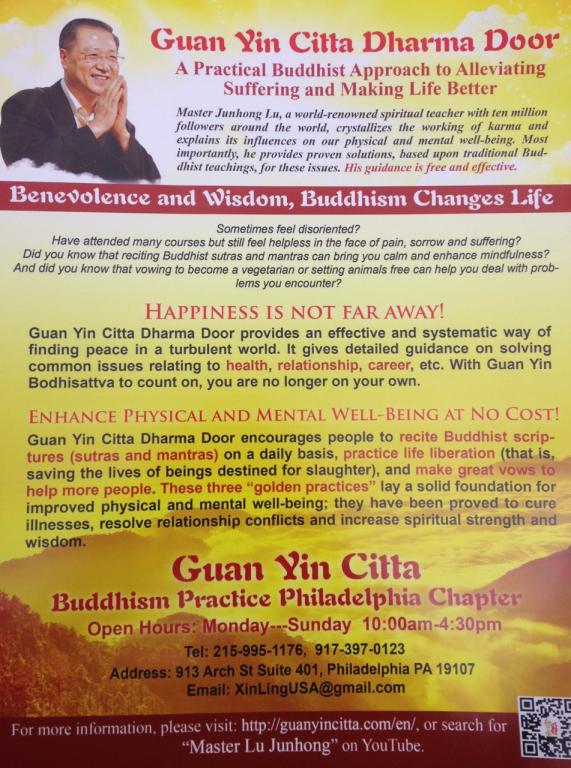
Guan Yin Citta caught my attention immediately. As a long-time scholar of Buddhist healing practices in Asia, I have recently turned my attention to the contemporary US, launching an ethnographic survey of the Buddhist healing landscape in the Greater Philadelphia area. Called “Beyond Mindfulness: Varieties of Buddhist Healing in Multiethnic Philadelphia,” this project catalogues the diverse approaches among a range of Buddhist organizations in one American city, as a microcosm of the contemporary global ecosystem of Buddhist healing.
The “Beyond Mindfulness” project has involved the participation of a multilingual team of undergraduate student researchers over the span of several years. In the first year, we identified about 40 organizations, evenly split between those that are largely Caucasian and those that are largely attended by Asian immigrants. We also developed a survey tool (http://goo.gl/forms/7bZcDZGzGR) to gauge ideas and practices regarding the connections between Buddhism and health. Over the course of the second year, three students and myself visited the targeted locations and conducted preliminary interviews with monastics, teachers, and/or community representatives at each. We were assisted in many cases by student liaisons who were themselves members of the cultural-linguistic group we were visiting, and who were able to facilitate cultural awareness and offer some basic translation assistance when necessary. Wherever possible, we also distributed the survey among community participants. Next year, the project will enter the third phase: more in-depth interviews at selected locations, extensive audio-video recording, and the production of a short documentary film on Buddhist responses to illness in the Philadelphia area.
So, we were excited when Guan Yin Citta burst onto the scene. The other day, a student and I visited the headquarters at 913 Arch Street, in the heart of Chinatown. While still outside the building, we were showered with bilingual DVDs, glossy booklets, newspapers, swag bags, and other paraphernalia (all free, raising the still unanswered question of how the well-funded operation is being financed). A handful of volunteers invited us upstairs to a shrine room, where a modest Guanyin altar and a few seats were provided. Our hosts (who happened to be mainland Chinese and Southeast-Asian-Chinese) excitedly told us about their devotion to the leader of their movement, Master Lu Junhong, who has earned a certain amount of international celebrity for his ability to channel the bodhisattva Guanyin. Master Lu has a visible presence on YouTube, social media groups, and web pages, but the current goal in Philadelphia is to create a community of local devotees that is large enough that Master Lu will make an personal appearance in the city. The closest he has come so far, we are told, is New York.
Although with Guanyin’s help he can see invisible spirits, know about previous lives, and locate missing objects, Master Lu’s specialty is diagnosing illnesses. Once the cause of the illness is revealed, he prescribes a remedy consisting of a certain number of yellow tallies (literally titled “gifts” 贈). Each tally requires devotees to complete a total of 247 repetitions of the Great Compassion Dharani 大悲咒, the Heart Sutra 心經, the Rebirth Dharani 往生咒, and the Seven Buddhas Mantra for the Eradication of Sins 七佛滅罪真言. Each tally—which we are told takes about 4 hours to complete once one is proficient—is worth 30,000 credits in hell, and can be used to liberate beings stuck in unfortunate rebirths or to appease demonic entities. However, one must constantly be on guard: completed tallies must be kept in a red envelope and away from windows, so as to prevent demons, ghosts, and other nefarious spiritual beings from stealing their power for their own benefit.
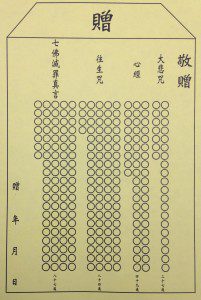
According to our hosts, there is seemingly nothing that cannot be cured or remedied with enough completed tallies. They mention a series of ailments they or their friends have suffered, ranging from inconvenient to life-threatening, and cite the precise number of tallies that was required to cure each one (these figures ranged from 21 to over 100). We spend over an hour listening to a whole string of stories of miraculous healing, changed fortunes, and lucky breaks. Before we finally have to depart, we are encouraged to drink a glass of the blessed water that sits in several large dispensers, charged with the beneficial powers of the many people who have stopped by the shrine room to chant and pray.
For scholars of Chinese Buddhism and of Chinese religions more generally, none of the above is particularly surprising. The charismatic male leader with a cadre of proselytizing devotees, the explicit focus on health benefits, the conceptualization of magical power as a type of currency, the unseen host of ghosts and deities that can harm and help ordinary humans, the possibilities for miraculous transformations latent in everyday life — all of this is the ordinary fare of Chinese popular religions of all stripes. I was excited to find this organization, not because of how different or unique they are, but because of how they are bringing such typically Chinese ideas and practices into the public eye on the streets of downtown Philadelphia in such a visible, high-profile, and bilingual way.
Guan Yin Citta is but one datapoint in our “Beyond Mindfulness” project, one of the many organizations in the area where our ethnographic work has revealed a close connection between Buddhism and healthcare. Though contemporary mainstream America is fascinated with the health benefits of meditation, this focus has tended to overshadow our appreciation of the sheer diversity of ways that Buddhism impacts the healthcare landscape in the US. Our study explicitly intends to draw more attention to the non-white and non-English-speaking voices that are often overlooked as this conversation unfolds in popular media. Guanyin’s miraculous interventions in the lives of the Philadelphia Chinese community matter not only because of the profound impact these have had on certain individuals, but also because they illuminate the rich spectrum of therapeutic repertoires that Buddhism continues to make available in America today—beyond the headlines and social media buzzwords associated with mindfulness.
If you’d like to contribute to our research project, please consider spending 10-15 minutes filling out this online questionnaire about how you understand the relationship between Buddhism and health: http://goo.gl/forms/7bZcDZGzGR. This version of the survey is open to people from any location in the world, of any religious or spiritual background, and I’m grateful for the information you choose to share!
——
Pierce Salguero is an interdisciplinary humanities scholar interested in the role of Buddhism in the crosscultural exchange of medical ideas. He has a PhD in the History of Medicine from Johns Hopkins School of Medicine, and is Assistant Professor of Asian History and Religious Studies at Penn State University’s Abington College, in the Philadelphia area. He is the author of Translating Buddhist Medicine in Medieval China (UPenn Press, 2014) and Traditional Thai Medicine (White Lotus Press, 2016). See www.piercesalguero.com.
Previous Post

March 13, 2016
Meditation Olympics - the winner might surprise you
Next Post
March 17, 2016 Buddha Beer?
Browse Our Archives
Select a Category Academia Activism American Buddhism Art Book review Buddhism Buddhism Today Buddhist Ethics Burma/Myanmar China Christianity Commodification Environment Gender Happiness Health Humor India Interfaith Islam Japanese Buddhism Kant Media / News Meditation mindfulness Photography Poetry Politics quicktakes Running Teaching Technology Thailand Theism/Atheism Theravada Tibet Tibetan Buddhism Travels Uncategorized Unitarian Universalism video Western Philosophy Zen
Select a Month June 2021 January 2021 November 2020 August 2020 July 2020 March 2020 January 2020 October 2019 August 2019 June 2019 May 2019 March 2019 February 2019 January 2019 December 2018 November 2018 October 2018 September 2018 August 2018 July 2018 June 2018 May 2018 April 2018 March 2018 February 2018 January 2018 December 2017 November 2017 October 2017 September 2017 August 2017 July 2017 June 2017 May 2017 April 2017 March 2017 February 2017 January 2017 December 2016 November 2016 October 2016 September 2016 August 2016 July 2016 June 2016 May 2016 April 2016 March 2016 February 2016 January 2016 December 2015 November 2015 October 2015 September 2015 August 2015 July 2015 June 2015 May 2015 April 2015 March 2015 February 2015 January 2015 December 2014 November 2014 October 2014 September 2014 August 2014 July 2014 June 2014 May 2014 April 2014 March 2014 February 2014 January 2014 December 2013 November 2013 October 2013 September 2013 August 2013 July 2013 June 2013 May 2013 April 2013 March 2013 February 2013 January 2013 December 2012 November 2012 October 2012 September 2012 August 2012 July 2012 June 2012 May 2012 April 2012 March 2012 February 2012 January 2012 December 2011 November 2011 October 2011 September 2011 August 2011 July 2011 June 2011 May 2011 April 2011 March 2011 February 2011 January 2011 December 2010 November 2010 October 2010 September 2010 August 2010 July 2010 June 2010 May 2010 April 2010 March 2010 February 2010 January 2010 December 2009 November 2009 October 2009 September 2009 August 2009 July 2009 June 2009 May 2009 April 2009 March 2009 February 2009 January 2009 December 2008 November 2008 October 2008 September 2008 August 2008 July 2008 June 2008 May 2008 April 2008 March 2008 September 2007 August 2007 July 2007 June 2007 May 2007 April 2007 March 2007 February 2007 January 2007 December 2006 November 2006 October 2006 September 2006 August 2006 July 2006 June 2006 May 2006 April 2006 March 2006 February 2006 January 2006 December 2005 November 2005 October 2005 September 2005 November 2004 September 2004 August 2004
Follow Us!
TAKE THE
Religious Wisdom Quiz
Who became Moses' spokesperson to Pharaoh?
Select your answer to see how you score.
Hur Joshua Aaron Miriam
Support this
Column


Related posts from American Buddhist Perspectives

For Pride Month: Our 2015 Interview with La...
American Buddhist Perspectives

In strife and uncertainty: let us remember loving-kindness
American Buddhist Perspectives

In the rush to return to normal, can...
American Buddhist Perspectives
A Festival of Radical Awakening: Socially Engaged Buddhism...
American Buddhist Perspectives
TRENDING AT PATHEOS Buddhist
On Taking Refuge in the Dharma
(Here I continue the feature of sharing talks and essays by teachers...
(Continuing my intention to share talks and essays by other members of Empty...
The Subtle Art of Bowing: A Dharma Discourse
(This presentation was first offered by my dear friend Dharma Holder Tom...

Internal Family Systems Can Heal you Mentally &...
How IFS Helped Me Stop Fighting Myself Internal Family Systems (IFS) is...

The Bible No One Spoke About: A Family’s...
A mysterious family Bible, unspoken faith, and a journey from curiosity to...

How Uncertainty Can Transform Your Life in 2025
Embracing Uncertainty: A New Year’s Resolution for the Brave As 2025 approaches,...
view all Buddhist blogs
Ad-Free & Subscriber Log-In Subscription Support
- About Us
- 2026 Calendar
- Videos
- Podcasts
- Library of World Religions
- Faith In Media Tracker
- Advertise With Us
- Write for Us
- Privacy Policy
- Terms of Service
- Do Not Sell My Data
- Contact Us
- Radiant Digital
- Manage Newsletter Subscriptions
- Unsubscribe From Notifications
- Sitemap
Copyright 2008-2026, Patheos, part of the Radiant Digital network of media brands. All rights reserved.
Subscription Support Ad-Free & Subscriber Log-In
Follow Patheos