
BuddhistCatholicContemplativeEvangelicalGeneral ChristianHinduJewishLatter-day SaintMuslimNew VisionsProgressive Christian
Beliefs
- Buddhist
- Catholic
- Contemplative
- Evangelical
- General Christian
- Hindu
- Jewish
- Latter-day Saint
- More Voices
- Muslim
- New Visions
- Pagan
- Progressive Christian
Topics
- Religion News
- Food and Religion
- Sports and Religion
- Religious Art
- Religious Music and Entertainment
- Religious Events
- History and Religion
- Style and Religion
- Politics and Religion
- Women in Religion
- Recreation Outdoors and Religion
- Business Finance and Religion
- Careers Workplace and Religion
- Education and Religion
- Family Parenting and Religion
- Health Fitness and Religion
- Home and Religion
- Relationships and Religion
- Technology and Religion
- Travel and Religion
Columnists
- Buddhist Columnists
- Business Finance and Religion Columnists
- Careers Workplace and Religion Columnists
- Catholic Columnists
- Contemplative Columnists
- Education and Religion Columnists
- Evangelists Columnists
- Family Parenting and Religion Columnists
- General Christian Columnists
- Health Fitness and Religion Columnists
- Hindu Columnists
- History and Religion Columnists
- Home and Religion Columnists
- Jewish Columnists
- More Voices Columnists
- Latter Day Columnists
- Muslim Columnists
- New Visions Columnists
- Nonreligious Columnists
- Pagan Columnists
- Politics and Religion Columnists
- Progressive Columnists
- Recreation Outdoors and Religion Columnists
- Relationships and Religion Columnists
- Religion News Columnists
- Religious Art Columnists
- Religious Events Columnists
- Religious Music and Entertainment Columnists
- Sports and Religion Columnists
- Style and Religion Columnists
- Technology and Religion Columnists
- Travel and Religion Columnists
- Women in Religion Columnists
Resource Library
- 2026 Calendar
- Library of World Religions
- The 100 Most Holy Places on Earth
- Patheos Answers
- Podcasts
- Videos
- Faith Leaders Database
- Anglican Episcopalian
- Bahai
- Baptist
- Buddhism
- Christianity
- Confucianism
- Eastern Orthodoxy
- Hinduism
- Holiness and Pentecostal
- ISKCON
- Islam
- Judaism
- Lutheran
- Methodist
- The Church of Jesus Christ of Latter-day Saints
- New Age
- Paganism
- Presbytarian and Reformed
- Protestantism
- Religion Behind the Scenes
- Roman Catholic
- Scientology
- Shia Islam
- Sikhism
- Sufism
- Sunni Islam
- Taoism
- Zen
- See all religions
Research Tools
 Ad-Free & Subscriber Log-In Subscription Support
Ad-Free & Subscriber Log-In Subscription Support
Follow Patheos 

- Trending:
- Forgiveness
- |
- Marriage
- |
- Consciousness
- |
- Death Penalty
- |
- Election
- |
- Halloween
 American Buddhist Perspectives
- Home
- Buddhist
- Religion News
- Buddhism, Romance, and Love – a Valentine’s Warning
Buddhism, Romance, and Love – a Valentine’s Warning
Last updated on: February 14, 2018 at 1:18 pm by Justin Whitaker
Buddhism, Romance, and Love – a Valentine’s Warning 2018-02-14T13:18:37-07:00 Justin Whitaker
Patheos Explore the world's faith through different perspectives on religion and spirituality! Patheos has the views of the prevalent religions and spiritualities of the world.
Or “Looking for Love (advice) in all the Wrong Places”
I once had the occasion to oversee a study on the topic of “Buddhism and Love.” The question, pondered my student, was “what is the ideal Buddhist romantic relationship?”
At hand we had:
- books written by and for contemporary Westerners about Buddhist practice
- tons of historical material and scholarly works, and
- actual Buddhists from various backgrounds to talk with about the subject.
The contemporary books had plenty of relatively good, if not platitudinous, advice: love yourself before you can love someone else, generate compassion, accept change, recognize our need for community and companionship, etc, etc.
Then we went to the scholarly works and early texts. There we had a problem. The ideal romantic relationship in most of those was: don’t have one. “The householder’s life is dusty and crowded,” warned the Buddha, “make your home at the base of a tree – alone, or with wise friends.”
And so it goes for nearly all of Buddhism’s 2500 years. The big names, saints, bodhisattvas, etc are well over 90% unmarried monastics and well over 90% male.
One could look at one of the jatakas – past life stories of the Buddha, often presented as morality tales – such as the tale of Prince Vessantara, when the bodhisattva (Buddha-to-be) perfected the virtue of generosity by literally giving away his children and then his wife – in the happy ending, the bodhisattva gets his wife and kids back – yay! And part of the story is that abandoning his wife and kids was tremendously difficult; but this only highlights the bodhisattva’s even more tremendous devotion to the goal of awakening. The story of the Buddha’s (final) life is similar: at the age of 29 and after just having a child with his wife, he leaves them both to seek awakening. The upshot again, of course, is that he finds awakening and teaches the path to his son and, eventually, reluctantly, to his former wife.
The appropriately often-cited Sigalovada Sutta, sometimes referred to as the “discourse on lay ethics”, has this to say of husband/wife relations:
“In five ways, young householder, should a wife as the West be ministered to by a husband:
(i) by being courteous to her, (ii) by not despising her, (iii) by being faithful to her, (iv) by handing over authority to her, (v) by providing her with adornments.
“The wife thus ministered to as the West by her husband shows her compassion to her husband in five ways:
(i) she performs her duties well, (ii) she is hospitable to relations and attendants (iii) she is faithful, (iv) she protects what he brings, (v) she is skilled and industrious in discharging her duties.
“In these five ways does the wife show her compassion to her husband who ministers to her as the West. Thus is the West covered by him and made safe and secure.
How romantic. Be courteous. Do not despise. Be faithful. I suppose feminists might find an ounce of good in “handing over authority to her” and yes, finally with #5, something resembling what we today seek in romance: bling.
For her part, romance is reduced to protecting that bling, being faithful and hospitable, and not one but two items relating to “her duties”. Perhaps one of these was said with a wink and a nod? (Note: from a scholarly perspective, that’s not out of the question, as Richard Gombrich has argued in What the Buddha Thought that in at least one sutta the text refers to something in the physical presence of the Buddha to which he gestures; however this is lost in redaction by those concerned simply with getting the words right.)
Even in one of the great love stories of early Buddhism, the marriage of King Pasenadi and Queen Mallika, we find much to scowl over. For one thing, Mallika is his “favorite” queen, meaning there are many. And at the time of her death, the king and the Buddha were sitting together and upon hearing the news the king “sat there miserable, sick at heart, his shoulders drooping…” The Buddha’s response was “to explain that all the sorrow the king feels ultimately is for no good” later using “her story to reflect on death and decay.” You can find an outstanding exposition on Mallika and the lives of other Buddhists in Buddhists: Understanding Buddhism Through the Lives of Practitioners (highly recommended!).
In any case, we don’t get much from the texts to help lovelorn Westerners. Later texts, with dakinis and tantric consorts are no better with women magically appearing, helping the man on his spiritual journey, and then disappearing. And do see the great “Bodhisattva’s Way of Life” by Shantideva if you are interested in even stronger words condemning sexual attraction – written by a monk for monks.
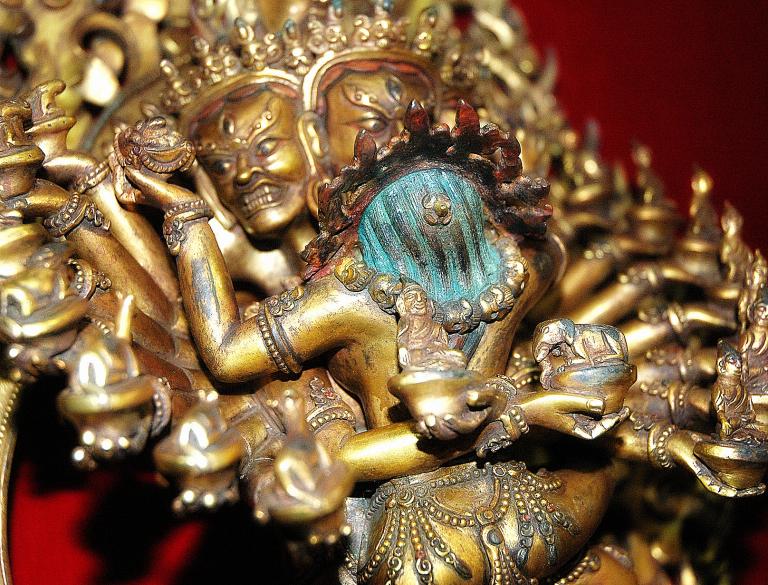
Hevajra and Nairãtmyã Buddhist Tantric deities, closeup top, Boudha, Kathmandu, Nepal (adapted with changes from photo by Flickr user Wonderlane)
Finally, we tried talking to a few of those actual Buddhists. Here we hit new speedbumps. For one thing, these are not things one tends to talk about with strangers. So it takes a little work. But then stories come out like, “Do I love my husband?” Asked of an elderly woman, “I’ve never thought about it like that. I mean, he works fairly hard and doesn’t drink too much. So yea, I guess I love him.”
Based on my studies/experience*, in the vast majority of Asian history, marriage was and is a matter of pragmatic necessity, not personal fulfillment in the way we know it in very recent Western history.
The bad news is that little in Buddhism is aimed explicitly at developing and maintaining good romantic relationships, so we’re left with scraping together otherwise wonderful Buddhist principles like compassion and gratitude and acceptance and letting go and repackaging them for the romantic West. This, some commentators point out, either cheapens Buddhism or simply co-opts its buzz-words for non-Buddhist ends.
The good news is that this might force us to rethink the way we go about looking for “the one”. And we can still find and enjoy love with an understanding of the whole Buddhist picture, which includes seeing the nature of death and decay in your partner and at times – not always, mind you – visualizing him or her as a pile of rotting flesh, guts, blood, and bones.
Now go have a Happy Valentine’s Day.
* If you know of good studies on Asian and/or Buddhist Asian in particular notions of marriage, please let me know. My experience is based largely on my anecdotal evidence living and traveling in six Asian countries and interviewing individuals from about six more. Upon further searching I did find and read “Cultural perspectives on romantic love” by K.K. and K.L. Dion Personal Relationships, 3 (1996); “A Cross-Cultural Perspective on Romantic Love” by W.R. Jankowiak and E.F. Fisher Ethnology, Vol 31, No. 2 (Apr 199) and a few other works, but while these support a clear disparity between Western (Individualistic) cultural notions of love and Asian (Collectivistic) notions, they are hardly sweeping or definitive.
Previous Post

February 11, 2016
Pain and Freedom: A Buddhist's Meditation Journey
Next Post

February 17, 2016 Exploring a new Buddhist America
Browse Our Archives
Select a Category Academia Activism American Buddhism Art Book review Buddhism Buddhism Today Buddhist Ethics Burma/Myanmar China Christianity Commodification Environment Gender Happiness Health Humor India Interfaith Islam Japanese Buddhism Kant Media / News Meditation mindfulness Photography Poetry Politics quicktakes Running Teaching Technology Thailand Theism/Atheism Theravada Tibet Tibetan Buddhism Travels Uncategorized Unitarian Universalism video Western Philosophy Zen
Select a Month June 2021 January 2021 November 2020 August 2020 July 2020 March 2020 January 2020 October 2019 August 2019 June 2019 May 2019 March 2019 February 2019 January 2019 December 2018 November 2018 October 2018 September 2018 August 2018 July 2018 June 2018 May 2018 April 2018 March 2018 February 2018 January 2018 December 2017 November 2017 October 2017 September 2017 August 2017 July 2017 June 2017 May 2017 April 2017 March 2017 February 2017 January 2017 December 2016 November 2016 October 2016 September 2016 August 2016 July 2016 June 2016 May 2016 April 2016 March 2016 February 2016 January 2016 December 2015 November 2015 October 2015 September 2015 August 2015 July 2015 June 2015 May 2015 April 2015 March 2015 February 2015 January 2015 December 2014 November 2014 October 2014 September 2014 August 2014 July 2014 June 2014 May 2014 April 2014 March 2014 February 2014 January 2014 December 2013 November 2013 October 2013 September 2013 August 2013 July 2013 June 2013 May 2013 April 2013 March 2013 February 2013 January 2013 December 2012 November 2012 October 2012 September 2012 August 2012 July 2012 June 2012 May 2012 April 2012 March 2012 February 2012 January 2012 December 2011 November 2011 October 2011 September 2011 August 2011 July 2011 June 2011 May 2011 April 2011 March 2011 February 2011 January 2011 December 2010 November 2010 October 2010 September 2010 August 2010 July 2010 June 2010 May 2010 April 2010 March 2010 February 2010 January 2010 December 2009 November 2009 October 2009 September 2009 August 2009 July 2009 June 2009 May 2009 April 2009 March 2009 February 2009 January 2009 December 2008 November 2008 October 2008 September 2008 August 2008 July 2008 June 2008 May 2008 April 2008 March 2008 September 2007 August 2007 July 2007 June 2007 May 2007 April 2007 March 2007 February 2007 January 2007 December 2006 November 2006 October 2006 September 2006 August 2006 July 2006 June 2006 May 2006 April 2006 March 2006 February 2006 January 2006 December 2005 November 2005 October 2005 September 2005 November 2004 September 2004 August 2004
Follow Us!
TAKE THE
Religious Wisdom Quiz
What is the correct chronological order of Paul's travels mentioned in his letters to the Corinthians?
Select your answer to see how you score.
Asia, Jerusalem, Corinth, Macedonia Corinth, Jerusalem, Macedonia, Asia Jerusalem, Macedonia, Corinth, Asia Macedonia, Corinth, Jerusalem, Asia
Support this
Column


Related posts from American Buddhist Perspectives

For Pride Month: Our 2015 Interview with La...
American Buddhist Perspectives

In strife and uncertainty: let us remember loving-kindness
American Buddhist Perspectives

In the rush to return to normal, can...
American Buddhist Perspectives

A Festival of Radical Awakening: Socially Engaged Buddhism...
American Buddhist Perspectives
TRENDING AT PATHEOS Buddhist

On Taking Refuge in the Dharma
(Here I continue the feature of sharing talks and essays by teachers...

(Continuing my intention to share talks and essays by other members of Empty...
The Subtle Art of Bowing: A Dharma Discourse
(This presentation was first offered by my dear friend Dharma Holder Tom...

Internal Family Systems Can Heal you Mentally &...
How IFS Helped Me Stop Fighting Myself Internal Family Systems (IFS) is...

The Bible No One Spoke About: A Family’s...
A mysterious family Bible, unspoken faith, and a journey from curiosity to...

How Uncertainty Can Transform Your Life in 2025
Embracing Uncertainty: A New Year’s Resolution for the Brave As 2025 approaches,...
view all Buddhist blogs
Ad-Free & Subscriber Log-In Subscription Support
- About Us
- 2026 Calendar
- Videos
- Podcasts
- Library of World Religions
- Faith In Media Tracker
- Advertise With Us
- Write for Us
- Privacy Policy
- Terms of Service
- Do Not Sell My Data
- Contact Us
- Radiant Digital
- Manage Newsletter Subscriptions
- Unsubscribe From Notifications
- Sitemap
Copyright 2008-2026, Patheos. All rights reserved.
Subscription Support Ad-Free & Subscriber Log-In
Follow Patheos