
BuddhistCatholicContemplativeEvangelicalGeneral ChristianHinduJewishLatter-day SaintMuslimNew VisionsProgressive Christian
Beliefs
- Buddhist
- Catholic
- Contemplative
- Evangelical
- General Christian
- Hindu
- Jewish
- Latter-day Saint
- More Voices
- Muslim
- New Visions
- Pagan
- Progressive Christian
Topics
- Religion News
- Food and Religion
- Sports and Religion
- Religious Art
- Religious Music and Entertainment
- Religious Events
- History and Religion
- Style and Religion
- Politics and Religion
- Women in Religion
- Recreation Outdoors and Religion
- Business Finance and Religion
- Careers Workplace and Religion
- Education and Religion
- Family Parenting and Religion
- Health Fitness and Religion
- Home and Religion
- Relationships and Religion
- Technology and Religion
- Travel and Religion
Columnists
- Buddhist Columnists
- Business Finance and Religion Columnists
- Careers Workplace and Religion Columnists
- Catholic Columnists
- Contemplative Columnists
- Education and Religion Columnists
- Evangelists Columnists
- Family Parenting and Religion Columnists
- General Christian Columnists
- Health Fitness and Religion Columnists
- Hindu Columnists
- History and Religion Columnists
- Home and Religion Columnists
- Jewish Columnists
- More Voices Columnists
- Latter Day Columnists
- Muslim Columnists
- New Visions Columnists
- Nonreligious Columnists
- Pagan Columnists
- Politics and Religion Columnists
- Progressive Columnists
- Recreation Outdoors and Religion Columnists
- Relationships and Religion Columnists
- Religion News Columnists
- Religious Art Columnists
- Religious Events Columnists
- Religious Music and Entertainment Columnists
- Sports and Religion Columnists
- Style and Religion Columnists
- Technology and Religion Columnists
- Travel and Religion Columnists
- Women in Religion Columnists
Resource Library
- 2026 Calendar
- Library of World Religions
- The 100 Most Holy Places on Earth
- Patheos Answers
- Podcasts
- Videos
- Faith Leaders Database
- Anglican Episcopalian
- Bahai
- Baptist
- Buddhism
- Christianity
- Confucianism
- Eastern Orthodoxy
- Hinduism
- Holiness and Pentecostal
- ISKCON
- Islam
- Judaism
- Lutheran
- Methodist
- The Church of Jesus Christ of Latter-day Saints
- New Age
- Paganism
- Presbytarian and Reformed
- Protestantism
- Religion Behind the Scenes
- Roman Catholic
- Scientology
- Shia Islam
- Sikhism
- Sufism
- Sunni Islam
- Taoism
- Zen
- See all religions
Research Tools
 Ad-Free & Subscriber Log-In Subscription Support
Ad-Free & Subscriber Log-In Subscription Support
Follow Patheos 

- Trending:
- Forgiveness
- |
- Marriage
- |
- Consciousness
- |
- Death Penalty
- |
- Election
- |
- Halloween
 American Buddhist Perspectives
- Home
- Buddhist
- Religion News
- David Bowie’s ashes to be spread in Bali “in accordance with the Buddhist rituals”
David Bowie’s ashes to be spread in Bali “in accordance with the Buddhist rituals”
Last updated on: January 30, 2016 at 9:34 pm by Justin Whitaker
David Bowie’s ashes to be spread in Bali “in accordance with the Buddhist rituals” 2016-01-30T21:34:50-07:00 Justin Whitaker
Patheos Explore the world's faith through different perspectives on religion and spirituality! Patheos has the views of the prevalent religions and spiritualities of the world.
As discussed here earlier this month, one of the many lives of David Bowie was as a Buddhist practitioner and later a devoted patron of Tibetan culture and the cause of Tibetan independence. As reported then, however, the late singer’s 1960s fascination with Buddhism was unclear – perhaps mirroring many people’s interest in Buddhism at the time – “Despite Bowie’s deep interest in Buddhism, he had no sympathy with the hippy package [that came with it]” wrote Sean O’Hagen of the Guardian in 2013. And quoting Bowie’s own words:
I was young, fancy free, and Tibetan Buddhism appealed to me at that time. I thought, ‘There’s salvation.’ It didn’t really work. Then I went through Nietzsche, Satanism, Christianity… pottery, and ended up singing. It’s been a long road.
However, as the NYTimes reports, David Bowie vacationed with Iggy Pop in Bali in the 1980s and the place apparently stuck with him. As did his appreciation for Buddhism, though not necessarily the Tibetan Buddhism of his youthful visit to Scotland, as his will specifies that his ashes be spread according to the “Buddhist rituals of Bali.”
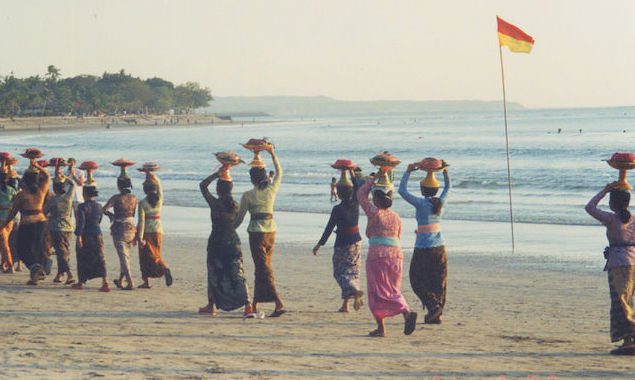
Bali funeral procession (photo via wikimedia commons C.C. mick62)
It’s not clear what exactly those rituals were though, as Bali’s population is overwhelmingly Hindu (83.5%) with just 0.5% of the population following Buddhism. However, Buddhism has a long history in Bali and surrounding areas and Wesak, the day commemorating the Buddha’s birth, awakening, and death, is a national holiday in Indonesia. Given the long history of Buddhism in the area, census numbers alone cannot measure the depth and breadth of the impact of the religion in Bali. As Ven S. Dhammika writes of Buddhism in Bali, “The last census in 1989 showed that there were 13,274 Buddhists in Bali, nearly all of them either ethnic Chinese or people from other parts of Indonesia. … I visited [two temples] and was sad to see that the monks in them did little more than conduct rituals and do blessings for the people who came. I was invited to the homes of several Buddhists and was treated with the greatest respect but it was very clear that my hosts knew little about the Dhamma. They all acknowledged their ignorance and seemed to have a genuine desire to know more but as they all said, there was no one to teach them.”
Today a number of Buddhist centers can be found on Bali:
Present-day Buddhist temples on Bali have been built in large part by Bali’s Chinese residents, the majority of Bali’s 20,000 Buddhists. Just as in Bali Hinduism, they believe that making offerings of canang (flowers) and gebogan (fruit bouquet) will bring them peace and prosperity. An International nondenominational Buddhist organization, The Bali Buddhist Community (BBC), holds morning and evening meditation sessions, hosts occasional Buddhist events and arranges talks on Buddhism by guest teachers and scholars. Their temple Vihara Buddha Dharma on Jl. Sunset Road in Seminyak, built in 2007, is open to Buddhists and anyone else who would like to join the Sunday services or weekly study class.
Vihara Dharmayana Kuta, once known as the Leeng Gwan Kuta Temple, just east of Kuta, was built to honor Tan Hu Cin Jin, a Chinese nobleman and multifaceted architect who served the raja of Mengwi. Monks and religious figures from foreign countries, including His Majesty Dalai Lama in 1982, have visited the monastery. Run by the Buddhist Dharma Semadi Foundation whose Balinese and Buddhist members have formed a banjar (Balinese-style village council), organize social activities together and arrange teaching programs for Hindu students.
Other Buddhist temples on Bali include: Vihara Buddha Guna on Jl. Raya Bualu Ungusan in Nusa Dua; Vihara Buddha Sakyamuni off Jl. Gunung Agung in Kerobokan; Vihãra Dharmagiri in Pupuan in Tabanan; Vihara Seng Heng Bio on Jl. Pulau Flores in Negara. Other Buddhist temples are located in Denpasar and in Singaraja in the north of the island built by the Thai and Indonesian governments in 1971.
A working Buddhist monastery, the Brahma Vihara Arama in Desa Banjar in the Buleleng District of north Bali is the island’s largest Buddhist monastery. Located about 90 kilometers north of Denpasar, this hilltop vihara was founded by a Buddhist monk who was a noted practitioner of the Vipassana breathing technique of meditation.
This storybook monastery, with its gleaming orange roof, gold leaf Buddha images, raksasa demon gate guardians, stupa with Buddha eyes, temple bell from Thailand, a specimen of the Bo tree of enlightenment and exuberant wood carved panels depicting Buddhist fables, is a dazzling and heady mix of Balinese Hindu and Buddhist components.
Plans are already underway for a popular culture and philosophy book discussing the Philosophical Impact of David Bowie.
If you know more about what rituals might have been performed, drop a comment below.


Browse Our Archives
Select a Category Academia Activism American Buddhism Art Book review Buddhism Buddhism Today Buddhist Ethics Burma/Myanmar China Christianity Commodification Environment Gender Happiness Health Humor India Interfaith Islam Japanese Buddhism Kant Media / News Meditation mindfulness Photography Poetry Politics quicktakes Running Teaching Technology Thailand Theism/Atheism Theravada Tibet Tibetan Buddhism Travels Uncategorized Unitarian Universalism video Western Philosophy Zen
Select a Month June 2021 January 2021 November 2020 August 2020 July 2020 March 2020 January 2020 October 2019 August 2019 June 2019 May 2019 March 2019 February 2019 January 2019 December 2018 November 2018 October 2018 September 2018 August 2018 July 2018 June 2018 May 2018 April 2018 March 2018 February 2018 January 2018 December 2017 November 2017 October 2017 September 2017 August 2017 July 2017 June 2017 May 2017 April 2017 March 2017 February 2017 January 2017 December 2016 November 2016 October 2016 September 2016 August 2016 July 2016 June 2016 May 2016 April 2016 March 2016 February 2016 January 2016 December 2015 November 2015 October 2015 September 2015 August 2015 July 2015 June 2015 May 2015 April 2015 March 2015 February 2015 January 2015 December 2014 November 2014 October 2014 September 2014 August 2014 July 2014 June 2014 May 2014 April 2014 March 2014 February 2014 January 2014 December 2013 November 2013 October 2013 September 2013 August 2013 July 2013 June 2013 May 2013 April 2013 March 2013 February 2013 January 2013 December 2012 November 2012 October 2012 September 2012 August 2012 July 2012 June 2012 May 2012 April 2012 March 2012 February 2012 January 2012 December 2011 November 2011 October 2011 September 2011 August 2011 July 2011 June 2011 May 2011 April 2011 March 2011 February 2011 January 2011 December 2010 November 2010 October 2010 September 2010 August 2010 July 2010 June 2010 May 2010 April 2010 March 2010 February 2010 January 2010 December 2009 November 2009 October 2009 September 2009 August 2009 July 2009 June 2009 May 2009 April 2009 March 2009 February 2009 January 2009 December 2008 November 2008 October 2008 September 2008 August 2008 July 2008 June 2008 May 2008 April 2008 March 2008 September 2007 August 2007 July 2007 June 2007 May 2007 April 2007 March 2007 February 2007 January 2007 December 2006 November 2006 October 2006 September 2006 August 2006 July 2006 June 2006 May 2006 April 2006 March 2006 February 2006 January 2006 December 2005 November 2005 October 2005 September 2005 November 2004 September 2004 August 2004
Follow Us!
TAKE THE
Religious Wisdom Quiz
Which prophet bought a field to symbolize hope for Israel's future?
Select your answer to see how you score.
Ezekiel Isaiah Hosea Jeremiah
Support this
Column


Related posts from American Buddhist Perspectives

For Pride Month: Our 2015 Interview with La...
American Buddhist Perspectives

In strife and uncertainty: let us remember loving-kindness
American Buddhist Perspectives

In the rush to return to normal, can...
American Buddhist Perspectives

The Coronavirus is coming - Some thoughts from...
American Buddhist Perspectives
TRENDING AT PATHEOS Buddhist

On Taking Refuge in the Dharma
(Here I continue the feature of sharing talks and essays by teachers...

(Continuing my intention to share talks and essays by other members of Empty...
The Subtle Art of Bowing: A Dharma Discourse
(This presentation was first offered by my dear friend Dharma Holder Tom...

Internal Family Systems Can Heal you Mentally &...
How IFS Helped Me Stop Fighting Myself Internal Family Systems (IFS) is...

The Bible No One Spoke About: A Family’s...
A mysterious family Bible, unspoken faith, and a journey from curiosity to...

How Uncertainty Can Transform Your Life in 2025
Embracing Uncertainty: A New Year’s Resolution for the Brave As 2025 approaches,...
view all Buddhist blogs
Ad-Free & Subscriber Log-In Subscription Support
- About Us
- 2026 Calendar
- Videos
- Podcasts
- Library of World Religions
- Faith In Media Tracker
- Advertise With Us
- Write for Us
- Privacy Policy
- Terms of Service
- Do Not Sell My Data
- Contact Us
- Radiant Digital
- Manage Newsletter Subscriptions
- Unsubscribe From Notifications
- Sitemap
Copyright 2008-2026, Patheos. All rights reserved.
Subscription Support Ad-Free & Subscriber Log-In
Follow Patheos