
BuddhistCatholicContemplativeEvangelicalGeneral ChristianHinduJewishLatter-day SaintMuslimNew VisionsProgressive Christian
Beliefs
- Buddhist
- Catholic
- Contemplative
- Evangelical
- General Christian
- Hindu
- Jewish
- Latter-day Saint
- More Voices
- Muslim
- New Visions
- Pagan
- Progressive Christian
Topics
- Religion News
- Food and Religion
- Sports and Religion
- Religious Art
- Religious Music and Entertainment
- Religious Events
- History and Religion
- Style and Religion
- Politics and Religion
- Women in Religion
- Recreation Outdoors and Religion
- Business Finance and Religion
- Careers Workplace and Religion
- Education and Religion
- Family Parenting and Religion
- Health Fitness and Religion
- Home and Religion
- Relationships and Religion
- Technology and Religion
- Travel and Religion
Columnists
- Buddhist Columnists
- Business Finance and Religion Columnists
- Careers Workplace and Religion Columnists
- Catholic Columnists
- Contemplative Columnists
- Education and Religion Columnists
- Evangelists Columnists
- Family Parenting and Religion Columnists
- General Christian Columnists
- Health Fitness and Religion Columnists
- Hindu Columnists
- History and Religion Columnists
- Home and Religion Columnists
- Jewish Columnists
- More Voices Columnists
- Latter Day Columnists
- Muslim Columnists
- New Visions Columnists
- Nonreligious Columnists
- Pagan Columnists
- Politics and Religion Columnists
- Progressive Columnists
- Recreation Outdoors and Religion Columnists
- Relationships and Religion Columnists
- Religion News Columnists
- Religious Art Columnists
- Religious Events Columnists
- Religious Music and Entertainment Columnists
- Sports and Religion Columnists
- Style and Religion Columnists
- Technology and Religion Columnists
- Travel and Religion Columnists
- Women in Religion Columnists
Resource Library
- 2026 Calendar
- Library of World Religions
- The 100 Most Holy Places on Earth
- Patheos Answers
- Podcasts
- Videos
- Faith Leaders Database
- Anglican Episcopalian
- Bahai
- Baptist
- Buddhism
- Christianity
- Confucianism
- Eastern Orthodoxy
- Hinduism
- Holiness and Pentecostal
- ISKCON
- Islam
- Judaism
- Lutheran
- Methodist
- The Church of Jesus Christ of Latter-day Saints
- New Age
- Paganism
- Presbytarian and Reformed
- Protestantism
- Religion Behind the Scenes
- Roman Catholic
- Scientology
- Shia Islam
- Sikhism
- Sufism
- Sunni Islam
- Taoism
- Zen
- See all religions
Research Tools
 Ad-Free & Subscriber Log-In Subscription Support
Ad-Free & Subscriber Log-In Subscription Support
Follow Patheos 

- Trending:
- Forgiveness
- |
- Marriage
- |
- Consciousness
- |
- Death Penalty
- |
- Election
- |
- Halloween
 American Buddhist Perspectives
- Home
- Buddhist
- Religion News
- Shantideva: Buddhism and the delight of solitude
Shantideva: Buddhism and the delight of solitude
Last updated on: November 11, 2015 at 8:16 am by Justin Whitaker
Shantideva: Buddhism and the delight of solitude 2015-11-11T08:16:17-07:00 Justin Whitaker
Patheos Explore the world's faith through different perspectives on religion and spirituality! Patheos has the views of the prevalent religions and spiritualities of the world.
I’ve just completed teaching the Bodhicaryāvatāra (Guide to the Bodhisattva’s Way of Life) for the third time in my academic life, which probably makes this the 6th or 7th time I’ve been through the text. Some of it is finally, maybe, starting to sink in.
Vesna and Alan Wallace, whose translation I borrow from below, tell us that it, “has been the most widely read, cited, and practiced text in the whole of the Indo-Tibetan Buddhist tradition” and that it is widely cited in the works of the current Dalai Lama. My friend Amod Lele, whose PhD thesis focused on the text, writes in a recent scholarly article:
The Bodhicaryāvatāra is a poetic, beautiful and mostly accessible text. For that reason it, or selections from it, often serve as an introduction to Mahāyāna and to Buddhist ethics. It is widely taught in first-year Buddhism courses and excerpted in anthologies, some not even specifically about Buddhism…
It is indeed poetic and highly evocative. I remind my students of Thich Nhat Hanh’s commentary to the Heart Sutra, which we cover earlier in the year along with the core text, letting them know that Shantideva’s work brings this together with the terse and rich philosophy of Nagarjuna. As we discover in the text though, Shantideva is also an inheritor and commenter on Yogacara thought and is keenly aware of the teachings traced to the historical Buddha.
In turn, his work is emblematic of – so I tell my students – half of Tibetan Buddhism. That is to say, his work represents a deeply powerful scholarly and monastic ideal that would make its way into Tibet. The other half of Tibetan Buddhism – the other wing, so to speak – is Tantra (which we study this week). All of this simplifies things enormously, of course, but given the constraints of one semester to introduce students to the entirety of Buddhism, many shortcuts need to be found and – most unfortunately – corners cut. However, if you wish to dig deeper, I’d recommend Geoffrey Samuel’s monumental Civilized Shamans: Buddhism in Tibetan Societies.*
Returning now to Shantideva and solitude; a few of the verses I found most meaningful in this latest reading were those on the pleasure – or, rather, contentment – found in dwelling in seclusion in the forest. These all come from chapter 8, the perfection of meditation:
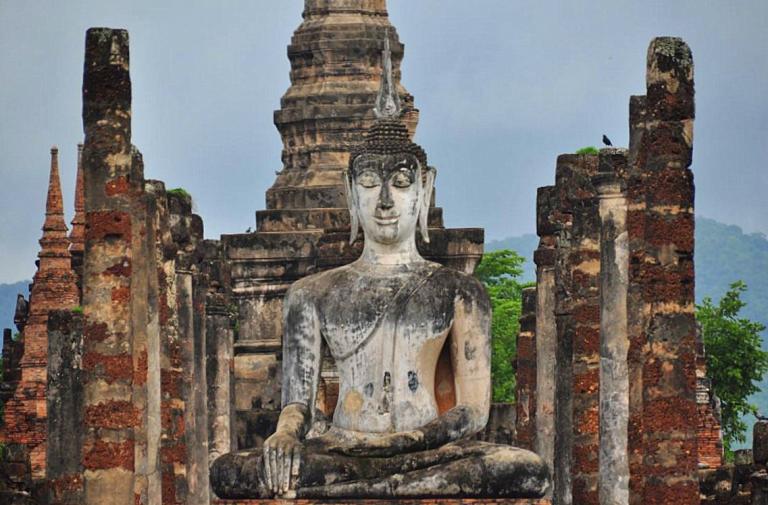
A Buddha in earth-touching mudra. Sukhothai, Thailand 2012, photo by the author.
Verses 26-29
Trees do not revile nor can they be pleased with effort.
When might I dwell with those whose company is a
delight?After dwelling in an empty temple, at the foot of a tree, or in
caves, when shall I set forth, unconcerned and not looking
back?When shall I dwell in unclaimed and naturally spacious
regions, wandering as I please and without a residence?When shall I dwell fearlessly, without protecting my body,
having a clay bowl as my only property and a garment
useless to a thief?Verses 85-88
Fearing sensual desires in this way, one should generate
delight in solitude and in deserted woodlands
devoid of strife and annoyances.The fortunate ones, caressed by silent and gentle forest
breezes, pace on pleasant boulders, spacious like palaces,
cooled by sandalwood-like moon rays, and ponder how to
benefit others.Dwelling here and there for as long as one likes, freed
from the exhaustion of guarding one’s
possessions and free of care, one lives as one
pleases in an empty dwelling, at the foot of a tree, or in a
cave.Living as one wishes, homeless, and not tied down by
anyone, one savors the joy of contentment, which is difficult
even for a king to find.
I don’t think I should give much commentary on these, and instead urge the reader to contemplate them, perhaps reading them a few times in the space of a day or two. If you have the book, I’d encourage thinking about how these verses fit in to the text as a whole. If you’ve studied the history of Buddhism, I’d encourage thought about how these fit into the tradition as it was shaped leading up to Shantideva.
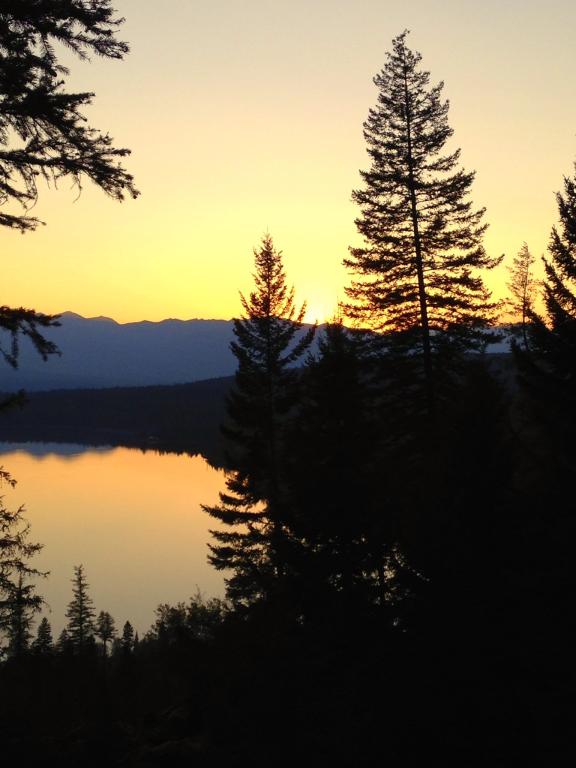
As a Montanan and avid hiker, one part that especially resonates with me was the notion of: “unclaimed and naturally spacious regions, wandering as I please and without a residence” (isn’t that part of the Wilderness Act?).
* On Civilized Shamans: I first encountered this text in 2004 and used it again in 2007 when I taught a University course in Tibetan Buddhism and even today I think it should rank in the top 10, if not 5 or 3, of textbooks covering the breadth and depth of Tibetan Buddhism.
Previous Post

November 9, 2015
Australia's Next Top Guru (Parody)
Next Post

November 13, 2015 The Daily Show's Trevor Noah takes us to Myanmar (Burma)
Browse Our Archives
Select a Category Academia Activism American Buddhism Art Book review Buddhism Buddhism Today Buddhist Ethics Burma/Myanmar China Christianity Commodification Environment Gender Happiness Health Humor India Interfaith Islam Japanese Buddhism Kant Media / News Meditation mindfulness Photography Poetry Politics quicktakes Running Teaching Technology Thailand Theism/Atheism Theravada Tibet Tibetan Buddhism Travels Uncategorized Unitarian Universalism video Western Philosophy Zen
Select a Month June 2021 January 2021 November 2020 August 2020 July 2020 March 2020 January 2020 October 2019 August 2019 June 2019 May 2019 March 2019 February 2019 January 2019 December 2018 November 2018 October 2018 September 2018 August 2018 July 2018 June 2018 May 2018 April 2018 March 2018 February 2018 January 2018 December 2017 November 2017 October 2017 September 2017 August 2017 July 2017 June 2017 May 2017 April 2017 March 2017 February 2017 January 2017 December 2016 November 2016 October 2016 September 2016 August 2016 July 2016 June 2016 May 2016 April 2016 March 2016 February 2016 January 2016 December 2015 November 2015 October 2015 September 2015 August 2015 July 2015 June 2015 May 2015 April 2015 March 2015 February 2015 January 2015 December 2014 November 2014 October 2014 September 2014 August 2014 July 2014 June 2014 May 2014 April 2014 March 2014 February 2014 January 2014 December 2013 November 2013 October 2013 September 2013 August 2013 July 2013 June 2013 May 2013 April 2013 March 2013 February 2013 January 2013 December 2012 November 2012 October 2012 September 2012 August 2012 July 2012 June 2012 May 2012 April 2012 March 2012 February 2012 January 2012 December 2011 November 2011 October 2011 September 2011 August 2011 July 2011 June 2011 May 2011 April 2011 March 2011 February 2011 January 2011 December 2010 November 2010 October 2010 September 2010 August 2010 July 2010 June 2010 May 2010 April 2010 March 2010 February 2010 January 2010 December 2009 November 2009 October 2009 September 2009 August 2009 July 2009 June 2009 May 2009 April 2009 March 2009 February 2009 January 2009 December 2008 November 2008 October 2008 September 2008 August 2008 July 2008 June 2008 May 2008 April 2008 March 2008 September 2007 August 2007 July 2007 June 2007 May 2007 April 2007 March 2007 February 2007 January 2007 December 2006 November 2006 October 2006 September 2006 August 2006 July 2006 June 2006 May 2006 April 2006 March 2006 February 2006 January 2006 December 2005 November 2005 October 2005 September 2005 November 2004 September 2004 August 2004
Follow Us!
TAKE THE
Religious Wisdom Quiz
What does "Naphtali" mean in Hebrew?
Select your answer to see how you score.
God is my rock Chosen One My struggle The Lord is my strength
Support this
Column


Related posts from American Buddhist Perspectives

In strife and uncertainty: let us remember loving-kindness
American Buddhist Perspectives

A Festival of Radical Awakening: Socially Engaged Buddhism...
American Buddhist Perspectives

The Coronavirus is coming - Some thoughts from...
American Buddhist Perspectives

Shambhala Buddhist Community Faces New Allegations in Chapman...
American Buddhist Perspectives
TRENDING AT PATHEOS Buddhist

On Taking Refuge in the Dharma
(Here I continue the feature of sharing talks and essays by teachers...

(Continuing my intention to share talks and essays by other members of Empty...
The Subtle Art of Bowing: A Dharma Discourse
(This presentation was first offered by my dear friend Dharma Holder Tom...

Internal Family Systems Can Heal you Mentally &...
How IFS Helped Me Stop Fighting Myself Internal Family Systems (IFS) is...

The Bible No One Spoke About: A Family’s...
A mysterious family Bible, unspoken faith, and a journey from curiosity to...

How Uncertainty Can Transform Your Life in 2025
Embracing Uncertainty: A New Year’s Resolution for the Brave As 2025 approaches,...
view all Buddhist blogs
Ad-Free & Subscriber Log-In Subscription Support
- About Us
- 2026 Calendar
- Videos
- Podcasts
- Library of World Religions
- Faith In Media Tracker
- Advertise With Us
- Write for Us
- Privacy Policy
- Terms of Service
- Do Not Sell My Data
- Contact Us
- Radiant Digital
- Manage Newsletter Subscriptions
- Unsubscribe From Notifications
- Sitemap
Copyright 2008-2026, Patheos. All rights reserved.
Subscription Support Ad-Free & Subscriber Log-In
Follow Patheos