
BuddhistCatholicContemplativeEvangelicalGeneral ChristianHinduJewishLatter-day SaintMuslimNew VisionsProgressive Christian
Beliefs
- Buddhist
- Catholic
- Contemplative
- Evangelical
- General Christian
- Hindu
- Jewish
- Latter-day Saint
- More Voices
- Muslim
- New Visions
- Pagan
- Progressive Christian
Topics
- Religion News
- Food and Religion
- Sports and Religion
- Religious Art
- Religious Music and Entertainment
- Religious Events
- History and Religion
- Style and Religion
- Politics and Religion
- Women in Religion
- Recreation Outdoors and Religion
- Business Finance and Religion
- Careers Workplace and Religion
- Education and Religion
- Family Parenting and Religion
- Health Fitness and Religion
- Home and Religion
- Relationships and Religion
- Technology and Religion
- Travel and Religion
Columnists
- Buddhist Columnists
- Business Finance and Religion Columnists
- Careers Workplace and Religion Columnists
- Catholic Columnists
- Contemplative Columnists
- Education and Religion Columnists
- Evangelists Columnists
- Family Parenting and Religion Columnists
- General Christian Columnists
- Health Fitness and Religion Columnists
- Hindu Columnists
- History and Religion Columnists
- Home and Religion Columnists
- Jewish Columnists
- More Voices Columnists
- Latter Day Columnists
- Muslim Columnists
- New Visions Columnists
- Nonreligious Columnists
- Pagan Columnists
- Politics and Religion Columnists
- Progressive Columnists
- Recreation Outdoors and Religion Columnists
- Relationships and Religion Columnists
- Religion News Columnists
- Religious Art Columnists
- Religious Events Columnists
- Religious Music and Entertainment Columnists
- Sports and Religion Columnists
- Style and Religion Columnists
- Technology and Religion Columnists
- Travel and Religion Columnists
- Women in Religion Columnists
Resource Library
- 2026 Calendar
- Library of World Religions
- The 100 Most Holy Places on Earth
- Patheos Answers
- Podcasts
- Videos
- Faith Leaders Database
- Anglican Episcopalian
- Bahai
- Baptist
- Buddhism
- Christianity
- Confucianism
- Eastern Orthodoxy
- Hinduism
- Holiness and Pentecostal
- ISKCON
- Islam
- Judaism
- Lutheran
- Methodist
- The Church of Jesus Christ of Latter-day Saints
- New Age
- Paganism
- Presbytarian and Reformed
- Protestantism
- Religion Behind the Scenes
- Roman Catholic
- Scientology
- Shia Islam
- Sikhism
- Sufism
- Sunni Islam
- Taoism
- Zen
- See all religions
Research Tools
 Ad-Free & Subscriber Log-In Subscription Support
Ad-Free & Subscriber Log-In Subscription Support
Follow Patheos 

- Trending:
- Forgiveness
- |
- Marriage
- |
- Consciousness
- |
- Death Penalty
- |
- Election
- |
- Halloween
 American Buddhist Perspectives
- Home
- Buddhist
- Religion News
- Rubin Museum hosts Sharon Salzberg: Mindfulness and Art
Rubin Museum hosts Sharon Salzberg: Mindfulness and Art
Last updated on: August 8, 2015 at 12:26 am by Justin Whitaker
Rubin Museum hosts Sharon Salzberg: Mindfulness and Art 2015-08-08T00:26:10-06:00 Justin Whitaker
Patheos Explore the world's faith through different perspectives on religion and spirituality! Patheos has the views of the prevalent religions and spiritualities of the world.
The Rubin Museum of Art in New York City is hosting Sharon Salzberg and other teachers from the New York Insight Meditation Center this month and next to teach mindfulness and discuss intersections between meditation and art.
The Rubin’s PR and Marketing Manager Robin Carol writes, “The practices of meditation and art have long gone hand in hand, and art itself is often described as a meditative experience. Today, the Rubin Museum of Art is launching a weekly lunchtime Mindfulness Meditation series, where visitors can learn from expert meditation teachers while being inspired by art.”
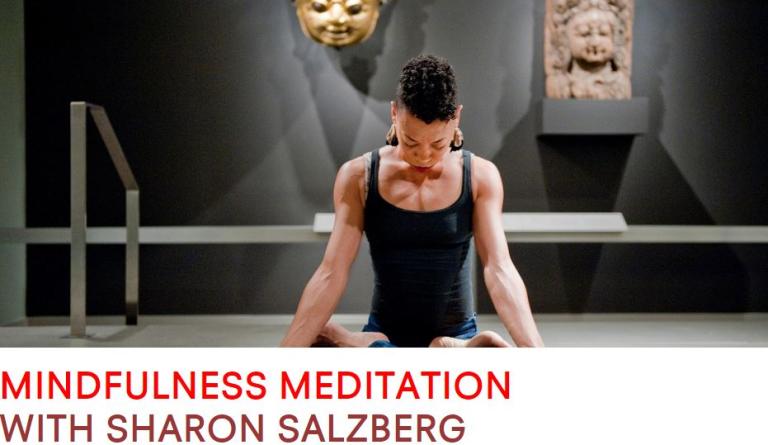
Image courtesy of Rubin Museum.
They have compiled a list of five well-known artists who meditate, including David Lynch and Yoko Ono (both practitioners of Transcendental Meditation), Marina Abramović (creator of her own “Abramović Method), and Leonard Cohen and Jack Kerouac (both practitioners of Buddhist meditation, Cohen spending time as a Zen monk).
There they quote Cohen from an interview with The Guardian, saying about Zen meditation: “If you sit there long enough, you run through all the alternative ways the events in your life could have turned out. After a while, the activity of thinking, that interior chatter, begins to subside from time to time. And what rushes in, in the same way that light rushes into a room when you switch on the light, is another kind of mood that overtakes you.”
Meditation, in particular mindfulness, grows out of early Buddhist teachings and has been secularized to varying extents as it has entered the modern western spiritual landscape. Today it has gained favor with artists, athletes, educators, business-people, and the military, sparking intense discussions and debates about the extent to which it must remain seated in its ethical and philosophical religious framework in order to truly work (and what it means for mindfulness to ‘work’ is itself debated).
Just how mindfulness works for artists is bound to be a very individual process, but artist, author and educator Steve Saitzyk sums up part of the process like this:
Developing a mindfulness meditation practice teaches us how we can place our mind where we want it to be. It helps us find that psychological space in which to land so we can begin [making art]. Meditation could be seen as a more efficient and less stressful way of arriving at a starting, or restarting, point. It provides the mental space for insight to arise and be recognized as such. If our heads are constantly filled with stuff, there is little room for something new and inspirational to take form. This increased awareness is the natural outcome of practicing mindfulness meditation. Meditation also helps us with our viewing process so we can see our work with fresh eyes and even glimpse how others might perceive the result of our creative process.
More philosophically, Saitzyk continues:
For the most part, I feel that the Western approach to art and art making over-emphasizes self-expression and narrative. A Buddhist or meditative approach examines this by posing the question: What is the “self” that is being expressed? Is it ego, or what? A meditative approach advocates that we would be best served if we focused less on the “self” and more on the expression part of the creative process. Such an approach is called pure expression rather than self-expression, because one has learned through meditation how to let go of the relentless self-referencing, self-dialoging, self-consciousness, self-criticism, and so on, for at least a few moments, in favor of being relaxed, present, tuned-in, and responsive. Which, by the way, is not all that easy to do, but meditation sure helps.
So perhaps a key to artistic creation is simply getting one’s ‘self’ out of the way so that creativity can flow. This would bring explanations of how mindfulness works for artists quite close to how it works for a wide range of other people and in other aspects of life. If you’re a meditating artist, comment below with how meditation fits into your creative process. Also, give us your list of a “top 5” meditating artists (this can be done by artists and non-artists alike). As for myself:
Top 5 meditating artists:
5. Jeff Bridges (Zen and Transcendental Meditation): aka ‘the Dude’ and co-author with Zen teacher Bernie Glassman of “The Dude and the Zen Master.” Watch them in conversation with my good friend Daniel Clarkson Fisher here:
4. Michelle Yeoh (Buddhist): world renowned actress as well as the executive producer of Pad Yatra: A Green Odyssey (2012). When asked about how Buddhism might have influenced her in her role as Aung San Suu Kyi, she responded, “We can be born Buddhist, but we have to practise to be a good Buddhist. I was asked: *“How can a mother choose to stay in the country and to be separated from her children?”*But as a Buddhist, your family is not blood-related, the whole world is your family. It is enlightment that you practise upon. It is suffering, but Buddhists do not relish in suffering. Through true suffering you understand what is the goodness that comes beyond it. You gain a slightly better understanding of compassion, of how to let go, it is not about revenge or retribution. So, Daw Suu and me having that same philosophy did help me tremendously.” See a peak at Pad Yatra:
3. bell hooks (Zen / Christian): longtime activist, feminist, and author, bell hooks writes of an experience giving a talk on Buddhism in a large auditorium on a Friday night: “Yet when the time came the seats were filled. And it was all about Buddhism. It was a truly awesome night. Sacred presence was there, a spirit of love and compassion like spring mist covered us, and loving-kindness embraced me and my words. This is always the measure of mindful practice—whether we can create the conditions for love and peace in circumstances that are difficult, whether we can stop resisting and surrender, working with what we have, where we are.” She discusses her works in depth at C-Span here (search the transcripts and click on selected passages to hear her talk about Buddhism and her spiritual practice).
2. Herbie Hancock (Nichiren Buddhism): discovered Buddhism in the early ’70s after his bassist, Buster Williams, played an opening solo that Hancock would later describe as “magical… so full of inspiration… And I could tell the whole band woke up, and there was some energy that was generating from Buster.” After discovering that Williams was a Nichiren Buddhist, Hancock checked it out andis quoted as saying “I said, This sounds like what I always believed in anyway. I thought I was the only one.” [read more] Watch Hancock talk about Buddhism and Creativity:
1. Leonard Cohen (Zen): A man of endless fascination, in both his personal thoughts and life as well as his music. Revisiting his days as a Zen monk at Mount Baldy, we read:
“It was Buddhist boot camp, grim, with all these broken young people trudging through the snow in walking meditation at three in the morning”. Monks hit meditators with sticks if they dozed off… [There Cohen] had his own WC and coffee machine and could go and listen to CDs in his jeep. Roshi granted him a special dispensation to have a coffee and cigarette first thing in the morning. Sometimes he would drive to LA and have Filet-o-Fish at MacDonald’s, later washed down with wine while watching Jerry Springer on TV. Back at the monastery, Cohen was able to find time to write, draw and compose music on the synthesiser.
Via the museum’s page on the program: “You don’t have to be an artist to embrace meditation as a vital tool for brain health. Whether you’re a new beginner or a skilled meditator already, you can join expert teachers from NY Insight at the Rubin during our lunchtime Mindfulness Meditation series. Learn more here.”
Next Post
August 17, 2015 Yongey Mingyur Rinpoche on how us lazy people can start meditation
Browse Our Archives
Select a Category Academia Activism American Buddhism Art Book review Buddhism Buddhism Today Buddhist Ethics Burma/Myanmar China Christianity Commodification Environment Gender Happiness Health Humor India Interfaith Islam Japanese Buddhism Kant Media / News Meditation mindfulness Photography Poetry Politics quicktakes Running Teaching Technology Thailand Theism/Atheism Theravada Tibet Tibetan Buddhism Travels Uncategorized Unitarian Universalism video Western Philosophy Zen
Select a Month June 2021 January 2021 November 2020 August 2020 July 2020 March 2020 January 2020 October 2019 August 2019 June 2019 May 2019 March 2019 February 2019 January 2019 December 2018 November 2018 October 2018 September 2018 August 2018 July 2018 June 2018 May 2018 April 2018 March 2018 February 2018 January 2018 December 2017 November 2017 October 2017 September 2017 August 2017 July 2017 June 2017 May 2017 April 2017 March 2017 February 2017 January 2017 December 2016 November 2016 October 2016 September 2016 August 2016 July 2016 June 2016 May 2016 April 2016 March 2016 February 2016 January 2016 December 2015 November 2015 October 2015 September 2015 August 2015 July 2015 June 2015 May 2015 April 2015 March 2015 February 2015 January 2015 December 2014 November 2014 October 2014 September 2014 August 2014 July 2014 June 2014 May 2014 April 2014 March 2014 February 2014 January 2014 December 2013 November 2013 October 2013 September 2013 August 2013 July 2013 June 2013 May 2013 April 2013 March 2013 February 2013 January 2013 December 2012 November 2012 October 2012 September 2012 August 2012 July 2012 June 2012 May 2012 April 2012 March 2012 February 2012 January 2012 December 2011 November 2011 October 2011 September 2011 August 2011 July 2011 June 2011 May 2011 April 2011 March 2011 February 2011 January 2011 December 2010 November 2010 October 2010 September 2010 August 2010 July 2010 June 2010 May 2010 April 2010 March 2010 February 2010 January 2010 December 2009 November 2009 October 2009 September 2009 August 2009 July 2009 June 2009 May 2009 April 2009 March 2009 February 2009 January 2009 December 2008 November 2008 October 2008 September 2008 August 2008 July 2008 June 2008 May 2008 April 2008 March 2008 September 2007 August 2007 July 2007 June 2007 May 2007 April 2007 March 2007 February 2007 January 2007 December 2006 November 2006 October 2006 September 2006 August 2006 July 2006 June 2006 May 2006 April 2006 March 2006 February 2006 January 2006 December 2005 November 2005 October 2005 September 2005 November 2004 September 2004 August 2004
Follow Us!
TAKE THE
Religious Wisdom Quiz
How many commandments were written on stone tablets?
Select your answer to see how you score.
Ten Seven Twelve Thirteen
Support this
Column


Related posts from American Buddhist Perspectives

For Pride Month: Our 2015 Interview with La...
American Buddhist Perspectives

In strife and uncertainty: let us remember loving-kindness
American Buddhist Perspectives

A Festival of Radical Awakening: Socially Engaged Buddhism...
American Buddhist Perspectives

The Coronavirus is coming - Some thoughts from...
American Buddhist Perspectives
TRENDING AT PATHEOS Buddhist

On Taking Refuge in the Dharma
(Here I continue the feature of sharing talks and essays by teachers...

(Continuing my intention to share talks and essays by other members of Empty...
The Subtle Art of Bowing: A Dharma Discourse
(This presentation was first offered by my dear friend Dharma Holder Tom...

Internal Family Systems Can Heal you Mentally &...
How IFS Helped Me Stop Fighting Myself Internal Family Systems (IFS) is...

The Bible No One Spoke About: A Family’s...
A mysterious family Bible, unspoken faith, and a journey from curiosity to...

How Uncertainty Can Transform Your Life in 2025
Embracing Uncertainty: A New Year’s Resolution for the Brave As 2025 approaches,...
view all Buddhist blogs
Ad-Free & Subscriber Log-In Subscription Support
- About Us
- 2026 Calendar
- Videos
- Podcasts
- Library of World Religions
- Faith In Media Tracker
- Advertise With Us
- Write for Us
- Privacy Policy
- Terms of Service
- Do Not Sell My Data
- Contact Us
- Radiant Digital
- Manage Newsletter Subscriptions
- Unsubscribe From Notifications
- Sitemap
Copyright 2008-2026, Patheos. All rights reserved.
Subscription Support Ad-Free & Subscriber Log-In
Follow Patheos