
BuddhistCatholicContemplativeEvangelicalGeneral ChristianHinduJewishLatter-day SaintMuslimNew VisionsProgressive Christian
Beliefs
- Buddhist
- Catholic
- Contemplative
- Evangelical
- General Christian
- Hindu
- Jewish
- Latter-day Saint
- More Voices
- Muslim
- New Visions
- Pagan
- Progressive Christian
Topics
- Religion News
- Food and Religion
- Sports and Religion
- Religious Art
- Religious Music and Entertainment
- Religious Events
- History and Religion
- Style and Religion
- Politics and Religion
- Women in Religion
- Recreation Outdoors and Religion
- Business Finance and Religion
- Careers Workplace and Religion
- Education and Religion
- Family Parenting and Religion
- Health Fitness and Religion
- Home and Religion
- Relationships and Religion
- Technology and Religion
- Travel and Religion
Columnists
- Buddhist Columnists
- Business Finance and Religion Columnists
- Careers Workplace and Religion Columnists
- Catholic Columnists
- Contemplative Columnists
- Education and Religion Columnists
- Evangelists Columnists
- Family Parenting and Religion Columnists
- General Christian Columnists
- Health Fitness and Religion Columnists
- Hindu Columnists
- History and Religion Columnists
- Home and Religion Columnists
- Jewish Columnists
- More Voices Columnists
- Latter Day Columnists
- Muslim Columnists
- New Visions Columnists
- Nonreligious Columnists
- Pagan Columnists
- Politics and Religion Columnists
- Progressive Columnists
- Recreation Outdoors and Religion Columnists
- Relationships and Religion Columnists
- Religion News Columnists
- Religious Art Columnists
- Religious Events Columnists
- Religious Music and Entertainment Columnists
- Sports and Religion Columnists
- Style and Religion Columnists
- Technology and Religion Columnists
- Travel and Religion Columnists
- Women in Religion Columnists
Resource Library
- 2026 Calendar
- Library of World Religions
- The 100 Most Holy Places on Earth
- Patheos Answers
- Podcasts
- Videos
- Faith Leaders Database
- Anglican Episcopalian
- Bahai
- Baptist
- Buddhism
- Christianity
- Confucianism
- Eastern Orthodoxy
- Hinduism
- Holiness and Pentecostal
- ISKCON
- Islam
- Judaism
- Lutheran
- Methodist
- The Church of Jesus Christ of Latter-day Saints
- New Age
- Paganism
- Presbytarian and Reformed
- Protestantism
- Religion Behind the Scenes
- Roman Catholic
- Scientology
- Shia Islam
- Sikhism
- Sufism
- Sunni Islam
- Taoism
- Zen
- See all religions
Research Tools
 Ad-Free & Subscriber Log-In Subscription Support
Ad-Free & Subscriber Log-In Subscription Support
Follow Patheos 

- Trending:
- Forgiveness
- |
- Marriage
- |
- Consciousness
- |
- Death Penalty
- |
- Election
- |
- Halloween
 American Buddhist Perspectives
- Home
- Buddhist
- Religion News
- Thich Nhat Hanh comes to USA for further treatment, funds sought to cover costs
Thich Nhat Hanh comes to USA for further treatment, funds sought to cover costs
Last updated on: July 15, 2015 at 9:27 pm by Justin Whitaker
Thich Nhat Hanh comes to USA for further treatment, funds sought to cover costs 2015-07-15T21:27:58-06:00 Justin Whitaker
Patheos Explore the world's faith through different perspectives on religion and spirituality! Patheos has the views of the prevalent religions and spiritualities of the world.
In their latest update, Plum Village of France, Thich Nhat Hanh’s home monastery, informs us that Thay has been transferred to UCSF (University of California, San Francisco) Medical Center for further rehabilitation after his stroke last November. You can read accounts of his continued progress here:
- Thich Nhat Hanh: still stable but “sleeping more deeply and communicating less” (November 22, 2014)
- Thich Nhat Hanh still stable and his “hemorrhage has slightly reduced in size” (December 1, 2014)
- Thich Nhat Hanh, still in coma, is recalled across the globe (December 21, 2014)
- Thich Nhat Hanh out of the coma, wakeful, and smiling (January 4, 2015)
- UPDATED: Thich Nhat Hanh drinks tea, smiles in rehab (February 19, 2015)
- Thich Nhat Hanh is home at Plum Village following his November stroke and rehab (April 6, 2015)
- Thich Nhat Hanh’s remarkable recovery shows that “everything is possible” (June 28, 2015)
According to the latest account, it was Thay’s own choice to intensify his rehabilitation program, which brought him to the US on July 11th. The new team of US doctors has suggested a 5-6 month period of intensive therapy with the latest technology and specialists.
The release also notes that while he is able to communicate, he cannot yet speak:
Thay’s diligence and determination are a powerful message for us all. Thay’s heart and mind will never abandon us or the practice. Although he cannot speak to us, he continues to transmit the essence of the practice. He continues to be with his beloved community, even in times of difficulty.
In addition to passing on Thay’s latest health information, the Monks and Nuns of Plum Village have established a donation page to help cover the costs, expected “to be in the hundreds of thousands of dollars.”
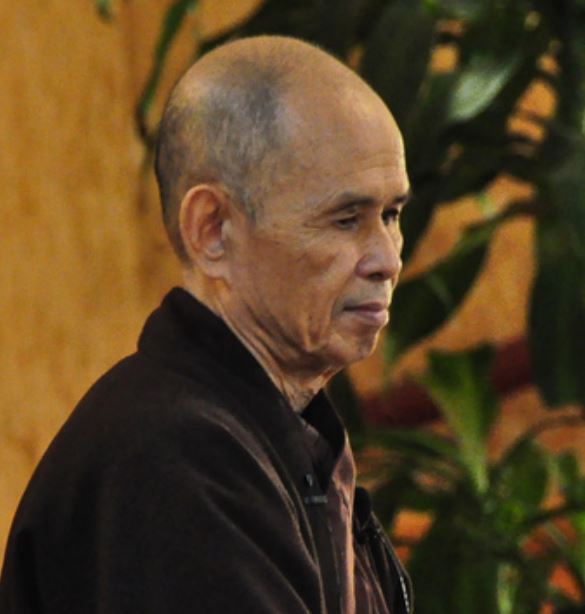
Thich Nhat Hanh by Geoff Livingston CC flickr
And while the latest news is doubtless great to hear for Thay’s students and admirers of his work, I have heard and read remarks from many over the past six plus months about why students would seemingly cling so tightly to a teacher or why an elderly Buddhist master (Thich Nhat Hanh is 88) would cling so tightly to life in this world.
When I have responded to such misgivings, it has usually been to note that all involved are still human, or to question the use of the term ‘clinging’ here. In Buddhist thought, motivation is key, and yet guessing about or supposing to know the motivations of others is a fool’s game. Perhaps those close to Thay are indeed clinging to him as much as devoted followers of any religious leader. Or perhaps they instead see his message that has reached so many people around the world and wish only to see that message continue in the strongest way possible, through his continuing to teach and write.
My sense is that too many people have seized on the message of non-clinging (which is a good and central message within Buddhism) and tried to apply it here too forcefully. Like all teachings, it should be taken with some nuance. When driving on a windy mountain road, a good Buddhist clings firmly to the steering wheel.
Perhaps Thay and his students see his journey as not quite finished and so hold on and work to see it through.
~
Another issue arising specifically from this update is the way healthcare is paid for around the world. As we heard of Thay’s hospitalization, his recovery, the doctors and nurses around him, and so on, no mention of needing funds was ever made. Now that he has been in the US for 3 days, “hundreds of thousands of dollars” are expected to be paid out in the coming months. Perhaps this is one of those curves on Thay’s life journey: using his recovery time to show us Americans how crazy our health care system continues to be.
Having lived much of the last 5 years in England, I watched with some dread the rise of medical bankruptcies in the U.S., fed by a system of uncontrolled and unreasonable costs. Traveling around India and Thailand, I could see why medical tourism (traveling from one country to another for cheaper medical procedures) has become a major industry lately, but I’ve never heard of anyone coming to the US for treatment, let alone rehab.
As a 2008 story on NPR notes:
In 2000, health care experts for the World Health Organization tried to do a statistical ranking of the world’s health care systems. They studied 191 countries and ranked them on things like the number of years people lived in good health and whether everyone had access to good health care. France came in first. The United States ranked 37th.
Physicians for a National Health Program further noted:
The French health care system was rated the best in the world by the World Health Organization in 2001. The American health care system ranked 37th. In 2004, France spent 10.5% of its gross domestic product on health while the U.S. spent 15.4%. Again, in 2004, the last year for which figures are available, the per capita total expenditure on health in U.S. dollars was $3,464 in France but $6,096 in the U.S.Analyzing the French system might provide some ideas for a solution to the current health care crisis in America.
Both of those are seven years old, but not a lot has changed: TIME: U.S. Healthcare Ranked Worst in the Developed World, June 2014 (read full report in .pdf here). Curiously, France has dropped to 9th there, while US has moved to dead last at 11 – as only 11 nations were compared. The story is complex, of course, as one Business Insider article puts it: “searching for the “best” healthcare system in the world may be futile — there’s simply too many variables to produce meaningful results.” Yet anecdotes like this one from a woman who gave birth in France speak volumes about our different systems.
Let us hope for a continued steady recovery for Thay.
But let us also think about all the other stroke victims – and others in need of medical care – in the U.S. who won’t have access to followers around the world to help cover costs. And let us think about moving the system in the direction of reason and justice.
For as we read in the story of “The Monk with Dysentery” people must take care of one another. When the Buddha found a monk sick and nobody attending to him, he immediately took up the task himself. He then admonished the monks:
Monks, you have no mother, you have no father, who might tend to you. If you don’t tend to one another, who then will tend to you? Whoever would tend to me, should tend to the sick.
Previous Post

July 12, 2015
F*ck That: a guided meditation (humor)
Next Post
August 8, 2015 Rubin Museum hosts Sharon Salzberg: Mindfulness and Art
Browse Our Archives
Select a Category Academia Activism American Buddhism Art Book review Buddhism Buddhism Today Buddhist Ethics Burma/Myanmar China Christianity Commodification Environment Gender Happiness Health Humor India Interfaith Islam Japanese Buddhism Kant Media / News Meditation mindfulness Photography Poetry Politics quicktakes Running Teaching Technology Thailand Theism/Atheism Theravada Tibet Tibetan Buddhism Travels Uncategorized Unitarian Universalism video Western Philosophy Zen
Select a Month June 2021 January 2021 November 2020 August 2020 July 2020 March 2020 January 2020 October 2019 August 2019 June 2019 May 2019 March 2019 February 2019 January 2019 December 2018 November 2018 October 2018 September 2018 August 2018 July 2018 June 2018 May 2018 April 2018 March 2018 February 2018 January 2018 December 2017 November 2017 October 2017 September 2017 August 2017 July 2017 June 2017 May 2017 April 2017 March 2017 February 2017 January 2017 December 2016 November 2016 October 2016 September 2016 August 2016 July 2016 June 2016 May 2016 April 2016 March 2016 February 2016 January 2016 December 2015 November 2015 October 2015 September 2015 August 2015 July 2015 June 2015 May 2015 April 2015 March 2015 February 2015 January 2015 December 2014 November 2014 October 2014 September 2014 August 2014 July 2014 June 2014 May 2014 April 2014 March 2014 February 2014 January 2014 December 2013 November 2013 October 2013 September 2013 August 2013 July 2013 June 2013 May 2013 April 2013 March 2013 February 2013 January 2013 December 2012 November 2012 October 2012 September 2012 August 2012 July 2012 June 2012 May 2012 April 2012 March 2012 February 2012 January 2012 December 2011 November 2011 October 2011 September 2011 August 2011 July 2011 June 2011 May 2011 April 2011 March 2011 February 2011 January 2011 December 2010 November 2010 October 2010 September 2010 August 2010 July 2010 June 2010 May 2010 April 2010 March 2010 February 2010 January 2010 December 2009 November 2009 October 2009 September 2009 August 2009 July 2009 June 2009 May 2009 April 2009 March 2009 February 2009 January 2009 December 2008 November 2008 October 2008 September 2008 August 2008 July 2008 June 2008 May 2008 April 2008 March 2008 September 2007 August 2007 July 2007 June 2007 May 2007 April 2007 March 2007 February 2007 January 2007 December 2006 November 2006 October 2006 September 2006 August 2006 July 2006 June 2006 May 2006 April 2006 March 2006 February 2006 January 2006 December 2005 November 2005 October 2005 September 2005 November 2004 September 2004 August 2004
Follow Us!
TAKE THE
Religious Wisdom Quiz
Who led the Israelites into the Promised Land?
Select your answer to see how you score.
Aaron Caleb Moses Joshua
Support this
Column


Related posts from American Buddhist Perspectives

In strife and uncertainty: let us remember loving-kindness
American Buddhist Perspectives

The Coronavirus is coming - Some thoughts from...
American Buddhist Perspectives

Sogyal Lakar, well-known Tibetan Buddhist teacher and alleged...
American Buddhist Perspectives

Secular vs Religious, Buddhism vs Mindfulness, and a...
American Buddhist Perspectives
TRENDING AT PATHEOS Buddhist

On Taking Refuge in the Dharma
(Here I continue the feature of sharing talks and essays by teachers...

(Continuing my intention to share talks and essays by other members of Empty...
The Subtle Art of Bowing: A Dharma Discourse
(This presentation was first offered by my dear friend Dharma Holder Tom...

Internal Family Systems Can Heal you Mentally &...
How IFS Helped Me Stop Fighting Myself Internal Family Systems (IFS) is...

The Bible No One Spoke About: A Family’s...
A mysterious family Bible, unspoken faith, and a journey from curiosity to...

How Uncertainty Can Transform Your Life in 2025
Embracing Uncertainty: A New Year’s Resolution for the Brave As 2025 approaches,...
view all Buddhist blogs
Ad-Free & Subscriber Log-In Subscription Support
- About Us
- 2026 Calendar
- Videos
- Podcasts
- Library of World Religions
- Faith In Media Tracker
- Advertise With Us
- Write for Us
- Privacy Policy
- Terms of Service
- Do Not Sell My Data
- Contact Us
- Radiant Digital
- Manage Newsletter Subscriptions
- Unsubscribe From Notifications
- Sitemap
Copyright 2008-2026, Patheos. All rights reserved.
Subscription Support Ad-Free & Subscriber Log-In
Follow Patheos