
BuddhistCatholicContemplativeEvangelicalGeneral ChristianHinduJewishLatter-day SaintMuslimNew VisionsProgressive Christian
Beliefs
- Buddhist
- Catholic
- Contemplative
- Evangelical
- General Christian
- Hindu
- Jewish
- Latter-day Saint
- More Voices
- Muslim
- New Visions
- Pagan
- Progressive Christian
Topics
- Religion News
- Food and Religion
- Sports and Religion
- Religious Art
- Religious Music and Entertainment
- Religious Events
- History and Religion
- Style and Religion
- Politics and Religion
- Women in Religion
- Recreation Outdoors and Religion
- Business Finance and Religion
- Careers Workplace and Religion
- Education and Religion
- Family Parenting and Religion
- Health Fitness and Religion
- Home and Religion
- Relationships and Religion
- Technology and Religion
- Travel and Religion
Columnists
- Buddhist Columnists
- Business Finance and Religion Columnists
- Careers Workplace and Religion Columnists
- Catholic Columnists
- Contemplative Columnists
- Education and Religion Columnists
- Evangelists Columnists
- Family Parenting and Religion Columnists
- General Christian Columnists
- Health Fitness and Religion Columnists
- Hindu Columnists
- History and Religion Columnists
- Home and Religion Columnists
- Jewish Columnists
- More Voices Columnists
- Latter Day Columnists
- Muslim Columnists
- New Visions Columnists
- Nonreligious Columnists
- Pagan Columnists
- Politics and Religion Columnists
- Progressive Columnists
- Recreation Outdoors and Religion Columnists
- Relationships and Religion Columnists
- Religion News Columnists
- Religious Art Columnists
- Religious Events Columnists
- Religious Music and Entertainment Columnists
- Sports and Religion Columnists
- Style and Religion Columnists
- Technology and Religion Columnists
- Travel and Religion Columnists
- Women in Religion Columnists
Resource Library
- 2026 Calendar
- Library of World Religions
- The 100 Most Holy Places on Earth
- Patheos Answers
- Podcasts
- Videos
- Faith Leaders Database
- Anglican Episcopalian
- Bahai
- Baptist
- Buddhism
- Christianity
- Confucianism
- Eastern Orthodoxy
- Hinduism
- Holiness and Pentecostal
- ISKCON
- Islam
- Judaism
- Lutheran
- Methodist
- The Church of Jesus Christ of Latter-day Saints
- New Age
- Paganism
- Presbytarian and Reformed
- Protestantism
- Religion Behind the Scenes
- Roman Catholic
- Scientology
- Shia Islam
- Sikhism
- Sufism
- Sunni Islam
- Taoism
- Zen
- See all religions
Research Tools
 Ad-Free & Subscriber Log-In Subscription Support
Ad-Free & Subscriber Log-In Subscription Support
Follow Patheos 

- Trending:
- Forgiveness
- |
- Marriage
- |
- Consciousness
- |
- Death Penalty
- |
- Election
- |
- Halloween
 American Buddhist Perspectives
- Home
- Buddhist
- Religion News
- Celebrating same-sex marriage in Buddhism
Celebrating same-sex marriage in Buddhism
Last updated on: June 27, 2015 at 6:38 pm by Justin Whitaker
Celebrating same-sex marriage in Buddhism 2015-06-27T18:38:12-06:00 Justin Whitaker
Patheos Explore the world's faith through different perspectives on religion and spirituality! Patheos has the views of the prevalent religions and spiritualities of the world.
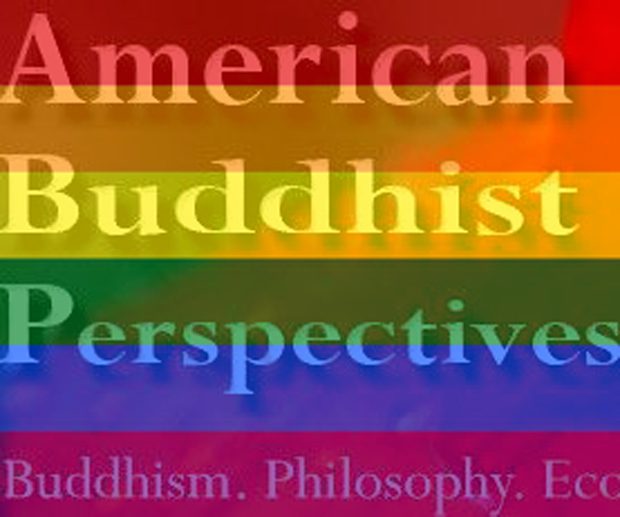
Today I am thrilled to join millions across the country in celebration of the Supreme Court’s decision to legalize same-sex marriage across all 50 states. In honor of the decision, along with joining the facebook “Celebrate Pride” campaign with this blog’s facebook profile pic, I thought I would repost one of the blog’s most popular entries. Please enjoy, comment, take pride, etc, and remember that there is still much work to be done.
~
The first place I generally turn whenever I come across a broad ethical issue in Buddhism is Peter Harvey’s masterful Introduction to Buddhist Ethics. There we find a whole chapter devoted to “Homosexuality and other forms of ‘queerness’”.
It shouldn’t be surprising that Buddhism, like any ancient religion, has nothing in particular to say about Gay Marriage. It’s just not an issue that cropped up. Just as marriage wasn’t always a sacrament in Christianity – I believe it was added in the 11th century, meaning that for the majority of the religion’s history it hasn’t regarded marriage as a sacred event, not to mention reformers who wished to drop marriage as a sacrament, but that’s another story – Buddhism hasn’t seen marriage as anything other than a social institution.
But through Harvey’s survey, what one comes away with is primarily a sense of acceptance and cultural malleability. Part of the problem, Harvey notes, is that our categories and terminology might not fit today in the West with terms used in other contexts:
the modern social category and erotic identity signified by the term gay is notthe same as the homosexual organizations or roles found in ancient times andin other cultures . . . it is in several respects a unique development in humansociety. This suggests a change from a predominantly gender-reversed feminization to a more frequent masculinization of overt homosexuality in popular culture. (Herdt, p.452)
So we can just look for cases that might be similar or in some way point toward what the Buddha would have thought about gay marriage. One case that comes up may seem, I suppose, a bit silly:
In the Vinaya, there is reference to a monk in whom the sexual characteristics of a woman appeared, and a nun in whom the sexual characteristics of a man appeared. In both cases, the Buddha appears to accept this and simply say that the ex-monk nun should follow the rules of the nuns, and the ex-nun monk should follow the rules of the monks. (Harvey, p.412)
What does it mean that these characteristics ‘appeared’? In any case, the Buddha’s response was apparently nonjudgmental: if you’re a man now, join the monks order; if you’re a woman, join the nuns.
Hermaphrodites, who are today called ‘intersex‘, (those having the characteristics of both sexes) aren’t so lucky, and are ruled ineligible for ordination on the grounds that they might seduce members of either sex. While I can see the sense of it at the time, I look forward to the first intersex monastics paving through this particular barrier.
Next mentioned are pandakas, or those ‘without testicles’ – which likely refers in a metaphorical way toward outwardly effeminate men. Sometimes female pandakas are mentioned and, by analogy, refer to women who were lesbians (thought it also may have suggested a physical abnormality with their reproductive organs). This section is a bit difficult to sum up, if only because the precise meaning and implications of the term pandaka is unclear. Sometimes the pandaka is described in physical terms as having an ‘incomplete body’, and in terms of behavior, having insufficient respect for his parents. Harvey sums up, “He has a sensual, shameless nature replete with the defilements of both sexes, but is uncertain and wavering, and cannot reflect on his defilements. He is incapable of spiritual discipline and so cannot be blamed as if he were being undisciplined intentionally. He is unloved by his parents.” (p. 418) Unfortunately, such views were (and no doubt in some cases still are) essentialized to the extent that these people were barred from entering monastic life and generally looked down upon. Gampopa, founder of the Kagyu school of Tibetan Buddhism, is given as a noteworthy exception to this, as he held that pandakas could practice asbodhisattvas outside the monastic context.
In terms of homosexual behavior, in monastic life it is seen as no more or less a fault than heterosexual behavior. In lay life, however, both Buddhaghosa (a Theravadin authority) and Shantideva (a major Mahayana authority) condemn same-sex affection.
I’ll spare you the run through that Harvey gives of views in various Buddhist countries (you should get his book though), only to say that there are signs of both acceptance and (usually mild) disapproval. Harvey cites authors a couple times who sum up homosexuality as basically not a big deal in Buddhist texts and thus Buddhist thought. I wrote a short article on this, with regard specifically to the Dalai Lama’s statements on homosexuality in 2005. Gary Daubney, in a thoughtful response to my article, further noted this sentiment, citing A.L. De Silva who wrote, “As homosexuality is not explicity mentioned in any of the Buddha’s discourses (more than 20 volumes in the Pali Text Society’s English translation), we can only assume that it is meant to be evaluted in the same way that heterosexuality is.” (http://www.buddhanet.net/homosexu.htm). Furthermore:
A.L. De Silva, quoted above, has also written that homosexuality was only made illegal in predominately Theravadan Burma and Sri Lanka when under British (Christian!) rule, and that Thailand, which was never colonized by a Western power, has never banned homosexual activity. The modern thriving gay scene including the colourful ‘lady-boy’ subculture are reflections of this traditionally tolerant attitude in the Land of (Buddhist) Smiles.
I conferred with my friend Paisarn, a journalist and activist from Thailand, and he sent me an article he cowrote for Valentines day on the topic: Love for a new age. There it is noted that:
At least two decades of newspaper headlines from Thailand about same-sex marriages–like that of Beer and Pick–have left many foreigners thinking that gay marriage is legal here. However, these weddings confer no legal benefits whatsoever.
In contrast, some Western countries grant homosexual couples rights similar to those of heterosexual ones, even while withholding the status of “marriage” due to its religious definition as a union of man and woman.
Since Buddhist scripture offers no particular objection to same-sex relationships, the concept of “marriage” in Thailand is largely familial, communal and social. A wedding reaffirms the couple’s bond and rallies support for them. Often monks are invited to preside and give blessings.
And yet:
On Valentine’s Day 2010, two lesbian couples – one in Chiang Mai and the other in Pathum Thani – attempted to register their relationships at their local district offices. Both were politely turned down.
As Thailand‘s LGBT community continues to grow and mature, the demand for such recognition will only become louder.
Meanwhile, over 8 years ago, the king of Cambodia announced his support for gay marriage, which raises an interesting question: how many heads of state vocally support same-sex marriage? Finally, two Theravadin monks who give compelling arguments for equality:
Ajahn Sujato on “Why Buddhists should support marriage equality.”
Here the Dalai Lama speaks to Larry King about Same Sex Marriage:
and Ajahn Brahm, “Gay marriage, why not?”
Oh, and this from a Zen priest, Rev. Jana Drakka, reading one of Thich Nhat Hanh’s most amazing poems at a gay marriage rally in 2008:
Imagine…
Something worth looking into if you have a few extra coins…
Herdt, G., 1987, ‘Homosexuality’, in Eliade, 1987 The Encyclopedia of Religion: vol. VI, pp. 445-53.
* This is a slightly updated version of a May 2012 post. See it for further discussion, information, and links in the comments.

Next Post
June 28, 2015 Thich Nhat Hanh's remarkable recovery shows that "everything is possible"
Browse Our Archives
Select a Category Academia Activism American Buddhism Art Book review Buddhism Buddhism Today Buddhist Ethics Burma/Myanmar China Christianity Commodification Environment Gender Happiness Health Humor India Interfaith Islam Japanese Buddhism Kant Media / News Meditation mindfulness Photography Poetry Politics quicktakes Running Teaching Technology Thailand Theism/Atheism Theravada Tibet Tibetan Buddhism Travels Uncategorized Unitarian Universalism video Western Philosophy Zen
Select a Month June 2021 January 2021 November 2020 August 2020 July 2020 March 2020 January 2020 October 2019 August 2019 June 2019 May 2019 March 2019 February 2019 January 2019 December 2018 November 2018 October 2018 September 2018 August 2018 July 2018 June 2018 May 2018 April 2018 March 2018 February 2018 January 2018 December 2017 November 2017 October 2017 September 2017 August 2017 July 2017 June 2017 May 2017 April 2017 March 2017 February 2017 January 2017 December 2016 November 2016 October 2016 September 2016 August 2016 July 2016 June 2016 May 2016 April 2016 March 2016 February 2016 January 2016 December 2015 November 2015 October 2015 September 2015 August 2015 July 2015 June 2015 May 2015 April 2015 March 2015 February 2015 January 2015 December 2014 November 2014 October 2014 September 2014 August 2014 July 2014 June 2014 May 2014 April 2014 March 2014 February 2014 January 2014 December 2013 November 2013 October 2013 September 2013 August 2013 July 2013 June 2013 May 2013 April 2013 March 2013 February 2013 January 2013 December 2012 November 2012 October 2012 September 2012 August 2012 July 2012 June 2012 May 2012 April 2012 March 2012 February 2012 January 2012 December 2011 November 2011 October 2011 September 2011 August 2011 July 2011 June 2011 May 2011 April 2011 March 2011 February 2011 January 2011 December 2010 November 2010 October 2010 September 2010 August 2010 July 2010 June 2010 May 2010 April 2010 March 2010 February 2010 January 2010 December 2009 November 2009 October 2009 September 2009 August 2009 July 2009 June 2009 May 2009 April 2009 March 2009 February 2009 January 2009 December 2008 November 2008 October 2008 September 2008 August 2008 July 2008 June 2008 May 2008 April 2008 March 2008 September 2007 August 2007 July 2007 June 2007 May 2007 April 2007 March 2007 February 2007 January 2007 December 2006 November 2006 October 2006 September 2006 August 2006 July 2006 June 2006 May 2006 April 2006 March 2006 February 2006 January 2006 December 2005 November 2005 October 2005 September 2005 November 2004 September 2004 August 2004
Follow Us!
TAKE THE
Religious Wisdom Quiz
What does "Rabboni" mean?
Select your answer to see how you score.
Savior My Teacher Holy One Master
Support this
Column


Related posts from American Buddhist Perspectives

For Pride Month: Our 2015 Interview with La...
American Buddhist Perspectives

Standing up to Lies: Can America Emerge from...
American Buddhist Perspectives

Progressive responses to the 2020 election of Biden...
American Buddhist Perspectives

In strife and uncertainty: let us remember loving-kindness
American Buddhist Perspectives
TRENDING AT PATHEOS Buddhist

On Taking Refuge in the Dharma
(Here I continue the feature of sharing talks and essays by teachers...

(Continuing my intention to share talks and essays by other members of Empty...
The Subtle Art of Bowing: A Dharma Discourse
(This presentation was first offered by my dear friend Dharma Holder Tom...

Internal Family Systems Can Heal you Mentally &...
How IFS Helped Me Stop Fighting Myself Internal Family Systems (IFS) is...

The Bible No One Spoke About: A Family’s...
A mysterious family Bible, unspoken faith, and a journey from curiosity to...

How Uncertainty Can Transform Your Life in 2025
Embracing Uncertainty: A New Year’s Resolution for the Brave As 2025 approaches,...
view all Buddhist blogs
Ad-Free & Subscriber Log-In Subscription Support
- About Us
- 2026 Calendar
- Videos
- Podcasts
- Library of World Religions
- Faith In Media Tracker
- Advertise With Us
- Write for Us
- Privacy Policy
- Terms of Service
- Do Not Sell My Data
- Contact Us
- Radiant Digital
- Manage Newsletter Subscriptions
- Unsubscribe From Notifications
- Sitemap
Copyright 2008-2026, Patheos. All rights reserved.
Subscription Support Ad-Free & Subscriber Log-In
Follow Patheos