
BuddhistCatholicContemplativeEvangelicalGeneral ChristianHinduJewishLatter-day SaintMuslimNew VisionsProgressive Christian
Beliefs
- Buddhist
- Catholic
- Contemplative
- Evangelical
- General Christian
- Hindu
- Jewish
- Latter-day Saint
- More Voices
- Muslim
- New Visions
- Pagan
- Progressive Christian
Topics
- Religion News
- Food and Religion
- Sports and Religion
- Religious Art
- Religious Music and Entertainment
- Religious Events
- History and Religion
- Style and Religion
- Politics and Religion
- Women in Religion
- Recreation Outdoors and Religion
- Business Finance and Religion
- Careers Workplace and Religion
- Education and Religion
- Family Parenting and Religion
- Health Fitness and Religion
- Home and Religion
- Relationships and Religion
- Technology and Religion
- Travel and Religion
Columnists
- Buddhist Columnists
- Business Finance and Religion Columnists
- Careers Workplace and Religion Columnists
- Catholic Columnists
- Contemplative Columnists
- Education and Religion Columnists
- Evangelists Columnists
- Family Parenting and Religion Columnists
- General Christian Columnists
- Health Fitness and Religion Columnists
- Hindu Columnists
- History and Religion Columnists
- Home and Religion Columnists
- Jewish Columnists
- More Voices Columnists
- Latter Day Columnists
- Muslim Columnists
- New Visions Columnists
- Nonreligious Columnists
- Pagan Columnists
- Politics and Religion Columnists
- Progressive Columnists
- Recreation Outdoors and Religion Columnists
- Relationships and Religion Columnists
- Religion News Columnists
- Religious Art Columnists
- Religious Events Columnists
- Religious Music and Entertainment Columnists
- Sports and Religion Columnists
- Style and Religion Columnists
- Technology and Religion Columnists
- Travel and Religion Columnists
- Women in Religion Columnists
Resource Library
- 2026 Calendar
- Library of World Religions
- The 100 Most Holy Places on Earth
- Patheos Answers
- Podcasts
- Videos
- Faith Leaders Database
- Anglican Episcopalian
- Bahai
- Baptist
- Buddhism
- Christianity
- Confucianism
- Eastern Orthodoxy
- Hinduism
- Holiness and Pentecostal
- ISKCON
- Islam
- Judaism
- Lutheran
- Methodist
- The Church of Jesus Christ of Latter-day Saints
- New Age
- Paganism
- Presbytarian and Reformed
- Protestantism
- Religion Behind the Scenes
- Roman Catholic
- Scientology
- Shia Islam
- Sikhism
- Sufism
- Sunni Islam
- Taoism
- Zen
- See all religions
Research Tools
 Ad-Free & Subscriber Log-In Subscription Support
Ad-Free & Subscriber Log-In Subscription Support
Follow Patheos 

- Trending:
- Forgiveness
- |
- Marriage
- |
- Consciousness
- |
- Death Penalty
- |
- Election
- |
- Halloween
 American Buddhist Perspectives
- Home
- Buddhist
- Religion News
- Žižek points us to the dark side of Buddhism, again
Žižek points us to the dark side of Buddhism, again
Last updated on: April 20, 2015 at 8:20 pm by Justin Whitaker
Žižek points us to the dark side of Buddhism, again 2015-04-20T20:20:06-06:00 Justin Whitaker
Patheos Explore the world's faith through different perspectives on religion and spirituality! Patheos has the views of the prevalent religions and spiritualities of the world.
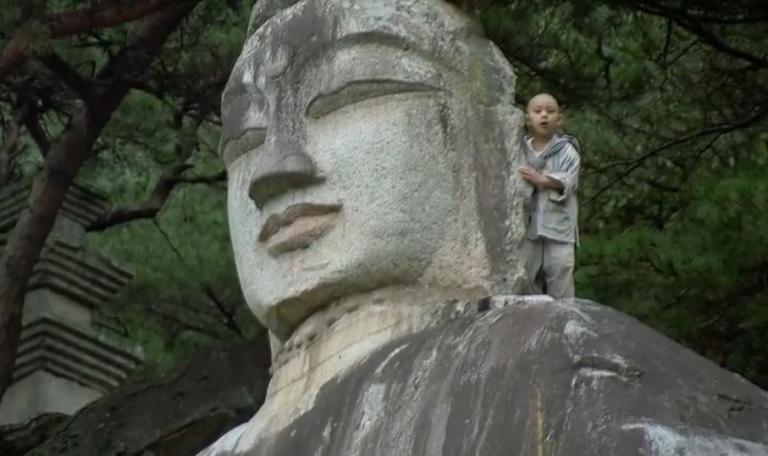
Screenshot from Spring, Summer, Autumn, Winter … and Spring
This week The Guardian published a selection of short essays titled, “I watch therefore I am: seven movies that teach us key philosophy lessons.” The newspaper deserves great praise for bringing together a wonderful variety of philosophers to draw our attention to the moral and epistemological issues in films. Greats like Julian Baggini, who I had the fortune of seeing with Owen Flanagan and Tim Lott last spring (video), Christine Korsgaard, an exemplary Kant scholar and philosopher in her own right (who I quoted at the start of a paper I gave in Oxford in 2012), and Peter Singer, among others.
And yet the most curious part of the series of essays come from Slovenian philosopher (and arch-nemesis of all things Buddhist, one might think) Slavoj Žižek. It’s called Is the quest for good a road to evil? and reads:
Kim Ki-duk’s Spring, Summer, Autumn, Winter … and Spring begins with a wise Buddhist monk and a small, innocent boy, his pupil. A few years later, a young woman arrives to be healed, and chaos is unleashed: the woman and the boy – now an adolescent – copulate, and the boy follows her to the city, abandoning the monk’s lone dwelling on a raft that floats on a mountain lake. A few years later, the boy, now a man in his early 30s, returns, pursued by two detectives. He has killed the woman out of jealousy, thus realising the prophecy of the old monk, who had warned him that love for a woman leads to attachment, which ends in the murder of the object of attachment. The first thing to do here is to take the film’s cycle more literally than it takes itself: why does the young man kill his love when she abandons him for another man? Why is his love so possessive? An average man in secular life would have accepted it, however painful it would have been for him.
So: what if it is his very Buddhist-monk upbringing that made him do it? What if a woman only appears as an object of lust and possession, which ultimately provokes a man to kill her, from the Buddhist position of detachment? So that the whole natural cycle that the film deploys, murder included, is internal to the Buddhist universe?
In his Phenomenology of Spirit, Hegel wrote that evil resides in the very gaze that perceives evil all around itself. Does Kim Ki-duk’s film not provide a perfect case of this insight? Evil is not just man’s possessive lust; evil is also the very detached gaze of the monk, which perceives possessive lust as evil. This is what, in philosophy, we call reflexivity: the standpoint from which we condemn a state of things can be itself part of this state of things.
So horrible on so many levels.
Perhaps “the average” man in secular life would have accepted it, but we don’t often make movies, especially ones that hold lessons about life, about the average man. Nor can we say that the average man in secular life necessarily would have acted differently. Domestic violence is all to real in the secular world, as it is anywhere else. Why is Žižek trying to drive a wedge between the secular man and the character in the movie with his Buddhist upbringing?
“Why is his love so possessive?” Žižek asks. And this is the point where, as I’ve said elsewhere, I don’t think Žižek has much of a clue about Buddhism. A message throughout Buddhism, and typified in this film, is that romantic love plays on the emotions of desire and resulting attachment. Love itself is not problematic, but love which objectifies and seeks to own the other for oneself, is an undeniable source of suffering. The movie could have had the young man simply return, brokenhearted, to the tiny temple on the lake. This itself would have portrayed the Buddhist teaching about the first noble truth:
“Suffering, as a noble truth, is this: Birth is suffering, aging is suffering, sickness is suffering, death is suffering, sorrow and lamentation, pain, grief and despair are suffering; association with the loathed is suffering, dissociation from the loved is suffering, not to get what one wants is suffering — in short, suffering is the five categories of clinging objects.[1]
However, this would have lost the opportunity to connect us to an earlier scene in the movie, when the young man, then a boy, tied stones to several animals in the woods. When his teacher saw him, he tied a stone to the boy’s back to teach him a lesson about the suffering this burden had caused to those animals. The boy complains and the monk, holding a Buddha statue in one hand, sends him off to unburden the animals, saying that when he returns, he too will be freed, but if any one of those creatures has died, “you will carry the stone in your heart for the rest of your life.”
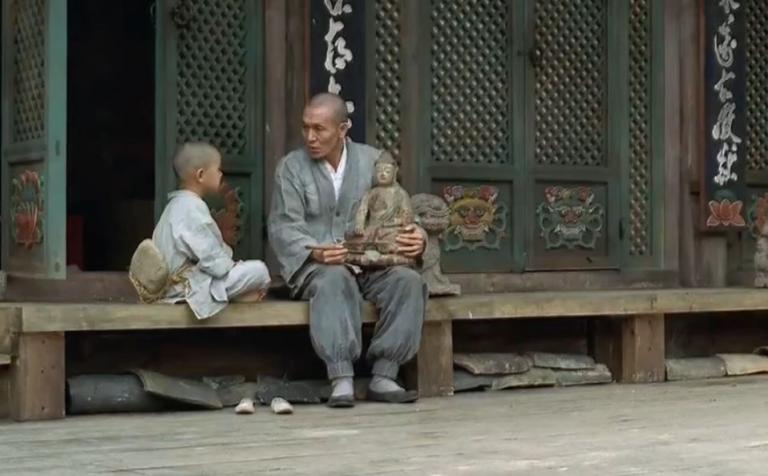
No spoilers, but what happens next, as the boy sets out to free the creatures and his reactions along the way closes out the first chapter (Spring) of the movie.
Žižek’s questions seem to show not only his ignorance about Buddhism, but about much of human history itself:
So: what if it is his very Buddhist-monk upbringing that made him do it? What if a woman only appears as an object of lust and possession, which ultimately provokes a man to kill her, from the Buddhist position of detachment? So that the whole natural cycle that the film deploys, murder included, is internal to the Buddhist universe?
Really? Because nowhere outside of Buddhist cultures have women ever been treated, legally or factually, as objects of lust and possession, right?
Come on, Žižek.
He next turns to Hegel, as if drawing from this exceptionally obscure 19th century philosopher will help his bizarre case. There is no doubt great value in Hegel’s philosophy, and even the notion to which Žižek refers: reflexivity. But Žižek’s analysis misses the point by trying to pin the evil action on the teachings about evil themselves. Again, this would seem to suggest that in the absence of such teachings, and the quest for non-attachment (not detachment), such evil actions simply would not and could not happen.
Žižek also seems oblivious to the fact that the teachings come from the elder monk, himself an exemplar of the Buddhist virtues of wisdom and compassion: caring for the boy, teaching him, and even knowingly letting him go when he –a young man by now– decides to chase after the young woman. The viewer is presented with this contrast: the boy (young man, and so on) who is ignorant, lustful, and angry, and the elder monk who has embodied the Buddhist teachings as a way of both engaging the viewer and making him/her reflect on his/her own place on the path between worldly obsessions and non-attached care and wisdom. And yet this simple cinematic device seems totally lost on Žižek.
If you haven’t seen the movie, do. It really is phenomenal, not just as a Buddhist-inspired fable, but also for it’s music, cinematography, and acting. Read some of the reviews at Rotten Tomatoes, ignore (or contemplate) Žižek’s analysis, and let me know what you think of the movie and the message it carries.
1. SN 56.11, Dhammacakkappavattana Sutta: Setting Rolling the Wheel of Truth, translated from the Pali by Ñanamoli Thera
http://www.accesstoinsight.org/tipitaka/sn/sn56/sn56.011.nymo.htm
(Updated 4/20 with correct spelling/diacritics on the ‘z’s in Žižek)
Previous Post

April 16, 2015
Buddhists: Sit for $15, fighting for higher minimum wage
Next Post
April 22, 2015 David Suzuki, Force of Nature (reposted for Earth Day)
Browse Our Archives
Select a Category Academia Activism American Buddhism Art Book review Buddhism Buddhism Today Buddhist Ethics Burma/Myanmar China Christianity Commodification Environment Gender Happiness Health Humor India Interfaith Islam Japanese Buddhism Kant Media / News Meditation mindfulness Photography Poetry Politics quicktakes Running Teaching Technology Thailand Theism/Atheism Theravada Tibet Tibetan Buddhism Travels Uncategorized Unitarian Universalism video Western Philosophy Zen
Select a Month June 2021 January 2021 November 2020 August 2020 July 2020 March 2020 January 2020 October 2019 August 2019 June 2019 May 2019 March 2019 February 2019 January 2019 December 2018 November 2018 October 2018 September 2018 August 2018 July 2018 June 2018 May 2018 April 2018 March 2018 February 2018 January 2018 December 2017 November 2017 October 2017 September 2017 August 2017 July 2017 June 2017 May 2017 April 2017 March 2017 February 2017 January 2017 December 2016 November 2016 October 2016 September 2016 August 2016 July 2016 June 2016 May 2016 April 2016 March 2016 February 2016 January 2016 December 2015 November 2015 October 2015 September 2015 August 2015 July 2015 June 2015 May 2015 April 2015 March 2015 February 2015 January 2015 December 2014 November 2014 October 2014 September 2014 August 2014 July 2014 June 2014 May 2014 April 2014 March 2014 February 2014 January 2014 December 2013 November 2013 October 2013 September 2013 August 2013 July 2013 June 2013 May 2013 April 2013 March 2013 February 2013 January 2013 December 2012 November 2012 October 2012 September 2012 August 2012 July 2012 June 2012 May 2012 April 2012 March 2012 February 2012 January 2012 December 2011 November 2011 October 2011 September 2011 August 2011 July 2011 June 2011 May 2011 April 2011 March 2011 February 2011 January 2011 December 2010 November 2010 October 2010 September 2010 August 2010 July 2010 June 2010 May 2010 April 2010 March 2010 February 2010 January 2010 December 2009 November 2009 October 2009 September 2009 August 2009 July 2009 June 2009 May 2009 April 2009 March 2009 February 2009 January 2009 December 2008 November 2008 October 2008 September 2008 August 2008 July 2008 June 2008 May 2008 April 2008 March 2008 September 2007 August 2007 July 2007 June 2007 May 2007 April 2007 March 2007 February 2007 January 2007 December 2006 November 2006 October 2006 September 2006 August 2006 July 2006 June 2006 May 2006 April 2006 March 2006 February 2006 January 2006 December 2005 November 2005 October 2005 September 2005 November 2004 September 2004 August 2004
Follow Us!
TAKE THE
Religious Wisdom Quiz
Who was Rebekah's father?
Select your answer to see how you score.
Bethuel Abraham Laban Terah
Support this
Column


Related posts from American Buddhist Perspectives

In strife and uncertainty: let us remember loving-kindness
American Buddhist Perspectives

The Coronavirus is coming - Some thoughts from...
American Buddhist Perspectives

Sogyal Lakar, well-known Tibetan Buddhist teacher and alleged...
American Buddhist Perspectives

Secular vs Religious, Buddhism vs Mindfulness, and a...
American Buddhist Perspectives
TRENDING AT PATHEOS Buddhist

On Taking Refuge in the Dharma
(Here I continue the feature of sharing talks and essays by teachers...

(Continuing my intention to share talks and essays by other members of Empty...
The Subtle Art of Bowing: A Dharma Discourse
(This presentation was first offered by my dear friend Dharma Holder Tom...

Internal Family Systems Can Heal you Mentally &...
How IFS Helped Me Stop Fighting Myself Internal Family Systems (IFS) is...

The Bible No One Spoke About: A Family’s...
A mysterious family Bible, unspoken faith, and a journey from curiosity to...

How Uncertainty Can Transform Your Life in 2025
Embracing Uncertainty: A New Year’s Resolution for the Brave As 2025 approaches,...
view all Buddhist blogs
Ad-Free & Subscriber Log-In Subscription Support
- About Us
- 2026 Calendar
- Videos
- Podcasts
- Library of World Religions
- Faith In Media Tracker
- Advertise With Us
- Write for Us
- Privacy Policy
- Terms of Service
- Do Not Sell My Data
- Contact Us
- Radiant Digital
- Manage Newsletter Subscriptions
- Unsubscribe From Notifications
- Sitemap
Copyright 2008-2026, Patheos. All rights reserved.
Subscription Support Ad-Free & Subscriber Log-In
Follow Patheos