
BuddhistCatholicContemplativeEvangelicalGeneral ChristianHinduJewishLatter-day SaintMuslimNew VisionsProgressive Christian
Beliefs
- Buddhist
- Catholic
- Contemplative
- Evangelical
- General Christian
- Hindu
- Jewish
- Latter-day Saint
- More Voices
- Muslim
- New Visions
- Pagan
- Progressive Christian
Topics
- Religion News
- Food and Religion
- Sports and Religion
- Religious Art
- Religious Music and Entertainment
- Religious Events
- History and Religion
- Style and Religion
- Politics and Religion
- Women in Religion
- Recreation Outdoors and Religion
- Business Finance and Religion
- Careers Workplace and Religion
- Education and Religion
- Family Parenting and Religion
- Health Fitness and Religion
- Home and Religion
- Relationships and Religion
- Technology and Religion
- Travel and Religion
Columnists
- Buddhist Columnists
- Business Finance and Religion Columnists
- Careers Workplace and Religion Columnists
- Catholic Columnists
- Contemplative Columnists
- Education and Religion Columnists
- Evangelists Columnists
- Family Parenting and Religion Columnists
- General Christian Columnists
- Health Fitness and Religion Columnists
- Hindu Columnists
- History and Religion Columnists
- Home and Religion Columnists
- Jewish Columnists
- More Voices Columnists
- Latter Day Columnists
- Muslim Columnists
- New Visions Columnists
- Nonreligious Columnists
- Pagan Columnists
- Politics and Religion Columnists
- Progressive Columnists
- Recreation Outdoors and Religion Columnists
- Relationships and Religion Columnists
- Religion News Columnists
- Religious Art Columnists
- Religious Events Columnists
- Religious Music and Entertainment Columnists
- Sports and Religion Columnists
- Style and Religion Columnists
- Technology and Religion Columnists
- Travel and Religion Columnists
- Women in Religion Columnists
Resource Library
- 2026 Calendar
- Library of World Religions
- The 100 Most Holy Places on Earth
- Patheos Answers
- Podcasts
- Videos
- Faith Leaders Database
- Anglican Episcopalian
- Bahai
- Baptist
- Buddhism
- Christianity
- Confucianism
- Eastern Orthodoxy
- Hinduism
- Holiness and Pentecostal
- ISKCON
- Islam
- Judaism
- Lutheran
- Methodist
- The Church of Jesus Christ of Latter-day Saints
- New Age
- Paganism
- Presbytarian and Reformed
- Protestantism
- Religion Behind the Scenes
- Roman Catholic
- Scientology
- Shia Islam
- Sikhism
- Sufism
- Sunni Islam
- Taoism
- Zen
- See all religions
Research Tools
 Ad-Free & Subscriber Log-In Subscription Support
Ad-Free & Subscriber Log-In Subscription Support
Follow Patheos 

- Trending:
- Forgiveness
- |
- Marriage
- |
- Consciousness
- |
- Death Penalty
- |
- Election
- |
- Halloween
 American Buddhist Perspectives
- Home
- Buddhist
- Religion News
- 100 Arrested in India in pro-Tibet Rally
100 Arrested in India in pro-Tibet Rally
Last updated on: March 10, 2015 at 7:23 pm by Justin Whitaker
100 Arrested in India in pro-Tibet Rally 2015-03-10T19:23:51-06:00 Justin Whitaker
Patheos Explore the world's faith through different perspectives on religion and spirituality! Patheos has the views of the prevalent religions and spiritualities of the world.
Today is the 56th anniversary of the March 10, 1959 start of the Tibetan uprising against Chinese occupation. The history around that day is outlined below, but first, in today’s news the Associated Press (via MB and BBC World News) reports that:
Indian police have detained about 100 Tibetans who were protesting outside the Chinese Embassy in New Delhi on the anniversary of a failed 1959 uprising against China’s rule in Tibet.
Protesters interlocked their hands and tried to form a chain around the embassy before police stepped in and dragged them away.
Protesters are expected to be released later today. The protesters dedicated their actions to the more than 130 Tibetan men and women who have died in self-immolations since 2009. According to the International Campaign for Tibet, similar events are planned for capitals and major cities around the world.
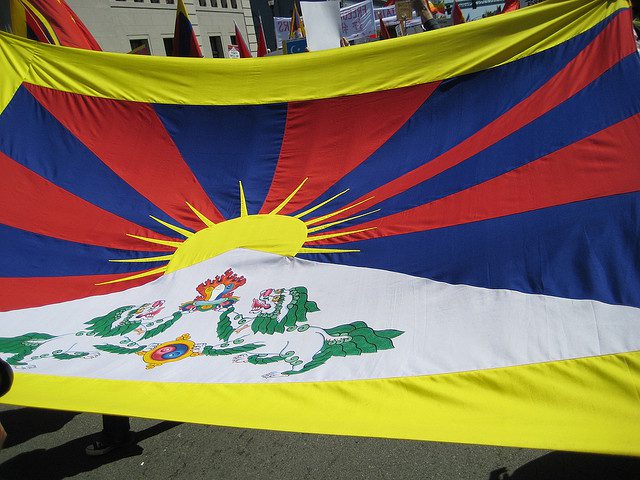
Tibetan Flag, photo by Kevin Wong (Flickr C.C.)
From Tibet.org, the following timeline depicts the events that March:
On March 1, 1959, while the Dalai Lama was preoccupied with taking his Final Master of Metaphysics examination, two junior Chinese army officers visited him at the sacred Jokhang cathedral and pressed him to confirm a date on which he could attend a theatrical performance and tea at the Chinese Army Headquarters in Lhasa. The Dalai Lama replied that he would fix a date once the ceremonies had been completed
This was an extraordinary occurrence for two reasons: one, the invitation was not conveyed through the Kashag (the Cabinet) as it should have been; and two, the party was not at the palace where such functions would normally have been held, but at the military headquarters – and the Dalai Lama had been asked to attend alone.
March 7, 1959. The interpreter of General Tan Kuan-sen – one of the three military leaders in Lhasa rang the Chief Official Abbot demanding the date the Dalai Lama would attend their army camp. March 10 was confirmed.
March 8, 1959. This was Women’s Day, and the Patriotic Women’s Association was treated to a harangue by General Tan Kuan-sen in which he threatened to shell and destroy monasteries if the Khampa guerrillas refused to surrender. “… we knew that the ordinary people of Lhasa were being driven to open rebellion against the Chinese though they would have to fight machine-gunners with their bare hands”, writes Mrs. Rinchen Dolma (Mary) Taring in her autobiography, Daughter of Tibet.
March 9, 1959. At 8.00 am two Chinese officers visited the commander of the Dalai Lama bodyguards’ house and asked him to accompany them to see Brigadier Fu at the Chinese military headquarters in Lhasa. Brigadier Fu told him that on the following day there was to be no customary ceremony as the Dalai Lama moved from the Norbulinka summer palace to the army headquarters, two miles beyond. No armed bodyguard was to escort him and no Tibetan soldiers would be allowed beyond the Stone Bridge – a landmark on the perimeter of the sprawling army camp.
By custom, an escort of twenty-five armed guards always accompanied the Dalai Lama and the entire city of Lhasa would line up whenever he went. Brigadier Fu told the commander of the Dalai Lama’s bodyguards that under no circumstances should the Tibetan army cross the Stone bridge and the entire procedure must be kept strictly secret.
The Chinese camp had always been an eyesore for the Tibetans and the fact that the Dalai Lama was now to visit it would surely create greater anxiety amongst the Tibetans.
March 10, 1959. The invitation provoked 30,000 loyal Tibetans to surround the Norbulinka palace, forming an human sea of protection for their Yeshe Norbu (nickname for the Dalai Lama, meaning “Precious Jewel”). They feared he would be abducted to Beijing to attend the upcoming Chinese National Assembly. This mobilization forced the Dalai Lama to turn down the army leader’s invitation. Instead he was held a prisoner of devotion.
March 12, 1959. 5,000 Tibetan women marched through the streets of Lhasa carrying banners demanding “Tibet for Tibetans” and shouting “From today Tibet is Independent”. They presented an appeal for help to the Indian Consulate-General in Lhasa.
Mimang Tsongdu members and their supporters had erected barricades in Lhasa’s narrow streets while the Chinese militia had positioned sandbag fortifications for machine guns on the city’s flat rooftops. 3000 Tibetans in Lhasa signed their willingness to join the rebels manning the valley’s ring of mountains.
On March 15, 3000 of the Dalai Lama’s bodyguards left Lhasa to position themselves along an anticipated escape route. Khampa rebel leaders moved their most trusted men to strategic points. Stalwarts of the Tibetan Army merged with civilians to cover the chosen route. By this time the Tibetans were out-numbered 25 to 2. An estimated 30,000 to 50,000 Chinese troops wielded modern weapons and had 17 heavy guns surrounding the city. While the Chinese manned swiveling howitzers, the Tibetans were wielding cannons into position with mules.
March 16, 1959. Chinese heavy artillery was seen being moved to sites within range of Lhasa and particularly the Norbulinka. Rumours were rife of more troops being flown in from China. By nightfall Lhasa was certain that the Dalai Lama’s palace was about to be shelled.
March 17, 1959 4 pm. The Chinese fired two mortar shells at the Norbulinka. They landed short of the palace walls in a marsh. This event triggered the Dalai Lama to finally decide to leave his homeland.
And for a thoughtful discussion on the Future of Tibet, see this video of a panel on that topic, held at Bard College in February 2013 (since little has changed in the official status of Tibet-China relations, it is still a very timely video):
You can read more about the panel and its participants here.

Next Post

March 19, 2015 Actor Bill Murray's Dharma talk: "What's it like to be you?" [Audio]
Browse Our Archives
Select a Category Academia Activism American Buddhism Art Book review Buddhism Buddhism Today Buddhist Ethics Burma/Myanmar China Christianity Commodification Environment Gender Happiness Health Humor India Interfaith Islam Japanese Buddhism Kant Media / News Meditation mindfulness Photography Poetry Politics quicktakes Running Teaching Technology Thailand Theism/Atheism Theravada Tibet Tibetan Buddhism Travels Uncategorized Unitarian Universalism video Western Philosophy Zen
Select a Month June 2021 January 2021 November 2020 August 2020 July 2020 March 2020 January 2020 October 2019 August 2019 June 2019 May 2019 March 2019 February 2019 January 2019 December 2018 November 2018 October 2018 September 2018 August 2018 July 2018 June 2018 May 2018 April 2018 March 2018 February 2018 January 2018 December 2017 November 2017 October 2017 September 2017 August 2017 July 2017 June 2017 May 2017 April 2017 March 2017 February 2017 January 2017 December 2016 November 2016 October 2016 September 2016 August 2016 July 2016 June 2016 May 2016 April 2016 March 2016 February 2016 January 2016 December 2015 November 2015 October 2015 September 2015 August 2015 July 2015 June 2015 May 2015 April 2015 March 2015 February 2015 January 2015 December 2014 November 2014 October 2014 September 2014 August 2014 July 2014 June 2014 May 2014 April 2014 March 2014 February 2014 January 2014 December 2013 November 2013 October 2013 September 2013 August 2013 July 2013 June 2013 May 2013 April 2013 March 2013 February 2013 January 2013 December 2012 November 2012 October 2012 September 2012 August 2012 July 2012 June 2012 May 2012 April 2012 March 2012 February 2012 January 2012 December 2011 November 2011 October 2011 September 2011 August 2011 July 2011 June 2011 May 2011 April 2011 March 2011 February 2011 January 2011 December 2010 November 2010 October 2010 September 2010 August 2010 July 2010 June 2010 May 2010 April 2010 March 2010 February 2010 January 2010 December 2009 November 2009 October 2009 September 2009 August 2009 July 2009 June 2009 May 2009 April 2009 March 2009 February 2009 January 2009 December 2008 November 2008 October 2008 September 2008 August 2008 July 2008 June 2008 May 2008 April 2008 March 2008 September 2007 August 2007 July 2007 June 2007 May 2007 April 2007 March 2007 February 2007 January 2007 December 2006 November 2006 October 2006 September 2006 August 2006 July 2006 June 2006 May 2006 April 2006 March 2006 February 2006 January 2006 December 2005 November 2005 October 2005 September 2005 November 2004 September 2004 August 2004
Follow Us!
TAKE THE
Religious Wisdom Quiz
Which New Testament book has the "Hall of Faith" listing heroes like Abraham and Moses?
Select your answer to see how you score.
1 Peter Galatians James Hebrews
Support this
Column


Related posts from American Buddhist Perspectives

For Pride Month: Our 2015 Interview with La...
American Buddhist Perspectives

Standing up to Lies: Can America Emerge from...
American Buddhist Perspectives

Progressive responses to the 2020 election of Biden...
American Buddhist Perspectives

In strife and uncertainty: let us remember loving-kindness
American Buddhist Perspectives
TRENDING AT PATHEOS Buddhist

On Taking Refuge in the Dharma
(Here I continue the feature of sharing talks and essays by teachers...

(Continuing my intention to share talks and essays by other members of Empty...
The Subtle Art of Bowing: A Dharma Discourse
(This presentation was first offered by my dear friend Dharma Holder Tom...

Internal Family Systems Can Heal you Mentally &...
How IFS Helped Me Stop Fighting Myself Internal Family Systems (IFS) is...

The Bible No One Spoke About: A Family’s...
A mysterious family Bible, unspoken faith, and a journey from curiosity to...

How Uncertainty Can Transform Your Life in 2025
Embracing Uncertainty: A New Year’s Resolution for the Brave As 2025 approaches,...
view all Buddhist blogs
Ad-Free & Subscriber Log-In Subscription Support
- About Us
- 2026 Calendar
- Videos
- Podcasts
- Library of World Religions
- Faith In Media Tracker
- Advertise With Us
- Write for Us
- Privacy Policy
- Terms of Service
- Do Not Sell My Data
- Contact Us
- Radiant Digital
- Manage Newsletter Subscriptions
- Unsubscribe From Notifications
- Sitemap
Copyright 2008-2026, Patheos. All rights reserved.
Subscription Support Ad-Free & Subscriber Log-In
Follow Patheos