
BuddhistCatholicContemplativeEvangelicalGeneral ChristianHinduJewishLatter-day SaintMuslimNew VisionsProgressive Christian
Beliefs
- Buddhist
- Catholic
- Contemplative
- Evangelical
- General Christian
- Hindu
- Jewish
- Latter-day Saint
- More Voices
- Muslim
- New Visions
- Pagan
- Progressive Christian
Topics
- Religion News
- Food and Religion
- Sports and Religion
- Religious Art
- Religious Music and Entertainment
- Religious Events
- History and Religion
- Style and Religion
- Politics and Religion
- Women in Religion
- Recreation Outdoors and Religion
- Business Finance and Religion
- Careers Workplace and Religion
- Education and Religion
- Family Parenting and Religion
- Health Fitness and Religion
- Home and Religion
- Relationships and Religion
- Technology and Religion
- Travel and Religion
Columnists
- Buddhist Columnists
- Business Finance and Religion Columnists
- Careers Workplace and Religion Columnists
- Catholic Columnists
- Contemplative Columnists
- Education and Religion Columnists
- Evangelists Columnists
- Family Parenting and Religion Columnists
- General Christian Columnists
- Health Fitness and Religion Columnists
- Hindu Columnists
- History and Religion Columnists
- Home and Religion Columnists
- Jewish Columnists
- More Voices Columnists
- Latter Day Columnists
- Muslim Columnists
- New Visions Columnists
- Nonreligious Columnists
- Pagan Columnists
- Politics and Religion Columnists
- Progressive Columnists
- Recreation Outdoors and Religion Columnists
- Relationships and Religion Columnists
- Religion News Columnists
- Religious Art Columnists
- Religious Events Columnists
- Religious Music and Entertainment Columnists
- Sports and Religion Columnists
- Style and Religion Columnists
- Technology and Religion Columnists
- Travel and Religion Columnists
- Women in Religion Columnists
Resource Library
- 2026 Calendar
- Library of World Religions
- The 100 Most Holy Places on Earth
- Patheos Answers
- Podcasts
- Videos
- Faith Leaders Database
- Anglican Episcopalian
- Bahai
- Baptist
- Buddhism
- Christianity
- Confucianism
- Eastern Orthodoxy
- Hinduism
- Holiness and Pentecostal
- ISKCON
- Islam
- Judaism
- Lutheran
- Methodist
- The Church of Jesus Christ of Latter-day Saints
- New Age
- Paganism
- Presbytarian and Reformed
- Protestantism
- Religion Behind the Scenes
- Roman Catholic
- Scientology
- Shia Islam
- Sikhism
- Sufism
- Sunni Islam
- Taoism
- Zen
- See all religions
Research Tools
 Ad-Free & Subscriber Log-In Subscription Support
Ad-Free & Subscriber Log-In Subscription Support
Follow Patheos 

- Trending:
- Forgiveness
- |
- Marriage
- |
- Consciousness
- |
- Death Penalty
- |
- Election
- |
- Halloween
 American Buddhist Perspectives
- Home
- Buddhist
- Religion News
- “Why am I here?” – a post-event interview with veteran journalist and university teacher, Eileen Flynn
“Why am I here?” – a post-event interview with veteran journalist and university teacher, Eileen Flynn
Last updated on: February 27, 2015 at 5:22 am by Justin Whitaker
“Why am I here?” – a post-event interview with veteran journalist and university teacher, Eileen Flynn 2015-02-27T05:22:05-07:00 Justin Whitaker
Patheos Explore the world's faith through different perspectives on religion and spirituality! Patheos has the views of the prevalent religions and spiritualities of the world.
Wrapping up what has been an unexpectedly interview-filled month here at American Buddhist Perspectives, I am pleased to present Eileen Flynn, who co-moderated last week’s interfaith panel on the topic of “why am I here?” Video from the event should be up at Deily.org on March 1st. My hope is that between this interview and the earlier one with Rev. Dr. David Zuniga, more people will go see the video and feel encouraged to start conversations like this in their own communities.
So, getting started, can you tell me a bit more about yourself and your role in Thursday’s discussion?
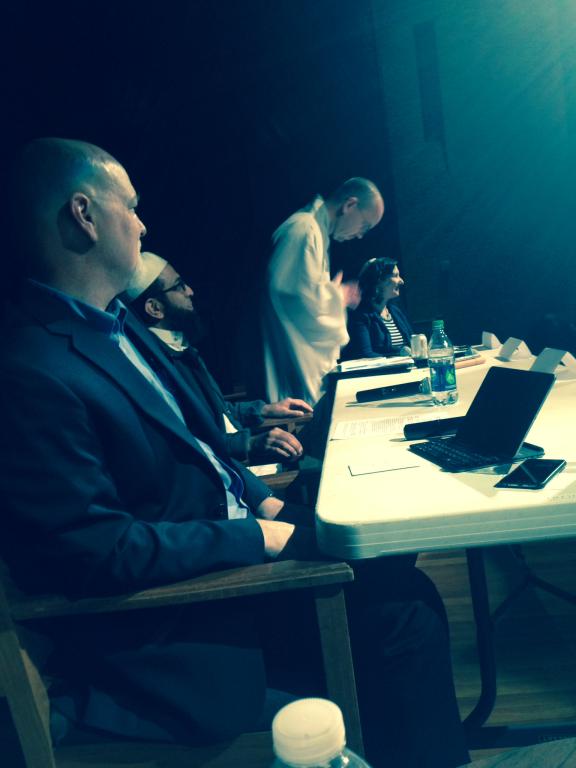
I was the religion reporter at the Austin American-Statesman for many years, and I teach a course called Journalism & Religion at the University of Texas. So I am in regular contact with local faith leaders. When Baptist pastor Tom Goodman and Zen priest Dr. David Zuniga started brainstorming a plan for an interfaith dialogue, they asked me to participate. I served as a co-moderator with Dr. James Kraft, a professor at Huston-Tillotson University where we held the event. Our job was to keep the conversation flowing among the panelists and audience and to monitor Twitter. Audience members were tweeting questions and reactions during the discussion.
Broadly speaking, how do you think the event went?
I think it went surprisingly well. I say “surprisingly” because we were navigating some unfamiliar territory – interfaith dialogue that focused on the differences rather than the similarities. This felt like a real departure from the discussions I’ve written about in the past. And there were certainly some tense moments. Yet, the overall vibe was really warm and collegial and filled with good humor. The panelists had the audience laughing several times.
I had forgotten just how highly educated these four people are. Tom, David, Rabbi Amy Cohen (Reform) and Shaykh Mufti Mohamed-Umer Esmail (Sunni) are all incredibly smart — and, thankfully, very personable.
One of the audience members said he wanted to take all the panelists out for a beer afterward because they seemed like really easy people to talk to. To me, that’s a great compliment, especially here in Austin.
Having representatives of the three major Abrahamic religions and just one “other” perspective at the dialogue will seem lopsided to a lot of people. Did the organizers and presenters find a way to acknowledge this and address issues of exclusion and inclusion?
It was disappointing that we did not include Sanatana Dharma/Hinduism, which is the oldest of the major world religions and the one that I believe is the least understood in the West. The panel did not officially recognize the absence of Hinduism. In retrospect, I wish we had offered some explanation on how we decided to feature these four traditions.
Personally, I wish we could have included the Baha’i faith as well as atheism. But, of course, the bigger the panel gets, the harder it is to have this kind of intimate conversation. So I do see why the organizers wanted to limit the number of panelists. I’m hoping we can do more of these dialogues that feature other faiths and philosophies.
Can you tell us about the dynamics between the presenters’ approaches; were there interesting and memorable points of similarity or difference among the Jewish, Christian, and Muslim speakers? What about David, representing Zen? How did his presentation fit in?
Each panelist had a unique approach to the four questions we asked them to address in their introduction.
It was interesting to see how David and Amy had some overlap in terms of the practical aspects of living in this world. David spoke about overcoming suffering and Amy explained the Jewish obligation to repair the world. Those ideas seemed to dovetail nicely.
Later in the discussion, both David and Amy fielded questions from my co-moderator about why they weren’t concerned with heaven and hell. James, a Catholic, said he and his students found the Buddhist concept of Nirvana “depressing.” They want an afterlife. After James really pressed him on this, David finally told him he was conditioned to think that way. It was a nice bit of pushback – and really the very type of honest and challenging discourse we wanted to see.
Another nice moment of divergence from the Abrahamic faiths came when David asserted that no tradition is the best tradition, including Buddhism. He urged people to find the most “skillful practice” for them. This is not a statement you would imagine coming from an imam or a Southern Baptist pastor.
That said, when Shaykh Umer was describing how a Muslim should live —do good, be kind — an audience member tweeted that it reminded her of the Dalai Lama’s statement that “my religion is kindness.” We don’t often hear people comparing Muslim clerics to the Dalai Lama these days. It made me really happy.
Often at events like this, the best moments come when an audience member gives a whole new angle on the topic or asks a particularly insightful question. Were there any ‘a-ha’ moments like that last night?
Our format did not allow for as much time as I would have liked for live questions from the audience. But James and I did monitor the Twitter feed throughout and saw some interesting ideas arise there. The people who showed up and used our hashtag (#SpiritualAustin) had very thoughtful questions and responses throughout the presentation. It was fascinating to get inside their heads a bit and see how they were reacting to the panel discussion as it happened. And a little uncomfortable at one point when a woman asked what the moderators’ beliefs were!
For me, the biggest “a-ha” moment came when David shared the Buddha’s Flower Sermon to demonstrate that so much of Zen is beyond words. You could just feel a collective moment of understanding.
Perfect! That really exemplifies the core of Zen for many people. And yet, as David said in last week’s interview, “Zen has written so many books!” So there’s often this ‘a-ha’ moment with the flower, then the teacher says, “now go study, learn more.” I hope the event inspired people to do just that. Thank you so much for taking the time to share your experiences at the event. I look forward to seeing the video soon. Is there anything you’d like to add?
Thank you for the opportunity, Justin! I just want to say how impressed I am with our panelists. They took a risk by opening the door to confrontation and disagreement. Very often interfaith dialogue glosses over the differences and focuses on the commonalities among the world’s religions. That’s fine, too. But I see a deeper learning happening with this format. And I was thrilled to see such a cross-section of folks show up. We had some old Austin hippies, students and professors, Muslims, Christians, Hindus, even monks from the Burmese monastery. It was wonderful and very, very Austin.
~
Eileen Flynn is a veteran journalist who specializes in religion. She teaches the course Journalism & Religion at the University of Texas and frequently speaks to faith-based and secular groups about media coverage of religion and atheism. She also does freelance writing and editing. Flynn was the religion beat writer at the Austin American-Statesman for many years. She lives in Austin with her husband and two daughters. Her blog is: https://eileenflynn.wordpress.com/
Previous Post

February 26, 2015
Fake Buddhist Monks hit San Francisco
Next Post
February 27, 2015 Mapping Buddhism in America
Browse Our Archives
Select a Category Academia Activism American Buddhism Art Book review Buddhism Buddhism Today Buddhist Ethics Burma/Myanmar China Christianity Commodification Environment Gender Happiness Health Humor India Interfaith Islam Japanese Buddhism Kant Media / News Meditation mindfulness Photography Poetry Politics quicktakes Running Teaching Technology Thailand Theism/Atheism Theravada Tibet Tibetan Buddhism Travels Uncategorized Unitarian Universalism video Western Philosophy Zen
Select a Month June 2021 January 2021 November 2020 August 2020 July 2020 March 2020 January 2020 October 2019 August 2019 June 2019 May 2019 March 2019 February 2019 January 2019 December 2018 November 2018 October 2018 September 2018 August 2018 July 2018 June 2018 May 2018 April 2018 March 2018 February 2018 January 2018 December 2017 November 2017 October 2017 September 2017 August 2017 July 2017 June 2017 May 2017 April 2017 March 2017 February 2017 January 2017 December 2016 November 2016 October 2016 September 2016 August 2016 July 2016 June 2016 May 2016 April 2016 March 2016 February 2016 January 2016 December 2015 November 2015 October 2015 September 2015 August 2015 July 2015 June 2015 May 2015 April 2015 March 2015 February 2015 January 2015 December 2014 November 2014 October 2014 September 2014 August 2014 July 2014 June 2014 May 2014 April 2014 March 2014 February 2014 January 2014 December 2013 November 2013 October 2013 September 2013 August 2013 July 2013 June 2013 May 2013 April 2013 March 2013 February 2013 January 2013 December 2012 November 2012 October 2012 September 2012 August 2012 July 2012 June 2012 May 2012 April 2012 March 2012 February 2012 January 2012 December 2011 November 2011 October 2011 September 2011 August 2011 July 2011 June 2011 May 2011 April 2011 March 2011 February 2011 January 2011 December 2010 November 2010 October 2010 September 2010 August 2010 July 2010 June 2010 May 2010 April 2010 March 2010 February 2010 January 2010 December 2009 November 2009 October 2009 September 2009 August 2009 July 2009 June 2009 May 2009 April 2009 March 2009 February 2009 January 2009 December 2008 November 2008 October 2008 September 2008 August 2008 July 2008 June 2008 May 2008 April 2008 March 2008 September 2007 August 2007 July 2007 June 2007 May 2007 April 2007 March 2007 February 2007 January 2007 December 2006 November 2006 October 2006 September 2006 August 2006 July 2006 June 2006 May 2006 April 2006 March 2006 February 2006 January 2006 December 2005 November 2005 October 2005 September 2005 November 2004 September 2004 August 2004
Follow Us!
TAKE THE
Religious Wisdom Quiz
Who built an ark to survive the flood?
Select your answer to see how you score.
Jacob Abraham Moses Noah
Support this
Column


Related posts from American Buddhist Perspectives

In strife and uncertainty: let us remember loving-kindness
American Buddhist Perspectives

The Coronavirus is coming - Some thoughts from...
American Buddhist Perspectives

Sogyal Lakar, well-known Tibetan Buddhist teacher and alleged...
American Buddhist Perspectives

Secular vs Religious, Buddhism vs Mindfulness, and a...
American Buddhist Perspectives
TRENDING AT PATHEOS Buddhist

On Taking Refuge in the Dharma
(Here I continue the feature of sharing talks and essays by teachers...

(Continuing my intention to share talks and essays by other members of Empty...
The Subtle Art of Bowing: A Dharma Discourse
(This presentation was first offered by my dear friend Dharma Holder Tom...

Internal Family Systems Can Heal you Mentally &...
How IFS Helped Me Stop Fighting Myself Internal Family Systems (IFS) is...

The Bible No One Spoke About: A Family’s...
A mysterious family Bible, unspoken faith, and a journey from curiosity to...

How Uncertainty Can Transform Your Life in 2025
Embracing Uncertainty: A New Year’s Resolution for the Brave As 2025 approaches,...
view all Buddhist blogs
Ad-Free & Subscriber Log-In Subscription Support
- About Us
- 2026 Calendar
- Videos
- Podcasts
- Library of World Religions
- Faith In Media Tracker
- Advertise With Us
- Write for Us
- Privacy Policy
- Terms of Service
- Do Not Sell My Data
- Contact Us
- Radiant Digital
- Manage Newsletter Subscriptions
- Unsubscribe From Notifications
- Sitemap
Copyright 2008-2026, Patheos. All rights reserved.
Subscription Support Ad-Free & Subscriber Log-In
Follow Patheos