
BuddhistCatholicContemplativeEvangelicalGeneral ChristianHinduJewishLatter-day SaintMuslimNew VisionsProgressive Christian
Beliefs
- Buddhist
- Catholic
- Contemplative
- Evangelical
- General Christian
- Hindu
- Jewish
- Latter-day Saint
- More Voices
- Muslim
- New Visions
- Pagan
- Progressive Christian
Topics
- Religion News
- Food and Religion
- Sports and Religion
- Religious Art
- Religious Music and Entertainment
- Religious Events
- History and Religion
- Style and Religion
- Politics and Religion
- Women in Religion
- Recreation Outdoors and Religion
- Business Finance and Religion
- Careers Workplace and Religion
- Education and Religion
- Family Parenting and Religion
- Health Fitness and Religion
- Home and Religion
- Relationships and Religion
- Technology and Religion
- Travel and Religion
Columnists
- Buddhist Columnists
- Business Finance and Religion Columnists
- Careers Workplace and Religion Columnists
- Catholic Columnists
- Contemplative Columnists
- Education and Religion Columnists
- Evangelists Columnists
- Family Parenting and Religion Columnists
- General Christian Columnists
- Health Fitness and Religion Columnists
- Hindu Columnists
- History and Religion Columnists
- Home and Religion Columnists
- Jewish Columnists
- More Voices Columnists
- Latter Day Columnists
- Muslim Columnists
- New Visions Columnists
- Nonreligious Columnists
- Pagan Columnists
- Politics and Religion Columnists
- Progressive Columnists
- Recreation Outdoors and Religion Columnists
- Relationships and Religion Columnists
- Religion News Columnists
- Religious Art Columnists
- Religious Events Columnists
- Religious Music and Entertainment Columnists
- Sports and Religion Columnists
- Style and Religion Columnists
- Technology and Religion Columnists
- Travel and Religion Columnists
- Women in Religion Columnists
Resource Library
- 2026 Calendar
- Library of World Religions
- The 100 Most Holy Places on Earth
- Patheos Answers
- Podcasts
- Videos
- Faith Leaders Database
- Anglican Episcopalian
- Bahai
- Baptist
- Buddhism
- Christianity
- Confucianism
- Eastern Orthodoxy
- Hinduism
- Holiness and Pentecostal
- ISKCON
- Islam
- Judaism
- Lutheran
- Methodist
- The Church of Jesus Christ of Latter-day Saints
- New Age
- Paganism
- Presbytarian and Reformed
- Protestantism
- Religion Behind the Scenes
- Roman Catholic
- Scientology
- Shia Islam
- Sikhism
- Sufism
- Sunni Islam
- Taoism
- Zen
- See all religions
Research Tools
 Ad-Free & Subscriber Log-In Subscription Support
Ad-Free & Subscriber Log-In Subscription Support
Follow Patheos 

- Trending:
- Forgiveness
- |
- Marriage
- |
- Consciousness
- |
- Death Penalty
- |
- Election
- |
- Halloween
 American Buddhist Perspectives
- Home
- Buddhist
- Religion News
- Studying Philosophy or Religion? Two articles you should read and share today
Studying Philosophy or Religion? Two articles you should read and share today
Last updated on: January 22, 2015 at 5:19 am by Justin Whitaker
Studying Philosophy or Religion? Two articles you should read and share today 2015-01-22T05:19:59-07:00 Justin Whitaker
Patheos Explore the world's faith through different perspectives on religion and spirituality! Patheos has the views of the prevalent religions and spiritualities of the world.
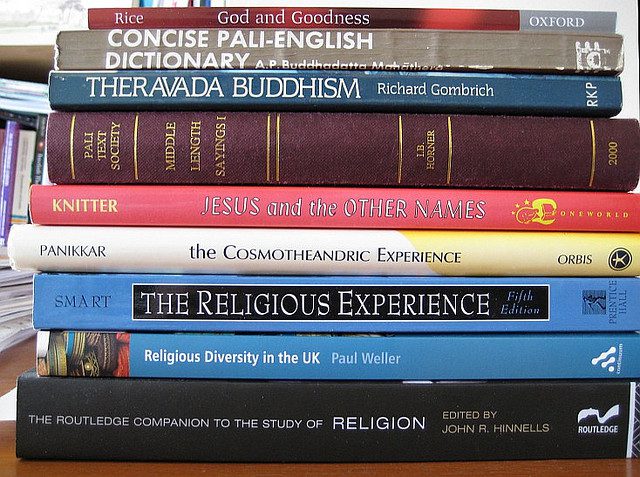
A small stack of books for religious studies, photo by Paul Trafford; C.C. Flickr.
As winter break wraps up and spring semester starts at colleges and universities across the country, more than a few students out there will be reconsidering their choice of majors, or at least dabbling in fun and interesting classes outside their department. While a number of classes may come highly recommended, two courses that really must be taken by any student today are an Introduction to World Religions and an introductory Philosophy course, which come under many names:
- “World Philosophies” tends to be rare, but should include thinkers from outside the typically Euro-American-centric world of Western academic Philosophy,
- “Ethics: Great Traditions” will give you Aristotle, Kant, and Mill with a few others sprinkled in,
- “Ancient Philosophy” will introduce you to mostly Greek and Roman thought that shaped European culture including its religious thought,
- “Modern Philosophy,” which usually follows from Ancient, introducing you to thinkers ranging generally from Descartes to Kant or so, again giving you access to the thoughts and ideas that shaped the world we live in today, and
- “Logic,” which is one I’d reserve for people who like systems, puzzles, and perhaps mathematics or those ready to dive fully into philosophy.
My own flirtations with philosophy and religious studies started as an undergraduate about 15 years ago. I was studying Business with a focus on Accounting and slowly came to realize that my highest career aspirations involved things like having my own office, and then one with a window, and, if I really did well, two windows. Suddenly accounting, which I had been great at in High School and my first year at University, lost all appeal. My whole life’s journey suddenly lost meaning and I had what some people would call an “existential crisis” and others would just trump up to late teen hormonal or brain-chemical imbalance. I suffered my way through the last months of spring semester and promptly dropped out of college, returned home and got a 9-5 job at a local radio station. The one thing that 9-5 job taught me was that I never wanted another 9-5 job again. In hindsight it wasn’t all that bad: I only really worked about 2-3 hours a day, with the rest of my time free to teach myself html (this was the late 90s) and to read books, the most memorable being Crime and Punishment. This sparked a fire in me of wonder about the world and the workings of the human mind. Returning to college the next fall, I promptly enrolled in as many non-business related classes as I could. Two of those were an Intro to Buddhism class and an Ethics: Great Traditions class. And as they say, the rest is history. (Or, in reality, they say that the rest is a meandering journey of changing majors, fumbling through two MA programs, landing in a nearly perfect PhD position and wandering to and fro from there as well, but that’s a longer story). On to the articles: 1. First, from the Studying Religion in Culture at the University of Alabama blog, comes a spirited argument – from a sophomore – about why every student should take a religious studies class. Not long after changing her major to Religious Studies, Emily Vork says:
It quickly became clear to me that the field of Religious Studies is not really all that well-known or well-understood. Religious Studies is not Theology, nor is it a field full of classes like “Why God Doesn’t Exist” or “Everyone Should Be Buddhist”.
Learning to live in a state of suspended ambiguity is key to the study of religion (and philosophy, and well, a lot of things). The students who will do well are those who can thrive in that larger realm of ambiguity: finding solid markers like texts, inscriptions, historical facts and arguments, etc, but still accepting that what any of these really mean might be open to certain degrees of interpretation and nuance. Those who suffer the most are the students who cling most firmly to past understandings of what x is or how x is to be taught. Volk nails it when she writes:
After taking just a handful of classes in the department, each of which covering a variety of different topics, I’ve found that my capacity for critical thinking has increased tremendously. Things are no longer quite so cut-and-dry. News headlines that I would have previously accepted without a second thought I now find myself wondering: who wrote that? How did they write it, and why did they write the way they did? On top of that, I notice now that I’m more willing to take a step back from anything and give it a critical glance. Why are social norms the norm? To quote one of our department’s business cards: “Why do we cheer for the home team?”
2. The second article is a defense of philosophy in light of today’s dismal state of politics and culture in American society. In a recent article at Huffington Post, Michael Shemmer, a “law student and cynical idealist,” writes of the current situation that, “Anger is everywhere; understanding is nowhere.” That anger is based in generally polarized views held with “iron certainty.”
Shemmer continues (with optimism not unlike my own – see my last post), that:
With a philosophic worldview, a Republican who despises any tax increase or economic stimulus could at least consider the notion of tax hikes or Keynesian economics. A Democrat facing antithetical ideas could do likewise. Thought rather than anger could become the default response to opposing worldviews.
Indeed, philosophy can do a great deal to lessen the anger that is growing like a cancerous tumor in modern America. The tools exist in both Eastern and Western thought — in the Stoic exhortation to accept the present as it is, in Buddhist meditation, in the Humanist’s transcendent appeal to reason, in Kant’s categorical imperative. Philosophy can help us inculcate virtue for, in the words of Socrates, “knowledge is virtue.”
Any philosophy major will know the cliche that we learn not what to think, but how to think. This is important to recognize because so many people and indeed so many stressed out students just want to know what to think, what to regurgitate, they want information to absorb (in the best case), or to be entertained (in the worst). All of the talk of shrinking attention spans and addictions to the instant gratification of technology seems true across our society these days, and all of this is antithetical to philosophical thinking.
In the age of instant access to the web: email, chat, facebook, insta-everything; there’s no time for simply pondering the big questions. Hence the demand for quick and easy answers. As Shemmer continues:
I think this is a great mistake. We should consider these questions. For by reading philosophy, I became less frightened of them. I no longer shirked away from contemplating death (thanks Epicurus) or morality (thanks Kant) or misfortune (thanks Epictetus). More, I realized that anger — in both politics and everyday life — is largely a reaction to fear, and that this fear can be lessened exponentially through the sort of reflection philosophy fosters.
People today, especially young people, have plenty of reasons to be afraid. But it is only in our incapacity to think through those fears that anger arises out of them. There are fine distinctions to be made, as well, between the kind of outrage one feels at seeing injustice and the resulting move to correct action and the kind of wild, destructive, polarizing anger Buddhists (and philosophers) tend to worry about.
But suffice to say that thinking deeply about world issues from a wide variety of standpoints, seeking to broaden one’s own in turn, leads to a calmer, clearer, more focused, and effective direction in life.
Previous Post

January 20, 2015
Does the "arc of the moral universe" bend toward justice?
Browse Our Archives
Select a Category Academia Activism American Buddhism Art Book review Buddhism Buddhism Today Buddhist Ethics Burma/Myanmar China Christianity Commodification Environment Gender Happiness Health Humor India Interfaith Islam Japanese Buddhism Kant Media / News Meditation mindfulness Photography Poetry Politics quicktakes Running Teaching Technology Thailand Theism/Atheism Theravada Tibet Tibetan Buddhism Travels Uncategorized Unitarian Universalism video Western Philosophy Zen
Select a Month June 2021 January 2021 November 2020 August 2020 July 2020 March 2020 January 2020 October 2019 August 2019 June 2019 May 2019 March 2019 February 2019 January 2019 December 2018 November 2018 October 2018 September 2018 August 2018 July 2018 June 2018 May 2018 April 2018 March 2018 February 2018 January 2018 December 2017 November 2017 October 2017 September 2017 August 2017 July 2017 June 2017 May 2017 April 2017 March 2017 February 2017 January 2017 December 2016 November 2016 October 2016 September 2016 August 2016 July 2016 June 2016 May 2016 April 2016 March 2016 February 2016 January 2016 December 2015 November 2015 October 2015 September 2015 August 2015 July 2015 June 2015 May 2015 April 2015 March 2015 February 2015 January 2015 December 2014 November 2014 October 2014 September 2014 August 2014 July 2014 June 2014 May 2014 April 2014 March 2014 February 2014 January 2014 December 2013 November 2013 October 2013 September 2013 August 2013 July 2013 June 2013 May 2013 April 2013 March 2013 February 2013 January 2013 December 2012 November 2012 October 2012 September 2012 August 2012 July 2012 June 2012 May 2012 April 2012 March 2012 February 2012 January 2012 December 2011 November 2011 October 2011 September 2011 August 2011 July 2011 June 2011 May 2011 April 2011 March 2011 February 2011 January 2011 December 2010 November 2010 October 2010 September 2010 August 2010 July 2010 June 2010 May 2010 April 2010 March 2010 February 2010 January 2010 December 2009 November 2009 October 2009 September 2009 August 2009 July 2009 June 2009 May 2009 April 2009 March 2009 February 2009 January 2009 December 2008 November 2008 October 2008 September 2008 August 2008 July 2008 June 2008 May 2008 April 2008 March 2008 September 2007 August 2007 July 2007 June 2007 May 2007 April 2007 March 2007 February 2007 January 2007 December 2006 November 2006 October 2006 September 2006 August 2006 July 2006 June 2006 May 2006 April 2006 March 2006 February 2006 January 2006 December 2005 November 2005 October 2005 September 2005 November 2004 September 2004 August 2004
Follow Us!
TAKE THE
Religious Wisdom Quiz
What is the small, portable cross worn as a sign of faith and blessing called?
Select your answer to see how you score.
Chalice Mitre Tabernacle Crucifix
Support this
Column


Related posts from American Buddhist Perspectives

For Pride Month: Our 2015 Interview with La...
American Buddhist Perspectives

Standing up to Lies: Can America Emerge from...
American Buddhist Perspectives

In strife and uncertainty: let us remember loving-kindness
American Buddhist Perspectives

A Festival of Radical Awakening: Socially Engaged Buddhism...
American Buddhist Perspectives
TRENDING AT PATHEOS Buddhist

On Taking Refuge in the Dharma
(Here I continue the feature of sharing talks and essays by teachers...

(Continuing my intention to share talks and essays by other members of Empty...
The Subtle Art of Bowing: A Dharma Discourse
(This presentation was first offered by my dear friend Dharma Holder Tom...

Internal Family Systems Can Heal you Mentally &...
How IFS Helped Me Stop Fighting Myself Internal Family Systems (IFS) is...

The Bible No One Spoke About: A Family’s...
A mysterious family Bible, unspoken faith, and a journey from curiosity to...

How Uncertainty Can Transform Your Life in 2025
Embracing Uncertainty: A New Year’s Resolution for the Brave As 2025 approaches,...
view all Buddhist blogs
Ad-Free & Subscriber Log-In Subscription Support
- About Us
- 2026 Calendar
- Videos
- Podcasts
- Library of World Religions
- Faith In Media Tracker
- Advertise With Us
- Write for Us
- Privacy Policy
- Terms of Service
- Do Not Sell My Data
- Contact Us
- Radiant Digital
- Manage Newsletter Subscriptions
- Unsubscribe From Notifications
- Sitemap
Copyright 2008-2026, Patheos. All rights reserved.
Subscription Support Ad-Free & Subscriber Log-In
Follow Patheos