
BuddhistCatholicContemplativeEvangelicalGeneral ChristianHinduJewishLatter-day SaintMuslimNew VisionsProgressive Christian
Beliefs
- Buddhist
- Catholic
- Contemplative
- Evangelical
- General Christian
- Hindu
- Jewish
- Latter-day Saint
- More Voices
- Muslim
- New Visions
- Pagan
- Progressive Christian
Topics
- Religion News
- Food and Religion
- Sports and Religion
- Religious Art
- Religious Music and Entertainment
- Religious Events
- History and Religion
- Style and Religion
- Politics and Religion
- Women in Religion
- Recreation Outdoors and Religion
- Business Finance and Religion
- Careers Workplace and Religion
- Education and Religion
- Family Parenting and Religion
- Health Fitness and Religion
- Home and Religion
- Relationships and Religion
- Technology and Religion
- Travel and Religion
Columnists
- Buddhist Columnists
- Business Finance and Religion Columnists
- Careers Workplace and Religion Columnists
- Catholic Columnists
- Contemplative Columnists
- Education and Religion Columnists
- Evangelists Columnists
- Family Parenting and Religion Columnists
- General Christian Columnists
- Health Fitness and Religion Columnists
- Hindu Columnists
- History and Religion Columnists
- Home and Religion Columnists
- Jewish Columnists
- More Voices Columnists
- Latter Day Columnists
- Muslim Columnists
- New Visions Columnists
- Nonreligious Columnists
- Pagan Columnists
- Politics and Religion Columnists
- Progressive Columnists
- Recreation Outdoors and Religion Columnists
- Relationships and Religion Columnists
- Religion News Columnists
- Religious Art Columnists
- Religious Events Columnists
- Religious Music and Entertainment Columnists
- Sports and Religion Columnists
- Style and Religion Columnists
- Technology and Religion Columnists
- Travel and Religion Columnists
- Women in Religion Columnists
Resource Library
- 2026 Calendar
- Library of World Religions
- The 100 Most Holy Places on Earth
- Patheos Answers
- Podcasts
- Videos
- Faith Leaders Database
- Anglican Episcopalian
- Bahai
- Baptist
- Buddhism
- Christianity
- Confucianism
- Eastern Orthodoxy
- Hinduism
- Holiness and Pentecostal
- ISKCON
- Islam
- Judaism
- Lutheran
- Methodist
- The Church of Jesus Christ of Latter-day Saints
- New Age
- Paganism
- Presbytarian and Reformed
- Protestantism
- Religion Behind the Scenes
- Roman Catholic
- Scientology
- Shia Islam
- Sikhism
- Sufism
- Sunni Islam
- Taoism
- Zen
- See all religions
Research Tools
 Ad-Free & Subscriber Log-In Subscription Support
Ad-Free & Subscriber Log-In Subscription Support
Follow Patheos 

- Trending:
- Forgiveness
- |
- Marriage
- |
- Consciousness
- |
- Death Penalty
- |
- Election
- |
- Halloween
 American Buddhist Perspectives
- Home
- Buddhist
- Religion News
- World Compassion and Vegan day – via the Jain eLibrary
World Compassion and Vegan day – via the Jain eLibrary
Last updated on: October 30, 2014 at 10:11 am by Justin Whitaker
World Compassion and Vegan day – via the Jain eLibrary 2014-10-30T10:11:18-06:00 Justin Whitaker
Patheos Explore the world's faith through different perspectives on religion and spirituality! Patheos has the views of the prevalent religions and spiritualities of the world.
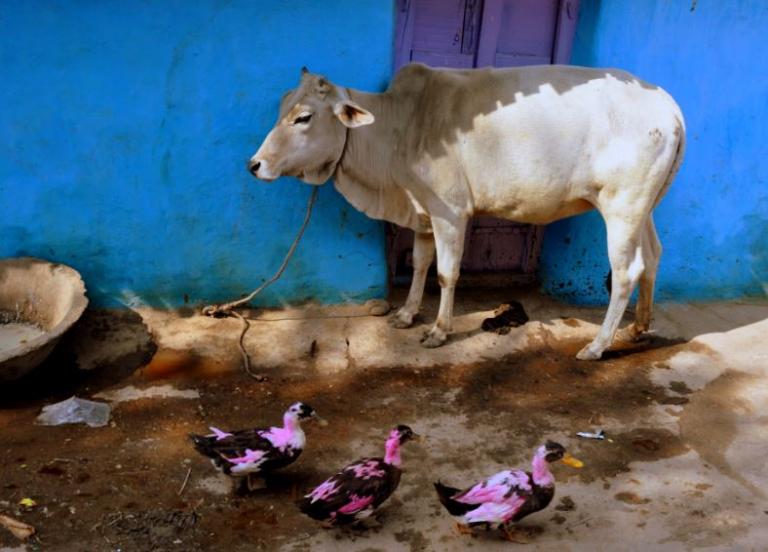
One of my favorite non-Buddhist religions to teach and to study is Jainism, which is a bit like Buddhist asceticism on steroids. Jains also share a deep respect for non-human animals and generally act on that in compassionate ways that put most other religions to shame. The religion is small, limited mostly to India, though there are Jains all over the world, so they rarely get much press. Yesterday I received the following newsletter from a Jain list I am on and I thought I’d pass it on to you in full. It contains information on veganism focused on India and the different ways that milk is obtained (by ‘conventional’ means and by a Jain dairy), and it requests a global day of veganism on Saturday, November 1st. You can subscribe at the bottom if you are interested. The photos inserted are mine from Bodhgaya. 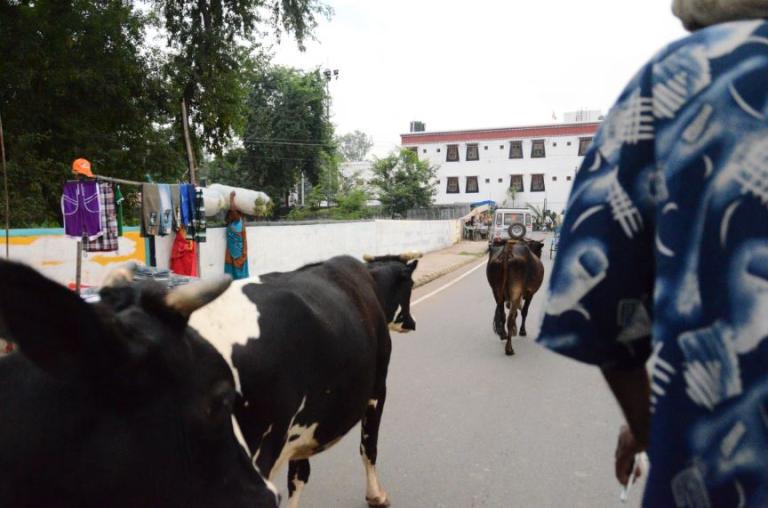
WORLD COMPASSION AND VEGAN DAY Federation of JAINA, Young Jains of America, Young Jain professionals and many Jain centers of North America jointly celebrate Nov. 1, 2014 as a World Compassion and Vegan Day. Several activities will be taking place in Jain centers of North America. Please be VEGAN on this day (November 1, 2014)! Veganism is the practice of abstaining from the use of animal products in all walks of life. Vegan diet is a strict vegetarian diet and do not consume meat, eggs, dairy products (milk cheese, ice-cream, Ghee, etc.) and other animal-derived substances. Vegans do not use silk, wool, and leather products. The basic and very fundamental principle of Jainism is Non-violence. Lord Mahavir said in Jain Agam Sutrakrutang that “One should treat all beings as one would like to be treated.” Since most of the Jains are vegetarian but they do consume dairy products, I have compiled the dairy related information in this short article. Operation of the Commercial Dairy Industry The Wikipedia explains the cruelty that exists in the dairy industry and also its impact on health and environment as follows (Ref – https://https://en.wikipedia.org/wiki/Veganism): “To obtain milk from dairy cattle, Cows are kept pregnant through artificial insemination to prolong lactation. Male calves are slaughtered at birth, or sent for veal production or reared for beef. Female calves are separated from their mothers within 24 to 48 hours of birth and fed milk replacer, so that the cows’ milk is retained for human consumption.[57] After five years or so they (mother cows) are slaughtered to be made into ground-meat products, although they might otherwise live for 20 years.[58] The situation is similar with goats and their kids.[59] In November 2006 a United Nations Food and Agriculture Organization report, Livestock’s Long Shadow, linked animal agriculture to environmental damage. It concluded that: Livestock farming (primarily of cows, chickens and pigs) has an impact on almost all aspects of the environment: air, land, soil, water, biodiversity and climate change.[152] According to the report, livestock account for 9 percent of carbon dioxide emissions, 37 percent of methane, 65 percent of nitrous oxide, and 68 percent of ammonia, and livestock waste emits 30 million tons of ammonia a year, which the report said is involved in the production of acid rain.[153]” In June 2010 a report from the United Nations Environment Programme said that a move toward a vegan diet is needed to save the world from hunger, fuel shortages, and climate change.[154 A 2009 research review indicated that “Vegan diets tend to be higher in dietary fibre, magnesium, folic acid, vitamin C, vitamin E, iron and phytochemicals, and lower in calories, saturated fat, cholesterol, long-chain omega-3 fatty acids, vitamin D, calcium, zinc and vitamin B12.[8] Well-planned vegan diets appear to offer protection against certain degenerative conditions, including heart disease,[9]and are regarded as appropriate for all stages of the life-cycle by the American Dietetic Association, the Australian National Health and Medical Research Council, and Dietitians of Canada.[10] Because uncontaminated plant foods do not provide vitamin B12 (which is produced by microorganisms such asbacteria), researchers agree that vegans should eat B12-fortified foods or take a supplement.[11]” A Jain Dairy Visit: The following practice is used by this Jain Dairy (size 25 to 35 cows) It keeps all cows pregnant not via artificial insemination but one bull is used to make them pregnant. Three months after the delivery, it makes the mother cow pregnant again. After birth baby calf is kept with the mother for upto six months. During this time it allows the calf to suck mother’s milk from one udder only. This way baby calf receives 25% of the required milk from the mother. It substitutes milk replacer (commercial product) to the calf to satisfy its remaining hunger. The remaining three udder milk is used for human consumption. Within six months, it ships the male calf either to Panjarapole or gives away to other dairy farmer who is in need of a Bull. When the calf is separated from the mother, the mother cow cries loudly and does not eat any meal for a day and does not produce any milk for a couple days. It remains depressed for a few days. At age of 5 to 6 years, it ships mother cow to Panjarapole because after three deliveries, its milk yield reduces significantly. Also during this time two year old female baby calves are ready to replace them. So long as cows produce enough quantity of milk, the Jain dairy farm takes care of them very well. The milk production cost of this Jain dairy is about 5 times than the commercial milk available in the market. One can see that even compassionate Jain dairy cannot afford to give all the milk of a mother cow to her baby. If it does, then there will not be any leftover milk for human consumption and the purpose of the dairy no longer exists. Cattle Slaughter in India (Ref – Wikipedia) “In a country where so many people view cows as sacred, India could soon become the world’s biggest beef exporter, according to the United States Department of Agriculture (USDA). India produced 3.643 million metric tons of beef in 2012, of which 1.963 million metric tons was consumed domestically and 1.680 million metric tons was exported. India ranks 5th in the world in beef production, 7th in domestic consumption and 1st in exporting.” http://www.financialexpress.com/news/india-could-soon-become-world-s-biggest-beef-exporter/1206978 Comment One can see that extreme cruelty exists in dairy and meat industries in India and everywhere in the world. The industry also destroys the environment and our health. Also the dairy product is not needed for our healthy survival (one billion Chinese people historically did not drink milk). On the contrary it destroys our health. Following is the simple explanation of cruelty in Dairy Industry:
- Cow does not produce milk unless she first delivers her baby Calf (just like humans)
- When the cow is just 15 months old, she is made pregnant the first time. She delivers her first baby 9 months later (similar to humans). This time she is just two years old.
- Now Mother cow starts to produce milk for her baby calf and just enough for her calf (it is also a law of nature for humans as well as animals).
- Nature has not provided any ability to the cows or any other animals or humans to produce more milk than the need of their babies.
- When baby calf reaches to 8 week of age she starts to eat other foods along with milk, and the mother cow’s milk production ability slowly reduces under natural environment.
- However under commercial environment, the new born female baby calf is given mother’s milk for only 3 to 4 days and then she is separated from mother and fed with milk replacer and some regular food upto 8 weeks, and then only regular food upto 15 months. At this time the dairy farmer will make the 15 month old female calf (now cow) pregnant by bull or artificial insemination.
- Also under commercial environment the newborn male baby calf is separated from her mother after 3 days and he is shipped to the veal industry or to a slaughter house.
- Also under commercial environment, the dairy farmers make the mother cow pregnant after 8 weeks of delivery so that she will continually produce large quantity of milk.
- After three deliveries, the mother cow’s natural milk producing ability drops even if she is kept pregnant. Hence she is not economical viable commodity. So the commercial dairy farmer ships her to slaughter house and Jain dairies in India ship them to Panjara-poles.
- No one wants to take care of less productive cows.
Summary: In summary, we steal milk from cow, feed her female baby calf substitute products, slaughter her male calf in three days for veal or within six months for beef, and slaughter her in 6 years. The milk and meat productions destroy the environment (cruelty to environment), and we destroy our health (cruelty to our self) by consuming dairy products. We become a part of this cruel cycle so that we can enjoy tasty foods using dairy products (milk, ice-cream, cheese, butter, ghee, sweets, etc.) not only in our homes, but also in Jain functions! Now can we ask ourselves – Are we really Jains practicing Ahmisa in its true spirit? Notes: Are Jello and Jello pudding dairy products? (a question was asked by our youth) Jello is an animal product, but not a dairy product. It is made of gelatin, which comes from the marrow of animal bones. The slaughterhouses produce gelatin after boiling bones, cartilage, hooves, skins, and the fat and meat by products. The gelatin is filtered out and dried, and sold in sheet or granulated form. Jello is a mix of water, gelatin, sugar, artificial colors and flavorings, acids for sour and tart taste, preservatives, and contains no milk or dairy products. Jello pudding however is based on cornstarch instead of gelatin, and requires milk to set, so it is a dairy product. Hats off The Jain community of Shree Digamber Jain Association, in London, UK, held their annual Swamivatsalya Bhojan (after Das-Laxana Paryushan Parva) on 14th September 2014, and the committee served only vegan Jain food on this occasion. In the menu they served following items: Vegan Bundi Ladoo, Puran puri with coconut oil, Mix vegetable shak, Daal instead of Kadhi, Samosas, Daal bhajia, Rice, Salad, Chutneys, Coconut water, and Plain water. To my knowledge, this is the first major adult Jain community function serving all vegan food to the community. It seems that the adult Jain community in UK is very receptive to Vegan concept. Jain vegan group in UK is very active in the community for the promotion of veganism Also there is a UTube video of a Digambara Jain muni describing the reasons that we should not consume dairy .products http://veganjains.com/2014/07/30/jain-digambar-muni-urges-jains-to-renounce-milk/
Veganism in America: The Huffing post report predicts that: “No Lie Can Live Forever: Predicting a Vegan America by 2050 http://www.huffingtonpost.com/kathy-stevens/predicting-a-vegan-america_b_4905691.html Vegetarian Times Study Shows 7.3 Million Americans Are Vegetarians and an additional 22.8 Million follow a Vegetarian-Inclined Diet. Approximately 1 million, of those are vegans, who consume no animal products at all. In addition, 10 percent of U.S., adults, or 22.8 million people, say they largely follow a vegetarian-inclined diet.” With regards to Jain community in America, Young Jain of America (YJA) and Young Jain Professionals (YJP) are two committed organizations with regards to Veganism. The last two YJA conventions were almost vegan conventions. Now we are very happy to know that Federation of JAINA joined the Vegan movement this year. We sincerely hope that the JAINA will put in practice what they are supporting and make the next JAINA convention of 2015 totally vegan and environmental friendly by not using dairy products, plastic/foam plates and cups. JAINA Education committee is totally dedicated to Veganism for the past 15 years. All our Päthashälä books are dedicated to the people around the world living vegan way of life. We do not support dairy products and other products such as silk, wool, and leather in any of our Päthashälä books. Also we sincerely hope that the Jain adult community of North America who are associated with various Jain centers learn some thing from our American born Jain youth and make every Jain functions environmental friendly and serve only cruelty free foods. . Significant resources are available on Internet to educate our selves with regards to Veganism, cruelty in dairy and meat industry, and impact on environment by these industries. The education committee is in process of compiling educational information on Veganism and cruelty in dairy industry. This information will be available via Jainelibrary website within a few months. I sincerely apologize if I have hurt your feeling. Pravin K Shah Jaina Education Committee Jain eLibrary Project [email protected] 919 859 4994 Home 919 889 1900 Cell To subscribe from Jain eLibrary Mailing list. – Please click the following Link http://jainelibrary.org/

Next Post

November 12, 2014 Thich Nhat Hanh is in hospital and "full recovery may be possible"
Browse Our Archives
Select a Category Academia Activism American Buddhism Art Book review Buddhism Buddhism Today Buddhist Ethics Burma/Myanmar China Christianity Commodification Environment Gender Happiness Health Humor India Interfaith Islam Japanese Buddhism Kant Media / News Meditation mindfulness Photography Poetry Politics quicktakes Running Teaching Technology Thailand Theism/Atheism Theravada Tibet Tibetan Buddhism Travels Uncategorized Unitarian Universalism video Western Philosophy Zen
Select a Month June 2021 January 2021 November 2020 August 2020 July 2020 March 2020 January 2020 October 2019 August 2019 June 2019 May 2019 March 2019 February 2019 January 2019 December 2018 November 2018 October 2018 September 2018 August 2018 July 2018 June 2018 May 2018 April 2018 March 2018 February 2018 January 2018 December 2017 November 2017 October 2017 September 2017 August 2017 July 2017 June 2017 May 2017 April 2017 March 2017 February 2017 January 2017 December 2016 November 2016 October 2016 September 2016 August 2016 July 2016 June 2016 May 2016 April 2016 March 2016 February 2016 January 2016 December 2015 November 2015 October 2015 September 2015 August 2015 July 2015 June 2015 May 2015 April 2015 March 2015 February 2015 January 2015 December 2014 November 2014 October 2014 September 2014 August 2014 July 2014 June 2014 May 2014 April 2014 March 2014 February 2014 January 2014 December 2013 November 2013 October 2013 September 2013 August 2013 July 2013 June 2013 May 2013 April 2013 March 2013 February 2013 January 2013 December 2012 November 2012 October 2012 September 2012 August 2012 July 2012 June 2012 May 2012 April 2012 March 2012 February 2012 January 2012 December 2011 November 2011 October 2011 September 2011 August 2011 July 2011 June 2011 May 2011 April 2011 March 2011 February 2011 January 2011 December 2010 November 2010 October 2010 September 2010 August 2010 July 2010 June 2010 May 2010 April 2010 March 2010 February 2010 January 2010 December 2009 November 2009 October 2009 September 2009 August 2009 July 2009 June 2009 May 2009 April 2009 March 2009 February 2009 January 2009 December 2008 November 2008 October 2008 September 2008 August 2008 July 2008 June 2008 May 2008 April 2008 March 2008 September 2007 August 2007 July 2007 June 2007 May 2007 April 2007 March 2007 February 2007 January 2007 December 2006 November 2006 October 2006 September 2006 August 2006 July 2006 June 2006 May 2006 April 2006 March 2006 February 2006 January 2006 December 2005 November 2005 October 2005 September 2005 November 2004 September 2004 August 2004
Follow Us!
TAKE THE
Religious Wisdom Quiz
Which prophet anointed both Saul and David as kings of Israel?
Select your answer to see how you score.
Samuel Gad Eli Nathan
Support this
Column


Related posts from American Buddhist Perspectives

For Pride Month: Our 2015 Interview with La...
American Buddhist Perspectives

A Festival of Radical Awakening: Socially Engaged Buddhism...
American Buddhist Perspectives

In Hong Kong, the Bodhisattvas wear Crosses
American Buddhist Perspectives

Bhikkhu Bodhi addresses the Climate Crisis at the...
American Buddhist Perspectives
TRENDING AT PATHEOS Buddhist

On Taking Refuge in the Dharma
(Here I continue the feature of sharing talks and essays by teachers...

(Continuing my intention to share talks and essays by other members of Empty...
The Subtle Art of Bowing: A Dharma Discourse
(This presentation was first offered by my dear friend Dharma Holder Tom...

Internal Family Systems Can Heal you Mentally &...
How IFS Helped Me Stop Fighting Myself Internal Family Systems (IFS) is...

The Bible No One Spoke About: A Family’s...
A mysterious family Bible, unspoken faith, and a journey from curiosity to...

How Uncertainty Can Transform Your Life in 2025
Embracing Uncertainty: A New Year’s Resolution for the Brave As 2025 approaches,...
view all Buddhist blogs
Ad-Free & Subscriber Log-In Subscription Support
- About Us
- 2026 Calendar
- Videos
- Podcasts
- Library of World Religions
- Faith In Media Tracker
- Advertise With Us
- Write for Us
- Privacy Policy
- Terms of Service
- Do Not Sell My Data
- Contact Us
- Radiant Digital
- Manage Newsletter Subscriptions
- Unsubscribe From Notifications
- Sitemap
Copyright 2008-2026, Patheos. All rights reserved.
Subscription Support Ad-Free & Subscriber Log-In
Follow Patheos