
BuddhistCatholicContemplativeEvangelicalGeneral ChristianHinduJewishLatter-day SaintMuslimNew VisionsProgressive Christian
Beliefs
- Buddhist
- Catholic
- Contemplative
- Evangelical
- General Christian
- Hindu
- Jewish
- Latter-day Saint
- More Voices
- Muslim
- New Visions
- Pagan
- Progressive Christian
Topics
- Religion News
- Food and Religion
- Sports and Religion
- Religious Art
- Religious Music and Entertainment
- Religious Events
- History and Religion
- Style and Religion
- Politics and Religion
- Women in Religion
- Recreation Outdoors and Religion
- Business Finance and Religion
- Careers Workplace and Religion
- Education and Religion
- Family Parenting and Religion
- Health Fitness and Religion
- Home and Religion
- Relationships and Religion
- Technology and Religion
- Travel and Religion
Columnists
- Buddhist Columnists
- Business Finance and Religion Columnists
- Careers Workplace and Religion Columnists
- Catholic Columnists
- Contemplative Columnists
- Education and Religion Columnists
- Evangelists Columnists
- Family Parenting and Religion Columnists
- General Christian Columnists
- Health Fitness and Religion Columnists
- Hindu Columnists
- History and Religion Columnists
- Home and Religion Columnists
- Jewish Columnists
- More Voices Columnists
- Latter Day Columnists
- Muslim Columnists
- New Visions Columnists
- Nonreligious Columnists
- Pagan Columnists
- Politics and Religion Columnists
- Progressive Columnists
- Recreation Outdoors and Religion Columnists
- Relationships and Religion Columnists
- Religion News Columnists
- Religious Art Columnists
- Religious Events Columnists
- Religious Music and Entertainment Columnists
- Sports and Religion Columnists
- Style and Religion Columnists
- Technology and Religion Columnists
- Travel and Religion Columnists
- Women in Religion Columnists
Resource Library
- 2026 Calendar
- Library of World Religions
- The 100 Most Holy Places on Earth
- Patheos Answers
- Podcasts
- Videos
- Faith Leaders Database
- Anglican Episcopalian
- Bahai
- Baptist
- Buddhism
- Christianity
- Confucianism
- Eastern Orthodoxy
- Hinduism
- Holiness and Pentecostal
- ISKCON
- Islam
- Judaism
- Lutheran
- Methodist
- The Church of Jesus Christ of Latter-day Saints
- New Age
- Paganism
- Presbytarian and Reformed
- Protestantism
- Religion Behind the Scenes
- Roman Catholic
- Scientology
- Shia Islam
- Sikhism
- Sufism
- Sunni Islam
- Taoism
- Zen
- See all religions
Research Tools
 Ad-Free & Subscriber Log-In Subscription Support
Ad-Free & Subscriber Log-In Subscription Support
Follow Patheos 

- Trending:
- Forgiveness
- |
- Marriage
- |
- Consciousness
- |
- Death Penalty
- |
- Election
- |
- Halloween
 American Buddhist Perspectives
- Home
- Buddhist
- Religion News
- Notes on teaching Buddhist philosophy
Notes on teaching Buddhist philosophy
Last updated on: September 20, 2014 at 4:27 am by Justin Whitaker
Notes on teaching Buddhist philosophy 2014-09-20T04:27:20-06:00 Justin Whitaker
Patheos Explore the world's faith through different perspectives on religion and spirituality! Patheos has the views of the prevalent religions and spiritualities of the world.
I’m teaching Buddhist philosophy in Bodhgaya, India at the moment, so much of my blogging-life is taken up by activities here. In lieu of all of that (I will post on my usual topics now and then) I thought I’d share notes from my teaching.
Teaching Buddhist philosophy to American college students from diverse backgrounds (some with extensive philosophy, some with Buddhism, some with a mix or neither) has been a challenge. To start, I wanted to get them thinking as philosophers, inheritors of a vast Western tradition, but not the kind of philosophers typified by or limited to 20th-century analytic philosophy. Rather, I want students to think about the kinds of philosophers who had the good life at the heart of their concerns. Read more from a post last year discussing Buddhism as a philosophy and/or a religion here.
So, casting philosophy as a wide net, I ask them to think about where and how Buddhism can fit in to the great philosophical tradition(s) we have today. As this image suggests, such an undertaking is by no means straightforward: even the artwork depicting how masters and disciples interacted around the same time period in Greece and India suggests two very different worlds of thought.
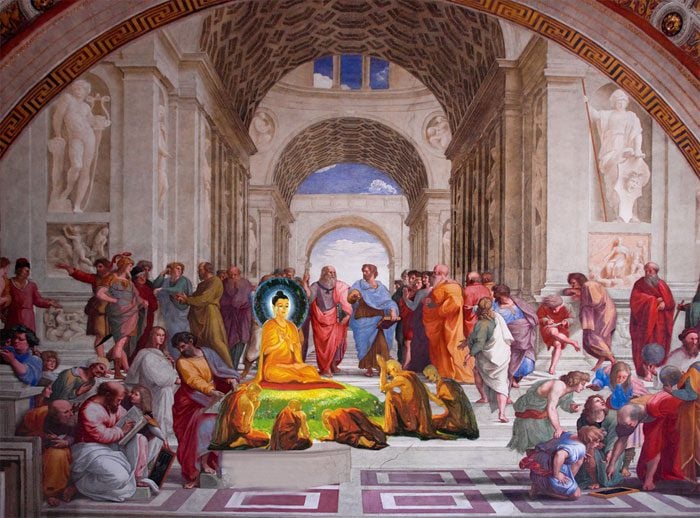
The job is difficult (and many people I’ve talked to over the years urge a quick abandoning of it – see comments in the link above), because it requires that students become bilingual in a way, speaking the languages of Western philosophy and Buddhism simultaneously. This is where the mixed classroom is difficult. We have to spend time getting everyone using the same terms and defining them in the same way. I’m told this is also a point of practice in Tibetan debate: if you can’t agree on basic terminology, the debate is over before it has begun. So terms like ontology, cosmology, metaphysics, and epistemology need to be defined and understood alongside karma, dependent origination, emptiness, and not-self.
My strategy has been one of an expanding spiral. We begin simply, with just a term, and then see how defining it invites in new terms. As we go we’ll notice that we’re coming back around to the original term, but now with a handful of definitions. From there we can expand to a few more definitions, using as many of the already-defined-and-understood terms as possible. The system is interlocking and continuously expanding. The danger is in expanding too far too fast. I’ve fallen into that a couple times.
In illustrating how some of these terms work, I have a handful of images taken from my studies of Buddhism, but more, it seems, from my background in philosophy. Something that Ethan Mills recently wrote in a comment at the Indian Philosophy Blog caught my eye. There, discussing the problem of mainstream receptions of Buddhist thought vs Western thought, he wrote:
When discussing Plato most professional philosophers today at least have a “cartoon version” of Plato for introductory courses. Discussion of Plato scholarship then at least has a place to start, a place from which you branch out into deeper, more interesting, and more uncertain terrain.
Nāgārjuna is as difficult as Plato, but the vast majority of professional philosophers lack a “cartoon version” of Nāgārjuna. This means there’s no solid place from which to swim off into the murky waters of Nāgārjuna scholarship. So when a respectable philosopher like Graham Priest comes along his Nāgārjuna becomes the cartoon Nāgārjuna, and indeed a stand in for the entire Buddhist tradition. If you can forgive a riff on Plato, philosophers mistake one shadow on the wall for the real thing!
Perhaps we need to remind our colleagues that the great philosophers of the Western tradition are still subject to competing interpretations and have been for a long time. People have been arguing about Plato for over 2,000 years! Thinking about a Buddhist philosopher like Nāgārjuna is like diving into Plato scholarship without having recourse to the cartoonish, simplified version of Plato. Learning about many philosophers is a complex process of going from simplistic shadows on the wall to the complexity of the real thing (or depending on how you feel about scholars, perhaps it’s the other way around!). For me, this is part of what makes the study of Indian philosophy exciting and interesting.
But how do we convince people that all this work is worthwhile? Which Nāgārjuna do you start with to even begin a serious conversation?
What I take from this is that we desperately need some “cartoon versions” of Buddhist thought because right now, while we have general agreement about certain key ideas in Buddhism, there is so much wiggle room that contemporary scholars and practitioners can get away with any number of interpretations.
With that by way of introduction, I’ll begin posting suggestions toward such “cartoon versions” of things like early Buddhist ontology, Nāgārjuna’s epistemology (?), and the likes with the hope that clarifications or counter-cartoons can be introduced by you, good readers.
Next Post

September 21, 2014 Shinnyo Lantern Floating for Peace: NY City, beginning Sept 21
Browse Our Archives
Select a Category Academia Activism American Buddhism Art Book review Buddhism Buddhism Today Buddhist Ethics Burma/Myanmar China Christianity Commodification Environment Gender Happiness Health Humor India Interfaith Islam Japanese Buddhism Kant Media / News Meditation mindfulness Photography Poetry Politics quicktakes Running Teaching Technology Thailand Theism/Atheism Theravada Tibet Tibetan Buddhism Travels Uncategorized Unitarian Universalism video Western Philosophy Zen
Select a Month June 2021 January 2021 November 2020 August 2020 July 2020 March 2020 January 2020 October 2019 August 2019 June 2019 May 2019 March 2019 February 2019 January 2019 December 2018 November 2018 October 2018 September 2018 August 2018 July 2018 June 2018 May 2018 April 2018 March 2018 February 2018 January 2018 December 2017 November 2017 October 2017 September 2017 August 2017 July 2017 June 2017 May 2017 April 2017 March 2017 February 2017 January 2017 December 2016 November 2016 October 2016 September 2016 August 2016 July 2016 June 2016 May 2016 April 2016 March 2016 February 2016 January 2016 December 2015 November 2015 October 2015 September 2015 August 2015 July 2015 June 2015 May 2015 April 2015 March 2015 February 2015 January 2015 December 2014 November 2014 October 2014 September 2014 August 2014 July 2014 June 2014 May 2014 April 2014 March 2014 February 2014 January 2014 December 2013 November 2013 October 2013 September 2013 August 2013 July 2013 June 2013 May 2013 April 2013 March 2013 February 2013 January 2013 December 2012 November 2012 October 2012 September 2012 August 2012 July 2012 June 2012 May 2012 April 2012 March 2012 February 2012 January 2012 December 2011 November 2011 October 2011 September 2011 August 2011 July 2011 June 2011 May 2011 April 2011 March 2011 February 2011 January 2011 December 2010 November 2010 October 2010 September 2010 August 2010 July 2010 June 2010 May 2010 April 2010 March 2010 February 2010 January 2010 December 2009 November 2009 October 2009 September 2009 August 2009 July 2009 June 2009 May 2009 April 2009 March 2009 February 2009 January 2009 December 2008 November 2008 October 2008 September 2008 August 2008 July 2008 June 2008 May 2008 April 2008 March 2008 September 2007 August 2007 July 2007 June 2007 May 2007 April 2007 March 2007 February 2007 January 2007 December 2006 November 2006 October 2006 September 2006 August 2006 July 2006 June 2006 May 2006 April 2006 March 2006 February 2006 January 2006 December 2005 November 2005 October 2005 September 2005 November 2004 September 2004 August 2004
Follow Us!
TAKE THE
Religious Wisdom Quiz
Who saw a burning bush that was not consumed?
Select your answer to see how you score.
Isaiah Moses Noah Elijah
Support this
Column


Related posts from American Buddhist Perspectives

For Pride Month: Our 2015 Interview with La...
American Buddhist Perspectives

Standing up to Lies: Can America Emerge from...
American Buddhist Perspectives

In strife and uncertainty: let us remember loving-kindness
American Buddhist Perspectives

In the rush to return to normal, can...
American Buddhist Perspectives
TRENDING AT PATHEOS Buddhist

On Taking Refuge in the Dharma
(Here I continue the feature of sharing talks and essays by teachers...

(Continuing my intention to share talks and essays by other members of Empty...
The Subtle Art of Bowing: A Dharma Discourse
(This presentation was first offered by my dear friend Dharma Holder Tom...

Internal Family Systems Can Heal you Mentally &...
How IFS Helped Me Stop Fighting Myself Internal Family Systems (IFS) is...

The Bible No One Spoke About: A Family’s...
A mysterious family Bible, unspoken faith, and a journey from curiosity to...

How Uncertainty Can Transform Your Life in 2025
Embracing Uncertainty: A New Year’s Resolution for the Brave As 2025 approaches,...
view all Buddhist blogs
Ad-Free & Subscriber Log-In Subscription Support
- About Us
- 2026 Calendar
- Videos
- Podcasts
- Library of World Religions
- Faith In Media Tracker
- Advertise With Us
- Write for Us
- Privacy Policy
- Terms of Service
- Do Not Sell My Data
- Contact Us
- Radiant Digital
- Manage Newsletter Subscriptions
- Unsubscribe From Notifications
- Sitemap
Copyright 2008-2026, Patheos. All rights reserved.
Subscription Support Ad-Free & Subscriber Log-In
Follow Patheos