
BuddhistCatholicContemplativeEvangelicalGeneral ChristianHinduJewishLatter-day SaintMuslimNew VisionsProgressive Christian
Beliefs
- Buddhist
- Catholic
- Contemplative
- Evangelical
- General Christian
- Hindu
- Jewish
- Latter-day Saint
- More Voices
- Muslim
- New Visions
- Pagan
- Progressive Christian
Topics
- Religion News
- Food and Religion
- Sports and Religion
- Religious Art
- Religious Music and Entertainment
- Religious Events
- History and Religion
- Style and Religion
- Politics and Religion
- Women in Religion
- Recreation Outdoors and Religion
- Business Finance and Religion
- Careers Workplace and Religion
- Education and Religion
- Family Parenting and Religion
- Health Fitness and Religion
- Home and Religion
- Relationships and Religion
- Technology and Religion
- Travel and Religion
Columnists
- Buddhist Columnists
- Business Finance and Religion Columnists
- Careers Workplace and Religion Columnists
- Catholic Columnists
- Contemplative Columnists
- Education and Religion Columnists
- Evangelists Columnists
- Family Parenting and Religion Columnists
- General Christian Columnists
- Health Fitness and Religion Columnists
- Hindu Columnists
- History and Religion Columnists
- Home and Religion Columnists
- Jewish Columnists
- More Voices Columnists
- Latter Day Columnists
- Muslim Columnists
- New Visions Columnists
- Nonreligious Columnists
- Pagan Columnists
- Politics and Religion Columnists
- Progressive Columnists
- Recreation Outdoors and Religion Columnists
- Relationships and Religion Columnists
- Religion News Columnists
- Religious Art Columnists
- Religious Events Columnists
- Religious Music and Entertainment Columnists
- Sports and Religion Columnists
- Style and Religion Columnists
- Technology and Religion Columnists
- Travel and Religion Columnists
- Women in Religion Columnists
Resource Library
- 2026 Calendar
- Library of World Religions
- The 100 Most Holy Places on Earth
- Patheos Answers
- Podcasts
- Videos
- Faith Leaders Database
- Anglican Episcopalian
- Bahai
- Baptist
- Buddhism
- Christianity
- Confucianism
- Eastern Orthodoxy
- Hinduism
- Holiness and Pentecostal
- ISKCON
- Islam
- Judaism
- Lutheran
- Methodist
- The Church of Jesus Christ of Latter-day Saints
- New Age
- Paganism
- Presbytarian and Reformed
- Protestantism
- Religion Behind the Scenes
- Roman Catholic
- Scientology
- Shia Islam
- Sikhism
- Sufism
- Sunni Islam
- Taoism
- Zen
- See all religions
Research Tools
 Ad-Free & Subscriber Log-In Subscription Support
Ad-Free & Subscriber Log-In Subscription Support
Follow Patheos 

- Trending:
- Forgiveness
- |
- Marriage
- |
- Consciousness
- |
- Death Penalty
- |
- Election
- |
- Halloween
 American Buddhist Perspectives
- Home
- Buddhist
- Religion News
- Ethnocentric Buddhism continued…
Ethnocentric Buddhism continued…
Last updated on: April 24, 2014 at 10:35 pm by Justin Whitaker
Ethnocentric Buddhism continued… 2014-04-24T22:35:46-06:00 Justin Whitaker
Patheos Explore the world's faith through different perspectives on religion and spirituality! Patheos has the views of the prevalent religions and spiritualities of the world.
Coming just off the heals of the 20th anniversary of the beginning of the Rwandan genocide, we are called ever more clearly to understand conflicts in the world that might lead to such horrors. What is happening in Burma today eerily reflects the ethnic divides and hateful rhetoric that precipitated the murder of over 800,000 Rwandans (primarily ethnic Tutsis) in 1994.
In addition to attacks in recent years, this January, mobs of (ethnic Rakhine) Buddhists massacred Rohingya Muslims in the western Rakhine state. Since then towns and businesses have been targeted and tens of thousands of Rohingya Muslims have become refugees in their own country, locked up in guarded encampments with little access to food, water, and basic medicine. Many, perhaps thousands, have drowned trying to escape by sea to Bangladesh or Malaysia. For some who survived such trips, the result was to simply be sent away, back to sea. Others still have been enslaved by Thai fishermen, wound up packed for months in Thai cages, or entered into cycles of human trafficking. Recently, major aid groups have also been attacked, forcing many to leave. Others, such as Doctors Without Borders, has been ordered out by the government.*
The situation in Burma is dire.
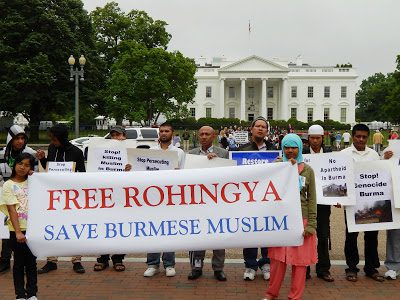
Rohingya and supporters protest in front of the White House in May, 2013. photo via Rohingya Blogger
The responsibility of academics is often to discuss the historical, religious, political, and other aspects of world events as they play out in order to get to the exact nature of what is happening. In case you missed it, my friends Danny Fisher and Paul Fuller have had some interesting discussion around the topic of recent violence on the part of Buddhists in Burma.
- Ethnocentric Buddhism: A new theme in Burmese Buddhism by Paul Fuller (you can read more from him at his blog here)
- “Ethnocentric Buddhism?” by Danny Fisher
For a while now, scholars have been debating and discussing how we should understand the recent violence on the part of Buddhists in these two countries. Avid readers of this blog will have some sense of my stance on categories. Basically we use what is useful. As we go, we seek greater degrees of precision while simultaneously drawing in alternative points of view. I don’t see anyone arriving at any final ‘right’ answer, nor will there ever be just one perspective, but there is value in continuing the conversation. In my own writing I have used phrases such as “Fundamentalism” as a problem in Buddhism and other religions, a (good) Fundamentalism or Protestant ideal, globalized “Buddhist anti-Muslim Hate” and perhaps most (in)famously, “American Buddhist Terrorist?“.
Here Paul has coined a new term, “Ethnocentric Buddhism” which he states, “points to the notion that Buddhist identity is intrinsically linked to national identity. It also denotes the idea that other factors will be apparent in creating Buddhist and national identity in different Buddhist cultures… the defence of one’s religion is linked to these other themes of national identity — to defend one is to defend the other.”
Danny responded that, “I confess, though, I was left wondering what exactly would be wrong with using terms like “Buddhist terror” or “Buddhist extremism” to describe some of the situations that precipitated Fuller’s article.” He continues, after discussing recent events in Burma, “Is “ethnocentric Buddhism,” then, really helping us understand the full extent of these particular phenomena? Or does it fail in these cases to capture some of the horrible realities here?”
Certainly any acute acts of terrorism, and those who support those acts in their words are well defined with “Buddhist terror.” “Buddhist extremism” is likewise useful for those groups and individuals who clearly stand out from the mainstream in a society, but this too can be a difficult label.
I would add though to Danny’s excellent questions that what Paul is describing might also be “Buddhist nationalism” or, if you prefer, “nationalistic Buddhism,” akin perhaps to how many people (mostly Evangelical Christians) discuss American Exceptionalism, or Zionism amongst certain Orthodox Jews. Here we have a clear religion-state connection.
The label “ethnocentric Buddhism” might be helpful in covering something much broader existing in these two countries, something we too often overlook. That is the broader ethnic chauvinism displayed by dominant ethnic groups, Sinhala and Bamar respectively, toward other ethnic groups in the country. You can read this article on Sinhala chauvinism to catch up on this angle on events in Sri Lanka. In Burma we must remember that it is not simply Buddhists vs Muslims, but rather a central government dominated by the Bamar ethnic group who are at war with numerous groups around the country: the Kachin in the north, the Shan in the east, and the Karen in the south. The ethnocentrism of the Rakhine Buddhists may not necessarily be nationalistic in nature – though it is certainly supported by the Bamar central government.
A general mood of distrust and even antagonism toward an ethnic or religious minority in a country might not be extreme (as it is pervasive) and it might not manifest in particular acts of terror, thus necessitating a new label such as “ethnocentric” or “nationalistic” Buddhism. Such a category could be used to designate attitudes and actions of religious leaders long before any overt extremism or acts of terror occur. Indeed, Paul alludes to this in his article when he writes:
There are a number of possible factors and ideas that could shape the formation of an ethnocentric type of Buddhism in a given country. Not all of these ideas are available in each cultural context. Some are available across Buddhist Asia, some confined to a particular area, or would have been used during different historical periods. There is the idea of the “true dharma” existing in one particular place and of that location preserving this true version of the Buddha’s teachings. For example, in Sri Lanka after the transmission of Buddhism, some aspects of the Pali Canon would be considered to preserve the essential word of the Buddha. Later, national identity could be built around this idea together with other texts being used and composed together with Buddhist symbols, the tooth relic for example, creating the notion of a direct lineage to the Buddha.
With a category such as “ethnocentric Buddhism” we could examine instances and perhaps frequency of claims to having “true dharma” and specific objects (relics, holy places, etc) that might need to be “defended” from outsiders.
So far we are only in the beginning stages of understanding this phenomenon, so I am glad to see Paul’s article and Danny’s response. I’m happy also to see that a conference will convene in London in just over a week to discuss the situation in Burma.
Regardless of what exactly we call it, it is necessary for people around the world, and particularly in Sri Lanka and Burma, to speak out against these acts of violence. In that vein, I offer this video:
* Read more on Burma here, and this account from a Western aid-worker.

Next Post

April 20, 2014 Buddhism and Modern Psychology : week four - "What is the *you*, anyway?"
Browse Our Archives
Select a Category Academia Activism American Buddhism Art Book review Buddhism Buddhism Today Buddhist Ethics Burma/Myanmar China Christianity Commodification Environment Gender Happiness Health Humor India Interfaith Islam Japanese Buddhism Kant Media / News Meditation mindfulness Photography Poetry Politics quicktakes Running Teaching Technology Thailand Theism/Atheism Theravada Tibet Tibetan Buddhism Travels Uncategorized Unitarian Universalism video Western Philosophy Zen
Select a Month June 2021 January 2021 November 2020 August 2020 July 2020 March 2020 January 2020 October 2019 August 2019 June 2019 May 2019 March 2019 February 2019 January 2019 December 2018 November 2018 October 2018 September 2018 August 2018 July 2018 June 2018 May 2018 April 2018 March 2018 February 2018 January 2018 December 2017 November 2017 October 2017 September 2017 August 2017 July 2017 June 2017 May 2017 April 2017 March 2017 February 2017 January 2017 December 2016 November 2016 October 2016 September 2016 August 2016 July 2016 June 2016 May 2016 April 2016 March 2016 February 2016 January 2016 December 2015 November 2015 October 2015 September 2015 August 2015 July 2015 June 2015 May 2015 April 2015 March 2015 February 2015 January 2015 December 2014 November 2014 October 2014 September 2014 August 2014 July 2014 June 2014 May 2014 April 2014 March 2014 February 2014 January 2014 December 2013 November 2013 October 2013 September 2013 August 2013 July 2013 June 2013 May 2013 April 2013 March 2013 February 2013 January 2013 December 2012 November 2012 October 2012 September 2012 August 2012 July 2012 June 2012 May 2012 April 2012 March 2012 February 2012 January 2012 December 2011 November 2011 October 2011 September 2011 August 2011 July 2011 June 2011 May 2011 April 2011 March 2011 February 2011 January 2011 December 2010 November 2010 October 2010 September 2010 August 2010 July 2010 June 2010 May 2010 April 2010 March 2010 February 2010 January 2010 December 2009 November 2009 October 2009 September 2009 August 2009 July 2009 June 2009 May 2009 April 2009 March 2009 February 2009 January 2009 December 2008 November 2008 October 2008 September 2008 August 2008 July 2008 June 2008 May 2008 April 2008 March 2008 September 2007 August 2007 July 2007 June 2007 May 2007 April 2007 March 2007 February 2007 January 2007 December 2006 November 2006 October 2006 September 2006 August 2006 July 2006 June 2006 May 2006 April 2006 March 2006 February 2006 January 2006 December 2005 November 2005 October 2005 September 2005 November 2004 September 2004 August 2004
Follow Us!
TAKE THE
Religious Wisdom Quiz
The name of the Lord is a fortified tower; the righteous run to it and are ____.
Select your answer to see how you score.
Hidden Saved Protected Uplifted
Support this
Column


Related posts from American Buddhist Perspectives

For Pride Month: Our 2015 Interview with La...
American Buddhist Perspectives

Standing up to Lies: Can America Emerge from...
American Buddhist Perspectives

Progressive responses to the 2020 election of Biden...
American Buddhist Perspectives

In strife and uncertainty: let us remember loving-kindness
American Buddhist Perspectives
TRENDING AT PATHEOS Buddhist

On Taking Refuge in the Dharma
(Here I continue the feature of sharing talks and essays by teachers...

(Continuing my intention to share talks and essays by other members of Empty...
The Subtle Art of Bowing: A Dharma Discourse
(This presentation was first offered by my dear friend Dharma Holder Tom...

Internal Family Systems Can Heal you Mentally &...
How IFS Helped Me Stop Fighting Myself Internal Family Systems (IFS) is...

The Bible No One Spoke About: A Family’s...
A mysterious family Bible, unspoken faith, and a journey from curiosity to...

How Uncertainty Can Transform Your Life in 2025
Embracing Uncertainty: A New Year’s Resolution for the Brave As 2025 approaches,...
view all Buddhist blogs
Ad-Free & Subscriber Log-In Subscription Support
- About Us
- 2026 Calendar
- Videos
- Podcasts
- Library of World Religions
- Faith In Media Tracker
- Advertise With Us
- Write for Us
- Privacy Policy
- Terms of Service
- Do Not Sell My Data
- Contact Us
- Radiant Digital
- Manage Newsletter Subscriptions
- Unsubscribe From Notifications
- Sitemap
Copyright 2008-2026, Patheos. All rights reserved.
Subscription Support Ad-Free & Subscriber Log-In
Follow Patheos