
BuddhistCatholicContemplativeEvangelicalGeneral ChristianHinduJewishLatter-day SaintMuslimNew VisionsProgressive Christian
Beliefs
- Buddhist
- Catholic
- Contemplative
- Evangelical
- General Christian
- Hindu
- Jewish
- Latter-day Saint
- More Voices
- Muslim
- New Visions
- Pagan
- Progressive Christian
Topics
- Religion News
- Food and Religion
- Sports and Religion
- Religious Art
- Religious Music and Entertainment
- Religious Events
- History and Religion
- Style and Religion
- Politics and Religion
- Women in Religion
- Recreation Outdoors and Religion
- Business Finance and Religion
- Careers Workplace and Religion
- Education and Religion
- Family Parenting and Religion
- Health Fitness and Religion
- Home and Religion
- Relationships and Religion
- Technology and Religion
- Travel and Religion
Columnists
- Buddhist Columnists
- Business Finance and Religion Columnists
- Careers Workplace and Religion Columnists
- Catholic Columnists
- Contemplative Columnists
- Education and Religion Columnists
- Evangelists Columnists
- Family Parenting and Religion Columnists
- General Christian Columnists
- Health Fitness and Religion Columnists
- Hindu Columnists
- History and Religion Columnists
- Home and Religion Columnists
- Jewish Columnists
- More Voices Columnists
- Latter Day Columnists
- Muslim Columnists
- New Visions Columnists
- Nonreligious Columnists
- Pagan Columnists
- Politics and Religion Columnists
- Progressive Columnists
- Recreation Outdoors and Religion Columnists
- Relationships and Religion Columnists
- Religion News Columnists
- Religious Art Columnists
- Religious Events Columnists
- Religious Music and Entertainment Columnists
- Sports and Religion Columnists
- Style and Religion Columnists
- Technology and Religion Columnists
- Travel and Religion Columnists
- Women in Religion Columnists
Resource Library
- 2026 Calendar
- Library of World Religions
- The 100 Most Holy Places on Earth
- Patheos Answers
- Podcasts
- Videos
- Faith Leaders Database
- Anglican Episcopalian
- Bahai
- Baptist
- Buddhism
- Christianity
- Confucianism
- Eastern Orthodoxy
- Hinduism
- Holiness and Pentecostal
- ISKCON
- Islam
- Judaism
- Lutheran
- Methodist
- The Church of Jesus Christ of Latter-day Saints
- New Age
- Paganism
- Presbytarian and Reformed
- Protestantism
- Religion Behind the Scenes
- Roman Catholic
- Scientology
- Shia Islam
- Sikhism
- Sufism
- Sunni Islam
- Taoism
- Zen
- See all religions
Research Tools
 Ad-Free & Subscriber Log-In Subscription Support
Ad-Free & Subscriber Log-In Subscription Support
Follow Patheos 

- Trending:
- Forgiveness
- |
- Marriage
- |
- Consciousness
- |
- Death Penalty
- |
- Election
- |
- Halloween
 American Buddhist Perspectives
- Home
- Buddhist
- Religion News
- Encountering the 16th Karmapa and living Buddhism in the West today [UPDATED with contributors]
Encountering the 16th Karmapa and living Buddhism in the West today [UPDATED with contributors]
Last updated on: March 26, 2014 at 2:04 pm by Justin Whitaker
Encountering the 16th Karmapa and living Buddhism in the West today [UPDATED with contributors] 2014-03-26T14:04:41-06:00 Justin Whitaker
Patheos Explore the world's faith through different perspectives on religion and spirituality! Patheos has the views of the prevalent religions and spiritualities of the world.
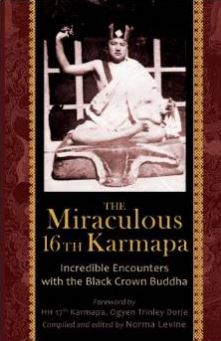 Shang Shung Publications, an Italian publisher founded around the teachings of Chögyal Namkhai Norbu and of other greats from the Tibetan Buddhist tradition, has a new book out called The Miraculous 16th Karmapa: Incredible Encounters with the Black Crown Buddha (Amazon/Shang Shung).
I was kindly offered not only an advance copy of the book to read, but also an opportunity to send a couple questions to some of the contributors to this memorable volume. I picked four contributors, all rather remarkable teachers, practitioners, and so on in their own right, and sent each just a question or two, along with a question to all four: “Where do you see Buddhism in N. America going? Do you have any predictions for the coming ten years?”
With great thanks to PR guru Erica Taylor, I have responses from two of them now to share with you.
The first to respond was Norma Levine, the book’s compiler and editor and author of “Blessing Power of the Buddhas” (http://earthmudra.com). Along with the question on Buddhism in N. America, I asked her:
You write in the book:
The miracle of the 17th Karmapa is that he has shouldered the immense responsibilities of his office with humour, and majestic dignity; that he gives love to all, that he can still show humanity within the cramped quarters of what he now calls “a permanent hotel” 6 in which he does not possess even his own shrine room. He is a humble human being, a perfect bodhisattva, and already a great Karmapa.
What do think is in store for H.H. the 17th Karmapa?
Norma Levine:
“He will triumph over all the obstacles created by politicians and tame those who are blocking buddha activity, just like Guru Rinpoche did in 8th century Tibet. He overpowered the demons and enabled the construction of Samye, the first monastery in Tibet, and from then onwards, Buddhism could develop and flourish. The 17th Karmapa is said to be not only an emanation of Guru Rinpoche but Guru Rinpoche himself.”
About Buddhism in the west (not necessarily America):
“As a general trend I can see that people want to have a more peaceful and calm mind and so they will continue to try to achieve that with mindfulness meditation and yoga. However, calming the mind is only an important but practical first step. What is important is to understand and contemplate deeply what it means to be stuck within cyclic existence. It is the wish to attain buddhahood in order to liberate all beings from suffering, that creates the conditions to achieve the ultimate state of enlightenment. All we want, it seems, is to have a happier and more comfortable samsara, and that’s not really Buddhism at all.”
Our second respondent was Don Morreale, who many of you will know as the author of The Complete Guide to Buddhist America (1998). I recall some happy moments flipping through this book during a retreat some time in the early ’00s and hearing Morreale’s name come up a couple times early on in Charles Prebish’s 2010 retrospective on studies of North American Buddhism (video below).
I likewise began with a quote from the book. Here Morreale describes his encounter with H.H. the 16th Karmapa:
I had no idea who this Karmapa guy was, and only the vaguest notion of what a puja was. Nor, to be honest, did I much care. In the thirteen years since last I’d practiced Zen, I’d fallen into an emotional and spiritual tar pit. Several promising love affairs had gone south, and to say that I’d become something of a grouch would be an understatement. I was pissed off at everything and everybody pretty much all the time. Anger had become my default position.
[you met the Karmapa and, as you wrote, everything changed]
That evening I sat down to practice, and I’ve been doing so every day since. It was Eido who’d sent me out into the world to grasp the meaning of suffering. It was the Karmapa who invited me back to learn how to overcome it.
It sounds like you still feel connected to, and appreciate, your early Zen training. Is that the case, and if so, how have the two ‘systems’ of practice expressed themselves in your everyday life?
And Morreale wrote back:
“I’ve had training in Zen, Tibetan Buddhism, and Theravada Vipassana. While I value all traditions, the one that has resonated the most with me is Vipassana, which I’ve been practicing since 1986, and teaching since 1991. I spent a lot of time in Thai Monasteries in the 80s, and here in the US attended some 13 three month and six week retreats at IMS. I will say, though, that without the influence of Eido Roshi and the Karmapa, I might not have pursued the Buddhist path at all. So I owe them both a mountain of gratitude for their compassion and interest. I really think there’s something to be said for “Spiritual Shopping.” I tried a lot of different approaches before finally encountering a tradition, and teachers, that worked for me.
What I learned from my Zen training was to sit with absolute determination, through everything the mind throws at you. What I’ve learned from Vipassana was to sit with an open heart, without any expectation or attachment to outcome. I also learned to do Metta practice from my Theravada teachers, which seems to come up spontaneously in all kinds of situations. I’ll be driving in my car, or walking down the street, and the Metta prayer just arises spontaneously. It’s made me a much happier person. It’s also a great way to establish concentration and to clear the mind of random distracting thoughts.”
On Buddhism in the West:
“I would say that the trend is toward greater and greater secularization. Everywhere you look, in every sphere of endeavor, you see mindfulness practice being taught and applied in ways that are not specifically or particularly Buddhist; mindful parenting, mindfulness as a cure for PTSD, mindful politics, mindfulness in the schools, the slow-food movement, even the “slow sex” movement (I’m not kidding). I myself teach a non-sectarian meditation course on Royal Caribbean Cruise Lines. I see fewer and fewer people heading east to take the robe. There will always be a handful of us who embrace the tradition and call ourselves Buddhist, of course, but we’ll be in the minority. This is, after all, a secular age.”
Fantastic; and that definitely branches off some of the discussions we’ve had here recently re: Buddhism and Modern Psychology and Buddhism without Superstition – your thoughts?
I’ll give you the links again to the book, The Miraculous 16th Karmapa: Incredible Encounters with the Black Crown Buddha (Amazon/Shang Shung). Again my great thanks to Norma Levine and Don Morreale!
Top Contributors from the book include:
· Kabir Bedi
o Kabir Bedi is an Indian television and film actor. His career has spanned three continents including India, the United States and many European countries in three mediums: film, television and theatre.
· Tony Visconti
o is an American record producer, musician and singer. Since the late 1960s, he has worked with an array of performers; his lengthiest involvement with any artist is with David Bowie: intermittently from Bowie’s 1969 album Space Oddity to 2013’s The Next Day, Visconti has produced and occasionally performed on many of Bowie’s albums.
· Vicki MacKenzie
o An author and journalist, was born in England and spent much of her early life in Australia. The daughter of a naval officer, she graduated from Queensland University and became a reporter at the Sun newspaper in Sydney. Since taking a month-long meditation course in Nepal in 1976, her primary interest has been to make the profundity of Buddhist philosophy accessible to the general public.
· Lama Surya Das
o Surya Das is an American-born lama in the Tibetan Buddhist tradition. He is a poet, chantmaster, spiritual activist and author of many popular works on Buddhism; a teacher and spokesperson for Buddhism in the West.
· Gyaltsab Rinpoche
o Goshir Gyaltsab Rinpoche is a leading incarnate lama in the Karma Kagyu lineage of Tibetan Buddhism. He is believed by his followers to embody the activity of Vajrapani.
I will leave you with that video of Charles Prebish mentioned above, delivering his keynote address, “The Swans Came to Canada Too: Looking backward-Looking forward” at the 2010 Buddhism in Canada conference.
Previous Post

March 24, 2014
Mary Midgely, a Philosopher you should know
Next Post

March 26, 2014 Still Breathing Meditation Center seeks support
Browse Our Archives
Select a Category Academia Activism American Buddhism Art Book review Buddhism Buddhism Today Buddhist Ethics Burma/Myanmar China Christianity Commodification Environment Gender Happiness Health Humor India Interfaith Islam Japanese Buddhism Kant Media / News Meditation mindfulness Photography Poetry Politics quicktakes Running Teaching Technology Thailand Theism/Atheism Theravada Tibet Tibetan Buddhism Travels Uncategorized Unitarian Universalism video Western Philosophy Zen
Select a Month June 2021 January 2021 November 2020 August 2020 July 2020 March 2020 January 2020 October 2019 August 2019 June 2019 May 2019 March 2019 February 2019 January 2019 December 2018 November 2018 October 2018 September 2018 August 2018 July 2018 June 2018 May 2018 April 2018 March 2018 February 2018 January 2018 December 2017 November 2017 October 2017 September 2017 August 2017 July 2017 June 2017 May 2017 April 2017 March 2017 February 2017 January 2017 December 2016 November 2016 October 2016 September 2016 August 2016 July 2016 June 2016 May 2016 April 2016 March 2016 February 2016 January 2016 December 2015 November 2015 October 2015 September 2015 August 2015 July 2015 June 2015 May 2015 April 2015 March 2015 February 2015 January 2015 December 2014 November 2014 October 2014 September 2014 August 2014 July 2014 June 2014 May 2014 April 2014 March 2014 February 2014 January 2014 December 2013 November 2013 October 2013 September 2013 August 2013 July 2013 June 2013 May 2013 April 2013 March 2013 February 2013 January 2013 December 2012 November 2012 October 2012 September 2012 August 2012 July 2012 June 2012 May 2012 April 2012 March 2012 February 2012 January 2012 December 2011 November 2011 October 2011 September 2011 August 2011 July 2011 June 2011 May 2011 April 2011 March 2011 February 2011 January 2011 December 2010 November 2010 October 2010 September 2010 August 2010 July 2010 June 2010 May 2010 April 2010 March 2010 February 2010 January 2010 December 2009 November 2009 October 2009 September 2009 August 2009 July 2009 June 2009 May 2009 April 2009 March 2009 February 2009 January 2009 December 2008 November 2008 October 2008 September 2008 August 2008 July 2008 June 2008 May 2008 April 2008 March 2008 September 2007 August 2007 July 2007 June 2007 May 2007 April 2007 March 2007 February 2007 January 2007 December 2006 November 2006 October 2006 September 2006 August 2006 July 2006 June 2006 May 2006 April 2006 March 2006 February 2006 January 2006 December 2005 November 2005 October 2005 September 2005 November 2004 September 2004 August 2004
Follow Us!
TAKE THE
Religious Wisdom Quiz
Who was King Saul's father?
Select your answer to see how you score.
Methuselah Job Kish Rehoboam
Support this
Column


Related posts from American Buddhist Perspectives

For Pride Month: Our 2015 Interview with La...
American Buddhist Perspectives

In strife and uncertainty: let us remember loving-kindness
American Buddhist Perspectives

A Festival of Radical Awakening: Socially Engaged Buddhism...
American Buddhist Perspectives

The Coronavirus is coming - Some thoughts from...
American Buddhist Perspectives
TRENDING AT PATHEOS Buddhist

On Taking Refuge in the Dharma
(Here I continue the feature of sharing talks and essays by teachers...

(Continuing my intention to share talks and essays by other members of Empty...
The Subtle Art of Bowing: A Dharma Discourse
(This presentation was first offered by my dear friend Dharma Holder Tom...

Internal Family Systems Can Heal you Mentally &...
How IFS Helped Me Stop Fighting Myself Internal Family Systems (IFS) is...

The Bible No One Spoke About: A Family’s...
A mysterious family Bible, unspoken faith, and a journey from curiosity to...

How Uncertainty Can Transform Your Life in 2025
Embracing Uncertainty: A New Year’s Resolution for the Brave As 2025 approaches,...
view all Buddhist blogs
Ad-Free & Subscriber Log-In Subscription Support
- About Us
- 2026 Calendar
- Videos
- Podcasts
- Library of World Religions
- Faith In Media Tracker
- Advertise With Us
- Write for Us
- Privacy Policy
- Terms of Service
- Do Not Sell My Data
- Contact Us
- Radiant Digital
- Manage Newsletter Subscriptions
- Unsubscribe From Notifications
- Sitemap
Copyright 2008-2026, Patheos. All rights reserved.
Subscription Support Ad-Free & Subscriber Log-In
Follow Patheos