
BuddhistCatholicContemplativeEvangelicalGeneral ChristianHinduJewishLatter-day SaintMuslimNew VisionsProgressive Christian
Beliefs
- Buddhist
- Catholic
- Contemplative
- Evangelical
- General Christian
- Hindu
- Jewish
- Latter-day Saint
- More Voices
- Muslim
- New Visions
- Pagan
- Progressive Christian
Topics
- Religion News
- Food and Religion
- Sports and Religion
- Religious Art
- Religious Music and Entertainment
- Religious Events
- History and Religion
- Style and Religion
- Politics and Religion
- Women in Religion
- Recreation Outdoors and Religion
- Business Finance and Religion
- Careers Workplace and Religion
- Education and Religion
- Family Parenting and Religion
- Health Fitness and Religion
- Home and Religion
- Relationships and Religion
- Technology and Religion
- Travel and Religion
Columnists
- Buddhist Columnists
- Business Finance and Religion Columnists
- Careers Workplace and Religion Columnists
- Catholic Columnists
- Contemplative Columnists
- Education and Religion Columnists
- Evangelists Columnists
- Family Parenting and Religion Columnists
- General Christian Columnists
- Health Fitness and Religion Columnists
- Hindu Columnists
- History and Religion Columnists
- Home and Religion Columnists
- Jewish Columnists
- More Voices Columnists
- Latter Day Columnists
- Muslim Columnists
- New Visions Columnists
- Nonreligious Columnists
- Pagan Columnists
- Politics and Religion Columnists
- Progressive Columnists
- Recreation Outdoors and Religion Columnists
- Relationships and Religion Columnists
- Religion News Columnists
- Religious Art Columnists
- Religious Events Columnists
- Religious Music and Entertainment Columnists
- Sports and Religion Columnists
- Style and Religion Columnists
- Technology and Religion Columnists
- Travel and Religion Columnists
- Women in Religion Columnists
Resource Library
- 2026 Calendar
- Library of World Religions
- The 100 Most Holy Places on Earth
- Patheos Answers
- Podcasts
- Videos
- Faith Leaders Database
- Anglican Episcopalian
- Bahai
- Baptist
- Buddhism
- Christianity
- Confucianism
- Eastern Orthodoxy
- Hinduism
- Holiness and Pentecostal
- ISKCON
- Islam
- Judaism
- Lutheran
- Methodist
- The Church of Jesus Christ of Latter-day Saints
- New Age
- Paganism
- Presbytarian and Reformed
- Protestantism
- Religion Behind the Scenes
- Roman Catholic
- Scientology
- Shia Islam
- Sikhism
- Sufism
- Sunni Islam
- Taoism
- Zen
- See all religions
Research Tools
 Ad-Free & Subscriber Log-In Subscription Support
Ad-Free & Subscriber Log-In Subscription Support
Follow Patheos 

- Trending:
- Forgiveness
- |
- Marriage
- |
- Consciousness
- |
- Death Penalty
- |
- Election
- |
- Halloween
 American Buddhist Perspectives
- Home
- Buddhist
- Religion News
- Buddhists in Pink, a look at nuns in Burma/Myanmar
Buddhists in Pink, a look at nuns in Burma/Myanmar
Last updated on: October 15, 2013 at 12:24 am by Justin Whitaker
Buddhists in Pink, a look at nuns in Burma/Myanmar 2013-10-15T00:24:52-06:00 Justin Whitaker
Patheos Explore the world's faith through different perspectives on religion and spirituality! Patheos has the views of the prevalent religions and spiritualities of the world.
The NY Times recently posted a video taking us briefly inside the world of female monastic life in contemporary Burma. Have a look:
They report that, “Enrollment is rising at the Aung Thawada Nunnery School on the northern border of Yangon. The nuns, whose ages range from 9 to 94, join for a variety of reasons, including to escape poverty or abuse.”
It was great to see that the reporter, Chelsi Moy, is a young woman from my home town of Helena, Montana and I even remember her interviewing me about 10 years ago for a story about our national Ethics Bowl team. Small world.
My first real exposure to Burma came through two wonderful venerables, Molini and Dhamma Vijaya. Ven Molini (below, left) is from Burma while Ven. Dhamma Vijaya is from Nepal, and both are ordained in the Theravadin tradition. They reside in Nepal where they run Dhamma Moli, which saves young girls from slavery and/or forced underage marriages. They also travel the world, including regular stops in the US, India, and Burma, offering teachings.
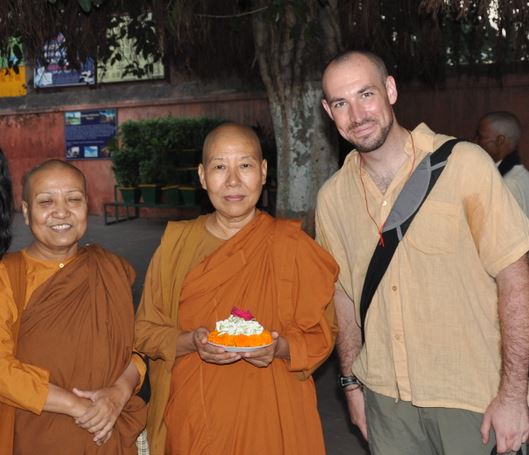
Ven. Molini and Ven. Dhamma Vijaya with the author in Bodh Gaya, 2010.
After my time spent in India teaching, I planned to visit Burma – nudged on by enthusiastic encouragement by many people in India including coworkers and these two. I was supposed to meet with Ven. Dhamma Vijaya in Rangoon (Yangon), but I wasn’t able to connect with her in the end, leaving me free to follow my guide book and the whims of myself and fellow travelers.
In my 17 days in Burma I didn’t see a lot of nuns. I think I saw a long line of them doing alms rounds in Rangoon once, but otherwise only encountered a handful in my journeys around Mandalay. Here are a few photos I managed to snap along the way:
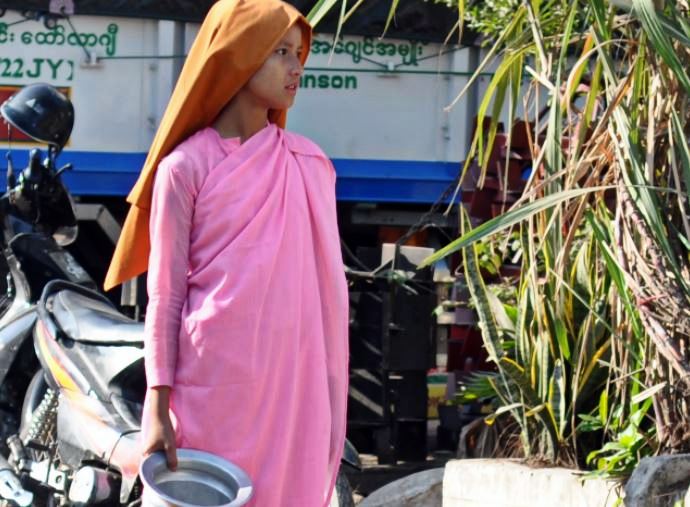
The term “nun” may be controversial, as Stanley Tambhiah wrote some 3o years ago: “In the countries of Theravada Buddhism, there is no order of nuns (bhikkhuni) left, the order having died out in Sri Lanka many centuries ago.” A bit more recently, Hiroko Kawanami (1990) writes specifically of the situation in Burma:
The formation of the Bhikkhuni Sangha and the textual account of bhikkhunis who once existed were important components of the story. Tradition also tells us that the lineage of bhikkhuni ordination has become extinct and there exists no bhikkhuni who can confer ordination on contemporary Buddhist nuns. Therefore, present-day thila-shin are not bhikkhuni . The pseudo-ordination ceremony that initiates laywomen into the Order is considered a ritual that provides them with a religious status no more than that of pious laywomen who abide by additional sabbatical vows. Ironically, the assumption that their predecessors once held a legitimate religious status seems to stress all the more the “illegitimate” religious status of present-day Buddhist nuns. These explanations are repeatedly referred to by monks and scholars to remind the general public of where a contemporary Buddhist nun “should stand,” in order to perpetuate the ideology that “she is not a bhikkhuni and that she can never become one.”
thila = sila (ethics/precepts) and shin = holder. Legally they are still lay people.
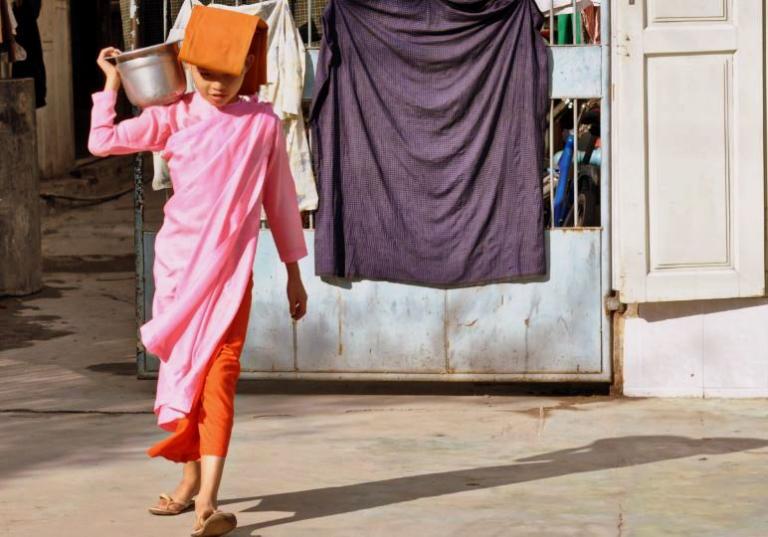
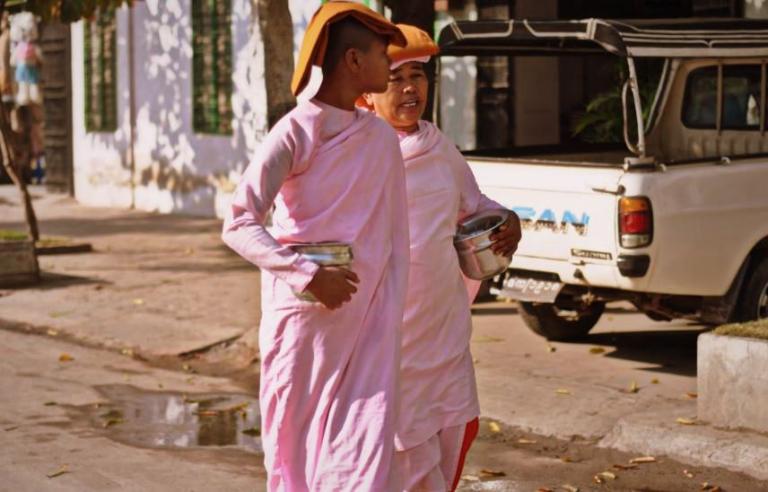
The Sangha census held in 1980 show 300,000 males wearing the Buddhist robes of a monk (bhikkhu) or a novice (samanera), and approximately 30,000 females in robes, that is, Buddhist nuns referred to as sila-rhan (pronounced thila-shin, meaning “owners of virtue”). If these figures are correct, and we have every reason to assume that they are, there would be ten males and one female wearing the robe in the Buddhist religious orders out of every thousand nationals in modern Burma… (Sakyadhita newsletter 1991)
~
Buddhist monasteries in 2008 number over 56,839, monks over eighteen years of age over 246,000, novices over 300,000, and nuns over 43,000. (David Steinberg, Burma/Myanmar: What Everyone Needs to Know)
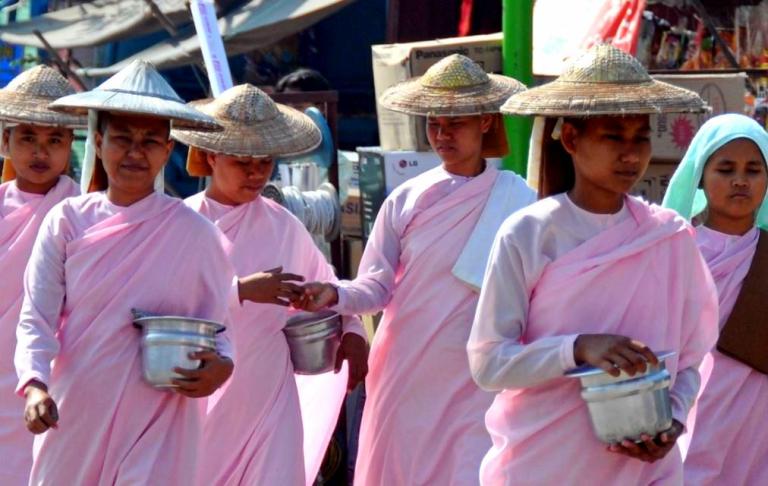
I may have captured part of a secret handshake here…
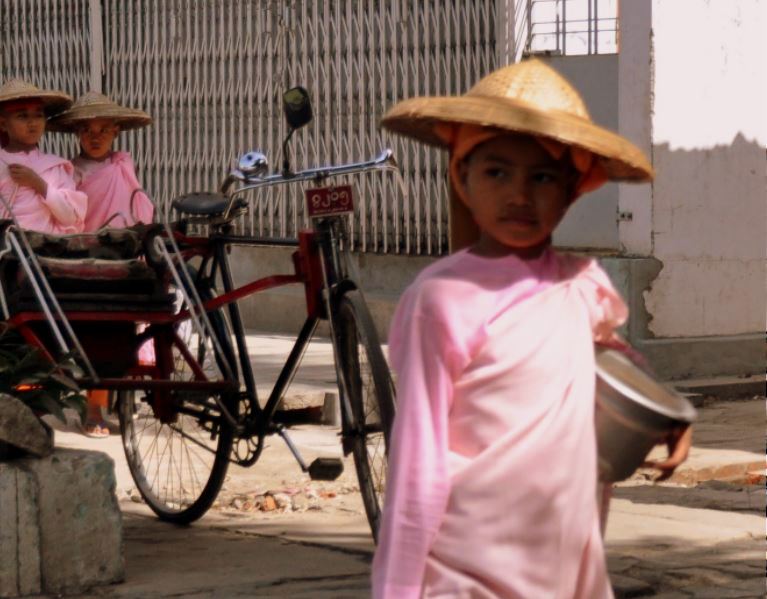
Click on any image for a slightly larger version. All can be freely used (with attribution please). And all are from Mandalay, Burma (January 25, 2011).
Read more:
The Position of Women in Buddhism (accesstoinsight)
Sakhyadhita, the International Organization of Buddhist Women
Therigatha: the Poems of the Elder Nuns (accesstoinsight)
Previous Post

October 11, 2013
Reposting "Femicide" for the International Day of the Girl Child
Next Post

October 15, 2013 Roshi Joan Halifax is a National Geographic Traveler of the Year
Browse Our Archives
Select a Category Academia Activism American Buddhism Art Book review Buddhism Buddhism Today Buddhist Ethics Burma/Myanmar China Christianity Commodification Environment Gender Happiness Health Humor India Interfaith Islam Japanese Buddhism Kant Media / News Meditation mindfulness Photography Poetry Politics quicktakes Running Teaching Technology Thailand Theism/Atheism Theravada Tibet Tibetan Buddhism Travels Uncategorized Unitarian Universalism video Western Philosophy Zen
Select a Month June 2021 January 2021 November 2020 August 2020 July 2020 March 2020 January 2020 October 2019 August 2019 June 2019 May 2019 March 2019 February 2019 January 2019 December 2018 November 2018 October 2018 September 2018 August 2018 July 2018 June 2018 May 2018 April 2018 March 2018 February 2018 January 2018 December 2017 November 2017 October 2017 September 2017 August 2017 July 2017 June 2017 May 2017 April 2017 March 2017 February 2017 January 2017 December 2016 November 2016 October 2016 September 2016 August 2016 July 2016 June 2016 May 2016 April 2016 March 2016 February 2016 January 2016 December 2015 November 2015 October 2015 September 2015 August 2015 July 2015 June 2015 May 2015 April 2015 March 2015 February 2015 January 2015 December 2014 November 2014 October 2014 September 2014 August 2014 July 2014 June 2014 May 2014 April 2014 March 2014 February 2014 January 2014 December 2013 November 2013 October 2013 September 2013 August 2013 July 2013 June 2013 May 2013 April 2013 March 2013 February 2013 January 2013 December 2012 November 2012 October 2012 September 2012 August 2012 July 2012 June 2012 May 2012 April 2012 March 2012 February 2012 January 2012 December 2011 November 2011 October 2011 September 2011 August 2011 July 2011 June 2011 May 2011 April 2011 March 2011 February 2011 January 2011 December 2010 November 2010 October 2010 September 2010 August 2010 July 2010 June 2010 May 2010 April 2010 March 2010 February 2010 January 2010 December 2009 November 2009 October 2009 September 2009 August 2009 July 2009 June 2009 May 2009 April 2009 March 2009 February 2009 January 2009 December 2008 November 2008 October 2008 September 2008 August 2008 July 2008 June 2008 May 2008 April 2008 March 2008 September 2007 August 2007 July 2007 June 2007 May 2007 April 2007 March 2007 February 2007 January 2007 December 2006 November 2006 October 2006 September 2006 August 2006 July 2006 June 2006 May 2006 April 2006 March 2006 February 2006 January 2006 December 2005 November 2005 October 2005 September 2005 November 2004 September 2004 August 2004
Follow Us!
TAKE THE
Religious Wisdom Quiz
Who was Rebekah's father?
Select your answer to see how you score.
Bethuel Abraham Laban Terah
Support this
Column


Related posts from American Buddhist Perspectives

For Pride Month: Our 2015 Interview with La...
American Buddhist Perspectives

In the rush to return to normal, can...
American Buddhist Perspectives

A Buddhist Story for Troubled Times: Grief, Loss,...
American Buddhist Perspectives
Spend a month in a Chinese Buddhist Monastery...
American Buddhist Perspectives
TRENDING AT PATHEOS Buddhist

On Taking Refuge in the Dharma
(Here I continue the feature of sharing talks and essays by teachers...

(Continuing my intention to share talks and essays by other members of Empty...
The Subtle Art of Bowing: A Dharma Discourse
(This presentation was first offered by my dear friend Dharma Holder Tom...

Internal Family Systems Can Heal you Mentally &...
How IFS Helped Me Stop Fighting Myself Internal Family Systems (IFS) is...

The Bible No One Spoke About: A Family’s...
A mysterious family Bible, unspoken faith, and a journey from curiosity to...

How Uncertainty Can Transform Your Life in 2025
Embracing Uncertainty: A New Year’s Resolution for the Brave As 2025 approaches,...
view all Buddhist blogs
Ad-Free & Subscriber Log-In Subscription Support
- About Us
- 2026 Calendar
- Videos
- Podcasts
- Library of World Religions
- Faith In Media Tracker
- Advertise With Us
- Write for Us
- Privacy Policy
- Terms of Service
- Do Not Sell My Data
- Contact Us
- Radiant Digital
- Manage Newsletter Subscriptions
- Unsubscribe From Notifications
- Sitemap
Copyright 2008-2026, Patheos. All rights reserved.
Subscription Support Ad-Free & Subscriber Log-In
Follow Patheos