
BuddhistCatholicContemplativeEvangelicalGeneral ChristianHinduJewishLatter-day SaintMuslimNew VisionsProgressive Christian
Beliefs
- Buddhist
- Catholic
- Contemplative
- Evangelical
- General Christian
- Hindu
- Jewish
- Latter-day Saint
- More Voices
- Muslim
- New Visions
- Pagan
- Progressive Christian
Topics
- Religion News
- Food and Religion
- Sports and Religion
- Religious Art
- Religious Music and Entertainment
- Religious Events
- History and Religion
- Style and Religion
- Politics and Religion
- Women in Religion
- Recreation Outdoors and Religion
- Business Finance and Religion
- Careers Workplace and Religion
- Education and Religion
- Family Parenting and Religion
- Health Fitness and Religion
- Home and Religion
- Relationships and Religion
- Technology and Religion
- Travel and Religion
Columnists
- Buddhist Columnists
- Business Finance and Religion Columnists
- Careers Workplace and Religion Columnists
- Catholic Columnists
- Contemplative Columnists
- Education and Religion Columnists
- Evangelists Columnists
- Family Parenting and Religion Columnists
- General Christian Columnists
- Health Fitness and Religion Columnists
- Hindu Columnists
- History and Religion Columnists
- Home and Religion Columnists
- Jewish Columnists
- More Voices Columnists
- Latter Day Columnists
- Muslim Columnists
- New Visions Columnists
- Nonreligious Columnists
- Pagan Columnists
- Politics and Religion Columnists
- Progressive Columnists
- Recreation Outdoors and Religion Columnists
- Relationships and Religion Columnists
- Religion News Columnists
- Religious Art Columnists
- Religious Events Columnists
- Religious Music and Entertainment Columnists
- Sports and Religion Columnists
- Style and Religion Columnists
- Technology and Religion Columnists
- Travel and Religion Columnists
- Women in Religion Columnists
Resource Library
- 2026 Calendar
- Library of World Religions
- The 100 Most Holy Places on Earth
- Patheos Answers
- Podcasts
- Videos
- Faith Leaders Database
- Anglican Episcopalian
- Bahai
- Baptist
- Buddhism
- Christianity
- Confucianism
- Eastern Orthodoxy
- Hinduism
- Holiness and Pentecostal
- ISKCON
- Islam
- Judaism
- Lutheran
- Methodist
- The Church of Jesus Christ of Latter-day Saints
- New Age
- Paganism
- Presbytarian and Reformed
- Protestantism
- Religion Behind the Scenes
- Roman Catholic
- Scientology
- Shia Islam
- Sikhism
- Sufism
- Sunni Islam
- Taoism
- Zen
- See all religions
Research Tools
 Ad-Free & Subscriber Log-In Subscription Support
Ad-Free & Subscriber Log-In Subscription Support
Follow Patheos 

- Trending:
- Forgiveness
- |
- Marriage
- |
- Consciousness
- |
- Death Penalty
- |
- Election
- |
- Halloween
 American Buddhist Perspectives
- Home
- Buddhist
- Religion News
- The Word ‘Revolution’
The Word ‘Revolution’
Last updated on: August 19, 2013 at 12:30 pm by Justin Whitaker
The Word ‘Revolution’ 2013-08-19T12:30:37-06:00 Justin Whitaker
Patheos Explore the world's faith through different perspectives on religion and spirituality! Patheos has the views of the prevalent religions and spiritualities of the world.
In which I meander through four philosophers: Weil, Marx, Kant, and Scruton and, somewhat strangely, take up a conservative position regarding the ‘revolution’ in Egypt…
The word ‘revolution’ is a word for which you kill, for which you die, for which you send the labouring masses to their death, but which does not possess any content.
– Simone Weil, Oppression and Liberty
Born and raised as a Jew in France in the early 1900s, Weil was drawn to philosophy, mysticism, and political activism in a time when all, in some way or another, were desperately needed. She studied religions of the east and west, and philosophy from the Greeks to Kant and Marx. She became fascinated with and sympathetic to the Cathars, a branch of Christians tracing themselves to early Christianity. They had survived for a thousand years, settled in southern France between modern-day Toulouse and Narbonne. Then in 1208, a crusade was launched against them by the Roman Catholic Church which over the next hundred or so years “killed thousands with merciless cruelty,” writes a Weil biographer, Stephen Plant.
Christian ‘holy wars’ would then ravage Europe, parts of N. Africa, and the Middle East for centuries.
Weil, who was fond of Marx, nevertheless found his model of human progress via economic revolution to be overly simplistic and, as the early 20th century played out, patently false (at least when driven by fallible humans – as history always will be). Contemporary Marxists quibble over the details and continue to ‘fine tune’ his system, but the heart of Weil’s argument, which draws from Kant, is that ‘revolutionaries’ often overthrow one despot only to run into the arms of another. For a revolution to work, it needs to start at a base and consist of people reaching out to others.
Kant wrote in “What is Enlightenment” in 1784 that revolution has the potential to put ‘an end to autocratic despotism and rapacious or power-seeking oppression’ and indeed it does have this power as we saw in Egypt in 2011. Then the ‘enemy’ was simply one man, one way of government that no longer served the people. Some, of course, benefited from Mubarak’s rule and thus sought to keep him in power, but the vast majority didn’t and thus came together in opposition:
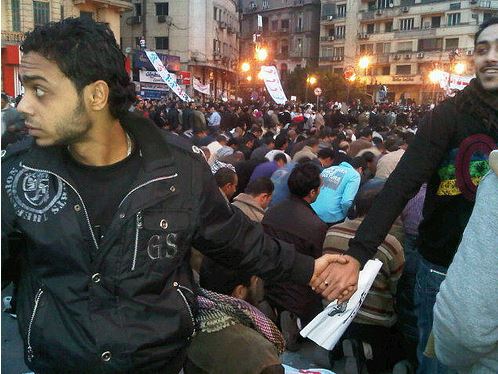
Egypt 2011 – Christians protect praying Muslims at an anti-Mubarak protest.
When the military deposed Mubarak, we all had good reason to be optimistic. They vowed a democratic process once security returned and they fulfilled their promise. Eventually the Muslim Brotherhood’s candidate, Mohammed Morsi, became president. He vowed to reach out across divisions within the society in mid 2012. But soon things changed.
On 22 November 2012, Morsi issued a declaration purporting to protect the work of the Constituent Assembly drafting the new constitution from judicial interference. In effect, this declaration immunises his actions from any legal challenge. The decree states that it only applies until a new constitution is ratified. The declaration also requires a retrial of those accused in the Mubarak-era killings of protesters, who had been acquitted, and extends the mandate of the Constituent Assembly by two months. Additionally, the declaration authorizes Morsi to take any measures necessary to protect the revolution. Liberal and secular groups walked out of the constitutional Constituent Assembly because they believed that it would impose strict Islamic practices, while members of the Muslim Brotherhood supported Morsi.
The move was criticized by Mohamed El Baradei who said Morsi had “usurped all state powers and appointed himself Egypt’s new pharaoh.”
– Via wikipedia; the details of Morsi’s decrees can be found at the Egypt Independent.
This is the other way a revolution might go. Kant saw this in the French Revolution, which he was very hesitant to support (recall The Reign of Terror). Kant also wrote (in the same document mentioned above) that revolution presented a potential source for new prejudices which ‘like the ones they replaced, will serve as a leash to control the great unthinking mass.’
The Reign of Terror made Kant and many others in Europe hesitant to advocate any kind of revolution against a sovereign (monarch). Then, as now, the sovereign would be the head of the military. In the Metaphysics of Morals (1797), one of his last works, Kant stated unequivocally that if constitutional change should be necessary, it should be done “only through reform by the sovereign itself, and not by the people, and therefore not by revolution.”
By this we might infer that Kant would have supported the military removal of Hosni Mubarak in 2011 and would again support the military now in removing another illegitimate political leader who tried to alter the constitution both above the judicial law of his country and against the will of fellow politicians.
The military is the sovereign and all reform must take place under its approval. Even the eventual move to divest the sovereign’s sovereignty to the people must be a conscious act of the sovereign.
This is an important move, so I’ll repeat it: the sovereign (military or monarchical) must eventually consciously divest its sovereignty to the people.
In England, where I live now, this was largely done between the very bloody 17th and the 19th centuries, and today the monarchy, while technically still in charge of everything, plays a merely ceremonial role. Roger Scruton writes of the English experience:
In the 17th Century our country was torn apart by civil war, and at the heart of that civil war was religion – the Puritan desire to impose godly rule on the people of Great Britain regardless of whether they wanted it, and the leaning of the Stuart Kings towards a Roman Catholic faith that had become deeply antipathetic to the majority and a vehicle for unwanted foreign interference. In a civil war both sides behave badly, precisely because the spirit of compromise had fled from the scene. The solution is not to impose a new set of decrees from on high, but to make room for opposition, and the politics of compromise. This was recognised at the Glorious Revolution of 1688, when Parliament was re-established as the supreme legislative institution, and the rights of the people against the sovereign power were reaffirmed the following year in a Bill of Rights.
In Egypt, the sovereign (the military) stepped back in 2011 and established a civilian government that started out okay, but then turned against various minorities (secularists, Christians, etc.) and thus defeated its very purpose as a government of the people. As Scruton stated:
Look at the pronouncements of the recently elected and recently deposed President Morsi of Egypt, however, and you will find little or nothing to suggest that he is aware that there are Egyptians who disagree with him and whose consent must be constantly solicited. It is impossible to discern from his speeches that there is a substantial minority of Egyptian citizens who are Christians, others who are atheists, others who, while following the Muslim way of life, would rather it did not make a show of itself as the state religion.
His view of elections is that they grant an absolute right to impose the ruling party’s agenda, and that opponents have lost all right to an agenda of their own. And the response of the army is to say, not so…
In no “democratic” nation could Morsi have gone so far as he did. Suspending judicial oversight? Hastily drafting a new constitution with the support of only one party? No. This is not how democracy works. This is autocracy and it is a wonder that the army waited as long as they did.
What now?
If you agree with the military’s actions, then the next step is to a) join Coptic Christians and others who seek to restore stability, just as was needed after the overthrow of Mubarak, and 2) to initiate steps toward a new democratic election.
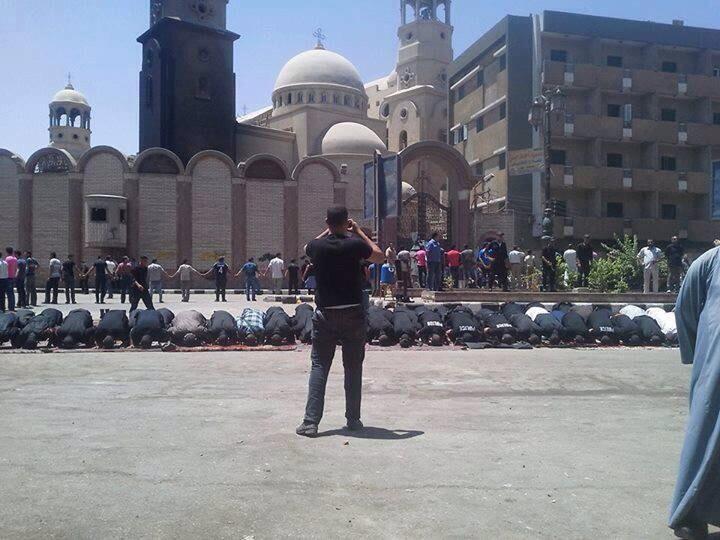
Muslims seen praying in Egypt while others join hands to protect St George’s Church – read more here.
Unfortunately, the church was later destroyed by arsonists (see here). Reading THIS IS WHAT IT LOOKS LIKE JUST BEFORE THE MUSLIM BROTHERHOOD JUMPS YOU, you get to see some of the chaos which is the current state of Egyptian life on the streets. We should note that 1) the majority of Muslim Brotherhood (MB) supporters are peaceful, but also that 2) the large crowds allow and sometimes support thug violence and the most extreme elements… So it makes no sense to blame the MB as a whole for recent violence, but we also cannot ignore the connection.
And for the leaders of the MB to call for “days of rage” (or “anger” – I don’t know the full gloss on the Arabic term being used), is not helping – at all.
Whether it is just vandals and thugs “hijacking” MB protests or not doesn’t make much difference to those attacked or to outside observers. Once violence breaks out, it is a violent protest and security forces have an interest in stopping it before it spirals out of control.
This is the lesson from Kant, from Marx if “correctly” read, and from Weil. Taking power as a political party doesn’t mean you can take absolute power over the people (i.e. become the next despot). Democracy is messy, but it must be pursued because anarchy is much messier and absolutism is a darkness into which no sane person would venture.
In Egypt, democracy must start with the military now (who willing seceded before and will again, we hope) and must rely on an eventual government of the people with a leader who doesn’t willingly exclude all others in a race for his own bid to become ‘pharaoh’–or divine king for Christians or chakravartin for Buddhists. Politicians need to stay out of overt (and often divisive and hateful) religious activities and this goes no less for the US or UK or Burma than it does for Egypt. We can only guess how much G.W. Bush’s mention of the word “crusade” destroyed hope of uniting people against radicals in 2011 and fueled the recruitment efforts of violent anti-American groups. Imagine our reaction if U Wirathu or his likes were to enter politics and be elected to the highest office in Burma.
Egyptians, we hope, are not discouraged by the democratic process, but rather will seek to learn from the failings of one government in their preparations to elect the next.
Of course drawing analogies from distant places and times is open to counter-example and arguments of dis-analogy. Perhaps Morsi’s Muslim Brotherhood is more like the Christian Democratic Union of post-war Germany than the Puritans and Roman Catholic Church of the 17th century or the 20th century Soviets discussed by Scruton.

Next Post

August 21, 2013 Buddhism and Violence on the BBC
Browse Our Archives
Select a Category Academia Activism American Buddhism Art Book review Buddhism Buddhism Today Buddhist Ethics Burma/Myanmar China Christianity Commodification Environment Gender Happiness Health Humor India Interfaith Islam Japanese Buddhism Kant Media / News Meditation mindfulness Photography Poetry Politics quicktakes Running Teaching Technology Thailand Theism/Atheism Theravada Tibet Tibetan Buddhism Travels Uncategorized Unitarian Universalism video Western Philosophy Zen
Select a Month June 2021 January 2021 November 2020 August 2020 July 2020 March 2020 January 2020 October 2019 August 2019 June 2019 May 2019 March 2019 February 2019 January 2019 December 2018 November 2018 October 2018 September 2018 August 2018 July 2018 June 2018 May 2018 April 2018 March 2018 February 2018 January 2018 December 2017 November 2017 October 2017 September 2017 August 2017 July 2017 June 2017 May 2017 April 2017 March 2017 February 2017 January 2017 December 2016 November 2016 October 2016 September 2016 August 2016 July 2016 June 2016 May 2016 April 2016 March 2016 February 2016 January 2016 December 2015 November 2015 October 2015 September 2015 August 2015 July 2015 June 2015 May 2015 April 2015 March 2015 February 2015 January 2015 December 2014 November 2014 October 2014 September 2014 August 2014 July 2014 June 2014 May 2014 April 2014 March 2014 February 2014 January 2014 December 2013 November 2013 October 2013 September 2013 August 2013 July 2013 June 2013 May 2013 April 2013 March 2013 February 2013 January 2013 December 2012 November 2012 October 2012 September 2012 August 2012 July 2012 June 2012 May 2012 April 2012 March 2012 February 2012 January 2012 December 2011 November 2011 October 2011 September 2011 August 2011 July 2011 June 2011 May 2011 April 2011 March 2011 February 2011 January 2011 December 2010 November 2010 October 2010 September 2010 August 2010 July 2010 June 2010 May 2010 April 2010 March 2010 February 2010 January 2010 December 2009 November 2009 October 2009 September 2009 August 2009 July 2009 June 2009 May 2009 April 2009 March 2009 February 2009 January 2009 December 2008 November 2008 October 2008 September 2008 August 2008 July 2008 June 2008 May 2008 April 2008 March 2008 September 2007 August 2007 July 2007 June 2007 May 2007 April 2007 March 2007 February 2007 January 2007 December 2006 November 2006 October 2006 September 2006 August 2006 July 2006 June 2006 May 2006 April 2006 March 2006 February 2006 January 2006 December 2005 November 2005 October 2005 September 2005 November 2004 September 2004 August 2004
Follow Us!
TAKE THE
Religious Wisdom Quiz
What did Isaiah see in his vision in Isaiah 6?
Select your answer to see how you score.
A chariot of fire The Lord seated on His throne A burning bush A ladder to heaven
Support this
Column


Related posts from American Buddhist Perspectives

Standing up to Lies: Can America Emerge from...
American Buddhist Perspectives

Progressive responses to the 2020 election of Biden...
American Buddhist Perspectives

In strife and uncertainty: let us remember loving-kindness
American Buddhist Perspectives

Hong Kong: Democracy, Protest, and Violence. A Primer...
American Buddhist Perspectives
TRENDING AT PATHEOS Buddhist

On Taking Refuge in the Dharma
(Here I continue the feature of sharing talks and essays by teachers...

(Continuing my intention to share talks and essays by other members of Empty...
The Subtle Art of Bowing: A Dharma Discourse
(This presentation was first offered by my dear friend Dharma Holder Tom...

Internal Family Systems Can Heal you Mentally &...
How IFS Helped Me Stop Fighting Myself Internal Family Systems (IFS) is...

The Bible No One Spoke About: A Family’s...
A mysterious family Bible, unspoken faith, and a journey from curiosity to...

How Uncertainty Can Transform Your Life in 2025
Embracing Uncertainty: A New Year’s Resolution for the Brave As 2025 approaches,...
view all Buddhist blogs
Ad-Free & Subscriber Log-In Subscription Support
- About Us
- 2026 Calendar
- Videos
- Podcasts
- Library of World Religions
- Faith In Media Tracker
- Advertise With Us
- Write for Us
- Privacy Policy
- Terms of Service
- Do Not Sell My Data
- Contact Us
- Radiant Digital
- Manage Newsletter Subscriptions
- Unsubscribe From Notifications
- Sitemap
Copyright 2008-2026, Patheos. All rights reserved.
Subscription Support Ad-Free & Subscriber Log-In
Follow Patheos