
BuddhistCatholicContemplativeEvangelicalGeneral ChristianHinduJewishLatter-day SaintMuslimNew VisionsProgressive Christian
Beliefs
- Buddhist
- Catholic
- Contemplative
- Evangelical
- General Christian
- Hindu
- Jewish
- Latter-day Saint
- More Voices
- Muslim
- New Visions
- Pagan
- Progressive Christian
Topics
- Religion News
- Food and Religion
- Sports and Religion
- Religious Art
- Religious Music and Entertainment
- Religious Events
- History and Religion
- Style and Religion
- Politics and Religion
- Women in Religion
- Recreation Outdoors and Religion
- Business Finance and Religion
- Careers Workplace and Religion
- Education and Religion
- Family Parenting and Religion
- Health Fitness and Religion
- Home and Religion
- Relationships and Religion
- Technology and Religion
- Travel and Religion
Columnists
- Buddhist Columnists
- Business Finance and Religion Columnists
- Careers Workplace and Religion Columnists
- Catholic Columnists
- Contemplative Columnists
- Education and Religion Columnists
- Evangelists Columnists
- Family Parenting and Religion Columnists
- General Christian Columnists
- Health Fitness and Religion Columnists
- Hindu Columnists
- History and Religion Columnists
- Home and Religion Columnists
- Jewish Columnists
- More Voices Columnists
- Latter Day Columnists
- Muslim Columnists
- New Visions Columnists
- Nonreligious Columnists
- Pagan Columnists
- Politics and Religion Columnists
- Progressive Columnists
- Recreation Outdoors and Religion Columnists
- Relationships and Religion Columnists
- Religion News Columnists
- Religious Art Columnists
- Religious Events Columnists
- Religious Music and Entertainment Columnists
- Sports and Religion Columnists
- Style and Religion Columnists
- Technology and Religion Columnists
- Travel and Religion Columnists
- Women in Religion Columnists
Resource Library
- 2026 Calendar
- Library of World Religions
- The 100 Most Holy Places on Earth
- Patheos Answers
- Podcasts
- Videos
- Faith Leaders Database
- Anglican Episcopalian
- Bahai
- Baptist
- Buddhism
- Christianity
- Confucianism
- Eastern Orthodoxy
- Hinduism
- Holiness and Pentecostal
- ISKCON
- Islam
- Judaism
- Lutheran
- Methodist
- The Church of Jesus Christ of Latter-day Saints
- New Age
- Paganism
- Presbytarian and Reformed
- Protestantism
- Religion Behind the Scenes
- Roman Catholic
- Scientology
- Shia Islam
- Sikhism
- Sufism
- Sunni Islam
- Taoism
- Zen
- See all religions
Research Tools
 Ad-Free & Subscriber Log-In Subscription Support
Ad-Free & Subscriber Log-In Subscription Support
Follow Patheos 

- Trending:
- Forgiveness
- |
- Marriage
- |
- Consciousness
- |
- Death Penalty
- |
- Election
- |
- Halloween
 American Buddhist Perspectives
- Home
- Buddhist
- Religion News
- Exploring discomfort: My first day of fasting for Ramadan
Exploring discomfort: My first day of fasting for Ramadan
Last updated on: July 20, 2013 at 6:36 pm by Justin Whitaker
Exploring discomfort: My first day of fasting for Ramadan 2013-07-20T18:36:06-06:00 Justin Whitaker
Patheos Explore the world's faith through different perspectives on religion and spirituality! Patheos has the views of the prevalent religions and spiritualities of the world.
As I said in my last post, I will be fasting one day a week this Ramadan as part of The Fasting Project here at Patheos. Wednesday was my first day.
It began at 2:45 am, when I rose for the pre-dawn meal, which I was told should be finished by 3:22 am, followed by salah (prayers) at 4:06 and 5:14am. I had a pretty large meal and then settled in for some work and periods of reflection during salah. Given the hour and the fact that my brain doesn’t normally start working until around 9am with 2 cups of coffee in me, my reflections were not too profound. I recall reading of the meal (called Suhoor):
“Being the last meal eaten by Muslims before fasting from dawn to sunset during the month of Ramadan, Suhoor is regarded by Islamic traditions as a benefit of the blessings in that it allows the person fasting to avoid the crankiness or the weakness caused by the fast.”
I was also warned not to have coffee or tea (diuretics), so I didn’t, which gave rise to worries that “cranky” might be an overly polite description of my state by the end of the day.
At the time of the second salah, I decided to read some of the posts at altmuslim, coming across this wonderful passage by Rushain Abbasi:
Ramadan is about the radical, the extreme. It is no shy creature, but rather an in-your-face sledgehammer against the chains of daily subjugation: an unending self-subjugation in which we ourselves play the biggest role. Our work, food and sex all serve as daily distractions from the complexities hidden deep within the crevices of our labyrinthine souls. But Ramadan comes with a tidal wave antinomy of unbound passion and peaceful solemnity to usurp the ordinary and routine and replace it with an unfamiliar feeling of hunger, thirst and most importantly, self-reflection.
…
I meditate on the verse of the Quran: “You who believe, fasting is prescribed for you, as it was prescribed for those before you, so that you may gain taqwa.” The translation of this foundational concept in Islam varies from “God-fearing” to being “mindful of God.” I like to think of it as consciousness, awareness, mindfulness.
The idea of giving up ordinary life, or rather hitting it with a “sledgehammer” in order to engender self-reflection as well as broader “consciousness, awareness, [and] mindfulness” seemed right at home with my Buddhist practice. Isn’t this what we do when we dedicate a period of time to sitting? Or, perhaps a better analogy, to retreat? No comparison will be quite right though for a number of reasons, one of which is that Ramadan is not a time off from Muslims: on the outside they are to continue with daily duties.
As I thought about that, the fact that I only slept about 3 and a half hours that night and been up for the last 2 or so invaded my sublime consciousness and beckoned me back to sleep.
By 9:30 (a much saner hour by my lazy standards) I was back up and beginning to catch up on morning emails, and soon I was working away properly. Sure I wanted coffee, but saying no to that was easy enough. Then thirst came up a bit, and that was harder to just ignore. By 11am I found myself checking the clock somewhat neurotically. But that passed, and on with my work I went. (I could note that it has been unseasonably hot for England lately, but I’ve lived through hotter without A/C and I work from home, so I don’t have to travel in the sun.)
At 1.25pm I realized that I had worked through the start of zohar, mid-day prayers; so I paused and reflected… and then I took a nap.
I woke up at 4pm, the hottest part of the day. Despite the heat, and despite a noticeably sticky mouth from thirst, what I really wanted was a cup of coffee.
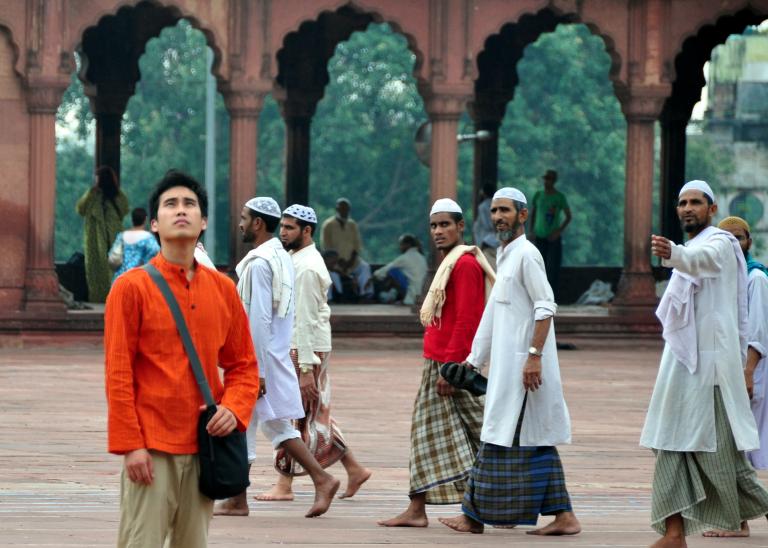
Jama Masjid – Old Delhi, India. 2010 Antioch Buddhist Studies in India TA Marcus Woo examines the Mosque while a group of Muslims pass behind him.
It was then that I sat back down at my desk with the sobering, even if entirely unprofound, realization: that discomfort is okay. It is so typical for me to simply brew up a pot coffee any time I want it, to grab a bite to eat any time my stomach even made the tiniest sound – and on most days, to be honest, I eat well before my stomach is growling. I know discomfort well enough from long-distance running and from forcing myself to write chapters and grade papers that sometimes lack appeal. But these are different somehow. I know I’ll get something out of the run (the joy of being able to run for as long as possible in life, finishing that next big race, discovery, etc etc); and writing and grading are just part of what I do as an academic – the temporary discomforts are made up for a dozen times over with (nerdily) exciting reading, conferences, conversations, and being able to be part of things like this Fasting Project.
But to just sit at 4 in the afternoon on an ordinary day, having had no food/water for over 12 hours and with about 5 hours still ahead of me, meant a sort of… I almost want to say arbitrary discomfort. But it’s not arbitrary at all, is it? The whole idea was self-reflection. And in that little unprofound sparkle, I did just that.
For the 6:45 salah, I tuned in to NPR’s live coverage of Ramadan in Mecca. The hypnotic recitation of the Quran (I believe this is what is happening between prayers there) by the muezzin, accompanied by the flow of people around the kaaba was deeply peaceful. In a moment of what can only be a clear indication that modernity has found it’s way to the heart of Islam, two people stopped in front of the camera, which was low and pulled tight on the kabba, and began jumping and waving.
It was 8pm before my stomach began to give its first real grumbles – perhaps knowing the roughly hour-long countdown had begun.
At 8:45 I met up with Farhad, a housemate and friend of mine from Bangladesh, to go together to the local Islamic Center. That is when a new sense of discomfort began to grow. Was I dressed appropriately? Would I act correctly? Would I remember the greetings “As-Salaam–Alaikum” and “Wa-Alaikum–Salaam“ after 18 hours without food or water? (I have similar, and other, worries any time I meet new people.)
On the walk there I felt okay; still a bit thirsty, a bit weak, but overall quite calm and at peace with the physiological discomfort of the day. When we arrived we realized we were quite early so he sat me down with an interpretation of the Quran to look over. I was introduced to a young man from Bangalore, India and another from Nigeria as we awaited the traditional dates to break the fast. I noticed that most of the people are speaking what I assume to be Arabic and Farhad explained that the center was set up by Arab Muslims, but that its proximity to the University tends to bring in some non-Arab Muslims.
And then, the muezzin called out magrib, or sunset prayers, followed by our breaking of the fast. We all sat together on the floor, with plastic sheets in front of us containing the dates, milk, juice, and water. Cashews soon followed. After a few minutes the call was made for the evening prayers. This is where I was a bit unsure what to do. Farhad invited me to join, or to stay there… I chose to stay. Watching the prayers and prostrations of those gathered, I couldn’t help but compare it with Buddhists: standing, reciting (sometimes in a language they themselves do not fully comprehend), bowing, kneeling, forehead to the ground.
As children played in the cramped spaces between praying men, I sat, reverently watching and contemplating my own (perhaps in this moment very unique) place in the world, an American Buddhist in an Arab Muslim house of prayer in England.
I’ll leave it there for tonight.
Sunday I’ll write about the end of my evening, which included a great meal -after 18 hours without food, what meal isn’t great?- and conversations, with at least one or two more awkward moments for yours truly, all ending with plenty of kindness, understanding, and handshakes with plans to talk more next week.
Until then, cheers and Ramadan Kareem.
Previous Post

July 16, 2013
Tiptoeing into Ramadan: a Buddhist's experience of Islam's holy month
Next Post

July 20, 2013 "Bones of the Buddha" to air on PBS
Browse Our Archives
Select a Category Academia Activism American Buddhism Art Book review Buddhism Buddhism Today Buddhist Ethics Burma/Myanmar China Christianity Commodification Environment Gender Happiness Health Humor India Interfaith Islam Japanese Buddhism Kant Media / News Meditation mindfulness Photography Poetry Politics quicktakes Running Teaching Technology Thailand Theism/Atheism Theravada Tibet Tibetan Buddhism Travels Uncategorized Unitarian Universalism video Western Philosophy Zen
Select a Month June 2021 January 2021 November 2020 August 2020 July 2020 March 2020 January 2020 October 2019 August 2019 June 2019 May 2019 March 2019 February 2019 January 2019 December 2018 November 2018 October 2018 September 2018 August 2018 July 2018 June 2018 May 2018 April 2018 March 2018 February 2018 January 2018 December 2017 November 2017 October 2017 September 2017 August 2017 July 2017 June 2017 May 2017 April 2017 March 2017 February 2017 January 2017 December 2016 November 2016 October 2016 September 2016 August 2016 July 2016 June 2016 May 2016 April 2016 March 2016 February 2016 January 2016 December 2015 November 2015 October 2015 September 2015 August 2015 July 2015 June 2015 May 2015 April 2015 March 2015 February 2015 January 2015 December 2014 November 2014 October 2014 September 2014 August 2014 July 2014 June 2014 May 2014 April 2014 March 2014 February 2014 January 2014 December 2013 November 2013 October 2013 September 2013 August 2013 July 2013 June 2013 May 2013 April 2013 March 2013 February 2013 January 2013 December 2012 November 2012 October 2012 September 2012 August 2012 July 2012 June 2012 May 2012 April 2012 March 2012 February 2012 January 2012 December 2011 November 2011 October 2011 September 2011 August 2011 July 2011 June 2011 May 2011 April 2011 March 2011 February 2011 January 2011 December 2010 November 2010 October 2010 September 2010 August 2010 July 2010 June 2010 May 2010 April 2010 March 2010 February 2010 January 2010 December 2009 November 2009 October 2009 September 2009 August 2009 July 2009 June 2009 May 2009 April 2009 March 2009 February 2009 January 2009 December 2008 November 2008 October 2008 September 2008 August 2008 July 2008 June 2008 May 2008 April 2008 March 2008 September 2007 August 2007 July 2007 June 2007 May 2007 April 2007 March 2007 February 2007 January 2007 December 2006 November 2006 October 2006 September 2006 August 2006 July 2006 June 2006 May 2006 April 2006 March 2006 February 2006 January 2006 December 2005 November 2005 October 2005 September 2005 November 2004 September 2004 August 2004
Follow Us!
TAKE THE
Religious Wisdom Quiz
According to Romans, how does faith come?
Select your answer to see how you score.
Through prayer By hearing the word From the Holy Spirit By reading Scripture
Support this
Column


Related posts from American Buddhist Perspectives

In strife and uncertainty: let us remember loving-kindness
American Buddhist Perspectives

The Coronavirus is coming - Some thoughts from...
American Buddhist Perspectives

Sogyal Lakar, well-known Tibetan Buddhist teacher and alleged...
American Buddhist Perspectives

Secular vs Religious, Buddhism vs Mindfulness, and a...
American Buddhist Perspectives
TRENDING AT PATHEOS Buddhist

On Taking Refuge in the Dharma
(Here I continue the feature of sharing talks and essays by teachers...

(Continuing my intention to share talks and essays by other members of Empty...
The Subtle Art of Bowing: A Dharma Discourse
(This presentation was first offered by my dear friend Dharma Holder Tom...

Internal Family Systems Can Heal you Mentally &...
How IFS Helped Me Stop Fighting Myself Internal Family Systems (IFS) is...

The Bible No One Spoke About: A Family’s...
A mysterious family Bible, unspoken faith, and a journey from curiosity to...

How Uncertainty Can Transform Your Life in 2025
Embracing Uncertainty: A New Year’s Resolution for the Brave As 2025 approaches,...
view all Buddhist blogs
Ad-Free & Subscriber Log-In Subscription Support
- About Us
- 2026 Calendar
- Videos
- Podcasts
- Library of World Religions
- Faith In Media Tracker
- Advertise With Us
- Write for Us
- Privacy Policy
- Terms of Service
- Do Not Sell My Data
- Contact Us
- Radiant Digital
- Manage Newsletter Subscriptions
- Unsubscribe From Notifications
- Sitemap
Copyright 2008-2026, Patheos. All rights reserved.
Subscription Support Ad-Free & Subscriber Log-In
Follow Patheos