
BuddhistCatholicContemplativeEvangelicalGeneral ChristianHinduJewishLatter-day SaintMuslimNew VisionsProgressive Christian
Beliefs
- Buddhist
- Catholic
- Contemplative
- Evangelical
- General Christian
- Hindu
- Jewish
- Latter-day Saint
- More Voices
- Muslim
- New Visions
- Pagan
- Progressive Christian
Topics
- Religion News
- Food and Religion
- Sports and Religion
- Religious Art
- Religious Music and Entertainment
- Religious Events
- History and Religion
- Style and Religion
- Politics and Religion
- Women in Religion
- Recreation Outdoors and Religion
- Business Finance and Religion
- Careers Workplace and Religion
- Education and Religion
- Family Parenting and Religion
- Health Fitness and Religion
- Home and Religion
- Relationships and Religion
- Technology and Religion
- Travel and Religion
Columnists
- Buddhist Columnists
- Business Finance and Religion Columnists
- Careers Workplace and Religion Columnists
- Catholic Columnists
- Contemplative Columnists
- Education and Religion Columnists
- Evangelists Columnists
- Family Parenting and Religion Columnists
- General Christian Columnists
- Health Fitness and Religion Columnists
- Hindu Columnists
- History and Religion Columnists
- Home and Religion Columnists
- Jewish Columnists
- More Voices Columnists
- Latter Day Columnists
- Muslim Columnists
- New Visions Columnists
- Nonreligious Columnists
- Pagan Columnists
- Politics and Religion Columnists
- Progressive Columnists
- Recreation Outdoors and Religion Columnists
- Relationships and Religion Columnists
- Religion News Columnists
- Religious Art Columnists
- Religious Events Columnists
- Religious Music and Entertainment Columnists
- Sports and Religion Columnists
- Style and Religion Columnists
- Technology and Religion Columnists
- Travel and Religion Columnists
- Women in Religion Columnists
Resource Library
- 2026 Calendar
- Library of World Religions
- The 100 Most Holy Places on Earth
- Patheos Answers
- Podcasts
- Videos
- Faith Leaders Database
- Anglican Episcopalian
- Bahai
- Baptist
- Buddhism
- Christianity
- Confucianism
- Eastern Orthodoxy
- Hinduism
- Holiness and Pentecostal
- ISKCON
- Islam
- Judaism
- Lutheran
- Methodist
- The Church of Jesus Christ of Latter-day Saints
- New Age
- Paganism
- Presbytarian and Reformed
- Protestantism
- Religion Behind the Scenes
- Roman Catholic
- Scientology
- Shia Islam
- Sikhism
- Sufism
- Sunni Islam
- Taoism
- Zen
- See all religions
Research Tools
 Ad-Free & Subscriber Log-In Subscription Support
Ad-Free & Subscriber Log-In Subscription Support
Follow Patheos 

- Trending:
- Forgiveness
- |
- Marriage
- |
- Consciousness
- |
- Death Penalty
- |
- Election
- |
- Halloween
 American Buddhist Perspectives
- Home
- Buddhist
- Religion News
- Wagner Dream: Buddhism from ancient India to Wales and England
Wagner Dream: Buddhism from ancient India to Wales and England
Last updated on: June 11, 2013 at 5:27 pm by Justin Whitaker
Wagner Dream: Buddhism from ancient India to Wales and England 2013-06-11T17:27:20-06:00 Justin Whitaker
Patheos Explore the world's faith through different perspectives on religion and spirituality! Patheos has the views of the prevalent religions and spiritualities of the world.
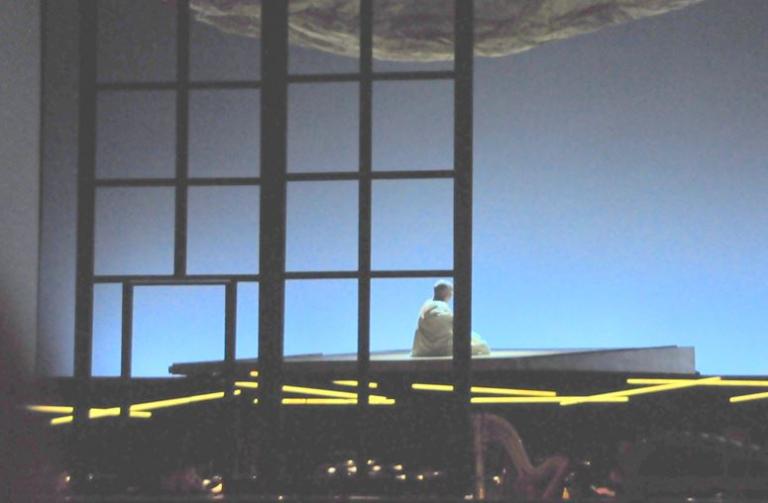
Opening scene from Harvey’s Wagner Dream (June 2013, performed by the Welsh National Opera)
Before the opera begins, a solitary figure in white robes walks purposefully out on to stage from the right, turns onto a raised platform, and sits, facing slightly away from the audience.
This is how Wagner Dream, a modern British opera, begins. The opera is based in two worlds, that of 1883 Venice and the last day in the life of Richard Wagner, and 5th century India and the romantic entanglement of a young outcast woman and the Buddha’s cousin and chief attendant, Ānanda.
The divide in time is rather creatively visualized, allowing both to exist on stage simultaneously by placing the scenes from Venice on a narrow strip of stage in front of (from the perspective of the audience) the orchestra pit. The scenes from ancient India, meanwhile, take place on and around the platform behind the orchestra. The divide is further accentuated by the Welsh National Opera’s director Pierre Audi’s decision to have the sung dialogue of the Buddhists placed in Pali, which is commonly described as the language of the Buddha, but is actually a term meaning ‘text’ – referring to the recorded teachings of the Buddha and his disciples. Meanwhile the spoken dialogue of Wagner and friends is in German. Surtitles (supertitles) translate both above the stage in English and Welsh. The use of the two languages helps move the audience both out of their own world and into the lives of the characters on the stage.
As you would guess, this is a bit of a niche opera. Four languages, three time periods (if you include the very modern use of minimalist stage sets and electronic sound effects), and the clashing of two very distant cultures as a 19th century German composer encounters ancient Indian ideas and stories. Again we might add our own time period as a third culture, in some ways as distant from Wagner as he finds himself from the Buddha. And, to further complicate things, the story that was placed in Pali itself comes from Eugene Burnouf’s 1844 work, “Introduction à l’Histoire du Buddhisme Indien” (recently translated into English here), which is based on a Sanskrit text, the Divyāvadāna (Divine Stories) an anthology of Buddhist tales dating to around the 2nd Century CE.
The framing story, that of Wagner, his wife, a young English lover, and a doctor, has the great composer agonizing over an unfinished piece of work. Wagner had read Burnouf’s work and was so fascinated by it that he planned an opera based on it. The opera was to be called Die Sieger (The Victors) and was composed – though never completed – between 1856 and 1858. As he is stricken with a heart attack he is visited by the Buddha Vairocana, who implores him to make the right decision at this oncoming moment of death. In his dying moments, Wagner retraces the love story of the outcast woman Prakriti and Ānanda, in which the Buddha eventually allows a chaste union, ordaining her into the community/Sangha.
As Stephen Walsh of the Arts Desk wrote:
To describe in detail the many levels of Harvey’s score would take a much longer review than this. Both musically and dramaturgically the opera is a palimpsest: layer on layer, from Harvey’s own culminating work and death, down through Wagner’s, and on into the virtual world of the Buddha and the hidden reality of Schopenhauer’s noumenon, the profound truth which, he maintained, we can only ever glimpse through music.
In the movement between layers, one is drawn in to parallels, either real or imagined, between
- Prakriti and Ānanda’s love affair and Wagner’s own with the young singer Carrie Pringle, who appears in the opera to comfort him, sparking discord with his wife;
- The motif of giving up / letting go; as Wagner must give up his ambition to complete his work and accept death and Prakriti must give up romantic ideas to truly be with her love Ānanda;
- and perhaps even eugenics or ideas of purity of blood; as Prakriti is an outcaste, denounced by a Brahmin in the play and Wagner himself is known to have held some of the racist and antisemitic views common to Germany of his time;
And there is likely more that will catch the trained eye of Wanger fans or those trained in aspects of Buddhism that I know very little about. But all in all, the motions back and forth, and it’s accompanying drama, was fluid and engrossing and I found myself drawn in to both stories, empathizing just as much with Prakriti and Ānanda as for Wagner in his struggle to face death.
As a student of early Buddhism, it is exciting to see a work of art such as this featuring both a story from the Buddha’s life and lengthy dialogue in Pali. Richard Gombrich, the man who translated Harvey’s English into Pali, once stated that we in Buddhist Studies are at least 100 years behind our fellow scholars in Biblical Studies, and I agree. We are still relatively few in number and those working hard on the texts rarely communicate well with those doing archaeological work; and then there are those who seem to do well by interpreting everyone else through postmodern psychoanalysis or other such contemporary theories.
So, popularizations such as this, as niche as they might be, are a welcome contribution to the world’s understanding of – and hopefully interest in – Buddhism.
For a couple more reviews that come from writers better versed in the arts/opera see here and here. I saw the opera on Friday the 8th of June at Cardiff’s Wales Millennium Centre; the opera can be seen for the last time in this run tomorrow in Birmingham – see here for tickets. I hope to have an interview with my friend, Caroline Barker, who acted as the Pali pronunciation coach for the opera, in the next week or two.
Previous Post

June 9, 2013
Grabbing hold of life
Next Post

June 14, 2013 Buddhism has the Rope and the Snake, Christianity has Jesus and the Pug
Browse Our Archives
Select a Category Academia Activism American Buddhism Art Book review Buddhism Buddhism Today Buddhist Ethics Burma/Myanmar China Christianity Commodification Environment Gender Happiness Health Humor India Interfaith Islam Japanese Buddhism Kant Media / News Meditation mindfulness Photography Poetry Politics quicktakes Running Teaching Technology Thailand Theism/Atheism Theravada Tibet Tibetan Buddhism Travels Uncategorized Unitarian Universalism video Western Philosophy Zen
Select a Month June 2021 January 2021 November 2020 August 2020 July 2020 March 2020 January 2020 October 2019 August 2019 June 2019 May 2019 March 2019 February 2019 January 2019 December 2018 November 2018 October 2018 September 2018 August 2018 July 2018 June 2018 May 2018 April 2018 March 2018 February 2018 January 2018 December 2017 November 2017 October 2017 September 2017 August 2017 July 2017 June 2017 May 2017 April 2017 March 2017 February 2017 January 2017 December 2016 November 2016 October 2016 September 2016 August 2016 July 2016 June 2016 May 2016 April 2016 March 2016 February 2016 January 2016 December 2015 November 2015 October 2015 September 2015 August 2015 July 2015 June 2015 May 2015 April 2015 March 2015 February 2015 January 2015 December 2014 November 2014 October 2014 September 2014 August 2014 July 2014 June 2014 May 2014 April 2014 March 2014 February 2014 January 2014 December 2013 November 2013 October 2013 September 2013 August 2013 July 2013 June 2013 May 2013 April 2013 March 2013 February 2013 January 2013 December 2012 November 2012 October 2012 September 2012 August 2012 July 2012 June 2012 May 2012 April 2012 March 2012 February 2012 January 2012 December 2011 November 2011 October 2011 September 2011 August 2011 July 2011 June 2011 May 2011 April 2011 March 2011 February 2011 January 2011 December 2010 November 2010 October 2010 September 2010 August 2010 July 2010 June 2010 May 2010 April 2010 March 2010 February 2010 January 2010 December 2009 November 2009 October 2009 September 2009 August 2009 July 2009 June 2009 May 2009 April 2009 March 2009 February 2009 January 2009 December 2008 November 2008 October 2008 September 2008 August 2008 July 2008 June 2008 May 2008 April 2008 March 2008 September 2007 August 2007 July 2007 June 2007 May 2007 April 2007 March 2007 February 2007 January 2007 December 2006 November 2006 October 2006 September 2006 August 2006 July 2006 June 2006 May 2006 April 2006 March 2006 February 2006 January 2006 December 2005 November 2005 October 2005 September 2005 November 2004 September 2004 August 2004
Follow Us!
TAKE THE
Religious Wisdom Quiz
What was an ephah's volume? (Biblical Measurement)
Select your answer to see how you score.
30 liters 15 liters 22 liters 10 liters
Support this
Column


Related posts from American Buddhist Perspectives

In strife and uncertainty: let us remember loving-kindness
American Buddhist Perspectives

A Festival of Radical Awakening: Socially Engaged Buddhism...
American Buddhist Perspectives

The Coronavirus is coming - Some thoughts from...
American Buddhist Perspectives

Sogyal Lakar, well-known Tibetan Buddhist teacher and alleged...
American Buddhist Perspectives
TRENDING AT PATHEOS Buddhist

On Taking Refuge in the Dharma
(Here I continue the feature of sharing talks and essays by teachers...

(Continuing my intention to share talks and essays by other members of Empty...
The Subtle Art of Bowing: A Dharma Discourse
(This presentation was first offered by my dear friend Dharma Holder Tom...

Internal Family Systems Can Heal you Mentally &...
How IFS Helped Me Stop Fighting Myself Internal Family Systems (IFS) is...

The Bible No One Spoke About: A Family’s...
A mysterious family Bible, unspoken faith, and a journey from curiosity to...

How Uncertainty Can Transform Your Life in 2025
Embracing Uncertainty: A New Year’s Resolution for the Brave As 2025 approaches,...
view all Buddhist blogs
Ad-Free & Subscriber Log-In Subscription Support
- About Us
- 2026 Calendar
- Videos
- Podcasts
- Library of World Religions
- Faith In Media Tracker
- Advertise With Us
- Write for Us
- Privacy Policy
- Terms of Service
- Do Not Sell My Data
- Contact Us
- Radiant Digital
- Manage Newsletter Subscriptions
- Unsubscribe From Notifications
- Sitemap
Copyright 2008-2026, Patheos. All rights reserved.
Subscription Support Ad-Free & Subscriber Log-In
Follow Patheos