
BuddhistCatholicContemplativeEvangelicalGeneral ChristianHinduJewishLatter-day SaintMuslimNew VisionsProgressive Christian
Beliefs
- Buddhist
- Catholic
- Contemplative
- Evangelical
- General Christian
- Hindu
- Jewish
- Latter-day Saint
- More Voices
- Muslim
- New Visions
- Pagan
- Progressive Christian
Topics
- Religion News
- Food and Religion
- Sports and Religion
- Religious Art
- Religious Music and Entertainment
- Religious Events
- History and Religion
- Style and Religion
- Politics and Religion
- Women in Religion
- Recreation Outdoors and Religion
- Business Finance and Religion
- Careers Workplace and Religion
- Education and Religion
- Family Parenting and Religion
- Health Fitness and Religion
- Home and Religion
- Relationships and Religion
- Technology and Religion
- Travel and Religion
Columnists
- Buddhist Columnists
- Business Finance and Religion Columnists
- Careers Workplace and Religion Columnists
- Catholic Columnists
- Contemplative Columnists
- Education and Religion Columnists
- Evangelists Columnists
- Family Parenting and Religion Columnists
- General Christian Columnists
- Health Fitness and Religion Columnists
- Hindu Columnists
- History and Religion Columnists
- Home and Religion Columnists
- Jewish Columnists
- More Voices Columnists
- Latter Day Columnists
- Muslim Columnists
- New Visions Columnists
- Nonreligious Columnists
- Pagan Columnists
- Politics and Religion Columnists
- Progressive Columnists
- Recreation Outdoors and Religion Columnists
- Relationships and Religion Columnists
- Religion News Columnists
- Religious Art Columnists
- Religious Events Columnists
- Religious Music and Entertainment Columnists
- Sports and Religion Columnists
- Style and Religion Columnists
- Technology and Religion Columnists
- Travel and Religion Columnists
- Women in Religion Columnists
Resource Library
- 2026 Calendar
- Library of World Religions
- The 100 Most Holy Places on Earth
- Patheos Answers
- Podcasts
- Videos
- Faith Leaders Database
- Anglican Episcopalian
- Bahai
- Baptist
- Buddhism
- Christianity
- Confucianism
- Eastern Orthodoxy
- Hinduism
- Holiness and Pentecostal
- ISKCON
- Islam
- Judaism
- Lutheran
- Methodist
- The Church of Jesus Christ of Latter-day Saints
- New Age
- Paganism
- Presbytarian and Reformed
- Protestantism
- Religion Behind the Scenes
- Roman Catholic
- Scientology
- Shia Islam
- Sikhism
- Sufism
- Sunni Islam
- Taoism
- Zen
- See all religions
Research Tools
 Ad-Free & Subscriber Log-In Subscription Support
Ad-Free & Subscriber Log-In Subscription Support
Follow Patheos 

- Trending:
- Forgiveness
- |
- Marriage
- |
- Consciousness
- |
- Death Penalty
- |
- Election
- |
- Halloween
 American Buddhist Perspectives
- Home
- Buddhist
- Religion News
- Shinnyo-en, esoteric Japanese Buddhism for laypeople, spreading around the world
Shinnyo-en, esoteric Japanese Buddhism for laypeople, spreading around the world
Last updated on: May 16, 2013 at 9:28 pm by Justin Whitaker
Shinnyo-en, esoteric Japanese Buddhism for laypeople, spreading around the world 2013-05-16T21:28:14-06:00 Justin Whitaker
Patheos Explore the world's faith through different perspectives on religion and spirituality! Patheos has the views of the prevalent religions and spiritualities of the world.
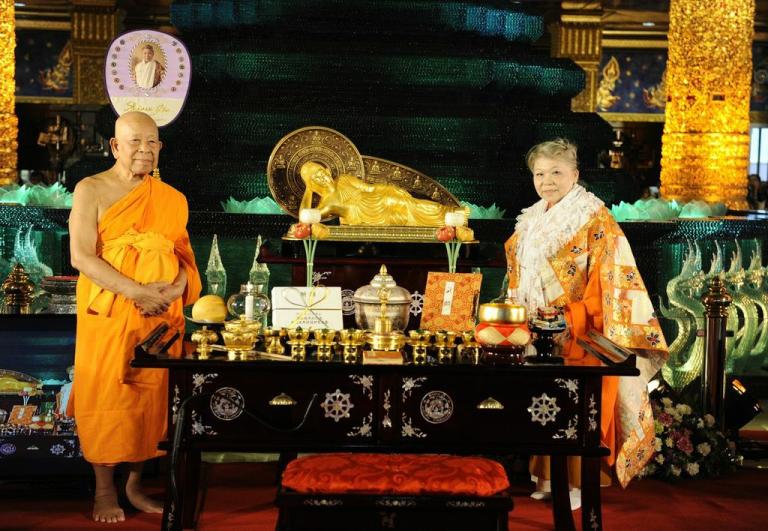
(April 2013) The Acting Supreme Patriarch of Thailand and Thai Theravada Buddhists joined Japanese Mahayana Buddhists in a prayer for peace. During the ceremony, Her Holiness Shinso Ito presented the Most Venerable Somdet Phra Maha Ratchamangkhlachan with a statue of Shakyamuni Buddha sculpted by Shinnyo-en’s founder, Master Shinjo Ito. The reclining Buddha or nirvana statue serves as Shinnyo-en’s principal figure of meditation and contemplation.
Today I am happy to introduce you to a branch of Buddhism that you probably have never heard of (I say that with confidence because before coming across them recently I had never heard or them): Shinnyo-en.
This particular branch began in 1936 as a community within Shingon Buddhism, a lineage started in Japan by a monk named Kūkai in the 8th-9th century CE. The founder of Shinnyo-en’s, Master Shinjo Ito, was trained in the Shingon Buddhist Daigo School (see their temple) and sought to adapt the practices to the needs of the laity. Shinnyo-en would go on to branch off as an independent denomination in the 1940s.
Below we discuss Shinnyo-en’s history, recent activities, and plans for the future with Her Holiness Shinso Ito.
JW: To begin, perhaps you could say more about what Shinnyo-en is, and how it is distinct from Shingon.
Shinnyo-en is a global Buddhist community for laypeople. Our founder, Shinjo Ito, was a master in Shingon Esoteric Buddhism. He developed an innovative practice for laypeople to use their everyday life as their spiritual training based on his own monastic training. He began Shinnyo-en as a community within Shingon Buddhism and eventually it branched off as an independent denomination in the 1940s. And although our foundation is in Shingon Buddhism, a lineage that has been practiced in Japan for more than one thousand years, there are distinct differences between Shingon and Shinnyo Buddhism.
The mere fact that Shinnyo-en is rooted in the teachings of the Mahaparinirvana Sutra and has its own unique form of meditation training distinguishes it from Shingon Buddhism. The meditation in Shinnyo-en, developed particularly for non-monastic practitioners, helps laypeople to cultivate moments of insight and awareness through their experiences in daily life. Sesshin meditation is a unique form of guided meditation that allows individuals to do deep self-reflection with the help of a trained meditation guide. The emphasis on enabling practitioners to translate gained insight into practical or concrete activities to improve their spirituality and the world around them is a core element of Shinnyo-en’s practice.
When looking at the relationship between Shinnyo Buddhism and Shingon Buddhism, it is important to recognize the authentic dharma lineage or transmission, which refers to the master-disciple structure for instruction and training. Our founder Shinjo stood in a long succession of spiritual transmissions of wisdom, lovingkindness and compassion that has been conferred upon one master to another in a lineage. This kind of transmission is often described in terms of water being poured from one vessel into another. Therefore, it was more than acquiring the knowledge of Shingon doctrine and the certification to carry out its rituals. By becoming a master himself, Shinjo was able to incorporate mudras, mantras, and authentic rituals and training procedures into Shinnyo-en and established training methods for people to experience the buddha’s wisdom, lovingkindness and compassion. Shinjo, thus, succeeded in progressively adapting monastic instruction to create a parallel path to monastic training for laypeople.
This is where the Mahayana Mahaparinirvana Sutra, or the Nirvana Sutra as it is often called, plays a larger role for Shinnyo Buddhism as our main Buddhist text. This sutra is not generally regarded as one of the “esoteric Buddhist texts.” However, based on his thorough training and spiritual achievements in esoteric Buddhism, Shinjo found a way of introducing and sharing essential aspects of esoteric Buddhism with laypeople through the Nirvana Sutra.
JW: I see that Shinnyo-en has centers in more than 15 countries around the world. Can you discuss recent growth of Shinnyo-en and your plans for the future. Do you plan to focus on Japan? Thailand? Western countries?
We do not have any plans to establish a particular number of centers. Our priority is helping people to realize greater self-awareness, happiness, and harmony no matter where they are from. Creating centers where people can meditate and reflect on their lives is just one of the ways in which we do this. Shinnyo-en also shares rituals and ceremonies with others around the world to cultivate compassion and inspire spiritual awakenings.
For example, since 1999 Shinnyo-en has been conducting a lantern floating ceremony in Hawaii on Memorial Day. This annual event has grown tremendously and now forty-thousand people come each year to reflect and pray for loved ones who have passed away. People have told us that they feel kinder and more peaceful after the service or that they feel a sense of warmth and healing. I think it allows people to connect with others and to cultivate compassion in their hearts. With the same intention, we engage in a variety of interfaith activities around the world from services at St. Peter’s Catholic Church in Manhattan to ceremonies with Theravada Buddhist monks from Thailand and Sri Lanka.
We also encourage our members to engage in service starting in their immediate surroundings, in their families, schools, and workplaces, and in their communities and to find ways to apply Buddhist principles of lovingkindness, compassion and harmony in their everyday life. It is our belief that people who have been touched by lovingkindness, wisdom and compassion carry these qualities into their daily lives and in turn, pass it on to those around them.
JW: The recent ceremony in Thailand points to the great potential for different branches of Buddhism to unite and foster deeper relations. Can you talk about some of the challenges you have faced in doing cross-cultural or interdenominational dialogue with other Buddhists or challenges you foresee in the coming years?
It is a delightful challenge to create new channels of interaction with people from different religions and cultural traditions. It is important to find people who share similar goals and to collaborate with them in order to realize true harmony amidst diversity. I find that a sincere approach to sharing in interfaith and interdenominational dialogues helps to develop a deeper understanding of one another and builds trusting relationships.
My parents, the founders of Shinnyo-en, taught me about meditation and reflection from the time I was a very small child. One of the things they taught me was to reflect on what was important for others and their needs. As a result, when I meet people from different traditions, I try to put myself in their place and respond accordingly. For me, compassion and empathy are essential elements in cultivating harmony.
Giving people the assistance, help, and opportunity they need to shine does not mean that we need to or have to huddle and hide ourselves in the dark. When we take each other by the hand and step out into the light together, we help bring even more light to those around us. That is something wonderful, which I hope to continue in the future.
JW: How do your teachings and practices help individuals in the ‘hyperconnected’ world we live in today? Is there something in particular about Buddhism or, more specifically, Shinnyo-en, that accounts for its growth and greater acceptance in recent decades?
More than two thousand years ago, Shakyamuni Buddha spoke about interdependence. Essentially, it describes everything as being interrelated. It does not mean that one thing is subsumed by another. Rather, it means that our individuality is brought out more fully in the realization of our deep connectedness with others. So I don’t believe that being “hyperconnected” is something we need to fear. Because of the awareness of the world as “hyperconnected,” people today are more aware of and can get a more concrete grasp of “pratityasamutpada,” or deep connectedness.
JW: I understand that the Mahāyāna Mahāparinirvāṇa Sūtra is a key foundation to Shinnyo-en. Can you discuss how this fits in with other Buddhist teachings?
Shinnyo Buddhism is inspired by the Mahayana Mahaparinirvana Sutra, also known as the Nirvana Sutra. This sutra emphasizes the ability of anyone to achieve enlightenment. It teaches that everyone has the potential to awaken to his or her buddha nature. The Nirvana Sutra is a well-known and authoritative source for many practitioners as it is considered to be the last teachings of the Buddha focused and expounding on wisdom, lovingkindness and compassion. In fact, wherever there is a profound interest in buddha nature, one is likely to find references to the Nirvana Sutra.
Dogen, the founder of Soto Zen, frequently quotes the Nirvana Sutra in his “Treasury of the True Dharma Eye” and the “Annotated Commentaries on the Three Sutras” by Prince Shotoku from 7th century Japan, also drew attention to the Nirvana Sutra’s emphasis on buddha nature and its presence in our lives. Shinjo Ito came to the Nirvana Sutra after his monastic training in esoteric Buddhism. Based on his spiritual achievements, in this sutra he found a way to illuminate esoteric Buddhist practice for everyday people.
The content of the Buddha’s enlightenment is said to be the middle way discouraging extremes, whether that be in the pursuit of pleasure or in ascetic practice. The Buddha’s focused meditation was the result of letting go of aimless pleasures and extreme asceticism. Shinnyo-en helps people to find the middle way through sesshin training. It enables people to find balance in their lives, to realize their fullest potential and to put their spiritual insights into practice to find a deeper sense of contentment in their own lives and for the betterment of the world. In this way, practitioners are guided on how to apply Buddhist teachings to solve the challenges they face in life and cultivate their buddha nature.
JW: Is there anything else you would like to add?
This September, Shinnyo-en will be holding its very first lantern floating ceremony in Central Park in New York City. We hope that little by little, by offering people ways or moments to take a step back to reflect on their lives, we can generate a little more hope and kindness in the world.
(My great thanks for the interview to Her Holiness Shinso Ito.My thanks also to Layla Raphael for facilitating this discussion.)
Next Post

May 18, 2013 An Opera and a Musical Revive interest in Buddhism
Browse Our Archives
Select a Category Academia Activism American Buddhism Art Book review Buddhism Buddhism Today Buddhist Ethics Burma/Myanmar China Christianity Commodification Environment Gender Happiness Health Humor India Interfaith Islam Japanese Buddhism Kant Media / News Meditation mindfulness Photography Poetry Politics quicktakes Running Teaching Technology Thailand Theism/Atheism Theravada Tibet Tibetan Buddhism Travels Uncategorized Unitarian Universalism video Western Philosophy Zen
Select a Month June 2021 January 2021 November 2020 August 2020 July 2020 March 2020 January 2020 October 2019 August 2019 June 2019 May 2019 March 2019 February 2019 January 2019 December 2018 November 2018 October 2018 September 2018 August 2018 July 2018 June 2018 May 2018 April 2018 March 2018 February 2018 January 2018 December 2017 November 2017 October 2017 September 2017 August 2017 July 2017 June 2017 May 2017 April 2017 March 2017 February 2017 January 2017 December 2016 November 2016 October 2016 September 2016 August 2016 July 2016 June 2016 May 2016 April 2016 March 2016 February 2016 January 2016 December 2015 November 2015 October 2015 September 2015 August 2015 July 2015 June 2015 May 2015 April 2015 March 2015 February 2015 January 2015 December 2014 November 2014 October 2014 September 2014 August 2014 July 2014 June 2014 May 2014 April 2014 March 2014 February 2014 January 2014 December 2013 November 2013 October 2013 September 2013 August 2013 July 2013 June 2013 May 2013 April 2013 March 2013 February 2013 January 2013 December 2012 November 2012 October 2012 September 2012 August 2012 July 2012 June 2012 May 2012 April 2012 March 2012 February 2012 January 2012 December 2011 November 2011 October 2011 September 2011 August 2011 July 2011 June 2011 May 2011 April 2011 March 2011 February 2011 January 2011 December 2010 November 2010 October 2010 September 2010 August 2010 July 2010 June 2010 May 2010 April 2010 March 2010 February 2010 January 2010 December 2009 November 2009 October 2009 September 2009 August 2009 July 2009 June 2009 May 2009 April 2009 March 2009 February 2009 January 2009 December 2008 November 2008 October 2008 September 2008 August 2008 July 2008 June 2008 May 2008 April 2008 March 2008 September 2007 August 2007 July 2007 June 2007 May 2007 April 2007 March 2007 February 2007 January 2007 December 2006 November 2006 October 2006 September 2006 August 2006 July 2006 June 2006 May 2006 April 2006 March 2006 February 2006 January 2006 December 2005 November 2005 October 2005 September 2005 November 2004 September 2004 August 2004
Follow Us!
TAKE THE
Religious Wisdom Quiz
Who prophesied the virgin birth?
Select your answer to see how you score.
Isaiah Ezekiel Jeremiah Daniel
Support this
Column


Related posts from American Buddhist Perspectives

In strife and uncertainty: let us remember loving-kindness
American Buddhist Perspectives

The Coronavirus is coming - Some thoughts from...
American Buddhist Perspectives

Sogyal Lakar, well-known Tibetan Buddhist teacher and alleged...
American Buddhist Perspectives

Secular vs Religious, Buddhism vs Mindfulness, and a...
American Buddhist Perspectives
TRENDING AT PATHEOS Buddhist

On Taking Refuge in the Dharma
(Here I continue the feature of sharing talks and essays by teachers...

(Continuing my intention to share talks and essays by other members of Empty...
The Subtle Art of Bowing: A Dharma Discourse
(This presentation was first offered by my dear friend Dharma Holder Tom...

Internal Family Systems Can Heal you Mentally &...
How IFS Helped Me Stop Fighting Myself Internal Family Systems (IFS) is...

The Bible No One Spoke About: A Family’s...
A mysterious family Bible, unspoken faith, and a journey from curiosity to...

How Uncertainty Can Transform Your Life in 2025
Embracing Uncertainty: A New Year’s Resolution for the Brave As 2025 approaches,...
view all Buddhist blogs
Ad-Free & Subscriber Log-In Subscription Support
- About Us
- 2026 Calendar
- Videos
- Podcasts
- Library of World Religions
- Faith In Media Tracker
- Advertise With Us
- Write for Us
- Privacy Policy
- Terms of Service
- Do Not Sell My Data
- Contact Us
- Radiant Digital
- Manage Newsletter Subscriptions
- Unsubscribe From Notifications
- Sitemap
Copyright 2008-2026, Patheos. All rights reserved.
Subscription Support Ad-Free & Subscriber Log-In
Follow Patheos