
BuddhistCatholicContemplativeEvangelicalGeneral ChristianHinduJewishLatter-day SaintMuslimNew VisionsProgressive Christian
Beliefs
- Buddhist
- Catholic
- Contemplative
- Evangelical
- General Christian
- Hindu
- Jewish
- Latter-day Saint
- More Voices
- Muslim
- New Visions
- Pagan
- Progressive Christian
Topics
- Religion News
- Food and Religion
- Sports and Religion
- Religious Art
- Religious Music and Entertainment
- Religious Events
- History and Religion
- Style and Religion
- Politics and Religion
- Women in Religion
- Recreation Outdoors and Religion
- Business Finance and Religion
- Careers Workplace and Religion
- Education and Religion
- Family Parenting and Religion
- Health Fitness and Religion
- Home and Religion
- Relationships and Religion
- Technology and Religion
- Travel and Religion
Columnists
- Buddhist Columnists
- Business Finance and Religion Columnists
- Careers Workplace and Religion Columnists
- Catholic Columnists
- Contemplative Columnists
- Education and Religion Columnists
- Evangelists Columnists
- Family Parenting and Religion Columnists
- General Christian Columnists
- Health Fitness and Religion Columnists
- Hindu Columnists
- History and Religion Columnists
- Home and Religion Columnists
- Jewish Columnists
- More Voices Columnists
- Latter Day Columnists
- Muslim Columnists
- New Visions Columnists
- Nonreligious Columnists
- Pagan Columnists
- Politics and Religion Columnists
- Progressive Columnists
- Recreation Outdoors and Religion Columnists
- Relationships and Religion Columnists
- Religion News Columnists
- Religious Art Columnists
- Religious Events Columnists
- Religious Music and Entertainment Columnists
- Sports and Religion Columnists
- Style and Religion Columnists
- Technology and Religion Columnists
- Travel and Religion Columnists
- Women in Religion Columnists
Resource Library
- 2026 Calendar
- Library of World Religions
- The 100 Most Holy Places on Earth
- Patheos Answers
- Podcasts
- Videos
- Faith Leaders Database
- Anglican Episcopalian
- Bahai
- Baptist
- Buddhism
- Christianity
- Confucianism
- Eastern Orthodoxy
- Hinduism
- Holiness and Pentecostal
- ISKCON
- Islam
- Judaism
- Lutheran
- Methodist
- The Church of Jesus Christ of Latter-day Saints
- New Age
- Paganism
- Presbytarian and Reformed
- Protestantism
- Religion Behind the Scenes
- Roman Catholic
- Scientology
- Shia Islam
- Sikhism
- Sufism
- Sunni Islam
- Taoism
- Zen
- See all religions
Research Tools
 Ad-Free & Subscriber Log-In Subscription Support
Follow Patheos 

- Trending:
- Advent
- |
- Forgiveness
- |
- Thanksgiving
- |
- Election
- |
- Seasonal Holidays
- |
- Marriage
 American Buddhist Perspectives
- Home
- Buddhist
- Religion News
- Violence, Optimism, and Dialogue
Violence, Optimism, and Dialogue
Last updated on: February 3, 2013 at 8:18 pm by Justin Whitaker
Violence, Optimism, and Dialogue 2013-02-03T20:18:37-07:00 Justin Whitaker
Patheos Explore the world's faith through different perspectives on religion and spirituality! Patheos has the views of the prevalent religions and spiritualities of the world.

US Civil War, a scene from Gettysburg
One of the most astonishing facts of the 21st century is the unprecedented rise in cosmopolitanism. Like never before in human history, each and every one of us is connected, or potentially connected, to literally billions of other people around the planet. We can even get news updates from people living beyond our planet.
It’s very true that poverty, lack of access to health, education, and technology are still major issues for humanity. Violence is still abundant, and with the rise in communication and population, there is no shortage of ‘breaking news’ about the latest tragedy. But it’s better now than it was in the 1980s; and it was better then than it was in the 1950s, which was better than the 1860s, and so on, indefinitely into human history.
Today I sit overlooking a street busy with foot-traffic. I overhear bits of conversations in dozens of languages. I share a living space with people from all corners of the earth. I’m not a rich businessman, I’m not royalty, but I am in touch with the world.
This contact, as Steven Pinker suggests in the video below, brings me face-to-face with the humanity of others in a way that my ancestors could hardly imagine.
And this makes, I would argue, for a necessarily, better, more peaceful world. Yes, there are those who are so racist, fundamentalist, etc-ist, that no amount of conversation or contact with others will break down their biases. And these very same ‘haters’ will tell you that they have met the ‘Other’ – so they know the ‘horrible truth’ of this Other. But even though the hateful are generally the loudest people around, they are also increasingly marginalized.
I’ve written about Pinker before: Despite Buddhist Beliefs: The world is becoming more peaceful (Oct 12, 2012), and Modernism, Optimism, and Naivety (Sept 20, 2011). I think his work is brilliant, and I highly recommend spending some time with his writings or finding some videos of him (the first link, “Despite Buddhist…” has a great discussion/debate between him and Robert Kaplan, the author of The Revenge of Geography: What the Map Tells Us About Coming Conflicts and the Battle Against Fate).
As many of you know, my work seeks to draw into dialogue some of the great traditions of the West with Buddhism. My current work is on Kant, the great Enlightenment thinker, but I’m also doing some work on a yet-to-be-published paper on Ignatian (Catholic) Spirituality.
Here, in looking broadly at human history, I think Buddhists could learn from Western thinkers.
Though many Western Buddhists are perhaps ignorant of the pessimism found in early texts – texts that speak of an age of decline – they are nonetheless there, and the idea that we are in an age in which awakening is exceptionally difficult exists in traditional Buddhist cultures (I’ve personally heard it expressed by Japanese and Thai Buddhists and read it in Pali suttas. It may be interestingly absent from Tibetan or other forms of Buddhism, but I’m not sure.).
Certainly many Western thinkers had a dismal view of humanity’s future as well: namely an eventual (and sometimes imminent) end of history itself. However, as Europeans became more adventurous, encountering people from around the world, some developed a new view on history, a view that would come to be known as the Age of Enlightenment. Of course this age was utterly disastrous for many of those people that Europeans encountered – we cannot forget that. And we also cannot forget that Asia had already gone through several Ages of Enlightenment, when trade and travel brought distant cultures, ideas, and technologies half-way around the world. I’m being a bit Eurocentric here only to draw attention to Kant (1724 -1804), who lived and wrote in the midst of this European Age of Enlightenment.
Kant was an amazingly cosmopolitan man, who, as it happens, never left his home city. He also expressed many of the prejudices against women and non-Europeans that were common to his time, so we mustn’t idealize his every word or try to make too great a hero out of him (though I suspect this isn’t really a problem). But he did have great hope, sometimes even with the sort of boom and bluster that anyone who has studied Kant would hardly believe came from his hand:
Was ist Äufklarung?
Enlightenment is man’s release from his self-incurred tutelage. Tutelage is man’s inability to make use of his understanding without direction from another. Self-incurred is this tutelage when its cause lies not in lack of reason but in lack of resolution and courage to use it without direction from another. Sapere aude! “Have courage to use your own reason!”- that is the motto of enlightenment.
He also wrote a treatise laying out a future that he hoped would lead to Perpetual Peace. His proposals, obviously well ahead of their time, would eventually become realized in the creation of the League of Nations and the United Nations.
One of Kant’s central theses was that each human being has dignity worthy of our respect, a respect that arises out of our sense of morality itself. All other feelings, for Kant, arise out of inclination or fear (in Buddhism, think of greed and aversion). We develop this respect over time, through our encounters with others. The precise details are a bit convoluted (in Kant as in other philosophies/psychologies/etc), but the idea is that at first we see other beings purely in terms of what pleasure they can give us or, alternatively, in terms of the pain they might bring. So we classify people into two simple categories of good and bad. But with a little experience we realize that ‘bad’ people aren’t bad all the time to everyone. To someone else, they are a ‘good’ person.
Seeing this, we see the complexity of other humans. We see, in fact, the amazing complexity that makes them human.
For Kant this is a sort of intuitive ‘ah-ha’ moment.
Today, most people reading this blog are probably fairly morally developed people, so thinking of a person you still think of in purely good (this person gives me stuff/makes me happy) or purely bad terms might be difficult. If that’s the case: good, keep it up. You’re living the enlightenment.
If, on the other hand, you think that all Catholics, Muslims, Jews, or whoever is ‘bad’ (or good, or pick any other group), then you still have work to do. In fact, you’re one of the folks Steven Pinker says we still have to be vigilant about.
The upshot is that as long as you are living and breathing, you still have opportunities to dialogue with these people, and in today’s world more so than ever. In dialogue we learn to see things from the perspective of the ‘Other’ – if we see them as human like us, then we see that we cannot automatically privilege ourselves over them. This is the second of Kant’s three stages in the development of the cosmopolitan human. The first step was to “think for oneself,” breaking free of the bonds of labels, of other people’s judgment and other people’s biases (Kant specifically singles out both religion and politicians as controlling forces that we must break free from). And the third is to think consistently, which is the most difficult, but is also a result of a full development of the previous two.
Kant’s optimism, and mine, is that we are all, collectively and as individuals, moving in this direction. We are breaking down barriers: Muslim and Jew, Gay and Straight, Asian and European, and so on.
In an upcoming post I’ll discuss “breaking down barriers” in Buddhist “cultivation of loving-kindness” practice. This is where I think Western philosophers and religious leaders could, in turn, learn a lot from Buddhism.
* My thinking on dialogue this week comes from a number of places, including great conversations with teachers and fellow students here in the UK. As a case in point of our wonderful, connected age, however, I also owe some of my thought on this to Doug Smith, blogger at the Secular Buddhist Association and his comments at and ‘heads-up’ about Prof. Massimo Pigliucci, a philosopher at the City University of New York’s blog, Rationally Speaking (discussing Buddhism). We all have a great deal to learn from one another, and I can’t help but requote the lines that are at the top of Pigliucci’s blog: a public intellectual … ought to be: someone who devotes himself to “the tracking down of prejudices in the hiding places where priests, the schools, the government, and all long-established institutions had gathered and protected them.”
Previous Post

February 1, 2013
Six Months given to Save the Buddhas of Mes Aynak
Next Post
February 9, 2013 A Pacifist Anarchist Catholic Saint
Browse Our Archives
Select a Category Academia Activism American Buddhism Art Book review Buddhism Buddhism Today Buddhist Ethics Burma/Myanmar China Christianity Commodification Environment Gender Happiness Health Humor India Interfaith Islam Japanese Buddhism Kant Media / News Meditation mindfulness Photography Poetry Politics quicktakes Running Teaching Technology Thailand Theism/Atheism Theravada Tibet Tibetan Buddhism Travels Uncategorized Unitarian Universalism video Western Philosophy Zen
Select a Month June 2021 January 2021 November 2020 August 2020 July 2020 March 2020 January 2020 October 2019 August 2019 June 2019 May 2019 March 2019 February 2019 January 2019 December 2018 November 2018 October 2018 September 2018 August 2018 July 2018 June 2018 May 2018 April 2018 March 2018 February 2018 January 2018 December 2017 November 2017 October 2017 September 2017 August 2017 July 2017 June 2017 May 2017 April 2017 March 2017 February 2017 January 2017 December 2016 November 2016 October 2016 September 2016 August 2016 July 2016 June 2016 May 2016 April 2016 March 2016 February 2016 January 2016 December 2015 November 2015 October 2015 September 2015 August 2015 July 2015 June 2015 May 2015 April 2015 March 2015 February 2015 January 2015 December 2014 November 2014 October 2014 September 2014 August 2014 July 2014 June 2014 May 2014 April 2014 March 2014 February 2014 January 2014 December 2013 November 2013 October 2013 September 2013 August 2013 July 2013 June 2013 May 2013 April 2013 March 2013 February 2013 January 2013 December 2012 November 2012 October 2012 September 2012 August 2012 July 2012 June 2012 May 2012 April 2012 March 2012 February 2012 January 2012 December 2011 November 2011 October 2011 September 2011 August 2011 July 2011 June 2011 May 2011 April 2011 March 2011 February 2011 January 2011 December 2010 November 2010 October 2010 September 2010 August 2010 July 2010 June 2010 May 2010 April 2010 March 2010 February 2010 January 2010 December 2009 November 2009 October 2009 September 2009 August 2009 July 2009 June 2009 May 2009 April 2009 March 2009 February 2009 January 2009 December 2008 November 2008 October 2008 September 2008 August 2008 July 2008 June 2008 May 2008 April 2008 March 2008 September 2007 August 2007 July 2007 June 2007 May 2007 April 2007 March 2007 February 2007 January 2007 December 2006 November 2006 October 2006 September 2006 August 2006 July 2006 June 2006 May 2006 April 2006 March 2006 February 2006 January 2006 December 2005 November 2005 October 2005 September 2005 November 2004 September 2004 August 2004
Follow Us!
TAKE THE
Religious Wisdom Quiz
Who was the strongest man mentioned in the Bible?
Select your answer to see how you score.
David Saul Goliath Samson
Support this
Column


Related posts from American Buddhist Perspectives

In strife and uncertainty: let us remember loving-kindness
American Buddhist Perspectives

The Coronavirus is coming - Some thoughts from...
American Buddhist Perspectives
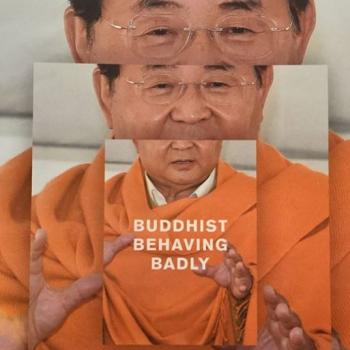
Sogyal Lakar, well-known Tibetan Buddhist teacher and alleged...
American Buddhist Perspectives

Secular vs Religious, Buddhism vs Mindfulness, and a...
American Buddhist Perspectives
TRENDING AT PATHEOS Buddhist

On Taking Refuge in the Dharma
(Here I continue the feature of sharing talks and essays by teachers...

(Continuing my intention to share talks and essays by other members of Empty...
The Subtle Art of Bowing: A Dharma Discourse
(This presentation was first offered by my dear friend Dharma Holder Tom...

Internal Family Systems Can Heal you Mentally &...
How IFS Helped Me Stop Fighting Myself Internal Family Systems (IFS) is...

The Bible No One Spoke About: A Family’s...
A mysterious family Bible, unspoken faith, and a journey from curiosity to...

How Uncertainty Can Transform Your Life in 2025
Embracing Uncertainty: A New Year’s Resolution for the Brave As 2025 approaches,...
view all Buddhist blogs
Ad-Free & Subscriber Log-In Subscription Support
- About Us
- 2026 Calendar
- Videos
- Podcasts
- Library of World Religions
- Faith In Media Tracker
- Advertise With Us
- Write for Us
- Privacy Policy
- Terms of Service
- Do Not Sell My Data
- Contact Us
- Radiant Digital
- Manage Newsletter Subscriptions
- Unsubscribe From Notifications
- Sitemap
Copyright 2008-2026, Patheos, part of the Radiant Digital network of media brands. All rights reserved.
Subscription Support Ad-Free & Subscriber Log-In
Follow Patheos