
BuddhistCatholicContemplativeEvangelicalGeneral ChristianHinduJewishLatter-day SaintMuslimNew VisionsProgressive Christian
Beliefs
- Buddhist
- Catholic
- Contemplative
- Evangelical
- General Christian
- Hindu
- Jewish
- Latter-day Saint
- More Voices
- Muslim
- New Visions
- Pagan
- Progressive Christian
Topics
- Religion News
- Food and Religion
- Sports and Religion
- Religious Art
- Religious Music and Entertainment
- Religious Events
- History and Religion
- Style and Religion
- Politics and Religion
- Women in Religion
- Recreation Outdoors and Religion
- Business Finance and Religion
- Careers Workplace and Religion
- Education and Religion
- Family Parenting and Religion
- Health Fitness and Religion
- Home and Religion
- Relationships and Religion
- Technology and Religion
- Travel and Religion
Columnists
- Buddhist Columnists
- Business Finance and Religion Columnists
- Careers Workplace and Religion Columnists
- Catholic Columnists
- Contemplative Columnists
- Education and Religion Columnists
- Evangelists Columnists
- Family Parenting and Religion Columnists
- General Christian Columnists
- Health Fitness and Religion Columnists
- Hindu Columnists
- History and Religion Columnists
- Home and Religion Columnists
- Jewish Columnists
- More Voices Columnists
- Latter Day Columnists
- Muslim Columnists
- New Visions Columnists
- Nonreligious Columnists
- Pagan Columnists
- Politics and Religion Columnists
- Progressive Columnists
- Recreation Outdoors and Religion Columnists
- Relationships and Religion Columnists
- Religion News Columnists
- Religious Art Columnists
- Religious Events Columnists
- Religious Music and Entertainment Columnists
- Sports and Religion Columnists
- Style and Religion Columnists
- Technology and Religion Columnists
- Travel and Religion Columnists
- Women in Religion Columnists
Resource Library
- 2026 Calendar
- Library of World Religions
- The 100 Most Holy Places on Earth
- Patheos Answers
- Podcasts
- Videos
- Faith Leaders Database
- Anglican Episcopalian
- Bahai
- Baptist
- Buddhism
- Christianity
- Confucianism
- Eastern Orthodoxy
- Hinduism
- Holiness and Pentecostal
- ISKCON
- Islam
- Judaism
- Lutheran
- Methodist
- The Church of Jesus Christ of Latter-day Saints
- New Age
- Paganism
- Presbytarian and Reformed
- Protestantism
- Religion Behind the Scenes
- Roman Catholic
- Scientology
- Shia Islam
- Sikhism
- Sufism
- Sunni Islam
- Taoism
- Zen
- See all religions
Research Tools
 Ad-Free & Subscriber Log-In Subscription Support
Ad-Free & Subscriber Log-In Subscription Support
Follow Patheos 

- Trending:
- Forgiveness
- |
- Marriage
- |
- Consciousness
- |
- Death Penalty
- |
- Election
- |
- Halloween
 American Buddhist Perspectives
- Home
- Buddhist
- Religion News
- Rise of the non-religious: A Buddhist Perspective?
Rise of the non-religious: A Buddhist Perspective?
Last updated on: January 20, 2013 at 6:31 pm by Justin Whitaker
Rise of the non-religious: A Buddhist Perspective? 2013-01-20T18:31:24-07:00 Justin Whitaker
Patheos Explore the world's faith through different perspectives on religion and spirituality! Patheos has the views of the prevalent religions and spiritualities of the world.
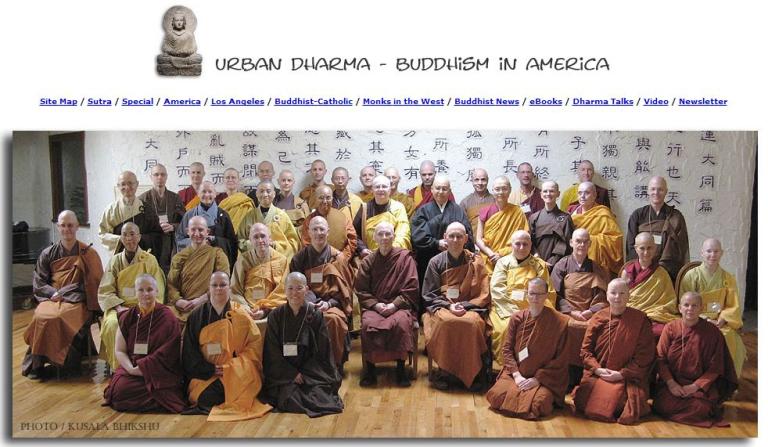
12th Western Buddhist Monastic Conference – April 2007 – City of the Dharma Realm – Sacramento, California – via UrbanDharma
The Huffington Post has a great discussion posted online late last week on the topic of religion in the US today (click the link for video). And all this week NPR has hosted a discussion of the topic, “losing our religion.”
Lacking, however, was a Buddhist (or Hindu or Jain) voice.
What does the rise of the ‘nones’ mean to American Buddhists?
As American Buddhists are very diverse, ranging from Asian “cradle” Buddhists who may be 2nd, 5th, 9th generation or otherwise to Asian “converts”; European “cradle” Buddhists, generally restricted to 2nd or perhaps 3rd generation Buddhists; European converts, as well as Black, Latino/a and (extremely rare) Native American converts – and others. Beyond the racial or ethnic groupings there are other ways of seeing American Buddhists: the curious, the committed newbies, the orientalists (those who think that since it comes from Asia it must be pure in a way that European traditions no longer are), the scholar-practitioners, the burn-outs, the secularists, and others.
While drawing different sets of distinctions is helpful, it’s also useful to talk about what they share in common as people in America (or “the West”) in the 21st century: access to varying traditions (Buddhist and non-Buddhist), access to fellow practitioners around the globe, distractions due to so much access, relative wealth and political stability, advanced technology, and so on.
Despite recent internet search trends, Buddhism as a practiced religion is still on the rise in the US as far as I know (determining this for sure is rife with difficulties). But, assuming that to be true, it is worth asking why Buddhism is growing at a time when mainstream Christianity is shrinking. Part of the answer can come in the “packaging” of Buddhism as a religion for our age: pro-science, psychologically astute, egalitarian, and so on. But Christians and others can package themselves in just this way. Perhaps there is a flexibility in Buddhism, as the “newcomer” to the West, that Christianity is lacking. How many of us read with excitement the following: “The Pope has tweeted for the first time in Latin, a language Vatican officials claim is the perfect tongue to tweet in.” (telegraph.co.uk)
Meanwhile, on the other side of the world is this: “Mind and Life XXVI: Mind, Brain and Matter – Critical Conversations Between Buddhist Thought and Science.” Both religious leaders are engaging with modernity, but obviously in very different ways.
An obvious question is: is this flexibility inherent to Buddhism, or is it just a survival technique that will fade as (if) Buddhism becomes more dominant in the West? A quick survey of the history of Buddhism in various Asian contexts suggests the latter. While “Buddhist Modernism” presents a very visible face of Buddhism today, traditional tendencies and undercurrents are still common in every tradition. Of course, what makes Buddhism “Buddhism” is this very appeal to and connection with a historical past – a past that includes many things that modernists would like to ignore or cut away. Yet how much trimming can be done before the “bodhi tree” is no longer recognizable? Such questions go beyond the simpler task of this post: to question how American Buddhists see the rise of the “nones.”
My own guess is that the “nones” will actually provide a large(r) pool of potential Buddhists in the years to come. The movement will, no doubt, gain some numbers from Buddhist communities, but the general drift will be in the opposite direction. Buddhism in many (most?) forms in the West requires little in the way of faith (some degree of belief in karma may be expected, but I’ve never witnessed a ‘hard sell’ on this or other tenants of Buddhist doctrine) or commitment. It’s easy to drift in and, given the basic benefits of simply enjoying community and meditation or chanting, it’s easy to gain some sense of benefit. As one gets “deeper” into it, one will likely get more of a sense of the “demands” of Buddhism: that one really needs to develop generosity and other basics of ethics, for instance, and that if one wants the kind of mental clarity promised in the traditions, one really needs to meditate regularly and perhaps even spend extended periods of time on retreat, and perhaps dealing with the effects of a direct experience of impermanence, non-self, and/or (the pervasive nature of ) dissatisfactoriness.
In any case, immigration (from already predominantly Buddhist countries) will play one important role in the future growth of Buddhism in America. Another key factor, however, will be cultural shifts. The last big shift: that of the late ’60s and early ’70s was a key turning point for Buddhism in the West. Are we in the midst of another similar era?
Previous Post

January 19, 2013
The Dalai Lama Hosts Mind and Life (Live Video)
Next Post
January 21, 2013 In case you missed it: the full Mind and Life 2013
Browse Our Archives
Select a Category Academia Activism American Buddhism Art Book review Buddhism Buddhism Today Buddhist Ethics Burma/Myanmar China Christianity Commodification Environment Gender Happiness Health Humor India Interfaith Islam Japanese Buddhism Kant Media / News Meditation mindfulness Photography Poetry Politics quicktakes Running Teaching Technology Thailand Theism/Atheism Theravada Tibet Tibetan Buddhism Travels Uncategorized Unitarian Universalism video Western Philosophy Zen
Select a Month June 2021 January 2021 November 2020 August 2020 July 2020 March 2020 January 2020 October 2019 August 2019 June 2019 May 2019 March 2019 February 2019 January 2019 December 2018 November 2018 October 2018 September 2018 August 2018 July 2018 June 2018 May 2018 April 2018 March 2018 February 2018 January 2018 December 2017 November 2017 October 2017 September 2017 August 2017 July 2017 June 2017 May 2017 April 2017 March 2017 February 2017 January 2017 December 2016 November 2016 October 2016 September 2016 August 2016 July 2016 June 2016 May 2016 April 2016 March 2016 February 2016 January 2016 December 2015 November 2015 October 2015 September 2015 August 2015 July 2015 June 2015 May 2015 April 2015 March 2015 February 2015 January 2015 December 2014 November 2014 October 2014 September 2014 August 2014 July 2014 June 2014 May 2014 April 2014 March 2014 February 2014 January 2014 December 2013 November 2013 October 2013 September 2013 August 2013 July 2013 June 2013 May 2013 April 2013 March 2013 February 2013 January 2013 December 2012 November 2012 October 2012 September 2012 August 2012 July 2012 June 2012 May 2012 April 2012 March 2012 February 2012 January 2012 December 2011 November 2011 October 2011 September 2011 August 2011 July 2011 June 2011 May 2011 April 2011 March 2011 February 2011 January 2011 December 2010 November 2010 October 2010 September 2010 August 2010 July 2010 June 2010 May 2010 April 2010 March 2010 February 2010 January 2010 December 2009 November 2009 October 2009 September 2009 August 2009 July 2009 June 2009 May 2009 April 2009 March 2009 February 2009 January 2009 December 2008 November 2008 October 2008 September 2008 August 2008 July 2008 June 2008 May 2008 April 2008 March 2008 September 2007 August 2007 July 2007 June 2007 May 2007 April 2007 March 2007 February 2007 January 2007 December 2006 November 2006 October 2006 September 2006 August 2006 July 2006 June 2006 May 2006 April 2006 March 2006 February 2006 January 2006 December 2005 November 2005 October 2005 September 2005 November 2004 September 2004 August 2004
Follow Us!
TAKE THE
Religious Wisdom Quiz
On which day did God create animals?
Select your answer to see how you score.
On the first day On the fourth day On the third day On the sixth day
Support this
Column


Related posts from American Buddhist Perspectives

In strife and uncertainty: let us remember loving-kindness
American Buddhist Perspectives

The Coronavirus is coming - Some thoughts from...
American Buddhist Perspectives

Sogyal Lakar, well-known Tibetan Buddhist teacher and alleged...
American Buddhist Perspectives

Secular vs Religious, Buddhism vs Mindfulness, and a...
American Buddhist Perspectives
TRENDING AT PATHEOS Buddhist

On Taking Refuge in the Dharma
(Here I continue the feature of sharing talks and essays by teachers...

(Continuing my intention to share talks and essays by other members of Empty...
The Subtle Art of Bowing: A Dharma Discourse
(This presentation was first offered by my dear friend Dharma Holder Tom...

Internal Family Systems Can Heal you Mentally &...
How IFS Helped Me Stop Fighting Myself Internal Family Systems (IFS) is...

The Bible No One Spoke About: A Family’s...
A mysterious family Bible, unspoken faith, and a journey from curiosity to...

How Uncertainty Can Transform Your Life in 2025
Embracing Uncertainty: A New Year’s Resolution for the Brave As 2025 approaches,...
view all Buddhist blogs
Ad-Free & Subscriber Log-In Subscription Support
- About Us
- 2026 Calendar
- Videos
- Podcasts
- Library of World Religions
- Faith In Media Tracker
- Advertise With Us
- Write for Us
- Privacy Policy
- Terms of Service
- Do Not Sell My Data
- Contact Us
- Radiant Digital
- Manage Newsletter Subscriptions
- Unsubscribe From Notifications
- Sitemap
Copyright 2008-2026, Patheos. All rights reserved.
Subscription Support Ad-Free & Subscriber Log-In
Follow Patheos