
BuddhistCatholicContemplativeEvangelicalGeneral ChristianHinduJewishLatter-day SaintMuslimNew VisionsProgressive Christian
Beliefs
- Buddhist
- Catholic
- Contemplative
- Evangelical
- General Christian
- Hindu
- Jewish
- Latter-day Saint
- More Voices
- Muslim
- New Visions
- Pagan
- Progressive Christian
Topics
- Religion News
- Food and Religion
- Sports and Religion
- Religious Art
- Religious Music and Entertainment
- Religious Events
- History and Religion
- Style and Religion
- Politics and Religion
- Women in Religion
- Recreation Outdoors and Religion
- Business Finance and Religion
- Careers Workplace and Religion
- Education and Religion
- Family Parenting and Religion
- Health Fitness and Religion
- Home and Religion
- Relationships and Religion
- Technology and Religion
- Travel and Religion
Columnists
- Buddhist Columnists
- Business Finance and Religion Columnists
- Careers Workplace and Religion Columnists
- Catholic Columnists
- Contemplative Columnists
- Education and Religion Columnists
- Evangelists Columnists
- Family Parenting and Religion Columnists
- General Christian Columnists
- Health Fitness and Religion Columnists
- Hindu Columnists
- History and Religion Columnists
- Home and Religion Columnists
- Jewish Columnists
- More Voices Columnists
- Latter Day Columnists
- Muslim Columnists
- New Visions Columnists
- Nonreligious Columnists
- Pagan Columnists
- Politics and Religion Columnists
- Progressive Columnists
- Recreation Outdoors and Religion Columnists
- Relationships and Religion Columnists
- Religion News Columnists
- Religious Art Columnists
- Religious Events Columnists
- Religious Music and Entertainment Columnists
- Sports and Religion Columnists
- Style and Religion Columnists
- Technology and Religion Columnists
- Travel and Religion Columnists
- Women in Religion Columnists
Resource Library
- 2026 Calendar
- Library of World Religions
- The 100 Most Holy Places on Earth
- Patheos Answers
- Podcasts
- Videos
- Faith Leaders Database
- Anglican Episcopalian
- Bahai
- Baptist
- Buddhism
- Christianity
- Confucianism
- Eastern Orthodoxy
- Hinduism
- Holiness and Pentecostal
- ISKCON
- Islam
- Judaism
- Lutheran
- Methodist
- The Church of Jesus Christ of Latter-day Saints
- New Age
- Paganism
- Presbytarian and Reformed
- Protestantism
- Religion Behind the Scenes
- Roman Catholic
- Scientology
- Shia Islam
- Sikhism
- Sufism
- Sunni Islam
- Taoism
- Zen
- See all religions
Research Tools
 Ad-Free & Subscriber Log-In Subscription Support
Ad-Free & Subscriber Log-In Subscription Support
Follow Patheos 

- Trending:
- Forgiveness
- |
- Marriage
- |
- Consciousness
- |
- Death Penalty
- |
- Election
- |
- Halloween
 American Buddhist Perspectives
- Home
- Buddhist
- Religion News
- Nietzsche meets the iPhone
Nietzsche meets the iPhone
Last updated on: January 10, 2013 at 8:41 pm by Justin Whitaker
Nietzsche meets the iPhone 2013-01-10T20:41:50-07:00 Justin Whitaker
Patheos Explore the world's faith through different perspectives on religion and spirituality! Patheos has the views of the prevalent religions and spiritualities of the world.
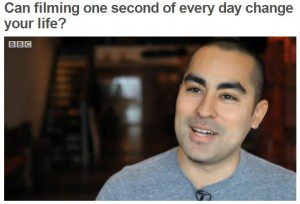
The BBC has a story this week titled “Can filming one second every day change your life?” (click for video) It makes for a useful meditation for the new year. The story features Cesar Kuriyama, who began filming one second of each day at the age of 30. What began as a one year project promises to be a life-long occupation. As he states in the video, “Trying to make the best movie possible is making me live the best life possible.”
This brought to mind one of my favorite philosophers, Friedrich Nietzsche (1844-1900), who wrote in his last (and widely misunderstood) work, “The Will to Power” (1901) that you should “Live your life as a work of art.”
Life as Art
“Live your life as a work of art,” urged the German philosopher Friedrich Nietzsche. He did not have a story in mind but more an art like sculpture, in which one lives by creating a shape for oneself, “building character.” developing what we call style.’ The German philosopher Friedrich von Schelling saw the whole of life as God’s work of art. (We are in effect God’s apprentices.) Artists often describe their sense of mission in life as simply “to create.” but it is the activity itself that counts for then as much as the results of their efforts. The ideal of this view is appropriately to live beautifully or, if that is not possible, to live at least with style, “with class” we might say. From this view, life is to be evaluated as an artwork—as moving, inspiring, well designed, dramatic, or colorful, or as clumsy uninspired and uninspiring, or easily forgettable.
– via The Big Questions: A Short Introduction to Philosophy by Solomon and Higgins.
Like an artist with her brush strokes, we should be conscious and intentional with every moment of our lives. Even if so much of our life becomes routine, we must know it as routine. And a routine, simply due to the number of hours we spend at it, should be perfectible.
Nietzsche’s work is often aphoristic and obscure, and in fact many (conservative/analytic) philosophers would hardly call his work “philosophy.” I think there is some truth in this and recommend that he is read through the interpretive lens of someone like the late Robert C Solomon. Solomon, who taught at the University of Texas-Austin, was the adviser for one of my own philosophy professors, David Sherman. Both understood the importance of historical grounding when teaching philosophy, which brings a sort of humility to the enterprise because it brings the philosopher’s words out of the clouds and back to the ground from which they, after all, came.
In this way we can see all philosophers as in an “all too human” progression which is merely historical and incremental and abandon any fantasies or false projections that one or another got it all right (the same goes for religion as well). All is a work in progress. Even Nietzsche, who might so strongly reject this understanding, is but a layer in our philosophical geology.
As Solomon writes elsewhere, Nietzsche isn’t really in such stark opposition to previous philosophers such as Plato, Aristotle, and Kant, but rather he is attempting to make their systems consistent (to himself and his day).
Generosity and kindness are marks of nobility (of strong Will to Power), the strong need rarely resort to cruelty. At times. Nietzsche goes so far as to say it is the duty of the strong to protect the week.
Nietzsche’s Will to Power Is thus far removed from the common imagery of military strength—the most powerful are not the politician and soldier, but the artist, the philosopher, and the aesthete. Will to Power Is ultimately control over one’s self; it is not license but restraint; not power to hurt or destroy but power to create.
– Solomon, From Rationalism to Existentialism: The Existentialists and Their Nineteenth-century Backgrounds
Reading that, Nietzsche doesn’t sound too far from the Buddha, either.
So, in so far as iphone can unleash our power to create, I think Nietzsche would be pleased.
And the Buddha?
The Buddhist too might ponder the karma of his devices, as Rohan Gunatillake did recently for wired magazine, UK (here):
“For too long has the narrative around digital and the mind been negative. Pop tech is constantly being accused of fragmenting our attention, ruining our concentration and at worst dehumanising us. This may well be true. But is it because all of that is intrinsic to technology, or because we’ve just not designed our technologies with the mind in mind?
The convergence of three trends … suggests we will benefit from a new wave of digital tools that not only reduce stress but lead to genuine insight, wisdom and compassion.”
Will devices actually begin to liberate us from the frustrations of greed, aversion, and delusion – frustrations that are to begin with so intimately tied up with the stuff in our lives?
Maybe.
But to be on the safe side, go easy on the Angry Birds.

Next Post

January 13, 2013 Ten Minutes of Mindfulness
Browse Our Archives
Select a Category Academia Activism American Buddhism Art Book review Buddhism Buddhism Today Buddhist Ethics Burma/Myanmar China Christianity Commodification Environment Gender Happiness Health Humor India Interfaith Islam Japanese Buddhism Kant Media / News Meditation mindfulness Photography Poetry Politics quicktakes Running Teaching Technology Thailand Theism/Atheism Theravada Tibet Tibetan Buddhism Travels Uncategorized Unitarian Universalism video Western Philosophy Zen
Select a Month June 2021 January 2021 November 2020 August 2020 July 2020 March 2020 January 2020 October 2019 August 2019 June 2019 May 2019 March 2019 February 2019 January 2019 December 2018 November 2018 October 2018 September 2018 August 2018 July 2018 June 2018 May 2018 April 2018 March 2018 February 2018 January 2018 December 2017 November 2017 October 2017 September 2017 August 2017 July 2017 June 2017 May 2017 April 2017 March 2017 February 2017 January 2017 December 2016 November 2016 October 2016 September 2016 August 2016 July 2016 June 2016 May 2016 April 2016 March 2016 February 2016 January 2016 December 2015 November 2015 October 2015 September 2015 August 2015 July 2015 June 2015 May 2015 April 2015 March 2015 February 2015 January 2015 December 2014 November 2014 October 2014 September 2014 August 2014 July 2014 June 2014 May 2014 April 2014 March 2014 February 2014 January 2014 December 2013 November 2013 October 2013 September 2013 August 2013 July 2013 June 2013 May 2013 April 2013 March 2013 February 2013 January 2013 December 2012 November 2012 October 2012 September 2012 August 2012 July 2012 June 2012 May 2012 April 2012 March 2012 February 2012 January 2012 December 2011 November 2011 October 2011 September 2011 August 2011 July 2011 June 2011 May 2011 April 2011 March 2011 February 2011 January 2011 December 2010 November 2010 October 2010 September 2010 August 2010 July 2010 June 2010 May 2010 April 2010 March 2010 February 2010 January 2010 December 2009 November 2009 October 2009 September 2009 August 2009 July 2009 June 2009 May 2009 April 2009 March 2009 February 2009 January 2009 December 2008 November 2008 October 2008 September 2008 August 2008 July 2008 June 2008 May 2008 April 2008 March 2008 September 2007 August 2007 July 2007 June 2007 May 2007 April 2007 March 2007 February 2007 January 2007 December 2006 November 2006 October 2006 September 2006 August 2006 July 2006 June 2006 May 2006 April 2006 March 2006 February 2006 January 2006 December 2005 November 2005 October 2005 September 2005 November 2004 September 2004 August 2004
Follow Us!
TAKE THE
Religious Wisdom Quiz
Blessed are the poor in spirit, for theirs is the kingdom of ____.
Select your answer to see how you score.
Heaven Truth God Grace
Support this
Column


Related posts from American Buddhist Perspectives

In strife and uncertainty: let us remember loving-kindness
American Buddhist Perspectives

A Festival of Radical Awakening: Socially Engaged Buddhism...
American Buddhist Perspectives

The Coronavirus is coming - Some thoughts from...
American Buddhist Perspectives

Sogyal Lakar, well-known Tibetan Buddhist teacher and alleged...
American Buddhist Perspectives
TRENDING AT PATHEOS Buddhist

On Taking Refuge in the Dharma
(Here I continue the feature of sharing talks and essays by teachers...

(Continuing my intention to share talks and essays by other members of Empty...
The Subtle Art of Bowing: A Dharma Discourse
(This presentation was first offered by my dear friend Dharma Holder Tom...

Internal Family Systems Can Heal you Mentally &...
How IFS Helped Me Stop Fighting Myself Internal Family Systems (IFS) is...

The Bible No One Spoke About: A Family’s...
A mysterious family Bible, unspoken faith, and a journey from curiosity to...

How Uncertainty Can Transform Your Life in 2025
Embracing Uncertainty: A New Year’s Resolution for the Brave As 2025 approaches,...
view all Buddhist blogs
Ad-Free & Subscriber Log-In Subscription Support
- About Us
- 2026 Calendar
- Videos
- Podcasts
- Library of World Religions
- Faith In Media Tracker
- Advertise With Us
- Write for Us
- Privacy Policy
- Terms of Service
- Do Not Sell My Data
- Contact Us
- Radiant Digital
- Manage Newsletter Subscriptions
- Unsubscribe From Notifications
- Sitemap
Copyright 2008-2026, Patheos. All rights reserved.
Subscription Support Ad-Free & Subscriber Log-In
Follow Patheos