
BuddhistCatholicContemplativeEvangelicalGeneral ChristianHinduJewishLatter-day SaintMuslimNew VisionsProgressive Christian
Beliefs
- Buddhist
- Catholic
- Contemplative
- Evangelical
- General Christian
- Hindu
- Jewish
- Latter-day Saint
- More Voices
- Muslim
- New Visions
- Pagan
- Progressive Christian
Topics
- Religion News
- Food and Religion
- Sports and Religion
- Religious Art
- Religious Music and Entertainment
- Religious Events
- History and Religion
- Style and Religion
- Politics and Religion
- Women in Religion
- Recreation Outdoors and Religion
- Business Finance and Religion
- Careers Workplace and Religion
- Education and Religion
- Family Parenting and Religion
- Health Fitness and Religion
- Home and Religion
- Relationships and Religion
- Technology and Religion
- Travel and Religion
Columnists
- Buddhist Columnists
- Business Finance and Religion Columnists
- Careers Workplace and Religion Columnists
- Catholic Columnists
- Contemplative Columnists
- Education and Religion Columnists
- Evangelists Columnists
- Family Parenting and Religion Columnists
- General Christian Columnists
- Health Fitness and Religion Columnists
- Hindu Columnists
- History and Religion Columnists
- Home and Religion Columnists
- Jewish Columnists
- More Voices Columnists
- Latter Day Columnists
- Muslim Columnists
- New Visions Columnists
- Nonreligious Columnists
- Pagan Columnists
- Politics and Religion Columnists
- Progressive Columnists
- Recreation Outdoors and Religion Columnists
- Relationships and Religion Columnists
- Religion News Columnists
- Religious Art Columnists
- Religious Events Columnists
- Religious Music and Entertainment Columnists
- Sports and Religion Columnists
- Style and Religion Columnists
- Technology and Religion Columnists
- Travel and Religion Columnists
- Women in Religion Columnists
Resource Library
- 2026 Calendar
- Library of World Religions
- The 100 Most Holy Places on Earth
- Patheos Answers
- Podcasts
- Videos
- Faith Leaders Database
- Anglican Episcopalian
- Bahai
- Baptist
- Buddhism
- Christianity
- Confucianism
- Eastern Orthodoxy
- Hinduism
- Holiness and Pentecostal
- ISKCON
- Islam
- Judaism
- Lutheran
- Methodist
- The Church of Jesus Christ of Latter-day Saints
- New Age
- Paganism
- Presbytarian and Reformed
- Protestantism
- Religion Behind the Scenes
- Roman Catholic
- Scientology
- Shia Islam
- Sikhism
- Sufism
- Sunni Islam
- Taoism
- Zen
- See all religions
Research Tools
 Ad-Free & Subscriber Log-In Subscription Support
Ad-Free & Subscriber Log-In Subscription Support
Follow Patheos 

- Trending:
- Forgiveness
- |
- Marriage
- |
- Consciousness
- |
- Death Penalty
- |
- Election
- |
- Halloween
 American Buddhist Perspectives
- Home
- Buddhist
- Religion News
- Tibetan Buddhists aflame and protests, Gangnam Style
Tibetan Buddhists aflame and protests, Gangnam Style
Last updated on: November 17, 2012 at 2:24 am by Justin Whitaker
Tibetan Buddhists aflame and protests, Gangnam Style 2012-11-17T02:24:15-07:00 Justin Whitaker
Patheos Explore the world's faith through different perspectives on religion and spirituality! Patheos has the views of the prevalent religions and spiritualities of the world.
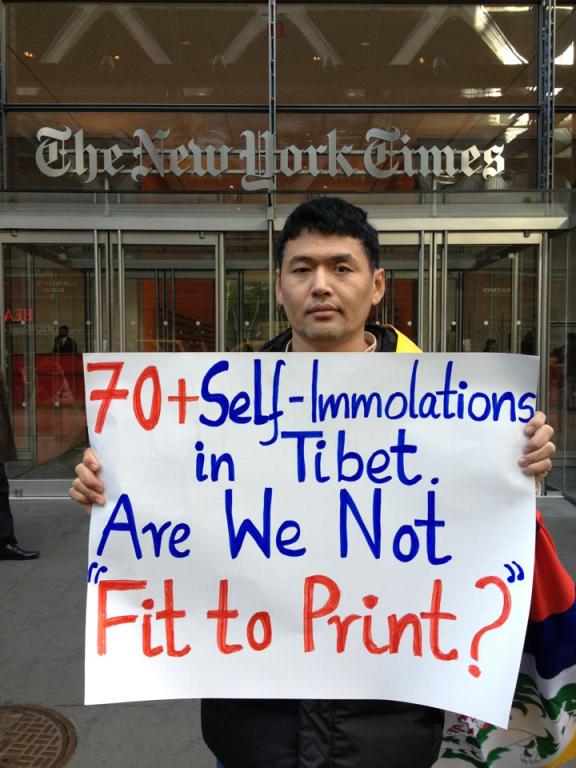
The crisis happening inside Tibet deserves more than a short paragraph in a dingy corner of the NYTimes. This new giant owes it to its millions of readers the fact about the self-immolation by Tibetans inside Tibet demanding freedom from China’s colonial rule. – via Students for a Free Tibet’s facebook.
The news regarding Tibetan self-immolations speaks for itself:
British Buddhist monk self-immolates at French monastery (Nov 16)
Tibetan boy, 14, dies in self-immolation (Nov 15)
2 Tibetans Dead After Self-Immolation Protests (Nov 15)
Slowly but surely these deaths are making their way into the mainstream media. But these aren’t the fifth or sixth or even tenth or eleventh cases of self-immolation. According to writer and activist Joshua Eaton, there have been 74 self-immolations inside Tibet alone since 2009 (names, dates, etc here).
China’s response? Massive surveillance and guards with fire extinguishers.
Everyone else’s response: mostly nothing.
What can you do?
The long answer is to educate yourself. While we’ve seen rapid (though often very unstable) political change recently in several countries affected by the Arab Spring, it’s unlikely that anything major will change in Tibet any time soon. Even if there is a major spike in protests, I don’t see any major changes in Tibet. Call me pessimistic, but this was my call in October 2007 for Burma and it turned out to be correct. Internally, I don’t think too much can be done. In fact, the most powerful thing that Tibetans can do, is to raise awareness outside of China-occupied Tibet.
And it is just this realization, I believe, that is driving so many to take their own lives in this manner – or, as they may understand it, to offer their own lives. In Buddhism, as in most religions, suicide is thought of as a grave offense and to take a ‘precious human life’ – including your own – results in an extraordinary amount of bad karma, that is, one will be reborn in hell (yes Buddhists have hells – 18 of them). But, also like most religions, there can be a certain understanding of the sacrifice as a selfless act, motivated not out of self-hatred or a desire to die but out of deep compassion for others.
If you are in the US, contact your congressperson. Avaaz has a petition you can sign here with over 1 million signatures and counting.
Get involved now however you can. Even if you start in a very passive role, simply ‘liking’ a pro-Tibet page on facebook, this will start something. It’s like Shantideva’s advice on generosity – start with carrots and potatoes (see below). If you care to give/do more, do. Share this post. Share the news stories linked above or the organizations below. Nudge your friends. While I am (I think rightly) pessimistic about internal changes in Tibet, I am optimistic about society in general.
Visit the Students for a Free Tibet here:
https://www.studentsforafreetibet.org/
or on facebook here:
https://www.facebook.com/StudentsforaFreeTibet
SFT in the UK:
And the blog for SFT in India:
http://lhasarising.wordpress.com/
And if all of this is a bit too depressing, keep in mind that through it all, most Tibetans have maintained a wonderful sense of humor about life and the willingness to get the word out, even if it requires… unconventional (though certainly ‘skillful’) means:
On the first level, a Bodhisattva just develops their giving to perfection, to ultimate
giving. And there are beautiful stories about the Buddha, before he was a buddha, he
was a bodhisattva already with the wish for enlightenment in his heart. There are
beautiful stories how he meets the hungry tigress and he gives his body to her, and
other such beautiful stories in the Jataka Tales.
Sometimes we get a little bit scared off by those stories: “If I give my body, then
how… what?” so Master Shantideva in his Guide to the Bodhisattva Way of Life – a
very famous buddhist text – he says: don’t worry. You begin with carrots and
potatoes. You give them carrots and potatoes, you develop your giving, the day will
come when for you to give your arm or your leg will be same as giving a carrot or
potato. No problem, no problem. And there are such stories, too. (from here.pdf)
Previous Post

November 13, 2012
Save the Buddhas of Mes Aynak
Next Post
November 20, 2012 Finding Happiness, one photo at a time
Browse Our Archives
Select a Category Academia Activism American Buddhism Art Book review Buddhism Buddhism Today Buddhist Ethics Burma/Myanmar China Christianity Commodification Environment Gender Happiness Health Humor India Interfaith Islam Japanese Buddhism Kant Media / News Meditation mindfulness Photography Poetry Politics quicktakes Running Teaching Technology Thailand Theism/Atheism Theravada Tibet Tibetan Buddhism Travels Uncategorized Unitarian Universalism video Western Philosophy Zen
Select a Month June 2021 January 2021 November 2020 August 2020 July 2020 March 2020 January 2020 October 2019 August 2019 June 2019 May 2019 March 2019 February 2019 January 2019 December 2018 November 2018 October 2018 September 2018 August 2018 July 2018 June 2018 May 2018 April 2018 March 2018 February 2018 January 2018 December 2017 November 2017 October 2017 September 2017 August 2017 July 2017 June 2017 May 2017 April 2017 March 2017 February 2017 January 2017 December 2016 November 2016 October 2016 September 2016 August 2016 July 2016 June 2016 May 2016 April 2016 March 2016 February 2016 January 2016 December 2015 November 2015 October 2015 September 2015 August 2015 July 2015 June 2015 May 2015 April 2015 March 2015 February 2015 January 2015 December 2014 November 2014 October 2014 September 2014 August 2014 July 2014 June 2014 May 2014 April 2014 March 2014 February 2014 January 2014 December 2013 November 2013 October 2013 September 2013 August 2013 July 2013 June 2013 May 2013 April 2013 March 2013 February 2013 January 2013 December 2012 November 2012 October 2012 September 2012 August 2012 July 2012 June 2012 May 2012 April 2012 March 2012 February 2012 January 2012 December 2011 November 2011 October 2011 September 2011 August 2011 July 2011 June 2011 May 2011 April 2011 March 2011 February 2011 January 2011 December 2010 November 2010 October 2010 September 2010 August 2010 July 2010 June 2010 May 2010 April 2010 March 2010 February 2010 January 2010 December 2009 November 2009 October 2009 September 2009 August 2009 July 2009 June 2009 May 2009 April 2009 March 2009 February 2009 January 2009 December 2008 November 2008 October 2008 September 2008 August 2008 July 2008 June 2008 May 2008 April 2008 March 2008 September 2007 August 2007 July 2007 June 2007 May 2007 April 2007 March 2007 February 2007 January 2007 December 2006 November 2006 October 2006 September 2006 August 2006 July 2006 June 2006 May 2006 April 2006 March 2006 February 2006 January 2006 December 2005 November 2005 October 2005 September 2005 November 2004 September 2004 August 2004
Follow Us!
TAKE THE
Religious Wisdom Quiz
According to Ecclesiastes 12, what happens to the human spirit when a person dies?
Select your answer to see how you score.
It is reincarnated It ceases to exist It returns to God It remains on earth
Support this
Column


Related posts from American Buddhist Perspectives

In strife and uncertainty: let us remember loving-kindness
American Buddhist Perspectives

The Coronavirus is coming - Some thoughts from...
American Buddhist Perspectives

Sogyal Lakar, well-known Tibetan Buddhist teacher and alleged...
American Buddhist Perspectives

Secular vs Religious, Buddhism vs Mindfulness, and a...
American Buddhist Perspectives
TRENDING AT PATHEOS Buddhist

On Taking Refuge in the Dharma
(Here I continue the feature of sharing talks and essays by teachers...

(Continuing my intention to share talks and essays by other members of Empty...
The Subtle Art of Bowing: A Dharma Discourse
(This presentation was first offered by my dear friend Dharma Holder Tom...

Internal Family Systems Can Heal you Mentally &...
How IFS Helped Me Stop Fighting Myself Internal Family Systems (IFS) is...

The Bible No One Spoke About: A Family’s...
A mysterious family Bible, unspoken faith, and a journey from curiosity to...

How Uncertainty Can Transform Your Life in 2025
Embracing Uncertainty: A New Year’s Resolution for the Brave As 2025 approaches,...
view all Buddhist blogs
Ad-Free & Subscriber Log-In Subscription Support
- About Us
- 2026 Calendar
- Videos
- Podcasts
- Library of World Religions
- Faith In Media Tracker
- Advertise With Us
- Write for Us
- Privacy Policy
- Terms of Service
- Do Not Sell My Data
- Contact Us
- Radiant Digital
- Manage Newsletter Subscriptions
- Unsubscribe From Notifications
- Sitemap
Copyright 2008-2026, Patheos. All rights reserved.
Subscription Support Ad-Free & Subscriber Log-In
Follow Patheos