
BuddhistCatholicContemplativeEvangelicalGeneral ChristianHinduJewishLatter-day SaintMuslimNew VisionsProgressive Christian
Beliefs
- Buddhist
- Catholic
- Contemplative
- Evangelical
- General Christian
- Hindu
- Jewish
- Latter-day Saint
- More Voices
- Muslim
- New Visions
- Pagan
- Progressive Christian
Topics
- Religion News
- Food and Religion
- Sports and Religion
- Religious Art
- Religious Music and Entertainment
- Religious Events
- History and Religion
- Style and Religion
- Politics and Religion
- Women in Religion
- Recreation Outdoors and Religion
- Business Finance and Religion
- Careers Workplace and Religion
- Education and Religion
- Family Parenting and Religion
- Health Fitness and Religion
- Home and Religion
- Relationships and Religion
- Technology and Religion
- Travel and Religion
Columnists
- Buddhist Columnists
- Business Finance and Religion Columnists
- Careers Workplace and Religion Columnists
- Catholic Columnists
- Contemplative Columnists
- Education and Religion Columnists
- Evangelists Columnists
- Family Parenting and Religion Columnists
- General Christian Columnists
- Health Fitness and Religion Columnists
- Hindu Columnists
- History and Religion Columnists
- Home and Religion Columnists
- Jewish Columnists
- More Voices Columnists
- Latter Day Columnists
- Muslim Columnists
- New Visions Columnists
- Nonreligious Columnists
- Pagan Columnists
- Politics and Religion Columnists
- Progressive Columnists
- Recreation Outdoors and Religion Columnists
- Relationships and Religion Columnists
- Religion News Columnists
- Religious Art Columnists
- Religious Events Columnists
- Religious Music and Entertainment Columnists
- Sports and Religion Columnists
- Style and Religion Columnists
- Technology and Religion Columnists
- Travel and Religion Columnists
- Women in Religion Columnists
Resource Library
- 2026 Calendar
- Library of World Religions
- The 100 Most Holy Places on Earth
- Patheos Answers
- Podcasts
- Videos
- Faith Leaders Database
- Anglican Episcopalian
- Bahai
- Baptist
- Buddhism
- Christianity
- Confucianism
- Eastern Orthodoxy
- Hinduism
- Holiness and Pentecostal
- ISKCON
- Islam
- Judaism
- Lutheran
- Methodist
- The Church of Jesus Christ of Latter-day Saints
- New Age
- Paganism
- Presbytarian and Reformed
- Protestantism
- Religion Behind the Scenes
- Roman Catholic
- Scientology
- Shia Islam
- Sikhism
- Sufism
- Sunni Islam
- Taoism
- Zen
- See all religions
Research Tools
 Ad-Free & Subscriber Log-In Subscription Support
Ad-Free & Subscriber Log-In Subscription Support
Follow Patheos 

- Trending:
- Forgiveness
- |
- Marriage
- |
- Consciousness
- |
- Death Penalty
- |
- Election
- |
- Halloween
 American Buddhist Perspectives
- Home
- Buddhist
- Religion News
- An interview with Lama Surya Das: American Buddhist and Bestselling Author
An interview with Lama Surya Das: American Buddhist and Bestselling Author
Last updated on: April 3, 2017 at 11:53 am by Justin Whitaker
An interview with Lama Surya Das: American Buddhist and Bestselling Author 2017-04-03T11:53:13-06:00 Justin Whitaker
Patheos Explore the world's faith through different perspectives on religion and spirituality! Patheos has the views of the prevalent religions and spiritualities of the world.

This week we present an interview with Lama Surya Das (bio at bottom, though well known to most of you). For the interview I solicited questions from friends and colleagues and chose a few to present to Surya Das. My great thanks to Lama Surya Das for taking the time to answer these questions and to the wonderful Erica Taylor for helping to bring this together, as well as to my friends Nick M, Nick W, Katherin, Emily, Warren, and Margaret for the questions. The first three questions focus on personal life and practice, while the last three focus on Buddhism in America. So, let us begin:
1) How do I “look for” or see the Buddha in my daily life? I understand Buddhism doesn’t emphasize a guiding relationship with any god figure; however, I enjoy the positive feeling in “seeing god around.” Can I grow that in Buddhist practice?
Buddha said that all beings are endowed with the luminous tathagata-garbha, or innate Buddha nature. We experienced Vajrayana (diamond path) meditators practice seeing the Buddha-nature, the buddhaness, the clear light in everyone and everything. That is what I like to call The Diamond Rule. Then we can grow closer to “Buddha” every moment, wherever we are, like what theists like to call the constant companion; and Buddha continues to radiate through us, beyond separation or joining. This practice is like an invisible friend with benefits!
“Wherever I go, I meet mySelf,” said a great Zen master of old. In Tibetan Buddhism, we have prayerful devotional practices such as “Calling the Master from Afar” which help us invoke and invite, exhort and bring closer the object of our respect and devotion, mainly in order to realize our primordial inseparability with him/That and open a world of sacredness before our eyes and our feet as we tread that path of a new awakefulness.
2) What is the best way to explain sunyata to a person who is curious about Buddhism but who refuses to budge on the idea of an “independent soul”? Is accepting the doctrine of no-self truly a key element for Buddhist practitioners in the West?
Mindfulness is probably the blue jeans of Buddhism in the West, good for any and all occasions, much more useful and effective for most of us than mere faith or doctrines. Sunyata and anatta—emptiness, and no-separate-independent-self– are the hardest nuts to crack in Buddhist thought. To explain sunyata to the uninitiated and unreceptive seems unnecessary and possibly contraindicated. However, exploring together the universal facts of impermanence and so forth can help loosen some clinging and dogmatism regarding various notions and concepts, including the soul theory. Anyway, it’d take a better man than you or me to clearly distinguish between the doctrine of soul, on one hand, and that of the unchanging and immaculate, unborn and undying Buddha nature or Dharmakaya, on the other hand– though people do try to teach about and explain that.
Let me go further in making waves where there’s no wind: How different, really—to the layperson, at least– is the theistic creator-God doctrine, from Tibetan Buddhism’s talk about the primordial Buddha, the primordial protector, the all-doer Samantabhadra? When we meditate and practice loving kindness and self-inquiry, and compassion in action, our hardheadedness and hardheartedness softens and certain distinctions and attachments, doctrinal or otherwise, can become a lot less problematic.
3) What is the place of dark retreats within the Buddhist tradition? How should one deal with difficult experiences within retreat?
Dark retreats as I know them in Tibetan Buddhism are mainly for practicing the bardo (afterlife) meditation experiences, and involves training in it for days and weeks at a time so as to be better prepared for when the moment of transition occurs. The secret Dzogchen practice of Togal (“leap over”, or “being there”) is also practiced sometime over periods of time in complete darkness. Removing visual along with other outer sense stimuli can help enhance and illuminate the “inner senses” and increase ones capacity for and experience of certain visionary realities. These kind of intensive practices are somewhat advanced and thus best undertaken with skilled guidance, to allow us to better develop and integrate all the experiences which occur along the path of practice.
4) What is a challenge unique to American Buddhist culture, and how can we use the experience of that challenge to grow stronger in the dharma?
One could mention challenges we face such as speediness and impatience; the habit and expectation of instant gratification; the commodifcation, thinning out and over- simplification of almost everything, and other particularly American character traits. Technology too plays its part, but cannot be turned back.
However, let me speculate that the big one is the great American leveling of everything, conducive to the common denominator and a sort of mere mediocrity rather than the great Golden Mean. ‘Good enough’ can too easily become the near-enemy of true excellence. The de-hierarchization of most if not all things in our society—although still suffering from racism and other forms of class inequality and even warfare, gross and subtle—leads to a disregard and utter disrespect from natural hierarchies of purity and intention, learning, experience, wisdom– and now, even of facts, where post-modern relativism and big money combine to make it impossible for the average person to sort through and sort out the facts, to the point where there are none in play and the loudest voice triumphs. This ignores the ancient American dictum that “All people are created equal, some more equal than others.”
We are drying up soul-wise and dying for spiritual elders and enlightened leaders whom we can trust and rely on to help us through dark times. For example, who has the chops and moxie to help us bring back the ‘higher’ into Higher Education, a wholistic life-wisdom education and emotional intelligence? Who embodies and serves the positive changes and qualities we long to see in the world today?
If these wounds and challenges are to become gifts, we have to be candid and dig deeper into ourselves and together carve out a new way and a new future, that future which begins now.
5) What do you think of the recent revelations of inappropriate behaviour towards their students by Western-born (as opposed to Tibetan-born) Tibetan Buddhist teachers, specifically Ken McLeod and Michael Roach?
It’s too soon to say, since the facts are not yet complete in these two cases; but I did write something about the general issue for the Huffington Post in late June of this year, called “ Spiritual Responsibility and Cult Awareness-<http://www.huffingtonpost.com/lama-surya-das/spiritual-responsibility-_b_1597886.html.>
Whatever the relative merits (or demerits) of these particular cases are, or may turn out to be, or the local legalities, social mores, and commonly accepted norms; the complex and troubling problems arising through inappropriate behavior between teachers and students, priests and parishioners, the top dog and the underdog etc. is an old and pernicious one (sexual misconduct, exploitation, misuse of power, pedophilia, incest, rape etc.). This turns out to be more far-ranging and pervasive than originally thought, in most if not all of the religious and other power structure institutions today, and extending to sports coaches, therapy couches, medical offices, old age homes and hospitals, corporate settings and so forth, as the informed public has now been finding out. What we can do to help alleviate this affliction is our task at hand.
6) Recently, my friend Charles Prebish brought up your 10-fold plan for the American Buddhism of the future. In your 1997 “Awakening the Buddha Within” bestseller, you described the Ten Emerging Trends of American Buddhism: (1) Dharma without dogma; (2) a lay-oriented sangha; (3) a meditation-based and experiential sangha; (4) gender equality; (5) a nonsectarian tradition; (6) an essentialized and simplified tradition; (7) an egalitarian, democratic, and nonhierarchical tradition; (8) a psychologically astute and rational traditional; (9) an experimental, innovating, inquiry-based tradition; and (10) a socially informed and engaged tradition. Prebish endorsed most of this plan in his 1999 “Luminous Passage” book. How do you think this plan looks today? Are there any changes you’d make, given the last decade?
These ten trends seem even more prominent and developed than before. I suppose neuroscience has come on strong in the past fifteen years, as well as contemplative education and also Internet Dharma, but these are within the purview of the Ten Trends, especially numbers 8 and 9.
7) And lastly, perhaps the most relevant question for many of our daily lives in the next couple months: Who do you think will win the Super Bowl?
My team will definitely win!
About Lama Surya Das
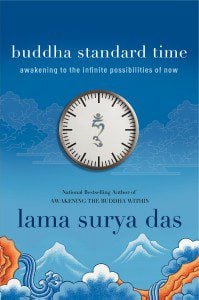
Lama Surya Das is one of the foremost Western Buddhist meditation teachers and scholars. The Dalai Lama affectionately calls him “the American Lama”. He has spent nearly forty years studying Zen, Vipassana, Yoga, and Tibetan Buddhism with many of the great old masters of Asia, among them, some of the Dalai Lama’s own teachers. He is an authorized lama in the Tibetan Buddhist order, a leading spokesperson for Buddhism and contemporary spirituality, a translator, poet, meditation master, chant master, and spiritual activist. Lama Surya Das is the author of the international bestselling Awakening trilogy*: Awakening the Buddha Within, Awakening to the Sacred* and Awakening the Buddhist Heart, as well as the recently released Buddha Standard Time (HarperCollins), and nine other books. In 1991 he established the Dzogchen Centers and Dzogchen Retreats (www.dzogchen.org) and in 1993, with the Dalai Lama, he founded the Western Buddhist Teachers Network and regularly organizes its International Buddhist Teachers’ Conferences.
Lama Surya Das resides in Concord, Massachusetts.Today, Lama Surya Das teaches and lectures around the world, conducting dozens of meditation retreats and workshops each year. He is a regular contributor at Beliefnet.com, Tricycle magazine, and The Huffington Post. His blog, Ask The Lama, can be found at http://askthelama.com and his lecture and retreat schedule are listed at www.surya.org. He can also be followed on Facebook (Lama Surya Das) and Twitter (@LamaSuryaDas).
Previous Post

October 28, 2012
New Petition to save the Mes Aynak Buddhas
Next Post
October 31, 2012 The Three Marks of Existence : Dr David Webster
Browse Our Archives
Select a Category Academia Activism American Buddhism Art Book review Buddhism Buddhism Today Buddhist Ethics Burma/Myanmar China Christianity Commodification Environment Gender Happiness Health Humor India Interfaith Islam Japanese Buddhism Kant Media / News Meditation mindfulness Photography Poetry Politics quicktakes Running Teaching Technology Thailand Theism/Atheism Theravada Tibet Tibetan Buddhism Travels Uncategorized Unitarian Universalism video Western Philosophy Zen
Select a Month June 2021 January 2021 November 2020 August 2020 July 2020 March 2020 January 2020 October 2019 August 2019 June 2019 May 2019 March 2019 February 2019 January 2019 December 2018 November 2018 October 2018 September 2018 August 2018 July 2018 June 2018 May 2018 April 2018 March 2018 February 2018 January 2018 December 2017 November 2017 October 2017 September 2017 August 2017 July 2017 June 2017 May 2017 April 2017 March 2017 February 2017 January 2017 December 2016 November 2016 October 2016 September 2016 August 2016 July 2016 June 2016 May 2016 April 2016 March 2016 February 2016 January 2016 December 2015 November 2015 October 2015 September 2015 August 2015 July 2015 June 2015 May 2015 April 2015 March 2015 February 2015 January 2015 December 2014 November 2014 October 2014 September 2014 August 2014 July 2014 June 2014 May 2014 April 2014 March 2014 February 2014 January 2014 December 2013 November 2013 October 2013 September 2013 August 2013 July 2013 June 2013 May 2013 April 2013 March 2013 February 2013 January 2013 December 2012 November 2012 October 2012 September 2012 August 2012 July 2012 June 2012 May 2012 April 2012 March 2012 February 2012 January 2012 December 2011 November 2011 October 2011 September 2011 August 2011 July 2011 June 2011 May 2011 April 2011 March 2011 February 2011 January 2011 December 2010 November 2010 October 2010 September 2010 August 2010 July 2010 June 2010 May 2010 April 2010 March 2010 February 2010 January 2010 December 2009 November 2009 October 2009 September 2009 August 2009 July 2009 June 2009 May 2009 April 2009 March 2009 February 2009 January 2009 December 2008 November 2008 October 2008 September 2008 August 2008 July 2008 June 2008 May 2008 April 2008 March 2008 September 2007 August 2007 July 2007 June 2007 May 2007 April 2007 March 2007 February 2007 January 2007 December 2006 November 2006 October 2006 September 2006 August 2006 July 2006 June 2006 May 2006 April 2006 March 2006 February 2006 January 2006 December 2005 November 2005 October 2005 September 2005 November 2004 September 2004 August 2004
Follow Us!
TAKE THE
Religious Wisdom Quiz
What Christian group follows the "Westminster Confession of Faith"?
Select your answer to see how you score.
Presbyterians Lutherans Baptists Catholics
Support this
Column


Related posts from American Buddhist Perspectives

For Pride Month: Our 2015 Interview with La...
American Buddhist Perspectives

In strife and uncertainty: let us remember loving-kindness
American Buddhist Perspectives

A Festival of Radical Awakening: Socially Engaged Buddhism...
American Buddhist Perspectives

The Coronavirus is coming - Some thoughts from...
American Buddhist Perspectives
TRENDING AT PATHEOS Buddhist

On Taking Refuge in the Dharma
(Here I continue the feature of sharing talks and essays by teachers...

(Continuing my intention to share talks and essays by other members of Empty...
The Subtle Art of Bowing: A Dharma Discourse
(This presentation was first offered by my dear friend Dharma Holder Tom...

Internal Family Systems Can Heal you Mentally &...
How IFS Helped Me Stop Fighting Myself Internal Family Systems (IFS) is...

The Bible No One Spoke About: A Family’s...
A mysterious family Bible, unspoken faith, and a journey from curiosity to...

How Uncertainty Can Transform Your Life in 2025
Embracing Uncertainty: A New Year’s Resolution for the Brave As 2025 approaches,...
view all Buddhist blogs
Ad-Free & Subscriber Log-In Subscription Support
- About Us
- 2026 Calendar
- Videos
- Podcasts
- Library of World Religions
- Faith In Media Tracker
- Advertise With Us
- Write for Us
- Privacy Policy
- Terms of Service
- Do Not Sell My Data
- Contact Us
- Radiant Digital
- Manage Newsletter Subscriptions
- Unsubscribe From Notifications
- Sitemap
Copyright 2008-2026, Patheos. All rights reserved.
Subscription Support Ad-Free & Subscriber Log-In
Follow Patheos