
BuddhistCatholicContemplativeEvangelicalGeneral ChristianHinduJewishLatter-day SaintMuslimNew VisionsProgressive Christian
Beliefs
- Buddhist
- Catholic
- Contemplative
- Evangelical
- General Christian
- Hindu
- Jewish
- Latter-day Saint
- More Voices
- Muslim
- New Visions
- Pagan
- Progressive Christian
Topics
- Religion News
- Food and Religion
- Sports and Religion
- Religious Art
- Religious Music and Entertainment
- Religious Events
- History and Religion
- Style and Religion
- Politics and Religion
- Women in Religion
- Recreation Outdoors and Religion
- Business Finance and Religion
- Careers Workplace and Religion
- Education and Religion
- Family Parenting and Religion
- Health Fitness and Religion
- Home and Religion
- Relationships and Religion
- Technology and Religion
- Travel and Religion
Columnists
- Buddhist Columnists
- Business Finance and Religion Columnists
- Careers Workplace and Religion Columnists
- Catholic Columnists
- Contemplative Columnists
- Education and Religion Columnists
- Evangelists Columnists
- Family Parenting and Religion Columnists
- General Christian Columnists
- Health Fitness and Religion Columnists
- Hindu Columnists
- History and Religion Columnists
- Home and Religion Columnists
- Jewish Columnists
- More Voices Columnists
- Latter Day Columnists
- Muslim Columnists
- New Visions Columnists
- Nonreligious Columnists
- Pagan Columnists
- Politics and Religion Columnists
- Progressive Columnists
- Recreation Outdoors and Religion Columnists
- Relationships and Religion Columnists
- Religion News Columnists
- Religious Art Columnists
- Religious Events Columnists
- Religious Music and Entertainment Columnists
- Sports and Religion Columnists
- Style and Religion Columnists
- Technology and Religion Columnists
- Travel and Religion Columnists
- Women in Religion Columnists
Resource Library
- 2026 Calendar
- Library of World Religions
- The 100 Most Holy Places on Earth
- Patheos Answers
- Podcasts
- Videos
- Faith Leaders Database
- Anglican Episcopalian
- Bahai
- Baptist
- Buddhism
- Christianity
- Confucianism
- Eastern Orthodoxy
- Hinduism
- Holiness and Pentecostal
- ISKCON
- Islam
- Judaism
- Lutheran
- Methodist
- The Church of Jesus Christ of Latter-day Saints
- New Age
- Paganism
- Presbytarian and Reformed
- Protestantism
- Religion Behind the Scenes
- Roman Catholic
- Scientology
- Shia Islam
- Sikhism
- Sufism
- Sunni Islam
- Taoism
- Zen
- See all religions
Research Tools
 Ad-Free & Subscriber Log-In Subscription Support
Follow Patheos 

- Trending:
- Advent
- |
- Forgiveness
- |
- Thanksgiving
- |
- Election
- |
- Seasonal Holidays
- |
- Marriage
 American Buddhist Perspectives
- Home
- Buddhist
- Religion News
- Eccentric Buddhist Masters
Eccentric Buddhist Masters
Last updated on: March 10, 2014 at 4:05 pm by Justin Whitaker
Eccentric Buddhist Masters 2014-03-10T16:05:01-06:00 Justin Whitaker
Patheos Explore the world's faith through different perspectives on religion and spirituality! Patheos has the views of the prevalent religions and spiritualities of the world.
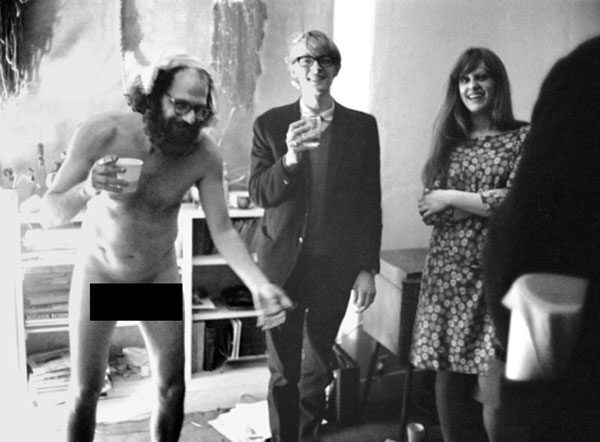
Allen Ginsberg, Eccentric Buddhist
A recent discussion in the academic listserv H-Buddhism has me thinking again about David McMahon’s book The Making of Buddhist Modernism. As I wrote last fall:
I have pretty mixed feelings about the book, and the few scholars I’ve discussed the book with have largely concurred. On the one hand it is a “must read” because of its sweeping scope and rhetorical force. It really has many more positive things I could say about it than negative. On the other hand, it shouldn’t be taken as gospel – at all. Dealing with so many disparate areas of thought, the treatment of any in particular is necessarily limited.
Another post, about 2 weeks later, called “There is no Pure Buddhism” is also inspired largely by aspects of McMahon’s book. In the book, McMahon sets up the dichotomy of ‘traditional’ and ‘modern’ (or ‘modernist’) forms of Buddhism. Like any set of categories, this is an artificial, scholarly construct, but one that can be used to illuminate broad trends in the recent development of Buddhism. I’m tempted to bring up my friend, Chuck Prebish’s, ‘Two Buddhisms’ model for Buddhism in North America – so I will… Both models allow us to see something that we might have missed in all of the messy particularity of countless human beings practicing their religion. Both thus have illuminating power. But both become problematic when they are not properly understood. McMahon warns early in the book that:
By “Buddhist modernism” I do not mean all Buddhism that happens to exist in the modern era but, rather, forms of Buddhism that have emerged out of an engagement with the dominant cultural and intellectual forces of modernity. Buddhist modernism is a dynamic, complex, and plural set of historical processes with loose bonds and fuzzy boundaries. (p.6)
The problem that might arise here is trying to figure out what aspects of contemporary Buddhism have ’emerged out of an engagement’ with what is essentially ‘the West’, and which ones are simply the working out of internal dynamics. To put it simply, and perhaps too crudely, the book seems to suggest that the changes in Buddhist traditions over the past 200 years, because they are a) a change, and b) resemble something coming from the West must c) be caused by something in the West.
McMahon writes, ‘It is often said as a matter of course that modernist forms of Buddhism have been westernized, demythologized, rationalized, Romanticized, Protestantized, or psychologized…’ (p.8). But haven’t some teachers demythologized in the past? While some Tibetan traditions were spreading stories of Padmasambhava flying around subduing demons and leaving footprints in rocks, Tsongkhapa’s Lam Rim Chen Mo (15th century) presents largely demythologized, toned down account of the path to awakening. While some Japanese teachers were making a living going around telling people about the horrors and suffering of hell (complete with charts and graphs), Dogen’s Shobogenzo (13th century) provides a similarly toned down, direct teaching on the Buddha’s path to awakening.
And one of the characters McMahon brings out as a demythologizer (and psychologizer) of Buddhism was Chogyam Trungpa (I reviewed a recent film about him here). And yet, didn’t he also re-mythologize Buddhism at the same time with his emphasis of creating a Shambhala (a mythical Kingdom of peace and righteousness) and having his followers dress up in military clothes and march in formation?
As we can find trends of rationalization in ‘modern’ Buddhism, we can often find trends if irrationality beside them and the same goes for the other factors.
Returning to our eccentric Buddhist masters, in one chapter McMahon presents a contrast:
A stark juxtaposition of scenes. In the fi rst, a row of black-robed, tonsured monks in a perfectly straight line sit dead still in identical postures, their backs erect, hands joined in a precise oval on their laps, eyes cast down, mouths closed. Another monk walks slowly past them holding upright a long stick, fl attened on the end. His eyes drift to one of the seated monks, and he stops in front of him. He turns toward the monk, and they bow to each other. Then he raises the stick into the air and smacks it down on the seated monk’s right shoulder four times in rapid succession, shattering the stillness of the meditation hall with sharp, staccato cracks. He repeats the beating on the left shoulder. The two again bow politely to each other, the seated monk slightly lower than his assailant. The wielder of the stick then continues his slow, deliberate pace past the row of seated figures, still as stone statues.
The second scene is of a large Victorian room with built-in bookcases and a baby grand piano. Four or fi ve occupants are stand-ing around talking, drinking, and smoking. Another, a long-haired, bearded man in a suit and tie, is dancing in the center of the room. He leaps in the air and twirls around, his tie swinging up into his face. His arm glides quickly from his hips, making a serpentine arc in the air until reaching its peak above his head and then gliding in a fl uid path back down to his torso. His other arm then makes an identical pattern, and they alternate in rapid succession. His face beams happily, and his hands gesture as if he is a master of ceremoniesoffering the contents of the room to an imaginary audience. For a second he falters; then he regains his balance and his unpremeditated and unself-conscious manner. His movements tread the fine line between pliable elegance and clownish goofiness, with a tendency toward the latter. (pp. 117-8)
McMahon continues, ‘It is difficult to imagine the two scenes having any connection to each other or bodies doing such different things. It is hard, too, to conceive that these scenes could be have much to do with the same religious tradition.’ Why? Unless we have some narrow, preconceived (orientalist) notion of what this religious tradition is and should be, this shouldn’t be hard to conceive. It’s like watching “Into Great Silence” and then attending a Catholic summer camp filled with kids singing, roasting marshmallows and jumping in lakes and saying ‘it’s hard to conceive that these scenes could be have much to do with the same religious tradition.’
One might suggest that such Catholic summer camps have undergone a process of westernization, rationalization, etc… Or we might find that the Catholic tradition, being quite broad both historically and geographically (and philosophically I might add) has contained elements of both extremes deep into its own history.
My hunch is that Buddhism is quite similar. But McMahon argues that the above (first) picture is ‘how Zen is typically practiced on the ground’ (in Japan) – and thus the suggestion that whenever we see Zen practitioners behaving otherwise – especially being a bit crazy as Allen Ginsberg is in the second description, it is because they have adopted aspects of modernism (in this chapter, the adoption of Western Romanticism). McMahon admits that there are stories of crazy Zen Masters (and I’d add other traditions as well), but this was always with the backdrop of the much more common silent, zazen, black-robes and stick kind of practice. I don’t think this is historically accurate at all.
Other than a layover in Tokyo, I haven’t spent time in Japan and I’m far from an expert in East Asian Buddhism. However, having spent some time in monastaries and temples in China, Taiwan, and S. Korea, I generally saw monastics doing various kinds of work, at other times chanting lengthy liturgies, dealing with temple/local politics, and so on. Furthermore, this was in visiting the more stable ‘orthodox’ temples. There were and are plenty of ‘fringe’ Buddhist/syncretic/shamanistic practicioners to be found in these countries and many of these would no doubt be right at home next to Ginsberg and friends. The outpouring of names and dates in the H-Buddhism discussion of eccentric Buddhist masters only accentuates this point.
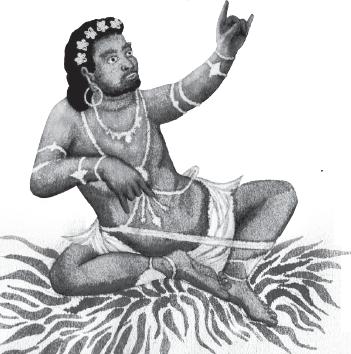
Virupa (7th-8th Century India) told a barmaid that he’d pay his beer tab when the sun was at its zenith. Then he used his tantric power to stop the sun in the sky before it got there. For three days he just kept drinking until the local king, rightly concerned, payed Virupa’s tab.
And if we point to Ginsberg as a representative of Zen in the West, we are likewise being historically inaccurate. We forget all of the Asian immigrants, for one, who have established centers in the West, as well as the converts who have adopted various degrees of ‘traditional’ Ch’an/Zen.
So the images set out a stark contrast that just isn’t there.
Again we can think of the ‘Two Buddhisms’ model and admit that okay, the ‘modernist’ and ‘traditional’ categories are still useful – in the right context and to a certain degree. The ‘Two Buddhisms’ model presents an excellent image of Buddhism in N. America in the 1970s (I highly recommend Prebish’s recent memoir, which I reviewed here). But be careful. Just as you cannot simply assume that an Asian Buddhist in America is not a convert or that a Caucasian didn’t grow up in a Buddhist family, you cannot simply assume that eccentric Buddhist masters today, or in the past, are a result of the incorporation of Western Romanticism.
Previous Post

June 22, 2012
Share this if you've ever lost someone...
Next Post
June 26, 2012 If Slaughterhouses Had Glass Walls...
Browse Our Archives
Select a Category Academia Activism American Buddhism Art Book review Buddhism Buddhism Today Buddhist Ethics Burma/Myanmar China Christianity Commodification Environment Gender Happiness Health Humor India Interfaith Islam Japanese Buddhism Kant Media / News Meditation mindfulness Photography Poetry Politics quicktakes Running Teaching Technology Thailand Theism/Atheism Theravada Tibet Tibetan Buddhism Travels Uncategorized Unitarian Universalism video Western Philosophy Zen
Select a Month June 2021 January 2021 November 2020 August 2020 July 2020 March 2020 January 2020 October 2019 August 2019 June 2019 May 2019 March 2019 February 2019 January 2019 December 2018 November 2018 October 2018 September 2018 August 2018 July 2018 June 2018 May 2018 April 2018 March 2018 February 2018 January 2018 December 2017 November 2017 October 2017 September 2017 August 2017 July 2017 June 2017 May 2017 April 2017 March 2017 February 2017 January 2017 December 2016 November 2016 October 2016 September 2016 August 2016 July 2016 June 2016 May 2016 April 2016 March 2016 February 2016 January 2016 December 2015 November 2015 October 2015 September 2015 August 2015 July 2015 June 2015 May 2015 April 2015 March 2015 February 2015 January 2015 December 2014 November 2014 October 2014 September 2014 August 2014 July 2014 June 2014 May 2014 April 2014 March 2014 February 2014 January 2014 December 2013 November 2013 October 2013 September 2013 August 2013 July 2013 June 2013 May 2013 April 2013 March 2013 February 2013 January 2013 December 2012 November 2012 October 2012 September 2012 August 2012 July 2012 June 2012 May 2012 April 2012 March 2012 February 2012 January 2012 December 2011 November 2011 October 2011 September 2011 August 2011 July 2011 June 2011 May 2011 April 2011 March 2011 February 2011 January 2011 December 2010 November 2010 October 2010 September 2010 August 2010 July 2010 June 2010 May 2010 April 2010 March 2010 February 2010 January 2010 December 2009 November 2009 October 2009 September 2009 August 2009 July 2009 June 2009 May 2009 April 2009 March 2009 February 2009 January 2009 December 2008 November 2008 October 2008 September 2008 August 2008 July 2008 June 2008 May 2008 April 2008 March 2008 September 2007 August 2007 July 2007 June 2007 May 2007 April 2007 March 2007 February 2007 January 2007 December 2006 November 2006 October 2006 September 2006 August 2006 July 2006 June 2006 May 2006 April 2006 March 2006 February 2006 January 2006 December 2005 November 2005 October 2005 September 2005 November 2004 September 2004 August 2004
Follow Us!
TAKE THE
Religious Wisdom Quiz
Who said, 'My kingdom is not of this world'?
Select your answer to see how you score.
Peter John Jesus Paul
Support this
Column


Related posts from American Buddhist Perspectives

For Pride Month: Our 2015 Interview with La...
American Buddhist Perspectives

In strife and uncertainty: let us remember loving-kindness
American Buddhist Perspectives

A Festival of Radical Awakening: Socially Engaged Buddhism...
American Buddhist Perspectives

The Coronavirus is coming - Some thoughts from...
American Buddhist Perspectives
TRENDING AT PATHEOS Buddhist

On Taking Refuge in the Dharma
(Here I continue the feature of sharing talks and essays by teachers...

(Continuing my intention to share talks and essays by other members of Empty...
The Subtle Art of Bowing: A Dharma Discourse
(This presentation was first offered by my dear friend Dharma Holder Tom...

Internal Family Systems Can Heal you Mentally &...
How IFS Helped Me Stop Fighting Myself Internal Family Systems (IFS) is...

The Bible No One Spoke About: A Family’s...
A mysterious family Bible, unspoken faith, and a journey from curiosity to...

How Uncertainty Can Transform Your Life in 2025
Embracing Uncertainty: A New Year’s Resolution for the Brave As 2025 approaches,...
view all Buddhist blogs
Ad-Free & Subscriber Log-In Subscription Support
- About Us
- 2026 Calendar
- Videos
- Podcasts
- Library of World Religions
- Faith In Media Tracker
- Advertise With Us
- Write for Us
- Privacy Policy
- Terms of Service
- Do Not Sell My Data
- Contact Us
- Radiant Digital
- Manage Newsletter Subscriptions
- Unsubscribe From Notifications
- Sitemap
Copyright 2008-2026, Patheos, part of the Radiant Digital network of media brands. All rights reserved.
Subscription Support Ad-Free & Subscriber Log-In
Follow Patheos