
BuddhistCatholicContemplativeEvangelicalGeneral ChristianHinduJewishLatter-day SaintMuslimNew VisionsProgressive Christian
Beliefs
- Buddhist
- Catholic
- Contemplative
- Evangelical
- General Christian
- Hindu
- Jewish
- Latter-day Saint
- More Voices
- Muslim
- New Visions
- Pagan
- Progressive Christian
Topics
- Religion News
- Food and Religion
- Sports and Religion
- Religious Art
- Religious Music and Entertainment
- Religious Events
- History and Religion
- Style and Religion
- Politics and Religion
- Women in Religion
- Recreation Outdoors and Religion
- Business Finance and Religion
- Careers Workplace and Religion
- Education and Religion
- Family Parenting and Religion
- Health Fitness and Religion
- Home and Religion
- Relationships and Religion
- Technology and Religion
- Travel and Religion
Columnists
- Buddhist Columnists
- Business Finance and Religion Columnists
- Careers Workplace and Religion Columnists
- Catholic Columnists
- Contemplative Columnists
- Education and Religion Columnists
- Evangelists Columnists
- Family Parenting and Religion Columnists
- General Christian Columnists
- Health Fitness and Religion Columnists
- Hindu Columnists
- History and Religion Columnists
- Home and Religion Columnists
- Jewish Columnists
- More Voices Columnists
- Latter Day Columnists
- Muslim Columnists
- New Visions Columnists
- Nonreligious Columnists
- Pagan Columnists
- Politics and Religion Columnists
- Progressive Columnists
- Recreation Outdoors and Religion Columnists
- Relationships and Religion Columnists
- Religion News Columnists
- Religious Art Columnists
- Religious Events Columnists
- Religious Music and Entertainment Columnists
- Sports and Religion Columnists
- Style and Religion Columnists
- Technology and Religion Columnists
- Travel and Religion Columnists
- Women in Religion Columnists
Resource Library
- 2026 Calendar
- Library of World Religions
- The 100 Most Holy Places on Earth
- Patheos Answers
- Podcasts
- Videos
- Faith Leaders Database
- Anglican Episcopalian
- Bahai
- Baptist
- Buddhism
- Christianity
- Confucianism
- Eastern Orthodoxy
- Hinduism
- Holiness and Pentecostal
- ISKCON
- Islam
- Judaism
- Lutheran
- Methodist
- The Church of Jesus Christ of Latter-day Saints
- New Age
- Paganism
- Presbytarian and Reformed
- Protestantism
- Religion Behind the Scenes
- Roman Catholic
- Scientology
- Shia Islam
- Sikhism
- Sufism
- Sunni Islam
- Taoism
- Zen
- See all religions
Research Tools
 Ad-Free & Subscriber Log-In Subscription Support
Ad-Free & Subscriber Log-In Subscription Support
Follow Patheos 

- Trending:
- Forgiveness
- |
- Marriage
- |
- Consciousness
- |
- Death Penalty
- |
- Election
- |
- Halloween
 American Buddhist Perspectives
- Home
- Buddhist
- Religion News
- Categories, Yoginis, and Gender
Categories, Yoginis, and Gender
Last updated on: May 16, 2012 at 9:08 am by Justin Whitaker
Categories, Yoginis, and Gender 2012-05-16T09:08:50-06:00 Justin Whitaker
Patheos Explore the world's faith through different perspectives on religion and spirituality! Patheos has the views of the prevalent religions and spiritualities of the world.
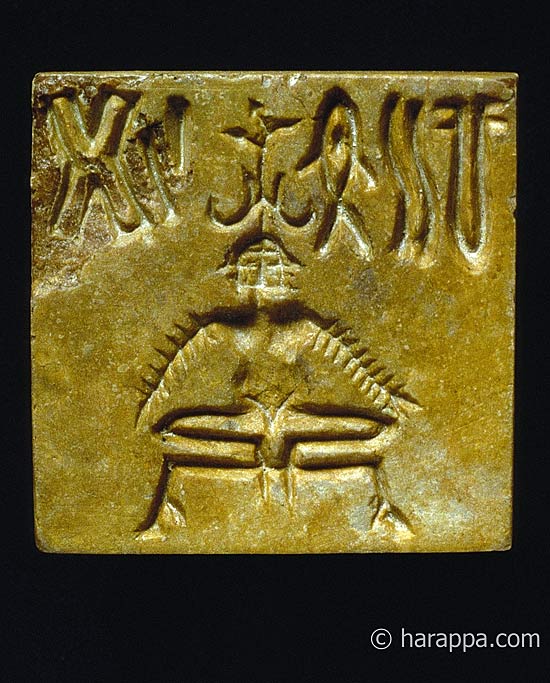
A Yogi at Mohenjo Daro.
Yesterday, Bristol University’s Department of Theology and Religious Studies seminar hosted Dr. Sondra Hausner, who teaches anthropology at Oxford. Her talk, while very good, won’t exactly be the subject of my blog post today. But instead I thought I’d write about a few of the ‘spin off’ ideas that came to me out of her talk**. [This is one of the things I’m very grateful for in academia, the opportunities one gets to hear leading researchers on countless topics and then to have a beer or glass of water with friends, or sometimes those very researchers, to discuss…]** As with most spin offs, these are just preliminary and perhaps fragmentary notes…
- She mentioned a researcher* who had contrasted Patañjali’s highly mentalistic notion of yoga with the emphasis on bodily understanding found in Indus Valley Civilization (IVC) depictions of yoga (more images). This, according to her source, suggested the possibility of inversions of the prioritization of body or mind in certain practices (viz. yoga). Thus we can infer shifting understandings of what it would mean to be a yogi or yogini. This is fair enough, if the premises hold up. But what do we actually know about the Indus Valley Civilization’s emphasis, be it mental or physical, in yoga? Do we even know that they did yoga of any sort?
–
My understanding is that we just don’t know enough about the IVC to say such things for sure. Yes, we have plenty of fragments depicting people and animals and perhaps some form of rudimentary script (it has not yet been translated and some researchers believe it is not a script at all), but to suggest that we can judge how mental-vs-bodily oriented the people were is at best very speculative. I asked Dr. Hausner about this and she gave a good response, but offered nothing in particular beyond suggesting that the image might suggest a more bodily oriented understanding of yoga in the IVC.
–
“Speculative” still comes to mind for me, though. Without texts or a continuous tradition of any kind, it’s really difficult to say much about the theory or practice of people in the Indus Valley Civilization. On the one hand, from images, we have no idea what the practitioners are supposed to be thinking about, and on the other hand with texts, we often have no idea what the practitioner is doing. I’m reminded of the (also Oxford-based) anthropologist David Gellner’s work in Nepal, where he found that there was very clearly an insider-outsider relationship with texts, and that, first of all, outsiders weren’t expected to ever read the texts, and if they did read them, they most definitely couldn’t interpret them correctly because of the hidden symbolic language used. That was in the specifically tantric context, which is different from the yoga sutras, but you can see that there can be difficulty in exact understanding of a 2000 year old text and tradition, especially when we’re talking in…
– - Non-emic terminology. That means that we’re using our (etic) categories to define and characterize their practices. Mind and body simply aren’t Indian terms, nor are mental and physical, though we can find and use plenty of Sanskrit, Pali, etc that match up fairly well. Early Indians probably didn’t think in terms like our Western, post-Descartes, polarity of mind and body, that which thinks vs that which is extended in space. In fact, early Buddhist texts sometimes define rūpa (body or form) in terms of the experience of solidity and resistance. Elsewhere nāma (name, or the mental side) and rūpa are described as being like two sticks or reeds of grass leaning against one another for support – the image suggesting mutual dependence and explicit denial of Cartesian Dualism which is not based on a theory of mutual dependence and in fact Descartes struggles (humorously) to even show how the two substances can interact with one another. All this is to say that our search through old texts and images in search of ‘mentalistic’ vs ‘bodily’ prioritization is fraught with difficulties. But that’s not to say it can’t be done and, after all, it was just a single seminar paper and one cannot demand too much (and this wasn’t even the main topic of the paper!), so this shouldn’t be read as criticism of the paper or the various sources, but more of a warning to students/readers who may pick up bits here and there in the realm of…
– - Categories. One of the central themes of the paper was that the category “yogini” has existed for thousands of years in Indian culture despite the vicissitudes of what exactly the term meant. In fact in her field work she found that it could be a contested label when placed on any one woman – is she a yogini? a real yogini? My girlfriend was sitting next to me at the talk. She does yoga. Is she a yogini, a real yogini? Sensing this puzzlement in my mind (I imagine, or perhaps I was just getting an overly confused look on my face), my girlfriend smacked my leg. Oh, she’s a psychic too, definitely a real yogini.In any case, the category “yogini” lives on, despite fluctuation and contestation (perhaps, in fact, because of it – it was never reified, ossified, and forsaken).
–
Think about that for a minute. Then think about a funny Western word that is about 140 years old…. Buddhism. There are already folks out there who argue that you can’t talk about Buddhism, you have to talk about Buddhisms; or, more often, that you can’t talk about the Buddhist religion, you can only talk about Buddhist religions. To me, this “zzz-ing” of categories reflects more of a postmodern ideology than anything else. Some distinctions are useful, for instance Pure Land Buddhism vs Zen Buddhism. But to say “there is no Buddhism, only Buddhisms” seems simply vapid. Do people do this with other religions? “There is no Catholic Church, only Catholic Churches…” What, one for each building? Each Catholic person? As a warning against monolithic interpretations (which have occurred and will surely continue), this is fine, but beyond that, I don’t see the value in pluralizing our categories, as if that “zzz” confers special recognition of differentiation hitherto ignored or somehow overlooked.
– - The final point she brought up was the idea of differentiating between categories (she gave the example of a person claiming, “I am a Hindu”) and practices (what that person actually does) and going beyond them to experience. I think that’s an interesting idea, especially after Robert Scharf‘s heavy (some might say devastating) blow to the idea of experience in the study of religion: “Buddhist Modernism and the Rhetoric of Meditative Experience,” Numen 42, no. 3 (1995), pp. 228-283. Download PDF – see also “The Rhetoric of Experience and the Study of Religion,” in Cognitive Models and Spiritual Maps (…). Download PDF. It has been a few years, but as I remember, for Scharf all so-called experience is reducible to categories and practices. The idea of some ineffable experience which is somehow beyond the concepts (texts, oral teachings) and practices is mere rhetoric cooked up after Buddhism’s (primarily Zen’s) encounter with the West. But it seems that there is some experience, ineffable as it may be, through which the yogini transcends the category of woman, transcends gender – and yet the power she obtains as a yogini is hers precisely because of her (gendered) practices contravening social norms. Of course it is her practice in the context of sexist categories which allow this, but, I think Dr. Hausner was suggesting, this two-part approach doesn’t satisfy either the complexity of what the yogini herself must experience or the experience we (as devotees, I suppose) have in her presence, an experience which in fact gives her the power which is so essential to her being within the category.
That researcher is Thomas MacEvilly. One of his works can be viewed (in part at least) here: the Archaeology of Yoga.
Previous Post

May 14, 2012
A Buddhist perspective on World News
Next Post
May 18, 2012 The Beer Belt of America
Browse Our Archives
Select a Category Academia Activism American Buddhism Art Book review Buddhism Buddhism Today Buddhist Ethics Burma/Myanmar China Christianity Commodification Environment Gender Happiness Health Humor India Interfaith Islam Japanese Buddhism Kant Media / News Meditation mindfulness Photography Poetry Politics quicktakes Running Teaching Technology Thailand Theism/Atheism Theravada Tibet Tibetan Buddhism Travels Uncategorized Unitarian Universalism video Western Philosophy Zen
Select a Month June 2021 January 2021 November 2020 August 2020 July 2020 March 2020 January 2020 October 2019 August 2019 June 2019 May 2019 March 2019 February 2019 January 2019 December 2018 November 2018 October 2018 September 2018 August 2018 July 2018 June 2018 May 2018 April 2018 March 2018 February 2018 January 2018 December 2017 November 2017 October 2017 September 2017 August 2017 July 2017 June 2017 May 2017 April 2017 March 2017 February 2017 January 2017 December 2016 November 2016 October 2016 September 2016 August 2016 July 2016 June 2016 May 2016 April 2016 March 2016 February 2016 January 2016 December 2015 November 2015 October 2015 September 2015 August 2015 July 2015 June 2015 May 2015 April 2015 March 2015 February 2015 January 2015 December 2014 November 2014 October 2014 September 2014 August 2014 July 2014 June 2014 May 2014 April 2014 March 2014 February 2014 January 2014 December 2013 November 2013 October 2013 September 2013 August 2013 July 2013 June 2013 May 2013 April 2013 March 2013 February 2013 January 2013 December 2012 November 2012 October 2012 September 2012 August 2012 July 2012 June 2012 May 2012 April 2012 March 2012 February 2012 January 2012 December 2011 November 2011 October 2011 September 2011 August 2011 July 2011 June 2011 May 2011 April 2011 March 2011 February 2011 January 2011 December 2010 November 2010 October 2010 September 2010 August 2010 July 2010 June 2010 May 2010 April 2010 March 2010 February 2010 January 2010 December 2009 November 2009 October 2009 September 2009 August 2009 July 2009 June 2009 May 2009 April 2009 March 2009 February 2009 January 2009 December 2008 November 2008 October 2008 September 2008 August 2008 July 2008 June 2008 May 2008 April 2008 March 2008 September 2007 August 2007 July 2007 June 2007 May 2007 April 2007 March 2007 February 2007 January 2007 December 2006 November 2006 October 2006 September 2006 August 2006 July 2006 June 2006 May 2006 April 2006 March 2006 February 2006 January 2006 December 2005 November 2005 October 2005 September 2005 November 2004 September 2004 August 2004
Follow Us!
TAKE THE
Religious Wisdom Quiz
What does the Bible say about parents and children?
Select your answer to see how you score.
Fathers, do not provoke your children Let them do as they wish Never instruct Spoil your children
Support this
Column


Related posts from American Buddhist Perspectives

In strife and uncertainty: let us remember loving-kindness
American Buddhist Perspectives

A Festival of Radical Awakening: Socially Engaged Buddhism...
American Buddhist Perspectives

The Coronavirus is coming - Some thoughts from...
American Buddhist Perspectives

Sogyal Lakar, well-known Tibetan Buddhist teacher and alleged...
American Buddhist Perspectives
TRENDING AT PATHEOS Buddhist

On Taking Refuge in the Dharma
(Here I continue the feature of sharing talks and essays by teachers...

(Continuing my intention to share talks and essays by other members of Empty...
The Subtle Art of Bowing: A Dharma Discourse
(This presentation was first offered by my dear friend Dharma Holder Tom...

Internal Family Systems Can Heal you Mentally &...
How IFS Helped Me Stop Fighting Myself Internal Family Systems (IFS) is...

The Bible No One Spoke About: A Family’s...
A mysterious family Bible, unspoken faith, and a journey from curiosity to...

How Uncertainty Can Transform Your Life in 2025
Embracing Uncertainty: A New Year’s Resolution for the Brave As 2025 approaches,...
view all Buddhist blogs
Ad-Free & Subscriber Log-In Subscription Support
- About Us
- 2026 Calendar
- Videos
- Podcasts
- Library of World Religions
- Faith In Media Tracker
- Advertise With Us
- Write for Us
- Privacy Policy
- Terms of Service
- Do Not Sell My Data
- Contact Us
- Radiant Digital
- Manage Newsletter Subscriptions
- Unsubscribe From Notifications
- Sitemap
Copyright 2008-2026, Patheos. All rights reserved.
Subscription Support Ad-Free & Subscriber Log-In
Follow Patheos