
BuddhistCatholicContemplativeEvangelicalGeneral ChristianHinduJewishLatter-day SaintMuslimNew VisionsProgressive Christian
Beliefs
- Buddhist
- Catholic
- Contemplative
- Evangelical
- General Christian
- Hindu
- Jewish
- Latter-day Saint
- More Voices
- Muslim
- New Visions
- Pagan
- Progressive Christian
Topics
- Religion News
- Food and Religion
- Sports and Religion
- Religious Art
- Religious Music and Entertainment
- Religious Events
- History and Religion
- Style and Religion
- Politics and Religion
- Women in Religion
- Recreation Outdoors and Religion
- Business Finance and Religion
- Careers Workplace and Religion
- Education and Religion
- Family Parenting and Religion
- Health Fitness and Religion
- Home and Religion
- Relationships and Religion
- Technology and Religion
- Travel and Religion
Columnists
- Buddhist Columnists
- Business Finance and Religion Columnists
- Careers Workplace and Religion Columnists
- Catholic Columnists
- Contemplative Columnists
- Education and Religion Columnists
- Evangelists Columnists
- Family Parenting and Religion Columnists
- General Christian Columnists
- Health Fitness and Religion Columnists
- Hindu Columnists
- History and Religion Columnists
- Home and Religion Columnists
- Jewish Columnists
- More Voices Columnists
- Latter Day Columnists
- Muslim Columnists
- New Visions Columnists
- Nonreligious Columnists
- Pagan Columnists
- Politics and Religion Columnists
- Progressive Columnists
- Recreation Outdoors and Religion Columnists
- Relationships and Religion Columnists
- Religion News Columnists
- Religious Art Columnists
- Religious Events Columnists
- Religious Music and Entertainment Columnists
- Sports and Religion Columnists
- Style and Religion Columnists
- Technology and Religion Columnists
- Travel and Religion Columnists
- Women in Religion Columnists
Resource Library
- 2026 Calendar
- Library of World Religions
- The 100 Most Holy Places on Earth
- Patheos Answers
- Podcasts
- Videos
- Faith Leaders Database
- Anglican Episcopalian
- Bahai
- Baptist
- Buddhism
- Christianity
- Confucianism
- Eastern Orthodoxy
- Hinduism
- Holiness and Pentecostal
- ISKCON
- Islam
- Judaism
- Lutheran
- Methodist
- The Church of Jesus Christ of Latter-day Saints
- New Age
- Paganism
- Presbytarian and Reformed
- Protestantism
- Religion Behind the Scenes
- Roman Catholic
- Scientology
- Shia Islam
- Sikhism
- Sufism
- Sunni Islam
- Taoism
- Zen
- See all religions
Research Tools
 Ad-Free & Subscriber Log-In Subscription Support
Ad-Free & Subscriber Log-In Subscription Support
Follow Patheos 

- Trending:
- Forgiveness
- |
- Marriage
- |
- Consciousness
- |
- Death Penalty
- |
- Election
- |
- Halloween
 American Buddhist Perspectives
- Home
- Buddhist
- Religion News
- Three Great Buddhist Podcasts
Three Great Buddhist Podcasts
Last updated on: March 6, 2012 at 1:32 am by Justin Whitaker
Three Great Buddhist Podcasts 2012-03-06T01:32:03-07:00 Justin Whitaker
Patheos Explore the world's faith through different perspectives on religion and spirituality! Patheos has the views of the prevalent religions and spiritualities of the world.
I think I’m nearing the final stretch of an incredibly busy month or so, at last. I have submitted a chapter of my thesis (on Kant), which has been weighing on me for several months; I gave a talk in Oxford last Monday (great thanks again to Richard Gombrich and the OCBS, audio and some text to be posted when available); I had a wisdom tooth removed last Wednesday (great thanks to socialized medicine); and now I only have a poster to finalize and a paper to write for a conference this Friday/Saturday and a proposal to submit by Friday for this year’s AAR in Chicago…
Can I just say how much I am looking forward to Sunday? And to the 2 months of relatively deadline-free life to follow? And did I mention I am going to Thailand in May?
Yes, life is suffering; but not all the time, right?
~
In any case, here are three great podcasts that you should listen to (and feel free to discuss in the comments below).
In the first, and most recent, Robert Ellis talks with Ted Meisner of the Secular Buddhist about his perspective on Buddhism and what he considers to be its central insight: the ‘middle way.’ Robert and I have been in touch since around 2007/8 when I started my Ph.D. and I have always valued his writings and perspective on Buddhism and Western philosophy. One of the topics of his conversation with Ted is the fact that we all bring some of our own background beliefs and assumptions into our practice and understanding of Buddhism. This is indeed a good insight, and I have been trying more lately to be more ‘open’ with the fact that my background (mathematics, computer science, accounting, and Kantian philosophy) leads me to ‘see’ systems when I come to Buddhism. I wondered, however, if and how that insight might be reflexively applied to Robert; i.e. what from his background beliefs or assumptions led him to see the ‘middle way’ as the central insight of Buddhism?
I say that in recognizing that many will not see the middle way as all too central to Buddhism, though certainly important. Others have placed not-self at the heart of Buddhist though, others the goal of awakening, and yet others have said that Buddhism is essentially a teaching about the question of how best to live.
Also Robert sees ideas such as rebirth and enlightenment as having a ‘dogmatic basis’ and ‘in conflict with the middle way’ (mentioned at around 35:20 in the talk). As someone interested primarily in the Buddha as a thinker and teacher, I would wonder then how he managed to teach -or at least strongly suggest- these conflicting ideas. As I believe I have pointed out before, the Buddha certainly could have been a materialist (the philosophy existed in India in his time, he rejected it). But he wasn’t. And I have yet to see a good argument that he ‘really was a materialist’ and just taught rebirth and karma ‘as a skillful means’ or some such thing. (More on that no doubt in future posts.)
~
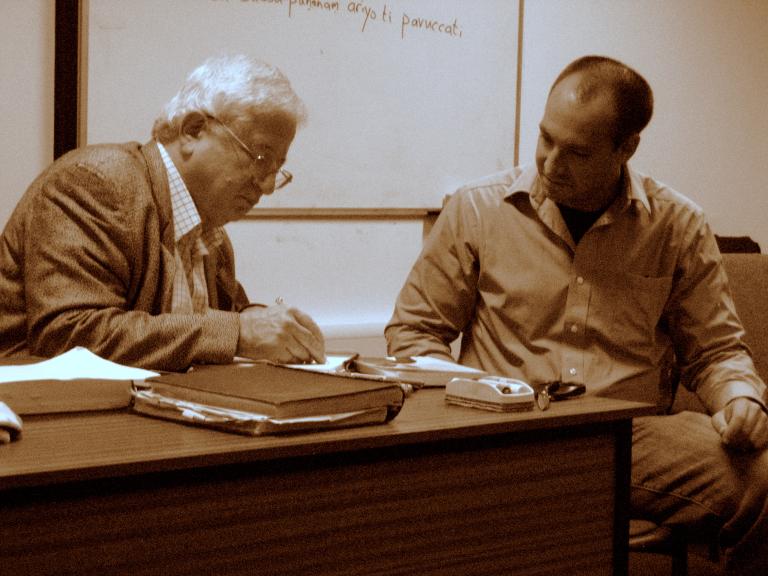
Richard Gombrich and yours truly after the 2011 Pali Summer School in Oxford
Next is an older lecture by Richard Gombrich, discussing Buddhism. It is a wonderful introduction to the religion, his own career, and Buddhist Studies at Oxford and beyond (see OCBS).
As he states – and I agree-, “I think the Buddha ranks with Plato and Aristotle… as one of the greatest thinkers of the ancient world.”
~
Third and finally is a great talk with Justin McDaniel at New Books in Religion, author of “The Lovelorn Ghost and the Magical Monk: Practicing Buddhism in Modern Thailand.”
As I mentioned, I’ll be heading to Thailand in May/June and look forward to spending some time learning about the practice of Buddhism there. I first heard of Justin McDaniel about 7 years ago, right here in Bristol, UK (where I live now). I was working on my MA, and a rather bright and precocious BA student from Ohio named Kelly kept talking about her brilliant professor from back home. His name, unsurprisingly, stuck with me, so I was delighted to reconnect with those memories and to hear more about this fantastic colleague in Theravada Buddhist studies. Have a listen. You’ll learn a lot about Justin, Thai Buddhism, and the study of Buddhism in general.
Previous Post

February 22, 2012
Photography, perfected
Next Post
March 8, 2012 Grassroots American Militarism... For the Children
Browse Our Archives
Select a Category Academia Activism American Buddhism Art Book review Buddhism Buddhism Today Buddhist Ethics Burma/Myanmar China Christianity Commodification Environment Gender Happiness Health Humor India Interfaith Islam Japanese Buddhism Kant Media / News Meditation mindfulness Photography Poetry Politics quicktakes Running Teaching Technology Thailand Theism/Atheism Theravada Tibet Tibetan Buddhism Travels Uncategorized Unitarian Universalism video Western Philosophy Zen
Select a Month June 2021 January 2021 November 2020 August 2020 July 2020 March 2020 January 2020 October 2019 August 2019 June 2019 May 2019 March 2019 February 2019 January 2019 December 2018 November 2018 October 2018 September 2018 August 2018 July 2018 June 2018 May 2018 April 2018 March 2018 February 2018 January 2018 December 2017 November 2017 October 2017 September 2017 August 2017 July 2017 June 2017 May 2017 April 2017 March 2017 February 2017 January 2017 December 2016 November 2016 October 2016 September 2016 August 2016 July 2016 June 2016 May 2016 April 2016 March 2016 February 2016 January 2016 December 2015 November 2015 October 2015 September 2015 August 2015 July 2015 June 2015 May 2015 April 2015 March 2015 February 2015 January 2015 December 2014 November 2014 October 2014 September 2014 August 2014 July 2014 June 2014 May 2014 April 2014 March 2014 February 2014 January 2014 December 2013 November 2013 October 2013 September 2013 August 2013 July 2013 June 2013 May 2013 April 2013 March 2013 February 2013 January 2013 December 2012 November 2012 October 2012 September 2012 August 2012 July 2012 June 2012 May 2012 April 2012 March 2012 February 2012 January 2012 December 2011 November 2011 October 2011 September 2011 August 2011 July 2011 June 2011 May 2011 April 2011 March 2011 February 2011 January 2011 December 2010 November 2010 October 2010 September 2010 August 2010 July 2010 June 2010 May 2010 April 2010 March 2010 February 2010 January 2010 December 2009 November 2009 October 2009 September 2009 August 2009 July 2009 June 2009 May 2009 April 2009 March 2009 February 2009 January 2009 December 2008 November 2008 October 2008 September 2008 August 2008 July 2008 June 2008 May 2008 April 2008 March 2008 September 2007 August 2007 July 2007 June 2007 May 2007 April 2007 March 2007 February 2007 January 2007 December 2006 November 2006 October 2006 September 2006 August 2006 July 2006 June 2006 May 2006 April 2006 March 2006 February 2006 January 2006 December 2005 November 2005 October 2005 September 2005 November 2004 September 2004 August 2004
Follow Us!
TAKE THE
Religious Wisdom Quiz
What does "Tabitha" mean in Aramaic?
Select your answer to see how you score.
Blessed one Daughter of God Servant Gazelle
Support this
Column


Related posts from American Buddhist Perspectives

For Pride Month: Our 2015 Interview with La...
American Buddhist Perspectives

In strife and uncertainty: let us remember loving-kindness
American Buddhist Perspectives

A Festival of Radical Awakening: Socially Engaged Buddhism...
American Buddhist Perspectives

The Coronavirus is coming - Some thoughts from...
American Buddhist Perspectives
TRENDING AT PATHEOS Buddhist

On Taking Refuge in the Dharma
(Here I continue the feature of sharing talks and essays by teachers...

(Continuing my intention to share talks and essays by other members of Empty...
The Subtle Art of Bowing: A Dharma Discourse
(This presentation was first offered by my dear friend Dharma Holder Tom...

Internal Family Systems Can Heal you Mentally &...
How IFS Helped Me Stop Fighting Myself Internal Family Systems (IFS) is...

The Bible No One Spoke About: A Family’s...
A mysterious family Bible, unspoken faith, and a journey from curiosity to...

How Uncertainty Can Transform Your Life in 2025
Embracing Uncertainty: A New Year’s Resolution for the Brave As 2025 approaches,...
view all Buddhist blogs
Ad-Free & Subscriber Log-In Subscription Support
- About Us
- 2026 Calendar
- Videos
- Podcasts
- Library of World Religions
- Faith In Media Tracker
- Advertise With Us
- Write for Us
- Privacy Policy
- Terms of Service
- Do Not Sell My Data
- Contact Us
- Radiant Digital
- Manage Newsletter Subscriptions
- Unsubscribe From Notifications
- Sitemap
Copyright 2008-2026, Patheos. All rights reserved.
Subscription Support Ad-Free & Subscriber Log-In
Follow Patheos