
BuddhistCatholicContemplativeEvangelicalGeneral ChristianHinduJewishLatter-day SaintMuslimNew VisionsProgressive Christian
Beliefs
- Buddhist
- Catholic
- Contemplative
- Evangelical
- General Christian
- Hindu
- Jewish
- Latter-day Saint
- More Voices
- Muslim
- New Visions
- Pagan
- Progressive Christian
Topics
- Religion News
- Food and Religion
- Sports and Religion
- Religious Art
- Religious Music and Entertainment
- Religious Events
- History and Religion
- Style and Religion
- Politics and Religion
- Women in Religion
- Recreation Outdoors and Religion
- Business Finance and Religion
- Careers Workplace and Religion
- Education and Religion
- Family Parenting and Religion
- Health Fitness and Religion
- Home and Religion
- Relationships and Religion
- Technology and Religion
- Travel and Religion
Columnists
- Buddhist Columnists
- Business Finance and Religion Columnists
- Careers Workplace and Religion Columnists
- Catholic Columnists
- Contemplative Columnists
- Education and Religion Columnists
- Evangelists Columnists
- Family Parenting and Religion Columnists
- General Christian Columnists
- Health Fitness and Religion Columnists
- Hindu Columnists
- History and Religion Columnists
- Home and Religion Columnists
- Jewish Columnists
- More Voices Columnists
- Latter Day Columnists
- Muslim Columnists
- New Visions Columnists
- Nonreligious Columnists
- Pagan Columnists
- Politics and Religion Columnists
- Progressive Columnists
- Recreation Outdoors and Religion Columnists
- Relationships and Religion Columnists
- Religion News Columnists
- Religious Art Columnists
- Religious Events Columnists
- Religious Music and Entertainment Columnists
- Sports and Religion Columnists
- Style and Religion Columnists
- Technology and Religion Columnists
- Travel and Religion Columnists
- Women in Religion Columnists
Resource Library
- 2026 Calendar
- Library of World Religions
- The 100 Most Holy Places on Earth
- Patheos Answers
- Podcasts
- Videos
- Faith Leaders Database
- Anglican Episcopalian
- Bahai
- Baptist
- Buddhism
- Christianity
- Confucianism
- Eastern Orthodoxy
- Hinduism
- Holiness and Pentecostal
- ISKCON
- Islam
- Judaism
- Lutheran
- Methodist
- The Church of Jesus Christ of Latter-day Saints
- New Age
- Paganism
- Presbytarian and Reformed
- Protestantism
- Religion Behind the Scenes
- Roman Catholic
- Scientology
- Shia Islam
- Sikhism
- Sufism
- Sunni Islam
- Taoism
- Zen
- See all religions
Research Tools
 Ad-Free & Subscriber Log-In Subscription Support
Ad-Free & Subscriber Log-In Subscription Support
Follow Patheos 

- Trending:
- Forgiveness
- |
- Marriage
- |
- Consciousness
- |
- Death Penalty
- |
- Election
- |
- Halloween
 American Buddhist Perspectives
- Home
- Buddhist
- Religion News
- Review: The Buddha in the Classroom
Review: The Buddha in the Classroom
Last updated on: August 31, 2016 at 10:07 am by Justin Whitaker
Review: The Buddha in the Classroom 2016-08-31T10:07:20-06:00 Justin Whitaker
Patheos Explore the world's faith through different perspectives on religion and spirituality! Patheos has the views of the prevalent religions and spiritualities of the world.
Subtitled: “Zen Wisdom to Inspire Teachers,” this is a book filled with much more than just “Zen” wisdom and it will surely inspire pretty much anyone who reads it. The first recipient of a 5 Star rating on this blog, this book is guaranteed to find a place amongst my ‘must read and re-read’ favorites on my bookshelf. (If she managed to add great photos, like David Bognar’s lovely book, I’d have to create a sixth star.)
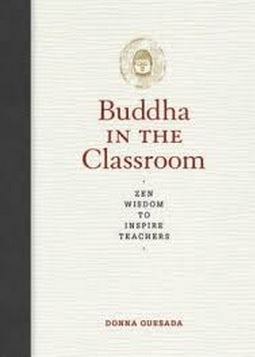 To be fair, some of my appreciation for the book is purely selfish: the book feels like it was written just for me. The author, Donna Quesada, is a philosophy professor in California, a Buddhist, a yoga instructor, a connoisseur of world-wisdom, and a watcher of good movies. She tells us the book is in part a product of a particularly hard semester at her college and part one of the book is called “The Burned-Out Professor.” At 31 and still in grad-school, with just three courses of my own and a hand-full of TA posts under my belt, I’m nowhere near burnout. But in academia it does seem to be all around me. I’ve faced mini-burnouts at the ends of semesters, as many undergraduates do, and I have seen friends end their studies for various reasons (burnout often being one of them), and I know that frustration with teaching, grading, university bureaucracy, and/or government policy-makers can hit professors even before they ever step into the classroom.
So some strategies with dealing with burnout sound quite appealing, even if only as a preventative measure. One area where I guess I am burned out is in certain aspects of Western philosophy, where, as Prof. Quesada describes, “It started to feel like a game–a board game, where you move your marker around a make-believe course and try to advance to the end first. You identify the logical fallacies–the begging questions, the slippery slopes…. You call out all the unsupported assumptions, and you win. You bask in the self-satisfaction that comes from weeding through the mess of fictitious claims. But the pleasure runs thin quickly, and truth still seems far away.”
Realizing this, Quesada stayed in philosophy, but moved Eastward in her focus where the emphasis isn’t on thinking right thoughts, but on the clarity of the mind itself:
When the water is clear, you see the infinite possibilities, Zen says. – (p.22)
Section 2, by far the largest section of the book, deals with life in the classroom. Each chapter is built around an anecdote which traces its way through the course of her semester. In the beginning, there is add-drop (or at least “add” where students try to get direct permission to get into an already-full class). Setting the tone for the whole semester can seem to fall on those first precious classes. Every extra student is a potential distraction for the others as well as extra time and work for the teacher. On the other hand they might be great students, eager to get in and helpful to those around them. If the class was meant for 25, what does one do when nearly 40 show up on day one? (This actually happened to me years ago when I taught Tibetan Buddhism. I let everyone in, found a new, bigger room, shifted the structure a bit, and in the relative chaos that ensued, the class weened itself down to about 25.) Quesada’s wisdom: no need for a rigid or open-door policy. Connect individually with each student wishing to add, even if it’s only to say there’s no more room. It can seem like compassion to just let everyone in, but students deserve smaller classes and the additional intimacy that creates.
Let’s just see how it goes, Zen says. – (p.36)
The next chapter, on grading papers, is humorously subtitled, “There is No Beginning and No End.” The theme is presence and simply tackling one thing at a time, even when staring down a mountain of work in front of you (note to self regarding my ph.d. thesis…). She even draws on the experiences of Pam Reed, an ultrarunner (see, I told you this book was written for me), who manages to run incredible distances by simply making it to the next marker, and the next, and the next, and so on. Stay focused on what’s here and now, and simply move forward, and you’ll make it. The lesson is profound, but easily overlooked in this age of endless wants and seemingly endless tasks.
The book continues with what seems like a whole life’s worth of lessons and wisdom. Again, the stories revolve around the classroom, but the lessons reach all of us in situations throughout our lives: when to let go, to forgive, to carry a big stick, and when to smile in the face of the absurd.
Like most any Zen book, the answer is more often than not to take a look at yourself. What are you bringing to this problem that only seems to be out there. Can a change of mind fix things? I laughed out loud when she mentioned the example of a blaring siren, having lived for a few months on a major road in South London, where police and ambulances would pass by every 10-15 minutes, sirens blasting. But Quesada suggests that this may be seen as an annoyance on the one hand (as it certainly was for me and my flatmates) or it may be seen as the sound of somebody’s life being saved. If only I’d read this back then!
But as with any Zen or Buddhism book, it is the humanness of the author that needs to seep through, to make a connection with the reader that will make him/her remember the stories, as well as the wisdom within them. And Donna Quesada has brought her humanity fully to these pages, in part by focusing on the very deepest of her struggles, but also through her wit and sincerity.
I don’t think a better book can be found for young teacher or aspiring teacher today, especially one with an interest in Buddhism. And this is also a book I’ll pass amongst all of my friends and family (careful each time to get it back!), as the wisdom goes well beyond the classroom and academia. Coincidentally (or not), the book is roughly the same size, weight, and color of another exceptional book for teachers, Jay Parini’s “The Art of Teaching.”
(Young/aspiring teachers: get them both, read them both!)

Previous Post

June 27, 2011
PBS Religion and Ethics visits Montana
Next Post

July 2, 2011 Assimilation and revalorization
Browse Our Archives
Select a Category Academia Activism American Buddhism Art Book review Buddhism Buddhism Today Buddhist Ethics Burma/Myanmar China Christianity Commodification Environment Gender Happiness Health Humor India Interfaith Islam Japanese Buddhism Kant Media / News Meditation mindfulness Photography Poetry Politics quicktakes Running Teaching Technology Thailand Theism/Atheism Theravada Tibet Tibetan Buddhism Travels Uncategorized Unitarian Universalism video Western Philosophy Zen
Select a Month June 2021 January 2021 November 2020 August 2020 July 2020 March 2020 January 2020 October 2019 August 2019 June 2019 May 2019 March 2019 February 2019 January 2019 December 2018 November 2018 October 2018 September 2018 August 2018 July 2018 June 2018 May 2018 April 2018 March 2018 February 2018 January 2018 December 2017 November 2017 October 2017 September 2017 August 2017 July 2017 June 2017 May 2017 April 2017 March 2017 February 2017 January 2017 December 2016 November 2016 October 2016 September 2016 August 2016 July 2016 June 2016 May 2016 April 2016 March 2016 February 2016 January 2016 December 2015 November 2015 October 2015 September 2015 August 2015 July 2015 June 2015 May 2015 April 2015 March 2015 February 2015 January 2015 December 2014 November 2014 October 2014 September 2014 August 2014 July 2014 June 2014 May 2014 April 2014 March 2014 February 2014 January 2014 December 2013 November 2013 October 2013 September 2013 August 2013 July 2013 June 2013 May 2013 April 2013 March 2013 February 2013 January 2013 December 2012 November 2012 October 2012 September 2012 August 2012 July 2012 June 2012 May 2012 April 2012 March 2012 February 2012 January 2012 December 2011 November 2011 October 2011 September 2011 August 2011 July 2011 June 2011 May 2011 April 2011 March 2011 February 2011 January 2011 December 2010 November 2010 October 2010 September 2010 August 2010 July 2010 June 2010 May 2010 April 2010 March 2010 February 2010 January 2010 December 2009 November 2009 October 2009 September 2009 August 2009 July 2009 June 2009 May 2009 April 2009 March 2009 February 2009 January 2009 December 2008 November 2008 October 2008 September 2008 August 2008 July 2008 June 2008 May 2008 April 2008 March 2008 September 2007 August 2007 July 2007 June 2007 May 2007 April 2007 March 2007 February 2007 January 2007 December 2006 November 2006 October 2006 September 2006 August 2006 July 2006 June 2006 May 2006 April 2006 March 2006 February 2006 January 2006 December 2005 November 2005 October 2005 September 2005 November 2004 September 2004 August 2004
Follow Us!
TAKE THE
Religious Wisdom Quiz
What does the Greek word 'Doulos' mean in the New Testament?
Select your answer to see how you score.
Teacher King Priest Servant/Slave
Support this
Column


Related posts from American Buddhist Perspectives

A Festival of Radical Awakening: Socially Engaged Buddhism...
American Buddhist Perspectives
Intersections between Buddhism, Health, and Diversity in an...
American Buddhist Perspectives
The ongoing importance of Engaging with Buddhism
American Buddhist Perspectives
Spend a month in a Chinese Buddhist Monastery...
American Buddhist Perspectives
TRENDING AT PATHEOS Buddhist

On Taking Refuge in the Dharma
(Here I continue the feature of sharing talks and essays by teachers...

(Continuing my intention to share talks and essays by other members of Empty...
The Subtle Art of Bowing: A Dharma Discourse
(This presentation was first offered by my dear friend Dharma Holder Tom...

Internal Family Systems Can Heal you Mentally &...
How IFS Helped Me Stop Fighting Myself Internal Family Systems (IFS) is...

The Bible No One Spoke About: A Family’s...
A mysterious family Bible, unspoken faith, and a journey from curiosity to...

How Uncertainty Can Transform Your Life in 2025
Embracing Uncertainty: A New Year’s Resolution for the Brave As 2025 approaches,...
view all Buddhist blogs
Ad-Free & Subscriber Log-In Subscription Support
- About Us
- 2026 Calendar
- Videos
- Podcasts
- Library of World Religions
- Faith In Media Tracker
- Advertise With Us
- Write for Us
- Privacy Policy
- Terms of Service
- Do Not Sell My Data
- Contact Us
- Radiant Digital
- Manage Newsletter Subscriptions
- Unsubscribe From Notifications
- Sitemap
Copyright 2008-2026, Patheos. All rights reserved.
Subscription Support Ad-Free & Subscriber Log-In
Follow Patheos