
BuddhistCatholicContemplativeEvangelicalGeneral ChristianHinduJewishLatter-day SaintMuslimNew VisionsProgressive Christian
Beliefs
- Buddhist
- Catholic
- Contemplative
- Evangelical
- General Christian
- Hindu
- Jewish
- Latter-day Saint
- More Voices
- Muslim
- New Visions
- Pagan
- Progressive Christian
Topics
- Religion News
- Food and Religion
- Sports and Religion
- Religious Art
- Religious Music and Entertainment
- Religious Events
- History and Religion
- Style and Religion
- Politics and Religion
- Women in Religion
- Recreation Outdoors and Religion
- Business Finance and Religion
- Careers Workplace and Religion
- Education and Religion
- Family Parenting and Religion
- Health Fitness and Religion
- Home and Religion
- Relationships and Religion
- Technology and Religion
- Travel and Religion
Columnists
- Buddhist Columnists
- Business Finance and Religion Columnists
- Careers Workplace and Religion Columnists
- Catholic Columnists
- Contemplative Columnists
- Education and Religion Columnists
- Evangelists Columnists
- Family Parenting and Religion Columnists
- General Christian Columnists
- Health Fitness and Religion Columnists
- Hindu Columnists
- History and Religion Columnists
- Home and Religion Columnists
- Jewish Columnists
- More Voices Columnists
- Latter Day Columnists
- Muslim Columnists
- New Visions Columnists
- Nonreligious Columnists
- Pagan Columnists
- Politics and Religion Columnists
- Progressive Columnists
- Recreation Outdoors and Religion Columnists
- Relationships and Religion Columnists
- Religion News Columnists
- Religious Art Columnists
- Religious Events Columnists
- Religious Music and Entertainment Columnists
- Sports and Religion Columnists
- Style and Religion Columnists
- Technology and Religion Columnists
- Travel and Religion Columnists
- Women in Religion Columnists
Resource Library
- 2026 Calendar
- Library of World Religions
- The 100 Most Holy Places on Earth
- Patheos Answers
- Podcasts
- Videos
- Faith Leaders Database
- Anglican Episcopalian
- Bahai
- Baptist
- Buddhism
- Christianity
- Confucianism
- Eastern Orthodoxy
- Hinduism
- Holiness and Pentecostal
- ISKCON
- Islam
- Judaism
- Lutheran
- Methodist
- The Church of Jesus Christ of Latter-day Saints
- New Age
- Paganism
- Presbytarian and Reformed
- Protestantism
- Religion Behind the Scenes
- Roman Catholic
- Scientology
- Shia Islam
- Sikhism
- Sufism
- Sunni Islam
- Taoism
- Zen
- See all religions
Research Tools
 Ad-Free & Subscriber Log-In Subscription Support
Ad-Free & Subscriber Log-In Subscription Support
Follow Patheos 

- Trending:
- Forgiveness
- |
- Marriage
- |
- Consciousness
- |
- Death Penalty
- |
- Election
- |
- Halloween
 American Buddhist Perspectives
- Home
- Buddhist
- Religion News
- It’s not just about Photography
It’s not just about Photography
Last updated on: March 23, 2011 at 7:41 pm by Justin Whitaker
It’s not just about Photography 2011-03-23T19:41:00-06:00 Justin Whitaker
Patheos Explore the world's faith through different perspectives on religion and spirituality! Patheos has the views of the prevalent religions and spiritualities of the world.

It’s about life.
I had hoped to have finished a review of The Practice of Contemplative Photography: Seeing the World with Fresh Eyes
We all remember the line from “As Good as it Gets” when Jack Nickolson’s character says “You make me want to be a better man.” Well, here is a book that makes me want to be a better photographer, a better perciever, a better listener, and, what the hell, a better man.
I still haven’t completed it, nor done many of the exercises, but it’s time now to write. I have a feeling more will come as my life settles down a bit in England… (suuuure….)
The book is by all means a masterpiece for those who want to bring their photography and contemplative lives to their pinnacle. Just opening it, I feel relaxed, with deepening awareness of the world around me, just as it is. I grow more inquisitive about the little things I would otherwise (and do otherwise) overlook a thousand times.
Much of my life, from around 8am until noon, revolves around coffee. Simple as it is, I might not have had that realization if it weren’t for this book. The photograph above is from this morning, my coffee cup sitting on a copy of one part of my recently completed UK student visa application. Peace triumphant over bureaucracy (I hope). The coffee stain on the left tells you it’s been here for a couple days. The page has three such stains now, as it sits without any real purpose on my desk.
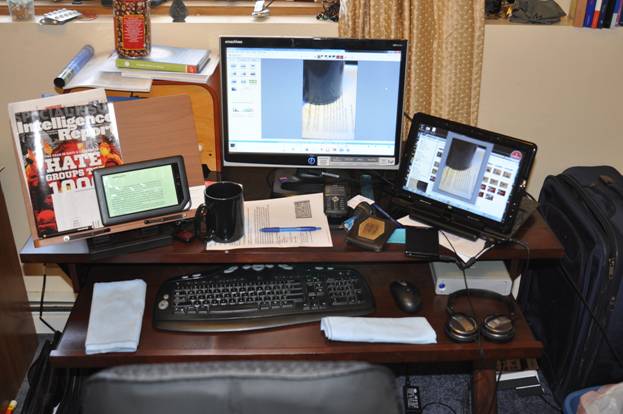
A full view of my desk, showing how decidedly un-contemplative my workspace tends to be.

And just to the right of my desk.
This isn’t a book about theory, or what to believe or how to understand the world. In fact, the couple times this came up in the book (early on), I found myself disagreeing with the authors. But this just shows that I’ve been trained (minimally) in the world of classical photography, where things like the rule of thirds, focus points, and checking your corners are gospel. It wasn’t until about a third of the way into the book that I realized that this book simply has a different purpose, when I read:
When you get home, take time with your images. Don’t rush to pick out the good shots and reject the bad ones. Try not to be harsh or judgmental with yourself, but keep looking. Recognize what you have and try to see what worked and what did not. When you have a good sense of that, delete the images that did not come from real flashes of perception. (emphasis mine)
The purpose here is not to capture a classically beautiful image, but instead to sink into the moment at which a photo is taken. So, when I reached the chapter on texture I paused and soaked up the world around me. What I found most appealing was the texture of my hemp/blend pants.

But this photo is indicative of my above messiness as well as a lesson later in the book: Simplicity. There is just too much going on in this photo (for me). I think it captures my true perception – click on it and just gaze at the light on the jeans above my hand and you might ‘sink in’ to the texture as I did in that moment. But the peripherals, which fell into a calm fuzz in my mind’s eye, did not as well in the photo. (perhaps a faster lens, like this beautiful Nikon 50mm f/1.2, only $750…)
In fact the top photo of my coffee cup may be too busy as well due to the coffee ring, but I like it. It tells a story, provides context. What do you think? (perhaps compare to my earlier coffee cup photo, below)
But when the book shifts back into what I lovingly call a ‘philosophical’ mode, I sink back in to the book with deep appreciation. When discussing the topic of “Boredom and Entertainment,” the authors write:
“Why do we check our e-mail so frequently, continually text our friends, or waste so much time on Facebook? The basic question is, why can’t we relax when we have nothing to do and enjoy a little bit of space in our lives?
The problem is that we are afraid of our own hearts. There are many, many things we haven’t wanted to look at. The heart is so sensitive, so ready to resonate with the world, that we keep it covered, fearing we won’t be able to stand being touched…”
So true. So beautifully stated.
And later, the discussion of the flash of perception as “sudden, shocking, and disorienting” reads like poetry or the soft words of a meditation-master walking you through the tapestry of your own experience.
In the end this is a book that will be many things to many different people. While I think you can practice contemplative photography with a point-and-shoot or your phone camera, I am skeptical about the quality of both the photos themselves (again, showing my classical photographer side) and the experience in the moment itself (something the authors would, I think, agree with me on). This kind of photography requires a human-perspectival fidelity that most cameras simply aren’t built for. And it requires a kind of human-machine connection by which the camera becomes an extension of your own perception. (If I really wanted to be a snob, I’d demand the use of medium-format cameras or at least a full frame DSLR, but alas, I won’t go that far)
But the practice itself can still be done with these, in principle. Whether the results are gratifying enough to keep you going or not is an open question.
And what I do love about this book is the step-by-step practices it contains. Each practice is like a guided meditation in which the camera replaces your cushion and the world around you substitutes for the world within. But the result is remarkably similar: a growing awareness of the present moment, a calming of thoughts, a heightened vividness in the detail, color, and texture of perceptions. Even with no camera at all, these practices are worthwhile for the reconnection with the world we gain. I return again and again to a quote found early in the book:
“The possibilities of perception are limitless, and clear seeing is joyful.”
And later in the practice:
“Learn to apply effort to discernment like a skillful violinist tuning his instrument: not too tight and not too loose.”
Wisdom not just for photography, but for life.


Previous Post

March 13, 2011
Yellowstone
Next Post
March 26, 2011 Burma: An Earthquake, Monks, Friends, and Rambo
Browse Our Archives
Select a Category Academia Activism American Buddhism Art Book review Buddhism Buddhism Today Buddhist Ethics Burma/Myanmar China Christianity Commodification Environment Gender Happiness Health Humor India Interfaith Islam Japanese Buddhism Kant Media / News Meditation mindfulness Photography Poetry Politics quicktakes Running Teaching Technology Thailand Theism/Atheism Theravada Tibet Tibetan Buddhism Travels Uncategorized Unitarian Universalism video Western Philosophy Zen
Select a Month June 2021 January 2021 November 2020 August 2020 July 2020 March 2020 January 2020 October 2019 August 2019 June 2019 May 2019 March 2019 February 2019 January 2019 December 2018 November 2018 October 2018 September 2018 August 2018 July 2018 June 2018 May 2018 April 2018 March 2018 February 2018 January 2018 December 2017 November 2017 October 2017 September 2017 August 2017 July 2017 June 2017 May 2017 April 2017 March 2017 February 2017 January 2017 December 2016 November 2016 October 2016 September 2016 August 2016 July 2016 June 2016 May 2016 April 2016 March 2016 February 2016 January 2016 December 2015 November 2015 October 2015 September 2015 August 2015 July 2015 June 2015 May 2015 April 2015 March 2015 February 2015 January 2015 December 2014 November 2014 October 2014 September 2014 August 2014 July 2014 June 2014 May 2014 April 2014 March 2014 February 2014 January 2014 December 2013 November 2013 October 2013 September 2013 August 2013 July 2013 June 2013 May 2013 April 2013 March 2013 February 2013 January 2013 December 2012 November 2012 October 2012 September 2012 August 2012 July 2012 June 2012 May 2012 April 2012 March 2012 February 2012 January 2012 December 2011 November 2011 October 2011 September 2011 August 2011 July 2011 June 2011 May 2011 April 2011 March 2011 February 2011 January 2011 December 2010 November 2010 October 2010 September 2010 August 2010 July 2010 June 2010 May 2010 April 2010 March 2010 February 2010 January 2010 December 2009 November 2009 October 2009 September 2009 August 2009 July 2009 June 2009 May 2009 April 2009 March 2009 February 2009 January 2009 December 2008 November 2008 October 2008 September 2008 August 2008 July 2008 June 2008 May 2008 April 2008 March 2008 September 2007 August 2007 July 2007 June 2007 May 2007 April 2007 March 2007 February 2007 January 2007 December 2006 November 2006 October 2006 September 2006 August 2006 July 2006 June 2006 May 2006 April 2006 March 2006 February 2006 January 2006 December 2005 November 2005 October 2005 September 2005 November 2004 September 2004 August 2004
Follow Us!
TAKE THE
Religious Wisdom Quiz
I come in nine varieties including joy, peace, and self-control. What am I?
Select your answer to see how you score.
The gifts of the Spirit Spiritual blessings The fruit of the Spirit The works of righteousness
Support this
Column


Related posts from American Buddhist Perspectives

For Pride Month: Our 2015 Interview with La...
American Buddhist Perspectives

Standing up to Lies: Can America Emerge from...
American Buddhist Perspectives

Progressive responses to the 2020 election of Biden...
American Buddhist Perspectives

In strife and uncertainty: let us remember loving-kindness
American Buddhist Perspectives
TRENDING AT PATHEOS Buddhist

On Taking Refuge in the Dharma
(Here I continue the feature of sharing talks and essays by teachers...

(Continuing my intention to share talks and essays by other members of Empty...
The Subtle Art of Bowing: A Dharma Discourse
(This presentation was first offered by my dear friend Dharma Holder Tom...

Internal Family Systems Can Heal you Mentally &...
How IFS Helped Me Stop Fighting Myself Internal Family Systems (IFS) is...

The Bible No One Spoke About: A Family’s...
A mysterious family Bible, unspoken faith, and a journey from curiosity to...

How Uncertainty Can Transform Your Life in 2025
Embracing Uncertainty: A New Year’s Resolution for the Brave As 2025 approaches,...
view all Buddhist blogs
Ad-Free & Subscriber Log-In Subscription Support
- About Us
- 2026 Calendar
- Videos
- Podcasts
- Library of World Religions
- Faith In Media Tracker
- Advertise With Us
- Write for Us
- Privacy Policy
- Terms of Service
- Do Not Sell My Data
- Contact Us
- Radiant Digital
- Manage Newsletter Subscriptions
- Unsubscribe From Notifications
- Sitemap
Copyright 2008-2026, Patheos. All rights reserved.
Subscription Support Ad-Free & Subscriber Log-In
Follow Patheos