
BuddhistCatholicContemplativeEvangelicalGeneral ChristianHinduJewishLatter-day SaintMuslimNew VisionsProgressive Christian
Beliefs
- Buddhist
- Catholic
- Contemplative
- Evangelical
- General Christian
- Hindu
- Jewish
- Latter-day Saint
- More Voices
- Muslim
- New Visions
- Pagan
- Progressive Christian
Topics
- Religion News
- Food and Religion
- Sports and Religion
- Religious Art
- Religious Music and Entertainment
- Religious Events
- History and Religion
- Style and Religion
- Politics and Religion
- Women in Religion
- Recreation Outdoors and Religion
- Business Finance and Religion
- Careers Workplace and Religion
- Education and Religion
- Family Parenting and Religion
- Health Fitness and Religion
- Home and Religion
- Relationships and Religion
- Technology and Religion
- Travel and Religion
Columnists
- Buddhist Columnists
- Business Finance and Religion Columnists
- Careers Workplace and Religion Columnists
- Catholic Columnists
- Contemplative Columnists
- Education and Religion Columnists
- Evangelists Columnists
- Family Parenting and Religion Columnists
- General Christian Columnists
- Health Fitness and Religion Columnists
- Hindu Columnists
- History and Religion Columnists
- Home and Religion Columnists
- Jewish Columnists
- More Voices Columnists
- Latter Day Columnists
- Muslim Columnists
- New Visions Columnists
- Nonreligious Columnists
- Pagan Columnists
- Politics and Religion Columnists
- Progressive Columnists
- Recreation Outdoors and Religion Columnists
- Relationships and Religion Columnists
- Religion News Columnists
- Religious Art Columnists
- Religious Events Columnists
- Religious Music and Entertainment Columnists
- Sports and Religion Columnists
- Style and Religion Columnists
- Technology and Religion Columnists
- Travel and Religion Columnists
- Women in Religion Columnists
Resource Library
- 2026 Calendar
- Library of World Religions
- The 100 Most Holy Places on Earth
- Patheos Answers
- Podcasts
- Videos
- Faith Leaders Database
- Anglican Episcopalian
- Bahai
- Baptist
- Buddhism
- Christianity
- Confucianism
- Eastern Orthodoxy
- Hinduism
- Holiness and Pentecostal
- ISKCON
- Islam
- Judaism
- Lutheran
- Methodist
- The Church of Jesus Christ of Latter-day Saints
- New Age
- Paganism
- Presbytarian and Reformed
- Protestantism
- Religion Behind the Scenes
- Roman Catholic
- Scientology
- Shia Islam
- Sikhism
- Sufism
- Sunni Islam
- Taoism
- Zen
- See all religions
Research Tools
 Ad-Free & Subscriber Log-In Subscription Support
Ad-Free & Subscriber Log-In Subscription Support
Follow Patheos 

- Trending:
- Forgiveness
- |
- Marriage
- |
- Consciousness
- |
- Death Penalty
- |
- Election
- |
- Halloween
 American Buddhist Perspectives
- Home
- Buddhist
- Religion News
- Varanasi: City of Lights
Varanasi: City of Lights
Last updated on: October 10, 2010 at 6:13 am by Justin Whitaker
Varanasi: City of Lights 2010-10-10T06:13:00-06:00 Justin Whitaker
Patheos Explore the world's faith through different perspectives on religion and spirituality! Patheos has the views of the prevalent religions and spiritualities of the world.

In describing Varanasi, I don’t think I could do any better than the Harvard scholar Diana Eck, author of Banaras
Are there not many holy places on this earth?
Yet which of them would equal in the balance on speck of Kāshī’s dust?
Are there not many rivers running to the sea?
Yet which of them is the River of Heaven in Kāshī?
Are there not many fields of liberation on earth?
Yet not one equals the smallest part of the city never foresaken by Shiva.
The Ganges, Shiva, and Kāshī: where this Trinity is watchful, no wonder there is found the grace that leads one to perfect bliss.
(Kāshī Khanda 35. 7-10 – from the Skanda Purana, a Hindu Holy book)

Sunrise over the Ganges.
In discussing past visitors to the city, Eck ponders:
How are we to understand this place, these religious acts, these people? Since most of these early visitors, Arnold being an exception, knew little of Hinduism but what presented itself to the eye, they were unable to broach these questions. Banāras was somehow too much for the mind to comprehend, and their writings are replete with expressions of speechless amazement. They had few interpretive resources with which to make sense of what they saw.
Some tried to understand Banāras by comparison with something cornparable in the West. François Bernier called it the “.‘the Athens of India,” and Edwin Arnold called it “the Oxford and Canterbury of India in one.”
And in the journal of Count Herman Keyserling, Eck recounts:
Benares is holy. Europe, grown superficial, hardly understands such truths anymore…. I feel nearer here than I have ever done to the heart of the world; here I feel every day as if soon, perhaps even to-day, I would receive the grace of supreme revelation. . . The atmosphere of devotion which hangs above the river is improbable in its strength: stronger than in any church that I have ever visited. Every would-be Christian priest would do well to sacrifice a year of his theological studies in order to spend this time on the Ganges: here he would discover what piety means.
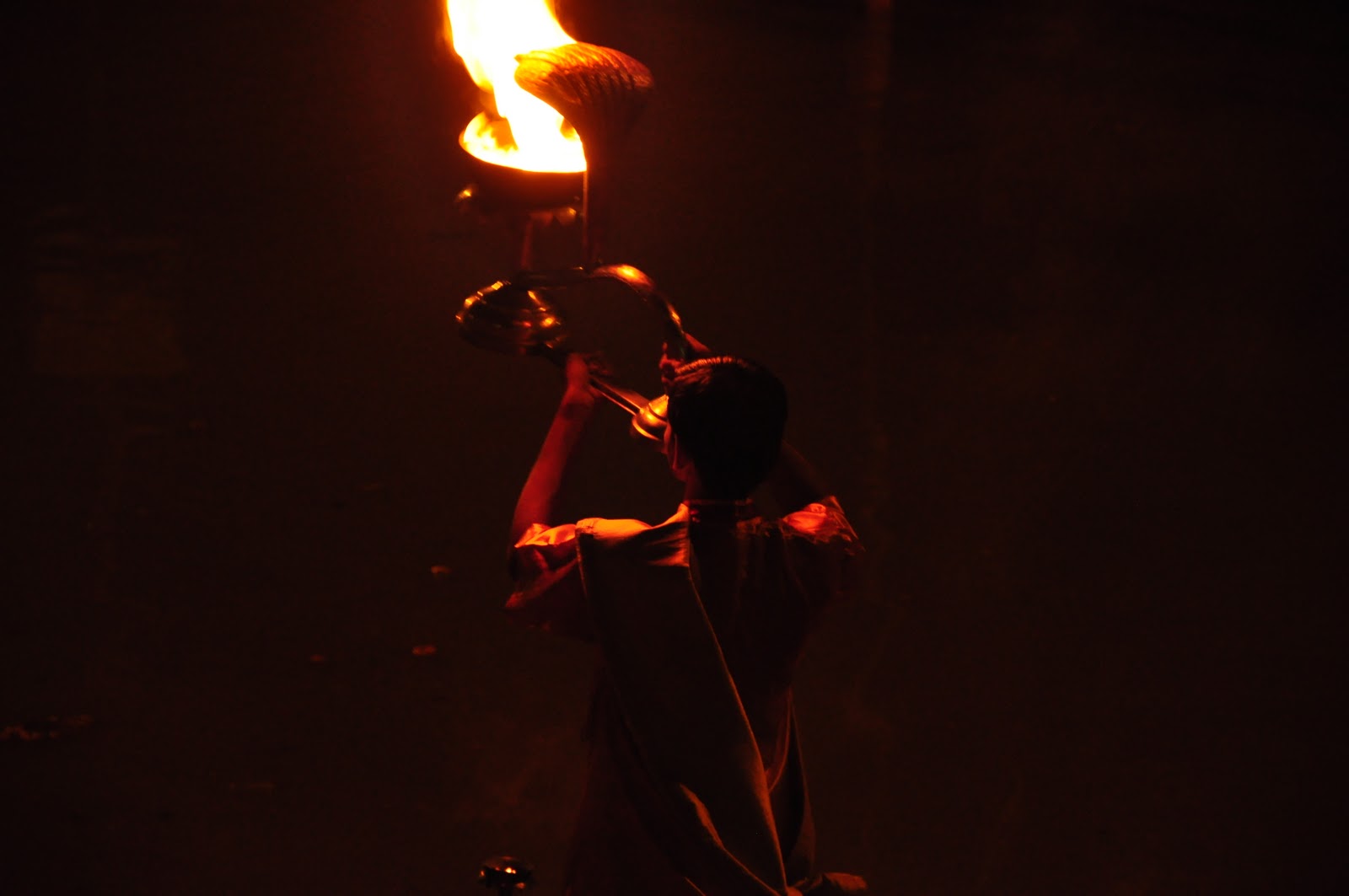
A young Brahmin priest performs Adhi Puja at the Ganges.
One employee of the London Missionary Society, James Kennedy, presents a wholly different picture:
“Everything you see here is wild, grotesque, unnatural, forbidding, utterly wanting in verisimilitude and refinement, with nothing to purify and raise the people, with everything fitted to pervert their taste and lower their character.”

A Sadhu bathes in the Ganga.
As for me, and for most visitors according to Eck, there was a mix of awe and less positive feelings. It is indeed a city of enormous beauty and religious devotion. But it is built on the back of enormous poverty. Yet the religiosity, for now, seems to be winning out. People, even the poorest who lined many streets with hands outstretched, seem content, or at least accepting of their lot in life. Many simply chatted as we walked by, laughing and smiling through broken and missing teeth. In Hindu belief, a death in Varanasi guarantees liberation, and the river and land (not to mention Shiva) are said to guarantee at least basic food for all who reside here.
So perhaps the worry of the hustle and bustle of life we so take for granted in the West is simply absent. And with that, perhaps such states that we find unacceptable become perfectly fine.
I hope to come back in January, when the water is lower and one can walk the full three miles of Ghats along the river between the Varana and Asi rivers which enter into the Ganges. Two or three days simply isn’t enough to get a real sense of the city, perhaps two or three years wouldn’t be either. But I’m sure a bit more time in the City of Lights will be well worth the journey.

Yours truly at Asi Ghat with Ganges behind me.


Next Post

October 16, 2010 Bits & pieces from India
Browse Our Archives
Select a Category Academia Activism American Buddhism Art Book review Buddhism Buddhism Today Buddhist Ethics Burma/Myanmar China Christianity Commodification Environment Gender Happiness Health Humor India Interfaith Islam Japanese Buddhism Kant Media / News Meditation mindfulness Photography Poetry Politics quicktakes Running Teaching Technology Thailand Theism/Atheism Theravada Tibet Tibetan Buddhism Travels Uncategorized Unitarian Universalism video Western Philosophy Zen
Select a Month June 2021 January 2021 November 2020 August 2020 July 2020 March 2020 January 2020 October 2019 August 2019 June 2019 May 2019 March 2019 February 2019 January 2019 December 2018 November 2018 October 2018 September 2018 August 2018 July 2018 June 2018 May 2018 April 2018 March 2018 February 2018 January 2018 December 2017 November 2017 October 2017 September 2017 August 2017 July 2017 June 2017 May 2017 April 2017 March 2017 February 2017 January 2017 December 2016 November 2016 October 2016 September 2016 August 2016 July 2016 June 2016 May 2016 April 2016 March 2016 February 2016 January 2016 December 2015 November 2015 October 2015 September 2015 August 2015 July 2015 June 2015 May 2015 April 2015 March 2015 February 2015 January 2015 December 2014 November 2014 October 2014 September 2014 August 2014 July 2014 June 2014 May 2014 April 2014 March 2014 February 2014 January 2014 December 2013 November 2013 October 2013 September 2013 August 2013 July 2013 June 2013 May 2013 April 2013 March 2013 February 2013 January 2013 December 2012 November 2012 October 2012 September 2012 August 2012 July 2012 June 2012 May 2012 April 2012 March 2012 February 2012 January 2012 December 2011 November 2011 October 2011 September 2011 August 2011 July 2011 June 2011 May 2011 April 2011 March 2011 February 2011 January 2011 December 2010 November 2010 October 2010 September 2010 August 2010 July 2010 June 2010 May 2010 April 2010 March 2010 February 2010 January 2010 December 2009 November 2009 October 2009 September 2009 August 2009 July 2009 June 2009 May 2009 April 2009 March 2009 February 2009 January 2009 December 2008 November 2008 October 2008 September 2008 August 2008 July 2008 June 2008 May 2008 April 2008 March 2008 September 2007 August 2007 July 2007 June 2007 May 2007 April 2007 March 2007 February 2007 January 2007 December 2006 November 2006 October 2006 September 2006 August 2006 July 2006 June 2006 May 2006 April 2006 March 2006 February 2006 January 2006 December 2005 November 2005 October 2005 September 2005 November 2004 September 2004 August 2004
Follow Us!
TAKE THE
Religious Wisdom Quiz
You have wearied the Lord with your words by saying all who do evil are good in his sight, or by asking where is the God of what?
Select your answer to see how you score.
Truth Justice Judgment Righteousness
Support this
Column


Related posts from American Buddhist Perspectives

For Pride Month: Our 2015 Interview with La...
American Buddhist Perspectives

Standing up to Lies: Can America Emerge from...
American Buddhist Perspectives

Progressive responses to the 2020 election of Biden...
American Buddhist Perspectives

In strife and uncertainty: let us remember loving-kindness
American Buddhist Perspectives
TRENDING AT PATHEOS Buddhist

On Taking Refuge in the Dharma
(Here I continue the feature of sharing talks and essays by teachers...

(Continuing my intention to share talks and essays by other members of Empty...
The Subtle Art of Bowing: A Dharma Discourse
(This presentation was first offered by my dear friend Dharma Holder Tom...

Internal Family Systems Can Heal you Mentally &...
How IFS Helped Me Stop Fighting Myself Internal Family Systems (IFS) is...

The Bible No One Spoke About: A Family’s...
A mysterious family Bible, unspoken faith, and a journey from curiosity to...

How Uncertainty Can Transform Your Life in 2025
Embracing Uncertainty: A New Year’s Resolution for the Brave As 2025 approaches,...
view all Buddhist blogs
Ad-Free & Subscriber Log-In Subscription Support
- About Us
- 2026 Calendar
- Videos
- Podcasts
- Library of World Religions
- Faith In Media Tracker
- Advertise With Us
- Write for Us
- Privacy Policy
- Terms of Service
- Do Not Sell My Data
- Contact Us
- Radiant Digital
- Manage Newsletter Subscriptions
- Unsubscribe From Notifications
- Sitemap
Copyright 2008-2026, Patheos. All rights reserved.
Subscription Support Ad-Free & Subscriber Log-In
Follow Patheos