
BuddhistCatholicContemplativeEvangelicalGeneral ChristianHinduJewishLatter-day SaintMuslimNew VisionsProgressive Christian
Beliefs
- Buddhist
- Catholic
- Contemplative
- Evangelical
- General Christian
- Hindu
- Jewish
- Latter-day Saint
- More Voices
- Muslim
- New Visions
- Pagan
- Progressive Christian
Topics
- Religion News
- Food and Religion
- Sports and Religion
- Religious Art
- Religious Music and Entertainment
- Religious Events
- History and Religion
- Style and Religion
- Politics and Religion
- Women in Religion
- Recreation Outdoors and Religion
- Business Finance and Religion
- Careers Workplace and Religion
- Education and Religion
- Family Parenting and Religion
- Health Fitness and Religion
- Home and Religion
- Relationships and Religion
- Technology and Religion
- Travel and Religion
Columnists
- Buddhist Columnists
- Business Finance and Religion Columnists
- Careers Workplace and Religion Columnists
- Catholic Columnists
- Contemplative Columnists
- Education and Religion Columnists
- Evangelists Columnists
- Family Parenting and Religion Columnists
- General Christian Columnists
- Health Fitness and Religion Columnists
- Hindu Columnists
- History and Religion Columnists
- Home and Religion Columnists
- Jewish Columnists
- More Voices Columnists
- Latter Day Columnists
- Muslim Columnists
- New Visions Columnists
- Nonreligious Columnists
- Pagan Columnists
- Politics and Religion Columnists
- Progressive Columnists
- Recreation Outdoors and Religion Columnists
- Relationships and Religion Columnists
- Religion News Columnists
- Religious Art Columnists
- Religious Events Columnists
- Religious Music and Entertainment Columnists
- Sports and Religion Columnists
- Style and Religion Columnists
- Technology and Religion Columnists
- Travel and Religion Columnists
- Women in Religion Columnists
Resource Library
- 2026 Calendar
- Library of World Religions
- The 100 Most Holy Places on Earth
- Patheos Answers
- Podcasts
- Videos
- Faith Leaders Database
- Anglican Episcopalian
- Bahai
- Baptist
- Buddhism
- Christianity
- Confucianism
- Eastern Orthodoxy
- Hinduism
- Holiness and Pentecostal
- ISKCON
- Islam
- Judaism
- Lutheran
- Methodist
- The Church of Jesus Christ of Latter-day Saints
- New Age
- Paganism
- Presbytarian and Reformed
- Protestantism
- Religion Behind the Scenes
- Roman Catholic
- Scientology
- Shia Islam
- Sikhism
- Sufism
- Sunni Islam
- Taoism
- Zen
- See all religions
Research Tools
 Ad-Free & Subscriber Log-In Subscription Support
Ad-Free & Subscriber Log-In Subscription Support
Follow Patheos 

- Trending:
- Forgiveness
- |
- Marriage
- |
- Consciousness
- |
- Death Penalty
- |
- Election
- |
- Halloween
 American Buddhist Perspectives
- Home
- Buddhist
- Religion News
- Philosophy: contextualizing Kant
Philosophy: contextualizing Kant
Last updated on: November 20, 2006 at 6:53 am by Justin Whitaker
Philosophy: contextualizing Kant 2006-11-20T06:53:00-07:00 Justin Whitaker
Patheos Explore the world's faith through different perspectives on religion and spirituality! Patheos has the views of the prevalent religions and spiritualities of the world.
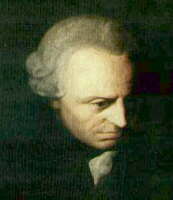 My Kant paper (previously due last Thursday, now the Monday after Thanksgiving) will be an evaluation of Kant as an advocate for a radical and perhaps unreasonable liberalism (liberalism here in the sense of simple human freedom).
Just how free are we ever? This question has vexed philosophers at least as far back as the rise of Christianity in philosophical circles. We must be free to accept Christ. But then doesn’t an omniscient God already know what we are going to do, thus rendering us determined? The Calvinists are the only major branch of Christianity to concede something like total determinism, while others have sided with freedom in the face of (some sort of) omnipotent God.
Kant showed why he is the greatest Western philosopher when he said that we just can’t know one way or the other. Similarly we cannot know whether the universe is limited in size or not, if the constituents of reality are infititely divisible or not (string theory), or whether there is an absolute being (God). We just cant know, we are finite beings and such things may only be known by something beyond our finite selves. These are reminiscent of the imponderable questions asked of the Buddha, who famously answered in silence no matter how often asked (according to tradition he would answer other questions if asked three times).
Yet Kant did still advocate for freedom as an idea in practical (moral) matters. We ought to live as if we are free. In fact we cannot live otherwise. Kant characterized most of human history as a struggle between freedom (or reason or morality) and desires (heteronomy, rule from without). Less-free people are led around by their desires, easily manipulated by others. Reason impels one toward choosing what is right for oneself, questioning what the state, the church and the TV comercials may suggest we ought to do.
Kant thought we have the power to question anything and everything if we employ reason, including the traditions that are responsible for our being rational. Thus it seems that we are incredibly free – insofar as we are rational. Theoriests have come down hard on this notion of rationality over and above our desires, and for the most part Kant has stood as a straw-man to all those who recognize the inseparability of reason and desires.
Those who criticize Kant as a supporter of radical freedom go too far, however. For Kant, again, only expounded the notion of freedom as a practical idea. We must act as if we are free, knowing that it is just as likely that we are not free. As moral beings though we must accept freedom if we are to accept responsibility and respect for one another. Or rather, as Kant argues in the first section of the Groundwork, because we do have a sense of morality (later spelled out in terms of responsibility and respect), we must concieve of ourselves as free. Of course we will be under the sway of desires much of the time, but we are not slaves to them! The separation between desire and reason arises at that moment when we are attracted to something (or someone) but say, “no, I shouldn’t.” (Of course it could always be argued that this reason is employed by a ‘higher-order’ desire, such as the desire to be a good person, but Kant recognized this and held that the only actions of moral worth are those that are done completely irregardless of consequences, completely and only from a sense of duty or morality.)
Our community is of immense importance for the Kantian. It is only in society that we are taught to use our reason in the first place. But this does not mean we are reducible to our society: we do not say an African villager’s morality is ultimately distinct from our own. We attribute the same rights upon them, we feel the same respect toward them, and we confer the same basic responsibilities upon them. We may give allowances for their lack of fully realized morality, just as we would a child or an adult in the U.S. who was subject to abuse early in life, but we do not deny that they are fully capable of morality as we know it.
To sum up:
Through our education, our family, and our community we are trained to employ our reason.
Because we are capable of reason, we are capable of freedom.
Acting freely (which means by reason alone) means acting morally.
Morality, freedom, rationality are virtually interchangeable terms.
Morality requires shedding the ego-centric stance and seeing others with respect.
Respect for others means acting under moral dictates we would wish all people to uphold.
Concern for all people means concern for community.
We cannot be realize our capacity for reason without a proper community.
All beings have this capacity.
All beings should be respected as such.
We ought to help all beings realize their capacity for morality, freedom, rationality.

Previous Post

November 17, 2006
Teaching: Day/Class 32 - Wizdum
Next Post
November 24, 2006 Life: giving thanks
Browse Our Archives
Select a Category Academia Activism American Buddhism Art Book review Buddhism Buddhism Today Buddhist Ethics Burma/Myanmar China Christianity Commodification Environment Gender Happiness Health Humor India Interfaith Islam Japanese Buddhism Kant Media / News Meditation mindfulness Photography Poetry Politics quicktakes Running Teaching Technology Thailand Theism/Atheism Theravada Tibet Tibetan Buddhism Travels Uncategorized Unitarian Universalism video Western Philosophy Zen
Select a Month June 2021 January 2021 November 2020 August 2020 July 2020 March 2020 January 2020 October 2019 August 2019 June 2019 May 2019 March 2019 February 2019 January 2019 December 2018 November 2018 October 2018 September 2018 August 2018 July 2018 June 2018 May 2018 April 2018 March 2018 February 2018 January 2018 December 2017 November 2017 October 2017 September 2017 August 2017 July 2017 June 2017 May 2017 April 2017 March 2017 February 2017 January 2017 December 2016 November 2016 October 2016 September 2016 August 2016 July 2016 June 2016 May 2016 April 2016 March 2016 February 2016 January 2016 December 2015 November 2015 October 2015 September 2015 August 2015 July 2015 June 2015 May 2015 April 2015 March 2015 February 2015 January 2015 December 2014 November 2014 October 2014 September 2014 August 2014 July 2014 June 2014 May 2014 April 2014 March 2014 February 2014 January 2014 December 2013 November 2013 October 2013 September 2013 August 2013 July 2013 June 2013 May 2013 April 2013 March 2013 February 2013 January 2013 December 2012 November 2012 October 2012 September 2012 August 2012 July 2012 June 2012 May 2012 April 2012 March 2012 February 2012 January 2012 December 2011 November 2011 October 2011 September 2011 August 2011 July 2011 June 2011 May 2011 April 2011 March 2011 February 2011 January 2011 December 2010 November 2010 October 2010 September 2010 August 2010 July 2010 June 2010 May 2010 April 2010 March 2010 February 2010 January 2010 December 2009 November 2009 October 2009 September 2009 August 2009 July 2009 June 2009 May 2009 April 2009 March 2009 February 2009 January 2009 December 2008 November 2008 October 2008 September 2008 August 2008 July 2008 June 2008 May 2008 April 2008 March 2008 September 2007 August 2007 July 2007 June 2007 May 2007 April 2007 March 2007 February 2007 January 2007 December 2006 November 2006 October 2006 September 2006 August 2006 July 2006 June 2006 May 2006 April 2006 March 2006 February 2006 January 2006 December 2005 November 2005 October 2005 September 2005 November 2004 September 2004 August 2004
Follow Us!
TAKE THE
Religious Wisdom Quiz
Who does Paul say is the man of lawlessness who will exalt himself in God's temple?
Select your answer to see how you score.
The antichrist The one doomed to destruction The beast Satan
Support this
Column


Related posts from American Buddhist Perspectives

For Pride Month: Our 2015 Interview with La...
American Buddhist Perspectives

Standing up to Lies: Can America Emerge from...
American Buddhist Perspectives

Progressive responses to the 2020 election of Biden...
American Buddhist Perspectives

In strife and uncertainty: let us remember loving-kindness
American Buddhist Perspectives
TRENDING AT PATHEOS Buddhist

On Taking Refuge in the Dharma
(Here I continue the feature of sharing talks and essays by teachers...

(Continuing my intention to share talks and essays by other members of Empty...
The Subtle Art of Bowing: A Dharma Discourse
(This presentation was first offered by my dear friend Dharma Holder Tom...

Internal Family Systems Can Heal you Mentally &...
How IFS Helped Me Stop Fighting Myself Internal Family Systems (IFS) is...

The Bible No One Spoke About: A Family’s...
A mysterious family Bible, unspoken faith, and a journey from curiosity to...

How Uncertainty Can Transform Your Life in 2025
Embracing Uncertainty: A New Year’s Resolution for the Brave As 2025 approaches,...
view all Buddhist blogs
Ad-Free & Subscriber Log-In Subscription Support
- About Us
- 2026 Calendar
- Videos
- Podcasts
- Library of World Religions
- Faith In Media Tracker
- Advertise With Us
- Write for Us
- Privacy Policy
- Terms of Service
- Do Not Sell My Data
- Contact Us
- Radiant Digital
- Manage Newsletter Subscriptions
- Unsubscribe From Notifications
- Sitemap
Copyright 2008-2026, Patheos. All rights reserved.
Subscription Support Ad-Free & Subscriber Log-In
Follow Patheos