
BuddhistCatholicContemplativeEvangelicalGeneral ChristianHinduJewishLatter-day SaintMuslimNew VisionsProgressive Christian
Beliefs
- Buddhist
- Catholic
- Contemplative
- Evangelical
- General Christian
- Hindu
- Jewish
- Latter-day Saint
- More Voices
- Muslim
- New Visions
- Pagan
- Progressive Christian
Topics
- Religion News
- Food and Religion
- Sports and Religion
- Religious Art
- Religious Music and Entertainment
- Religious Events
- History and Religion
- Style and Religion
- Politics and Religion
- Women in Religion
- Recreation Outdoors and Religion
- Business Finance and Religion
- Careers Workplace and Religion
- Education and Religion
- Family Parenting and Religion
- Health Fitness and Religion
- Home and Religion
- Relationships and Religion
- Technology and Religion
- Travel and Religion
Columnists
- Buddhist Columnists
- Business Finance and Religion Columnists
- Careers Workplace and Religion Columnists
- Catholic Columnists
- Contemplative Columnists
- Education and Religion Columnists
- Evangelists Columnists
- Family Parenting and Religion Columnists
- General Christian Columnists
- Health Fitness and Religion Columnists
- Hindu Columnists
- History and Religion Columnists
- Home and Religion Columnists
- Jewish Columnists
- More Voices Columnists
- Latter Day Columnists
- Muslim Columnists
- New Visions Columnists
- Nonreligious Columnists
- Pagan Columnists
- Politics and Religion Columnists
- Progressive Columnists
- Recreation Outdoors and Religion Columnists
- Relationships and Religion Columnists
- Religion News Columnists
- Religious Art Columnists
- Religious Events Columnists
- Religious Music and Entertainment Columnists
- Sports and Religion Columnists
- Style and Religion Columnists
- Technology and Religion Columnists
- Travel and Religion Columnists
- Women in Religion Columnists
Resource Library
- 2026 Calendar
- Library of World Religions
- The 100 Most Holy Places on Earth
- Patheos Answers
- Podcasts
- Videos
- Faith Leaders Database
- Anglican Episcopalian
- Bahai
- Baptist
- Buddhism
- Christianity
- Confucianism
- Eastern Orthodoxy
- Hinduism
- Holiness and Pentecostal
- ISKCON
- Islam
- Judaism
- Lutheran
- Methodist
- The Church of Jesus Christ of Latter-day Saints
- New Age
- Paganism
- Presbytarian and Reformed
- Protestantism
- Religion Behind the Scenes
- Roman Catholic
- Scientology
- Shia Islam
- Sikhism
- Sufism
- Sunni Islam
- Taoism
- Zen
- See all religions
Research Tools
 Ad-Free & Subscriber Log-In Subscription Support
Ad-Free & Subscriber Log-In Subscription Support
Follow Patheos 

- Trending:
- Forgiveness
- |
- Marriage
- |
- Consciousness
- |
- Death Penalty
- |
- Election
- |
- Halloween
 American Buddhist Perspectives
- Home
- Buddhist
- Religion News
- Philosophy: Wrestling with Sartre on the self
Philosophy: Wrestling with Sartre on the self
Last updated on: April 11, 2014 at 8:05 pm by Justin Whitaker
Philosophy: Wrestling with Sartre on the self 2014-04-11T20:05:58-06:00 Justin Whitaker
Patheos Explore the world's faith through different perspectives on religion and spirituality! Patheos has the views of the prevalent religions and spiritualities of the world.
This may be part of a series of posts dealing with the Buddhist relationship with French Existentialist Jean-Paul Sartre. My last post on him was “Life: Existential Reflections (solipsistic brooding?)“, and an earlier one, “Buddhism: learning via enigma” introduced a great book that I’ll be reading over the next couple months. Today I want to interrogate Sartre’s notion of selfhood (as well as I know it) and see how it fits with the Buddhist concept of anatta (not-self). For a quick primer on anatta/anatman, see this old post of mine: Philosophy: “Self, where art thou?”
Sartre’s model of the self could look something like this:
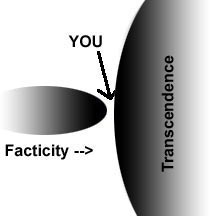 Your facticity is, as the term suggests, all the facts about you: your height, weight, hair color, etc. As well as the sum total of your past facts: where you graduated high school, what your mother’s maiden name is, who you first kissed, and so on.
Your Transcendence is the world of possibilities ahead of you, everything you could be or do. Usually the near possibilities seem fairly concrete (going to bed soon if it’s 2am, getting a degree soon if I keep studying, getting a real kiss if I’m good in the next few weeks).
What is your true self? Are you your facticity? Are you your transcendence? No. You are separate from both. And what separates you? Nothingness. Think about facticity. A rock has facticity. It has its own history of facts. As do all inanimate objects. Surely you are not merely your facticity, your history. And your transcendence? In my realm of possibilities is ‘amateur ballet dancer’, right? It is, after all, possible. Professional would be another matter, but my realm of possibilities is enormous. Even very seriously contemplating my future I wonder about more school (England, Canada, USA?), the health of my parents and relationship with my siblings (they could need me at any time), jobs, relationships, and so on. The future is in no legitimate way determined, it is quite open.
This takes us to the key argument (or realization) of Sartre that we inevitably yet always wrongly identify ourselves with either our facticity or our transcendence! Like damned fools we say “I AM a Buddhist”, “I AM an American” to identify with our facticity, or “I AM a philosopher” or “I AM a family man” to identify with our transcendence. We do this, we take on labels. And then we act them out. I am acting the part of the Buddhist-Philosopher. If I try too hard, it becomes terribly obvious to you. What is worse is that if my labeling (my objectification) of myself is not reinforced by others, then I will break down. Our acting, that is, our putting a label on ourselves and then trying to act as one with that label would act, is what Sartre calls Bad Faith.
2 graphic examples:
Sartre gives two graphic examples exemplifying our existence between facticity and transcendence. The first is Vertigo (p.66-69). Imagine standing at the ledge of a tall building, looking over. There is no wind, no one around to push you. You feel dizzy, drawn downward: vertigo. Why? Why shouldn’t this be just like looking down at your feet if you were standing down to the sidewalk below. Your fear arises because you see, ever so faintly, yourself, falling by your own choice to the sidewalk below. You fear the possibility which lies directly before you. The vertigo is actually “anguish in the face of the future.”
The second is The Gambler (p.69-70). This person is wasting his life away in gambling, his children are suffering, he knows he must stop. So one day he decides to stop. He firmly commits to it, he will not gamble any more. But then, soon after that, he passes by a casino. He is drawn toward it. He knows that he has decided to stop, but now that decision has no real power over him – he is not his past as he wishes he were. The possibility to gamble again will forever haunt him. The possibility to undo his decision is what Sartre calls “anguish in the face of the past.” He fears the past, himself as an addicted gambler, overcoming him.
* page numbers here are from “Being and Nothingness: An Essay on Phenomenological Ontology” (1943)
So You are that space between facticity and transcendence, the space which, paradoxically, binds them together. Your history is always there, pushing you forward. Your future is always there as well, an invisible force drawing you forward.
The problem (or at least where Sartre disagrees with Buddhists) is that Sartre seems to deny that we can truthfully realize this fact. Again, we always (wrongly) identify with one side or the other. But there are two notable exceptions to this pessimism over our human condition. I’d like to expound upon both of these in future posts, but for now let me just state them for your consideration:
First, in “The Transcendence of the Ego” (1937, one of Sartre’s earliest works), he comments, “A reflective apprehension of spontaneous consciousness as non-personal spontaneity would have to be accomplished without any antecedent motivation. This is always possible in principle, but remains very improbable or, at least, extremely rare in our human condition.” [his italics] (p.92)
Then, in “Being and Nothingness” he places in a footnote at the very end of his section on Bad Faith, “If it is indifferent whether one is in good or in bad faith, because bad faith reapprehends good faith and slides to the very origin of the project of good faith, that does not mean that we cannot radically escape bad faith. But this supposes a self-recovery of being which was previously currupted. This self-recovery we shall call authenticity, the description of which has no place here.” (p.116)
So, in the first case, Sartre seems to leave open, even if only a tiny bit, our possibility of apprehending our ‘non-personal,’ ‘spontaneous consciousness’. Sounds very much like an opening for a discussion of meditation, dhyanas, and truly living in the moment. And in the second case he contradicts much of his previous discussion on the apparent inevitability of bad faith. He opens the possibility for authenticity (I am told that this notion of authenticity is nothing like that used by Heidegger), or a recovery of that which has been corrupted. It could sound something like this:
From the Mahaparinirvana Sutra: “The atman is the Tathagatagarbha. All beings possess a Buddha Nature: this is what the atman is. This atman, from the start, is always covered by innumerable passions (klesha): this is why beings are unable to see it.” (borrowed from Tom at Blogmandu, who grabbed it at The Zennist)
atman=true, eternal Self.
Tathagatagarbha= ‘womb’ of the ‘thus-come/gone-one’ 0r Buddha = Buddha Nature.
So it seems, at this point at least, that Sartre at least for moment held a nugget of very profound wisdom. Yet his work focuses ad nausium on the inadequacies of the common man rather than our most brilliant achievements, the lies we tell ourselves rather than our moments of truth, and the conflict of life instead of the beauty.
In short, he sees well the first two noble truths but lacks a sense that a third and fourth might be out there.
(note, this was mildly updated 4/11/2014)
Previous Post

March 3, 2006
Politics: Buddhism in Politics
Next Post
March 5, 2006 Life: Friends in Low Places
Browse Our Archives
Select a Category Academia Activism American Buddhism Art Book review Buddhism Buddhism Today Buddhist Ethics Burma/Myanmar China Christianity Commodification Environment Gender Happiness Health Humor India Interfaith Islam Japanese Buddhism Kant Media / News Meditation mindfulness Photography Poetry Politics quicktakes Running Teaching Technology Thailand Theism/Atheism Theravada Tibet Tibetan Buddhism Travels Uncategorized Unitarian Universalism video Western Philosophy Zen
Select a Month June 2021 January 2021 November 2020 August 2020 July 2020 March 2020 January 2020 October 2019 August 2019 June 2019 May 2019 March 2019 February 2019 January 2019 December 2018 November 2018 October 2018 September 2018 August 2018 July 2018 June 2018 May 2018 April 2018 March 2018 February 2018 January 2018 December 2017 November 2017 October 2017 September 2017 August 2017 July 2017 June 2017 May 2017 April 2017 March 2017 February 2017 January 2017 December 2016 November 2016 October 2016 September 2016 August 2016 July 2016 June 2016 May 2016 April 2016 March 2016 February 2016 January 2016 December 2015 November 2015 October 2015 September 2015 August 2015 July 2015 June 2015 May 2015 April 2015 March 2015 February 2015 January 2015 December 2014 November 2014 October 2014 September 2014 August 2014 July 2014 June 2014 May 2014 April 2014 March 2014 February 2014 January 2014 December 2013 November 2013 October 2013 September 2013 August 2013 July 2013 June 2013 May 2013 April 2013 March 2013 February 2013 January 2013 December 2012 November 2012 October 2012 September 2012 August 2012 July 2012 June 2012 May 2012 April 2012 March 2012 February 2012 January 2012 December 2011 November 2011 October 2011 September 2011 August 2011 July 2011 June 2011 May 2011 April 2011 March 2011 February 2011 January 2011 December 2010 November 2010 October 2010 September 2010 August 2010 July 2010 June 2010 May 2010 April 2010 March 2010 February 2010 January 2010 December 2009 November 2009 October 2009 September 2009 August 2009 July 2009 June 2009 May 2009 April 2009 March 2009 February 2009 January 2009 December 2008 November 2008 October 2008 September 2008 August 2008 July 2008 June 2008 May 2008 April 2008 March 2008 September 2007 August 2007 July 2007 June 2007 May 2007 April 2007 March 2007 February 2007 January 2007 December 2006 November 2006 October 2006 September 2006 August 2006 July 2006 June 2006 May 2006 April 2006 March 2006 February 2006 January 2006 December 2005 November 2005 October 2005 September 2005 November 2004 September 2004 August 2004
Follow Us!
TAKE THE
Religious Wisdom Quiz
Who lamented Saul and Jonathan's death with a song?
Select your answer to see how you score.
David Nathan Abiathar Samuel
Support this
Column


Related posts from American Buddhist Perspectives

For Pride Month: Our 2015 Interview with La...
American Buddhist Perspectives

In strife and uncertainty: let us remember loving-kindness
American Buddhist Perspectives

In the rush to return to normal, can...
American Buddhist Perspectives

The Coronavirus is coming - Some thoughts from...
American Buddhist Perspectives
TRENDING AT PATHEOS Buddhist

On Taking Refuge in the Dharma
(Here I continue the feature of sharing talks and essays by teachers...

(Continuing my intention to share talks and essays by other members of Empty...
The Subtle Art of Bowing: A Dharma Discourse
(This presentation was first offered by my dear friend Dharma Holder Tom...

Internal Family Systems Can Heal you Mentally &...
How IFS Helped Me Stop Fighting Myself Internal Family Systems (IFS) is...

The Bible No One Spoke About: A Family’s...
A mysterious family Bible, unspoken faith, and a journey from curiosity to...

How Uncertainty Can Transform Your Life in 2025
Embracing Uncertainty: A New Year’s Resolution for the Brave As 2025 approaches,...
view all Buddhist blogs
Ad-Free & Subscriber Log-In Subscription Support
- About Us
- 2026 Calendar
- Videos
- Podcasts
- Library of World Religions
- Faith In Media Tracker
- Advertise With Us
- Write for Us
- Privacy Policy
- Terms of Service
- Do Not Sell My Data
- Contact Us
- Radiant Digital
- Manage Newsletter Subscriptions
- Unsubscribe From Notifications
- Sitemap
Copyright 2008-2026, Patheos. All rights reserved.
Subscription Support Ad-Free & Subscriber Log-In
Follow Patheos