
BuddhistCatholicContemplativeEvangelicalGeneral ChristianHinduJewishLatter-day SaintMuslimNew VisionsProgressive Christian
Beliefs
- Buddhist
- Catholic
- Contemplative
- Evangelical
- General Christian
- Hindu
- Jewish
- Latter-day Saint
- More Voices
- Muslim
- New Visions
- Pagan
- Progressive Christian
Topics
- Religion News
- Food and Religion
- Sports and Religion
- Religious Art
- Religious Music and Entertainment
- Religious Events
- History and Religion
- Style and Religion
- Politics and Religion
- Women in Religion
- Recreation Outdoors and Religion
- Business Finance and Religion
- Careers Workplace and Religion
- Education and Religion
- Family Parenting and Religion
- Health Fitness and Religion
- Home and Religion
- Relationships and Religion
- Technology and Religion
- Travel and Religion
Columnists
- Buddhist Columnists
- Business Finance and Religion Columnists
- Careers Workplace and Religion Columnists
- Catholic Columnists
- Contemplative Columnists
- Education and Religion Columnists
- Evangelists Columnists
- Family Parenting and Religion Columnists
- General Christian Columnists
- Health Fitness and Religion Columnists
- Hindu Columnists
- History and Religion Columnists
- Home and Religion Columnists
- Jewish Columnists
- More Voices Columnists
- Latter Day Columnists
- Muslim Columnists
- New Visions Columnists
- Nonreligious Columnists
- Pagan Columnists
- Politics and Religion Columnists
- Progressive Columnists
- Recreation Outdoors and Religion Columnists
- Relationships and Religion Columnists
- Religion News Columnists
- Religious Art Columnists
- Religious Events Columnists
- Religious Music and Entertainment Columnists
- Sports and Religion Columnists
- Style and Religion Columnists
- Technology and Religion Columnists
- Travel and Religion Columnists
- Women in Religion Columnists
Resource Library
- 2026 Calendar
- Library of World Religions
- The 100 Most Holy Places on Earth
- Patheos Answers
- Podcasts
- Videos
- Faith Leaders Database
- Anglican Episcopalian
- Bahai
- Baptist
- Buddhism
- Christianity
- Confucianism
- Eastern Orthodoxy
- Hinduism
- Holiness and Pentecostal
- ISKCON
- Islam
- Judaism
- Lutheran
- Methodist
- The Church of Jesus Christ of Latter-day Saints
- New Age
- Paganism
- Presbytarian and Reformed
- Protestantism
- Religion Behind the Scenes
- Roman Catholic
- Scientology
- Shia Islam
- Sikhism
- Sufism
- Sunni Islam
- Taoism
- Zen
- See all religions
Research Tools
 Ad-Free & Subscriber Log-In Subscription Support
Ad-Free & Subscriber Log-In Subscription Support
Follow Patheos 

- Trending:
- Forgiveness
- |
- Marriage
- |
- Consciousness
- |
- Death Penalty
- |
- Election
- |
- Halloween
 Always Re-forming
- Home
- Progressive Christian
- Women in Religion
- What Is a Pastor, Really? (thoughts on Alexander Lang’s “Why I Left the Church”)
What Is a Pastor, Really? (thoughts on Alexander Lang’s “Why I Left the Church”)
Last updated on: September 14, 2023 at 9:31 pm by Liz Cooledge Jenkins
What Is a Pastor, Really? (thoughts on Alexander Lang’s “Why I Left the Church”) 2023-09-14T21:31:55-07:00 Liz Cooledge Jenkins
Patheos Explore the world's faith through different perspectives on religion and spirituality! Patheos has the views of the prevalent religions and spiritualities of the world.
A friend shared Alexander Lang’s blog post “Departure: Why I Left the Church” with me recently. Like many others, I have thoughts and feelings. So many thoughts and feelings. Mostly centered around these questions: What do we expect from our pastors? What is a pastor, really?
I’m fascinated by the assumptions we make around what a pastor’s role should be. (And by “we,” I mean pastors and parishioners alike, even if in different ways.) And I wonder how we can rethink some of these things.
I hope to add something productive to the conversation—not to shame or attack Alexander Lang, but to push back on some of the assumptions I feel as I read his words. And to see if we can build a better way together.
Two thoughts, for starters:
1. Let’s make preaching less exhausting.
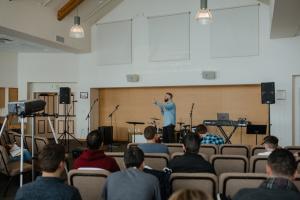
What does preaching look like? And does it have to be this way? / Photo by adrianna geo on Unsplash
Lang writes, “I was exhausted from writing, memorizing and preaching sermons week after week for 10 years.”
He says that’s not at all the whole story of why he left the pastorate, but it’s part of the story.
And I get it. Sort of. I haven’t preached every week straight for ten years. (That does sound exhausting!) But I’ve preached plenty of sermons, and I get that each one takes a lot out of you.
I wonder, though. Perhaps there are ways we can make preaching less exhausting.
For example: Does a sermon really need to be memorized? Or does the preacher just need to be familiar enough with the material so that she can look up, make eye contact with the congregation, connect with people and gauge their reactions, and adjust some parts of the sermon in the moment as needed?
I also wonder: How long does a sermon need to be?
Personally, I find that the shorter the sermon, the less time-consuming the preparation. I’ve preached sermons ranging from about 7 minutes (cute little mini-sermons like this one and this one) to over 30 minutes. The difference in prep time, as one might expect, is significant.
Sure, it can take some deep thinking to figure out how to say something meaningful succinctly. But once you know where you’re going, the less you actually have to write—and memorize, if you really want to memorize it—the easier the preparation.
Plus, congregations’ attention spans are short. We forget so much of what we hear. Often, the more streamlined a sermon is, the better.
Maybe we as preachers don’t need to make all the points we might want to make. Maybe we can just pick one point, tell a good story about it, and let that be enough. Maybe a 15-minute sermon can be just as effective as a 45-minute one—and much less exhausting for everyone involved.
I also think about the week in, week out, nature of the preaching role. This, too, doesn’t have to be that way.
The senior pastor at my current church is always sharing the pulpit, always inviting others to preach and share. Sometimes the “sermon” time is more of a conversation. Other times, we switch things up entirely.
We spent the whole month of August, for example, hearing stories and reflections from people in the congregation. No formal sermons. I loved hearing about different people’s experiences. And the usual preachers got to take the month off from preaching—and are (hopefully) back now with renewed energy.
Pastors: Does it always have to be you, doing the preaching? How can we share the responsibility, burden, and delight of preaching with others who have a gift and interest in it? How can we mentor younger preachers and give them opportunities to learn how to preach?
Let’s make preaching less exhausting.
2. Let’s let go of the 24/7 sense of responsibility.
Lang goes on to reflect, “Being a pastor is like being a parent. You can imagine what it’s like to have a child, but until you are in the role, you cannot fully appreciate what it’s like to shoulder the responsibility of caring for a life 24/7.”
To be fair, I’ve never been either a senior pastor or a parent. I have no doubt that there are so many things I don’t fully understand about both roles.
But I have worked in full-time ministry, in what was basically a college pastor role. I wasn’t the senior pastor of a church, and that is different. But some of the pressures were similar.

Do pastors have to be “on” 24/7? / Photo by RODOLFO BARRETO on Unsplash
I did have to push back against a sense of 24/7 responsibility. And I’m strongly with therapist Clint Schnekloth in his encouragement to set boundaries. Being a pastor—or in any role where you could be “on” 24/7—is all about boundaries. So many boundaries.
Sure, as a pastor you work most Sundays, and many Saturdays too—when there’s a wedding, funeral, or other special event. So, you choose a day or two during the week to take off. You say, Fridays are my day off. And you stick to it.
In many cases, no one is going to hand this to you. You have to choose to set boundaries around your time so that you can get the rest and refreshment you need in order to be a healthy human. And in order to make pastoral ministry sustainable.
Fortunately, as a pastor, you are not the only person who can do most of the things you do. (If this sounds humbling, let it be humbling.)
Yes, you are wonderful. But no, your congregation does not need your 24/7 availability.
You can pull together teams of people—staff and/or volunteers—who can take care of the things that need to be taken care of on your day(s) off.
Because really, you are not a parent. The adults in the congregation are, well, adults. You aren’t there to “parent” them 24/7. You’re there to help them connect with and serve one another in meaningful ways such that their needs are taken care of—by one another, in community.
To me as a parishioner, that’s a much more compelling vision. I want to care for others in my community. And I want to be cared for—not just by the pastor, but by the community.
I don’t want to be dependent on a pastor. I want to be part of a loving community.
Work/life balance is a struggle for lots and lots of people in lots and lots of different careers. Maybe a pastor, rather than trying to be “on” 24/7, can try to model a healthy balance. To model setting boundaries. To model saying no to things. (Building our “no” muscles, if you will.) To model delegating tasks to others, sharing leadership and responsibility.
Maybe a pastor can seek personal freedom from that 24/7 capitalist drive toward a very particular definition of productivity—and maybe, in doing so, she helps congregants find their own liberation too.
That’s what I’ve got for now. I’m sure there will be more. In the meanwhile, feel free to hit up the comments with your own thoughts and feels. If you’ve spent much time in church, I’m sure you have them.
Let’s figure out how we do this pastoring thing—and really, this church thing—in healthier ways together.
General Christian
Careers, Workplace and Religion
Previous Post

August 29, 2023
Women, Let's Not Bench Ourselves
Next Post

September 21, 2023 Church Leadership Doesn't Have to Be So Lonely...or So Toxic
Recent Comments
Browse Our Archives
Select a Category conversations seminary Uncategorized
Select a Month September 2023 August 2023 July 2023 June 2023 May 2023 April 2023 March 2023 February 2023 January 2023 December 2022 November 2022
Follow Us!
TAKE THE
Religious Wisdom Quiz
What does "Sheol," often found in Psalms, mean?
Select your answer to see how you score.
The grave or abode of the dead Above the mountain Blessing Eternal light
Related posts from Always Re-forming

Church Leadership Doesn't Have to Be So Lonely...or...
What If Sermons Were a Conversation?

I Take Sermons With a Grain of Salt

Religious Leaders: From Answer Givers to People Who...
TRENDING AT PATHEOS Progressive Christian

16 Spiritual Touchstones for a More Grounded Life
After decades of spiritual study, here are 16 principles I try...

Catholic Evangelization: Sharing Your Faith Every Day
Welcome back to the Graceful Awakening mini-series called, “From Faith to Mission.” ...

The Pillar of the Boatmen: the Ancient Monument...
The Pillar of the Boatmen is a Romano-Gaulish sculpture that dates from...

In one sense walking into Westminster Abbey is like walking down the...

'Super Scam Me' Exposes AI Jon Bon Jovi...
Leslie Pickett believed she was in a relationship with Jon Bon Jovi....

The Brazilian Remake of Kendricks' 'Flywheel' Opens in...
“Flywheel,” the story that launched the Kendrick Brothers’ filmmaking career is getting...
view all Progressive Christian blogs
Ad-Free & Subscriber Log-In Subscription Support
- About Us
- 2026 Calendar
- Videos
- Podcasts
- Library of World Religions
- Faith In Media Tracker
- Advertise With Us
- Write for Us
- Privacy Policy
- Terms of Service
- Do Not Sell My Data
- Contact Us
- Radiant Digital
- Manage Newsletter Subscriptions
- Unsubscribe From Notifications
- Sitemap
Copyright 2008-2026, Patheos. All rights reserved.
Subscription Support Ad-Free & Subscriber Log-In
Follow Patheos