
BuddhistCatholicContemplativeEvangelicalGeneral ChristianHinduJewishLatter-day SaintMuslimNew VisionsProgressive Christian
Beliefs
- Buddhist
- Catholic
- Contemplative
- Evangelical
- General Christian
- Hindu
- Jewish
- Latter-day Saint
- More Voices
- Muslim
- New Visions
- Pagan
- Progressive Christian
Topics
- Religion News
- Food and Religion
- Sports and Religion
- Religious Art
- Religious Music and Entertainment
- Religious Events
- History and Religion
- Style and Religion
- Politics and Religion
- Women in Religion
- Recreation Outdoors and Religion
- Business Finance and Religion
- Careers Workplace and Religion
- Education and Religion
- Family Parenting and Religion
- Health Fitness and Religion
- Home and Religion
- Relationships and Religion
- Technology and Religion
- Travel and Religion
Columnists
- Buddhist Columnists
- Business Finance and Religion Columnists
- Careers Workplace and Religion Columnists
- Catholic Columnists
- Contemplative Columnists
- Education and Religion Columnists
- Evangelists Columnists
- Family Parenting and Religion Columnists
- General Christian Columnists
- Health Fitness and Religion Columnists
- Hindu Columnists
- History and Religion Columnists
- Home and Religion Columnists
- Jewish Columnists
- More Voices Columnists
- Latter Day Columnists
- Muslim Columnists
- New Visions Columnists
- Nonreligious Columnists
- Pagan Columnists
- Politics and Religion Columnists
- Progressive Columnists
- Recreation Outdoors and Religion Columnists
- Relationships and Religion Columnists
- Religion News Columnists
- Religious Art Columnists
- Religious Events Columnists
- Religious Music and Entertainment Columnists
- Sports and Religion Columnists
- Style and Religion Columnists
- Technology and Religion Columnists
- Travel and Religion Columnists
- Women in Religion Columnists
Resource Library
- 2026 Calendar
- Library of World Religions
- The 100 Most Holy Places on Earth
- Patheos Answers
- Podcasts
- Videos
- Faith Leaders Database
- Anglican Episcopalian
- Bahai
- Baptist
- Buddhism
- Christianity
- Confucianism
- Eastern Orthodoxy
- Hinduism
- Holiness and Pentecostal
- ISKCON
- Islam
- Judaism
- Lutheran
- Methodist
- The Church of Jesus Christ of Latter-day Saints
- New Age
- Paganism
- Presbytarian and Reformed
- Protestantism
- Religion Behind the Scenes
- Roman Catholic
- Scientology
- Shia Islam
- Sikhism
- Sufism
- Sunni Islam
- Taoism
- Zen
- See all religions
Research Tools
 Ad-Free & Subscriber Log-In Subscription Support
Ad-Free & Subscriber Log-In Subscription Support
Follow Patheos 

- Trending:
- Forgiveness
- |
- Marriage
- |
- Consciousness
- |
- Death Penalty
- |
- Election
- |
- Halloween
 Always Re-forming
- Home
- Progressive Christian
- Women in Religion
- I Take Sermons With a Grain of Salt
I Take Sermons With a Grain of Salt
Last updated on: July 11, 2023 at 3:30 pm by Liz Cooledge Jenkins
I Take Sermons With a Grain of Salt 2023-07-11T15:30:39-07:00 Liz Cooledge Jenkins
Patheos Explore the world's faith through different perspectives on religion and spirituality! Patheos has the views of the prevalent religions and spiritualities of the world.

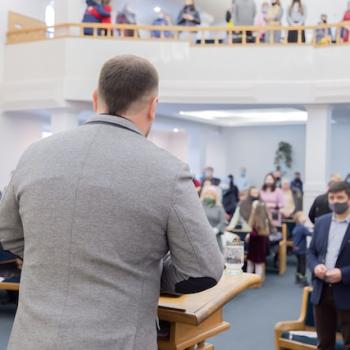
It’s okay to regard the pulpit with a little healthy suspicion / Photo by Mitchell Leach on Unsplash
I’m not ashamed to say it. These days, I take sermons with a grain of salt.
This has nothing to do with the wonderful preaching team at my current church. It’s more a reflection on what preaching is meant to be in general, and how we can engage with sermons in healthier ways.
From Starry-Eyed in Love…
When I was in college, I was part of a local campus chapter of an international campus ministry organization. And I loved our weekly Christian fellowship group meetings.
By the time I was an upperclassman, I began to realize how much the weekly messages during these meetings catered to freshmen. They tended to cycle back and repeat themselves every year or two.
But as a freshman, I was in love. Not with our lead campus staff worker, let’s call him Tim, but with the things he would say about God and the Bible and Jesus and community and a life of faith. I drank it all up eagerly. I hung on Tim’s every word.
…To Finding Some Shortcomings
As with most sets of teachings, though, taught by flawed humans, there were some true gems in there—but there were also some messed-up things.
In this case, the messed up things Tim taught us included the idea that leading Bible study groups as a student—and then working for the campus ministry organization after you graduate—is the best possible thing you could be doing with your life.
Everything else is, well, a little less holy. A little less faithful.
As a student, I bought into it. Later on, I realized how messed up it was.
The goal for Christians should not be to contort ourselves to fit into one particular mold of what a Christian looks like—after all, it’s okay that we’re different—but to explore what our own God-given gifts, curiosities, and talents might be, and to find roles that let us bring all of who we are to the table. Roles that bring out the best in us, in all our glorious (and sometimes frustrating) uniqueness.
Most of my college friends and I came to recognize this, eventually. But in the interim, it harmed us.
Some students chose to spend time doing things other than leading Bible study groups and felt that they were considered less of a Christian. Other students dove into it all wholeheartedly, only coming to realize much later that it probably wasn’t the best fit for who they are.
Repentance…
A few years after I graduated from college, I was still somewhat connected to the local world of that campus ministry organization. And so, one summer, when I received an invitation to an event the organization was hosting that was open to alumni as well as current students, I went.
It was an evening focused on work and faith. How do we understand the connections between the work we do for forty (or more) hours every week and the Christian faith we want to embody in our whole lives? What are the tensions? What are the possibilities?
I don’t remember whether I knew, going into it, that Tim—now no longer working for the organization, but still connected to its world—would be one of the speakers. But there he was. Speaking just as passionately and compellingly as he ever did. But saying some very different things.
Tim spoke about a close family member’s serious illness, and how that changed the way he saw the world. He shared that he used to think going into ministry was the best possible thing people could do, but interacting closely with the medical system on behalf of someone so close to him had changed his mind.
Tim saw firsthand the work that doctors, nurses, and other medical professionals do, and what a difference it made for his family member. How they, along with the researchers behind the treatments his family member was given, saved his family member’s life. And he was eternally grateful.
Basically, Tim publicly repented of his former sin of trying to convince all of us college students that working in Christian ministry was the holiest thing we could do with our lives. He acknowledged that some are called to go into medicine, engineering, and all sorts of different fields—serving God there, in ways no less meaningful.
…a Little Too Late
Hearing this from Tim, a few years later, was healing in some ways. And it was frustrating in others.
I was glad that he, too, had come around to the realization that I and most of my friends had already come around to. But I also felt like it was a little too late.
Better late than never, of course. But what about all the students who had been influenced by Tim over the years? I felt like there was a need for more acknowledgment of the messed-up-ness—to all the students Tim had worked with, not just the couple of us who happened to show up for this one event—and maybe something by way of apology.
A Large Grain of Salt
Experiences like this have helped me listen to sermons differently. Every human preacher is a mixed bag. They’re right about some things and wrong about others. They believe some things now that they might totally change their minds about a few years from now.
I think it’s good to keep these things in mind as we listen. We can appreciate sermons and listen for what resonates with our souls. And we can engage our minds, hearts, and bodies in the important work of considering what we want to hold onto and what we want to let go.
We can look for what’s good without swallowing the whole thing, hook, line, and sinker.
After all, now that I preach sometimes, that’s what I want people to do when they hear me. I don’t want them to think the same way I do about everything. I want to offer food for thought that people can take, leave, or run with in all sorts of different directions.
I want to provide something meaningful for people to wrestle with. And I do want them to wrestle. I don’t want them to take my word for it.
A sermon isn’t—or shouldn’t be—a transfer of beliefs and values from the preacher to the listeners. It isn’t—or shouldn’t be—one person telling others what to do.
It’s just one person doing the best they can to speak truly, while acknowledging there is likely so much they are missing. It’s one person starting a conversation that others can then join in, adding their own experience and wisdom. It’s a community event, something experienced and wrestled with together.
This is how I see sermons now. I take them with a grain of salt. And I think that is a good thing.
Evangelical
Careers, Workplace and Religion

Next Post

July 21, 2023 What If Sermons Were a Conversation?
Recent Comments
Browse Our Archives
Select a Category conversations seminary Uncategorized
Select a Month September 2023 August 2023 July 2023 June 2023 May 2023 April 2023 March 2023 February 2023 January 2023 December 2022 November 2022
Follow Us!
TAKE THE
Religious Wisdom Quiz
Who was promised descendants as numerous as the stars?
Select your answer to see how you score.
Abraham Jacob David Moses
Related posts from Always Re-forming

What Is a Pastor, Really? (thoughts on Alexander...

Christian Education: From Teaching to Co-learning
What If Sermons Were a Conversation?

TRENDING AT PATHEOS Progressive Christian

The Problem with False Prophets
Miller’s Station UMC| 10/18/26| Anchor Verse: Jeremiah 23: 1, 9-23 I...

Emotion in Early Christianity by Andrew Crislip
Andrew Crislip’s Emotion in Early Christianity examines an often overlooked dimension of...

16 Spiritual Touchstones for a More Grounded Life
After decades of spiritual study, here are 16 principles I try...

Catholic Evangelization: Sharing Your Faith Every Day
Welcome back to the Graceful Awakening mini-series called, “From Faith to Mission.” ...

The Pillar of the Boatmen: the Ancient Monument...
The Pillar of the Boatmen is a Romano-Gaulish sculpture that dates from...

In one sense walking into Westminster Abbey is like walking down the...
view all Progressive Christian blogs
Ad-Free & Subscriber Log-In Subscription Support
- About Us
- 2026 Calendar
- Videos
- Podcasts
- Library of World Religions
- Faith In Media Tracker
- Advertise With Us
- Write for Us
- Privacy Policy
- Terms of Service
- Do Not Sell My Data
- Contact Us
- Radiant Digital
- Manage Newsletter Subscriptions
- Unsubscribe From Notifications
- Sitemap
Copyright 2008-2026, Patheos. All rights reserved.
Subscription Support Ad-Free & Subscriber Log-In
Follow Patheos