
BuddhistCatholicContemplativeEvangelicalGeneral ChristianHinduJewishLatter-day SaintMuslimNew VisionsProgressive Christian
Beliefs
- Buddhist
- Catholic
- Contemplative
- Evangelical
- General Christian
- Hindu
- Jewish
- Latter-day Saint
- More Voices
- Muslim
- New Visions
- Pagan
- Progressive Christian
Topics
- Religion News
- Food and Religion
- Sports and Religion
- Religious Art
- Religious Music and Entertainment
- Religious Events
- History and Religion
- Style and Religion
- Politics and Religion
- Women in Religion
- Recreation Outdoors and Religion
- Business Finance and Religion
- Careers Workplace and Religion
- Education and Religion
- Family Parenting and Religion
- Health Fitness and Religion
- Home and Religion
- Relationships and Religion
- Technology and Religion
- Travel and Religion
Columnists
- Buddhist Columnists
- Business Finance and Religion Columnists
- Careers Workplace and Religion Columnists
- Catholic Columnists
- Contemplative Columnists
- Education and Religion Columnists
- Evangelists Columnists
- Family Parenting and Religion Columnists
- General Christian Columnists
- Health Fitness and Religion Columnists
- Hindu Columnists
- History and Religion Columnists
- Home and Religion Columnists
- Jewish Columnists
- More Voices Columnists
- Latter Day Columnists
- Muslim Columnists
- New Visions Columnists
- Nonreligious Columnists
- Pagan Columnists
- Politics and Religion Columnists
- Progressive Columnists
- Recreation Outdoors and Religion Columnists
- Relationships and Religion Columnists
- Religion News Columnists
- Religious Art Columnists
- Religious Events Columnists
- Religious Music and Entertainment Columnists
- Sports and Religion Columnists
- Style and Religion Columnists
- Technology and Religion Columnists
- Travel and Religion Columnists
- Women in Religion Columnists
Resource Library
- 2026 Calendar
- Library of World Religions
- The 100 Most Holy Places on Earth
- Patheos Answers
- Podcasts
- Videos
- Faith Leaders Database
- Anglican Episcopalian
- Bahai
- Baptist
- Buddhism
- Christianity
- Confucianism
- Eastern Orthodoxy
- Hinduism
- Holiness and Pentecostal
- ISKCON
- Islam
- Judaism
- Lutheran
- Methodist
- The Church of Jesus Christ of Latter-day Saints
- New Age
- Paganism
- Presbytarian and Reformed
- Protestantism
- Religion Behind the Scenes
- Roman Catholic
- Scientology
- Shia Islam
- Sikhism
- Sufism
- Sunni Islam
- Taoism
- Zen
- See all religions
Research Tools
 Ad-Free & Subscriber Log-In Subscription Support
Ad-Free & Subscriber Log-In Subscription Support
Follow Patheos 

- Trending:
- Forgiveness
- |
- Marriage
- |
- Consciousness
- |
- Death Penalty
- |
- Election
- |
- Halloween
 Always Re-forming
- Home
- Progressive Christian
- Women in Religion
- Christian Education: From Teaching to Co-learning
Christian Education: From Teaching to Co-learning
Last updated on: September 12, 2023 at 12:46 pm by Liz Cooledge Jenkins
Christian Education: From Teaching to Co-learning 2023-09-12T12:46:20-07:00 Liz Cooledge Jenkins
Patheos Explore the world's faith through different perspectives on religion and spirituality! Patheos has the views of the prevalent religions and spiritualities of the world.
Once, at a work-related social event, I ran into someone I recognized. Let’s call him Nick. I remembered Nick from a week-long training I had attended a while prior. He had been invited to share his advice and experiences as part of one of the class sessions.
Since I was part of the class and he was up in front of the class, I didn’t expect him to remember me. So I introduced myself and mentioned that I remembered him from the training. Nick responded positively, and we chatted for a few minutes.
Then a couple other people joined our conversation. They asked how we knew each other, and Nick answered quickly, “I taught a class that Liz was in!”
I nodded and smiled. There wasn’t really much else to do in the moment. But what he said didn’t sit well with me.
“I Taught a Class…”
I thought, if I had been in his position, I might have said something more like, “we met last year at the such-and-such training!” Or, more precisely, “we met at the such-and-such training, where the people teaching the class had invited me to come and share.”
The word “taught” did not feel quite right. And the word “class” could mean just about anything.
In this particular case, the classes were all day every day for five days straight. Nick had been invited to speak to us and field questions about his work for maybe half an hour or forty-five minutes.
Other people taught the classes and had invited him as part of their lesson plan. And he was only there for a very small part of the week-long class series.
His statement, “I taught a class that Liz was in,” felt a bit presumptuous to me, a bit misleading. It wasn’t exactly a lie. But it wasn’t exactly accurate, either. And it certainly wasn’t gracious to me.
Claiming Expert Status
Nick’s statement propped up his own image—expert, knowledgeable, teacher. And it diminished me—student, inexperienced, in need of his “teaching.”
Nick is a white man, and in our white-male-dominated world this is how white men are often socialized to be. Claim all the credit you can possibly claim. Make yourself look good. Prop up your own accomplishments. Diminish others. Get ahead. Trample over others if necessary. Show yourself superior.
Not all white men operate in these ways, of course. And not only white men operate in these ways.
But they are ways of being that are formed at the intersection of white supremacy culture and toxic masculinity. And they’re worth talking about as such.
An Indigenous Perspective
I came across a different perspective recently in Indigenous theologian Randy S. Woodley’s preface to his book Indigenous Theology and the Western Worldview.
Woodley puts words to something I’ve been moving toward—or at least wanting to move toward—whenever I’m in a position to lead, teach, preach, or that sort of thing.
Woodley reflects, “Pedagogy implies that one person, the teacher or adult, has knowledge to share with the other, the receiver or child. In my graduate and undergraduate courses, I have always referenced my students (another word that implies the former inequality of position) as co-learners. Co-learners, short for ‘collaborative learners,’ implies we are positionally equal, learning together” (ix-x).
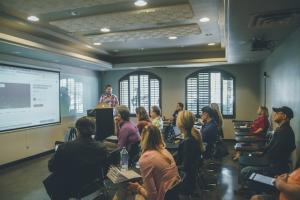
We can rethink the ways teaching and learning happen in church. / Photo by Kenny Eliason on Unsplash
I appreciate this attention to language, to equality, to the implications of words like “teacher” and “student” and how we hear them. It helps me better understand why I found Nick’s answer about how we knew each other so off-putting.
I don’t know if it was intentional or not—or how much that matters—but in one simple sentence, Nick placed himself in a position of power over me. He seemed to assume that he was the one who knew things, who had things to teach, and I was just there to receive his wisdom.
Operating as Co-learners
I appreciate the way the word “co-learners” acknowledges that the teacher, too, has much to learn. Always. They have not arrived at an all-knowing place, a godlike state where they have everything under control and will never need to change their mind about anything.
As Woodley goes on to write, “Knowledge, not applied, does us little good. I have found that most learning experiences stick best when we bring not just knowledge but our own truth and experience to the conversation. As co-learners apply the knowledge that I help them bring forth, making it real in their own contexts, we learn from one another. Thus, real knowledge, that which is real to each one’s experience, is shared together as co-learners in collaboration with the subject matter” (x).
I like this vision for learning: the teacher has studied the topic and brings what they know, but the real learning happens for everyone as different people apply knowledge “in their own contexts.” In their own lives and experiences and communities.
This is the “real knowledge.” And it is shared together. The classroom is a group of people on a learning journey together.
Co-learners in Christian Education
I feel like all this is easier said than done. But I think it’s worth aiming for.
And I think it’s worth aiming for particularly in our faith communities. Because what better place to recognize that we’re all on a spiritual journey together? That none of us has everything figured out? That we all have different gifts to offer, and we can learn so much from each other?
What better place to see that all real knowledge is embodied? That all meaningful wisdom is located in people, in places, in communities?
These are some of my hopes for the way teaching and learning happens in churches—whether through sermons, Bible studies, small groups, adult ed classes, or whatever other structures might be involved.
It’s part of how we avoid authoritarianism. It’s part of how we build environments where people can learn to “authorize” themselves.
We do not use teaching as a way to declare power or superiority over others. Instead, we seek to learn together. We seek to apply knowledge together.
Churches are often not this way—but they could be. It’s worth seeking, together.
General Christian
Education and Religion
Previous Post
July 21, 2023
What If Sermons Were a Conversation?
Next Post

August 2, 2023 Deprogramming from Patriarchy Is Not as Easy as Barbie Makes It Seem
Recent Comments
Browse Our Archives
Select a Category conversations seminary Uncategorized
Select a Month September 2023 August 2023 July 2023 June 2023 May 2023 April 2023 March 2023 February 2023 January 2023 December 2022 November 2022
Follow Us!
TAKE THE
Religious Wisdom Quiz
What does Proverbs 23:4-5 warn against pursuing too much?
Select your answer to see how you score.
Power Knowledge Wealth Status
Related posts from Always Re-forming
What If Sermons Were a Conversation?
I Take Sermons With a Grain of Salt


TRENDING AT PATHEOS Progressive Christian

Catholic Evangelization: Sharing Your Faith Every Day
Welcome back to the Graceful Awakening mini-series called, “From Faith to Mission.” ...

The Pillar of the Boatmen: the Ancient Monument...
The Pillar of the Boatmen is a Romano-Gaulish sculpture that dates from...

In one sense walking into Westminster Abbey is like walking down the...

'Super Scam Me' Exposes AI Jon Bon Jovi...
Leslie Pickett believed she was in a relationship with Jon Bon Jovi....

The Brazilian Remake of Kendricks' 'Flywheel' Opens in...
“Flywheel,” the story that launched the Kendrick Brothers’ filmmaking career is getting...

The Dangers of Gradual Accommodation (Winking at Sin)
Recently, the “law of gradualness” resurfaced during the opening of a weeklong,...
view all Progressive Christian blogs
Ad-Free & Subscriber Log-In Subscription Support
- About Us
- 2026 Calendar
- Videos
- Podcasts
- Library of World Religions
- Faith In Media Tracker
- Advertise With Us
- Write for Us
- Privacy Policy
- Terms of Service
- Do Not Sell My Data
- Contact Us
- Radiant Digital
- Manage Newsletter Subscriptions
- Unsubscribe From Notifications
- Sitemap
Copyright 2008-2026, Patheos. All rights reserved.
Subscription Support Ad-Free & Subscriber Log-In
Follow Patheos