
BuddhistCatholicContemplativeEvangelicalGeneral ChristianHinduJewishLatter-day SaintMuslimNew VisionsProgressive Christian
Beliefs
- Buddhist
- Catholic
- Contemplative
- Evangelical
- General Christian
- Hindu
- Jewish
- Latter-day Saint
- More Voices
- Muslim
- New Visions
- Pagan
- Progressive Christian
Topics
- Religion News
- Food and Religion
- Sports and Religion
- Religious Art
- Religious Music and Entertainment
- Religious Events
- History and Religion
- Style and Religion
- Politics and Religion
- Women in Religion
- Recreation Outdoors and Religion
- Business Finance and Religion
- Careers Workplace and Religion
- Education and Religion
- Family Parenting and Religion
- Health Fitness and Religion
- Home and Religion
- Relationships and Religion
- Technology and Religion
- Travel and Religion
Columnists
- Buddhist Columnists
- Business Finance and Religion Columnists
- Careers Workplace and Religion Columnists
- Catholic Columnists
- Contemplative Columnists
- Education and Religion Columnists
- Evangelists Columnists
- Family Parenting and Religion Columnists
- General Christian Columnists
- Health Fitness and Religion Columnists
- Hindu Columnists
- History and Religion Columnists
- Home and Religion Columnists
- Jewish Columnists
- More Voices Columnists
- Latter Day Columnists
- Muslim Columnists
- New Visions Columnists
- Nonreligious Columnists
- Pagan Columnists
- Politics and Religion Columnists
- Progressive Columnists
- Recreation Outdoors and Religion Columnists
- Relationships and Religion Columnists
- Religion News Columnists
- Religious Art Columnists
- Religious Events Columnists
- Religious Music and Entertainment Columnists
- Sports and Religion Columnists
- Style and Religion Columnists
- Technology and Religion Columnists
- Travel and Religion Columnists
- Women in Religion Columnists
Resource Library
- 2026 Calendar
- Library of World Religions
- The 100 Most Holy Places on Earth
- Patheos Answers
- Podcasts
- Videos
- Faith Leaders Database
- Anglican Episcopalian
- Bahai
- Baptist
- Buddhism
- Christianity
- Confucianism
- Eastern Orthodoxy
- Hinduism
- Holiness and Pentecostal
- ISKCON
- Islam
- Judaism
- Lutheran
- Methodist
- The Church of Jesus Christ of Latter-day Saints
- New Age
- Paganism
- Presbytarian and Reformed
- Protestantism
- Religion Behind the Scenes
- Roman Catholic
- Scientology
- Shia Islam
- Sikhism
- Sufism
- Sunni Islam
- Taoism
- Zen
- See all religions
Research Tools
 Ad-Free & Subscriber Log-In Subscription Support
Ad-Free & Subscriber Log-In Subscription Support
Follow Patheos 

- Trending:
- Forgiveness
- |
- Marriage
- |
- Consciousness
- |
- Death Penalty
- |
- Election
- |
- Halloween
 altmuslim
- Home
- Muslim
- Muslims and Voting – What Does Sharia Have To Do With It?
Muslims and Voting – What Does Sharia Have To Do With It?
Last updated on: November 4, 2018 at 10:19 pm by Guest Contributor
Muslims and Voting – What Does Sharia Have To Do With It? 2018-11-04T22:19:36-04:00 Guest Contributor
Patheos Explore the world's faith through different perspectives on religion and spirituality! Patheos has the views of the prevalent religions and spiritualities of the world.
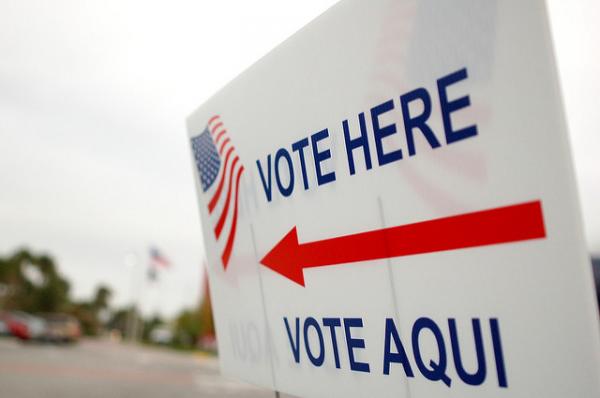
Image source: Erik (HASH) Hersman, Flickr Creative Commons
Muslims must follow the law of the land wherever we live, regardless of whether it is ruled by Muslims or non-Muslims. Sharia scholars have told us this for centuries, because Muslims have lived as religious minorities since the beginning of Islam.
(Many scholars even said that if Muslims do anything hostile against a non-Muslim host country, they could be prosecuted for that in a Muslim-ruled land.)
But, there is something different about what “law of the land” means in a democracy. For American Muslims, the law isn’t imposed on us by a Christian king; it is created by a democratic process that includes our voices. That creates an interesting question: Since we have a say in what the laws of the land are, how should we be voting?
Because part of being a Muslim involves paying attention to sharia, some think that American Muslims will (or should) advocate for sharia rules to become the law of the land in the United States. Indeed, fear of this idea is exactly what motivates anti-sharia campaigns across the country.
So, does sharia advocate for American Muslims to try to enact Muslim rules of behavior as the law of the land? Are we supposed to be pushing for a national ban on alcohol, for example, or to require attendance at Friday prayers? The answer is no, but to understand why, we need a little Sharia 101.
First, Some Definitions
Literally meaning “street,” or “way,” sharia means the way God has instructed us to live, via the sources of the Quran and the life of the Prophet Muhammad (the Sunnah). Scholars interpret those sources to provide specific rules on how to live a Muslim life — things like how to pray, what to eat and drink, who and how to marry, who gets your money after you die and so on.
These rules are called fiqh, a word that means “understanding,” indicating that these scholars didn’t claim to speak for God; they only provided their best understanding of God’s Way for our lives. That is why there are so many different schools of fiqh, all equally valid for Muslims choosing to live by sharia.
But, fiqh is only one part of a bigger picture. Before colonialism changed everything, there were actually two types of law in Muslim countries. One was fiqh — the rules for living a Muslim life. The other was siyasa (political administration). Siyasa laws were made by rulers, not religious scholars. They were not based on scriptural study but on the idea that a ruler must serve the maslaha ‘amma (public good). (An Islamic legal maxim says, “The affairs of the ruler concerning his people are judged by reference to public good.”)
Siyasa laws included things like setting standard weights and measures, punishing corruption, and raising armies to defend the land. Today we might include things like traffic laws, professional licensing regulations, and health and zoning codes. In other words, siyasa covers all those laws that are important for social order but can’t be derived from scripture. (No matter how long we look through the Quran and Sunnah, we won’t find anything telling us how far apart wall studs should be so that our houses don’t fall down.)
Should Sharia Influence Muslim Votes?
Knowing this, the question of what sharia demands of American Muslim voters becomes quite simple. If the first Islamic responsibility of a ruler is to serve the public good, and if in a democracy the “ruler” is all of us, then the only question on my mind when I go to the voting booth in the United States is: “What will serve the American public good?” (Notice that this is a very different question than “How do I live my life as a Muslim?” That is the business of fiqh personal law, not siyasa state law.)
This same question should be on the minds of all American Muslims who cast a ballot, or vote in Congress, or judge a case.
Most importantly, this is not a selling out of our Islamic values. As USC professor and Islamic scholar Sherman Jackson points out in The Islamic Secular, there are all sorts of important societal rules that don’t come from scripture, but that does not make them any less Islamic. For example, the Quran and Sunnah tell us to take care of nature, the poor and the sick, but they don’t tell us what level of emissions standards to set, what the minimum wage should be, or how to get everyone adequate health care.
Will we disagree on the public good? Of course. I might vote for universal health care whereas you might think a privatized system will better serve us. I might want a higher minimum wage, and you might think that would hurt small businesses. Those debates are inevitable. The important thing is that we make sure we are debating over what each of us thinks truly serves the public good and that we know this is our Islamic duty as American citizens.
But, what about laws that are contrary to fiqh rules? Many think that American Muslims can’t support such laws because that would mean they are supporting something that contradicts sharia. A popular example is same-sex marriage: Muslims may think that they must oppose the legalization of same-sex marriage because it is prohibited in the fiqh. But they are forgetting the crucial difference between fiqh and siyasa.
Remember, fiqh rules are guidelines for Muslim behavior. They were never meant to be uniformly applied by the state to everyone. Fiqh forbids Muslims from drinking wine, but Muslim rulers never used state power (siyasa) to apply that rule to non-Muslims.
Sharia Restrictions on the Public Good?
So, if we want to make sure that we don’t contradict sharia when we vote for the public good, we need to use something different than the fiqh rules of Muslim behavior. Personally, I think we should use the purposes (maqasid) of sharia. Sharia scholars of all schools have long agreed that the rules of sharia ultimately serve one of five primary purposes: The preservation of life, religion, family, property and intellect (some add a sixth, human honor/dignity). These purposes are, I believe, the best way to ensure that our human determinations of the public good doesn’t violate sharia. For example, what if we decided that population control was an important public good, and we passed a law to kill half the population to serve that public good? A Muslim would have to reject such a law because it would contradict the preservation of life, one of the primary purposes of sharia.
Putting all this together, let’s go back to the legalization of same-sex marriage, one of the trickiest and continuously controversial laws for American Muslims to navigate. Here is how I analyze it: First, I ask myself, does legalizing same-sex marriage serve the American public good? My answer? Yes. I think it serves the public good for same-sex couples to be able to, for example, make medical decisions for each other as spouses and have other benefits that come from legal marriage recognition.
Next, I ask, would legalizing same-sex marriages violate any of the primary purposes of sharia? (Again, whether fiqh allows same sex-marriage for Muslims is irrelevant.). To that question I answer, no. I do not see how legalizing same-sex marriage would violate the preservation of life, property, family, religion, intellect or human dignity. Therefore, I support – as an American Muslim – the decision to legalize same sex marriage in this country.
Others may disagree with the process of my analysis, of course. God knows best who is correct. But, the most important thing to me is that we recognize the two steps of the analysis. Many tend to skip over the step looking for the public good. I believe it is that very step that is our first Islamic responsibility as voting citizens.
Of course, at some level, none of this is relevant because secular countries are not supposed to be held to sharia standards in the first place. But if they were, the picture is a lot more encouraging than the one painted by those fearing “creeping sharia.” Sharia simply obligates American Muslims to work for the public good. And, it turns out that we already are.
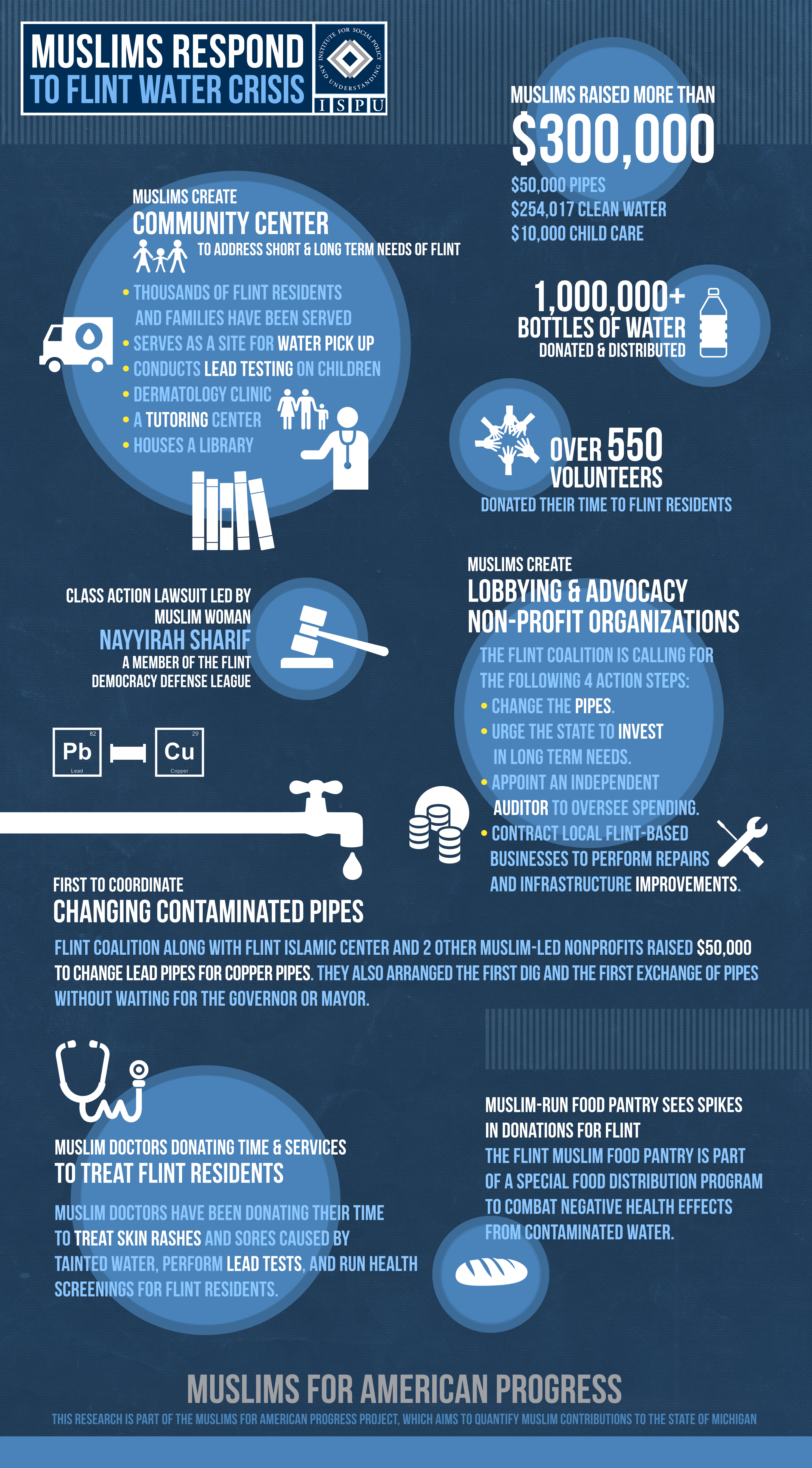
Take the Muslim response to the water crisis in Flint: Muslims in Michigan raised $300,000 for new pipes, clean water and child care, arranged the first pipe dig, and set up tutoring, a library and a community center for water pick up. Muslim doctors donated time to treat skin rashes and sores and conduct lead testing. And, a Muslim lawyer and member of the Flint Democracy Defense League is leading a class action lawsuit on behalf of the victims.
We’re doing these things because we believe sharia tells us to. According to a 2017 Pew Research Center poll, about 7 in 10 American Muslims say “working for justice and equality in society” is an essential part of their Muslim identity. Sixty-two percent say the same thing about “working to protect the environment.”
It saddens me that the popular rhetoric about sharia in the United States does not reflect this truth. But, that can change. If American Muslims are clear, bold and public about the fact that it is our Islamic duty to serve the public good, I can see a future in which sharia is not seen as a threat to America, but as the very thing that makes American Muslims care about the good of all. More and more of our fellow Americans will see that this country is better because we’re part of it.
As Muslim country singer Kareem Salama puts it, “When I’m six feet in the ground, the poor and the weak and the orphan and meek will miss having me around.”
About Asifa Quraishi-Landes
Asifa-Quraishi-Landes is a law professor at the University of Wisconsin Law School, specializing in comparative Islamic and U.S. constitutional law with a current focus on modern Islamic constitutional theory. She is also a fellow at the Institute for Social Policy and Understanding (ISPU). You can read more about the author here.


Browse Our Archives
Select a Category 2012 Elections 30 Dayd 30 Writers (2017) 30 Days 30 Writers 30 Days 30 Writers (2015) 30 Days 30 Writers (2016) 30 Days 30 Writers (2018) 30 Days 30 Writers 2017 Ali Asadullah Ali Eteraz Alper Bilgili Arthur Richards Asides Asma Uddin Black History Month Briefings Charles Turner Commentary Cyrus McGoldrick Eman H Aly Fatimah Popal Hajj Hajj and Dhul Hijjah Hesham Hassaballa Hisham Hellyer Ibrahim Abusharif Inas Younis Irfan Yusuf Jalal Baig Junaid Afeef Laila Alawa Laila Alwala Mas'ood Cajee Muqtedar Khan Nakia Jackson Newsmakers Parvez Ahmed Podcasts Rabia Chaudry Rafia Zakaria Ramadan Reviews Safiyyah Ally Saud Inam Shahed Amanullah Svend White The Opinionated Oncologist Visions Wajahat Ali Zahed Amanullah Zahir Janmohamed Zainab Khan
Select a Month November 2018 October 2018 September 2018 August 2018 July 2018 June 2018 May 2018 April 2018 March 2018 February 2018 January 2018 December 2017 November 2017 October 2017 September 2017 August 2017 July 2017 June 2017 May 2017 April 2017 March 2017 February 2017 January 2017 December 2016 November 2016 October 2016 September 2016 August 2016 July 2016 June 2016 May 2016 April 2016 March 2016 February 2016 January 2016 December 2015 November 2015 October 2015 September 2015 August 2015 July 2015 June 2015 May 2015 April 2015 March 2015 February 2015 January 2015 December 2014 November 2014 October 2014 September 2014 August 2014 July 2014 June 2014 May 2014 April 2014 March 2014 February 2014 January 2014 December 2013 November 2013 October 2013 September 2013 August 2013 July 2013 June 2013 May 2013 April 2013 March 2013 February 2013 January 2013 December 2012 November 2012 October 2012 September 2012 August 2012 July 2012 June 2012 May 2012 April 2012 March 2012 February 2012 January 2012 December 2011 November 2011 October 2011 September 2011 August 2011 July 2011 June 2011 May 2011 April 2011 March 2011 February 2011 January 2011 December 2010 November 2010 October 2010 September 2010 August 2010 July 2010 June 2010 May 2010 April 2010 March 2010 February 2010 January 2010 December 2009 November 2009 October 2009 September 2009 August 2009 July 2009 June 2009 May 2009 April 2009 March 2009 February 2009 January 2009 December 2008 November 2008 October 2008 September 2008 August 2008 July 2008 June 2008 May 2008 April 2008 March 2008 February 2008 January 2008 December 2007 November 2007 October 2007 September 2007 August 2007 July 2007 June 2007 May 2007 April 2007 March 2007 February 2007 January 2007 December 2006 November 2006 October 2006 September 2006 August 2006 July 2006 June 2006 May 2006 April 2006 March 2006 February 2006 January 2006 December 2005 November 2005 October 2005 September 2005 August 2005 July 2005 June 2005 May 2005 April 2005 March 2005 February 2005 January 2005 December 2004 November 2004 October 2004 September 2004 August 2004 July 2004 June 2004 May 2004 April 2004 March 2004 February 2004 January 2004 December 2003 November 2003 October 2003 September 2003 August 2003 July 2003 June 2003 May 2003 April 2003 March 2003 February 2003 January 2003 December 2002 November 2002 October 2002 September 2002 August 2002 July 2002 June 2002 May 2002 April 2002 March 2002
Follow Us!
TAKE THE
Religious Wisdom Quiz
What Roman road was Paul traveling when he encountered Jesus?
Select your answer to see how you score.
Jericho Road Corinthian Way Roman Forum Road Damascus Road
Related posts from altmuslim

Mawlid 2018: Praise Songs from Around the World

Gaslighting, Anti-Jewish and Anti-Muslim Rhetoric: What to Know

How One Ottoman Reconciled Islamic Teachings with Darwin's...

As #TreeofLife Shows, Trump's Mainstreaming of Hate Puts...
TRENDING AT PATHEOS Muslim

25 Years Later: How Much Has Changed for...
As we approach the 25th anniversary of September 11th, I’ve found myself...

Podcast: Third Spaces & The Rise of Yemeni...
In the latest episode of The Artistic Foodies Podcast, hosts Abbas...

HalalFest Picks: Best 60 Halal Spots for Super...
Back in 2016, I came up with a list of 29...

Unity Is America’s Strength — Division Is Its...
by Hidayatullah Ahsan When Valentina Gomez, a Republican candidate for Congress in...

Zohran Mamdani and New York’s Fight Against Islamophobia
This past June, against all odds, Zohran Mamdani won the Democratic primary...

What the Fourth of July Means to a...
As we mark another Fourth of July, millions of Americans will celebrate...
view all Muslim blogs
Ad-Free & Subscriber Log-In Subscription Support
- About Us
- 2026 Calendar
- Videos
- Podcasts
- Library of World Religions
- Faith In Media Tracker
- Advertise With Us
- Write for Us
- Privacy Policy
- Terms of Service
- Do Not Sell My Data
- Contact Us
- Radiant Digital
- Manage Newsletter Subscriptions
- Unsubscribe From Notifications
- Sitemap
Copyright 2008-2026, Patheos. All rights reserved.
Subscription Support Ad-Free & Subscriber Log-In
Follow Patheos