
BuddhistCatholicContemplativeEvangelicalGeneral ChristianHinduJewishLatter-day SaintMuslimNew VisionsProgressive Christian
Beliefs
- Buddhist
- Catholic
- Contemplative
- Evangelical
- General Christian
- Hindu
- Jewish
- Latter-day Saint
- More Voices
- Muslim
- New Visions
- Pagan
- Progressive Christian
Topics
- Religion News
- Food and Religion
- Sports and Religion
- Religious Art
- Religious Music and Entertainment
- Religious Events
- History and Religion
- Style and Religion
- Politics and Religion
- Women in Religion
- Recreation Outdoors and Religion
- Business Finance and Religion
- Careers Workplace and Religion
- Education and Religion
- Family Parenting and Religion
- Health Fitness and Religion
- Home and Religion
- Relationships and Religion
- Technology and Religion
- Travel and Religion
Columnists
- Buddhist Columnists
- Business Finance and Religion Columnists
- Careers Workplace and Religion Columnists
- Catholic Columnists
- Contemplative Columnists
- Education and Religion Columnists
- Evangelists Columnists
- Family Parenting and Religion Columnists
- General Christian Columnists
- Health Fitness and Religion Columnists
- Hindu Columnists
- History and Religion Columnists
- Home and Religion Columnists
- Jewish Columnists
- More Voices Columnists
- Latter Day Columnists
- Muslim Columnists
- New Visions Columnists
- Nonreligious Columnists
- Pagan Columnists
- Politics and Religion Columnists
- Progressive Columnists
- Recreation Outdoors and Religion Columnists
- Relationships and Religion Columnists
- Religion News Columnists
- Religious Art Columnists
- Religious Events Columnists
- Religious Music and Entertainment Columnists
- Sports and Religion Columnists
- Style and Religion Columnists
- Technology and Religion Columnists
- Travel and Religion Columnists
- Women in Religion Columnists
Resource Library
- 2026 Calendar
- Library of World Religions
- The 100 Most Holy Places on Earth
- Patheos Answers
- Podcasts
- Videos
- Faith Leaders Database
- Anglican Episcopalian
- Bahai
- Baptist
- Buddhism
- Christianity
- Confucianism
- Eastern Orthodoxy
- Hinduism
- Holiness and Pentecostal
- ISKCON
- Islam
- Judaism
- Lutheran
- Methodist
- The Church of Jesus Christ of Latter-day Saints
- New Age
- Paganism
- Presbytarian and Reformed
- Protestantism
- Religion Behind the Scenes
- Roman Catholic
- Scientology
- Shia Islam
- Sikhism
- Sufism
- Sunni Islam
- Taoism
- Zen
- See all religions
Research Tools
 Ad-Free & Subscriber Log-In Subscription Support
Ad-Free & Subscriber Log-In Subscription Support
Follow Patheos 

- Trending:
- Forgiveness
- |
- Marriage
- |
- Consciousness
- |
- Death Penalty
- |
- Election
- |
- Halloween
 altmuslim
- Home
- Muslim
- Ramadan is an Opportunity in Culinary Diplomacy
Ramadan is an Opportunity in Culinary Diplomacy
Last updated on: June 9, 2018 at 2:38 pm by Guest Contributor
Ramadan is an Opportunity in Culinary Diplomacy 2018-06-09T14:38:00-04:00 Guest Contributor
Patheos Explore the world's faith through different perspectives on religion and spirituality! Patheos has the views of the prevalent religions and spiritualities of the world.
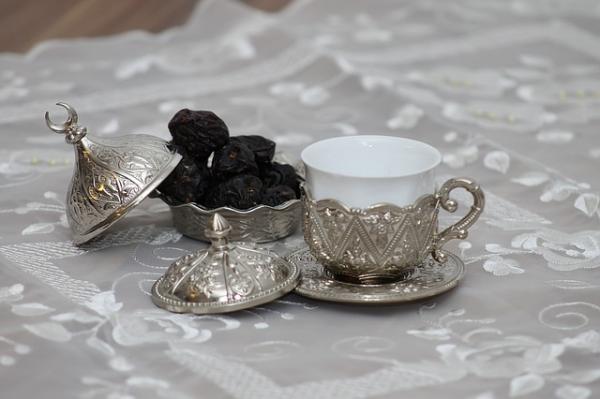
Image source: Pixabay
The first time I fasted in Ramadan I wasn’t a Muslim; I was a curious young woman who had recently experienced a very short but very impactful trip to Morocco during the blessed month a few years earlier.
I learned that the Islamic way of fasting was quite different — detailed and comprehensive — in comparison to my Catholic upbringing, where my experience with fasting was to diligently refrain from one particularly favored item during Lent (for me it was always chocolate). The rules were set and clear, and everyone around me — my graduate school friends from various parts of the Muslim world — all seemed to follow these rules quite stringently.
I found their refrain from food and drink was a phenomenon I could never picture myself participating in wholly, particularly because I loved food too much and partly because I didn’t think I had the willpower to deny myself the earthly pleasures I treasured. I was impressed by their dedication, but not enough to consider it something to adopt for the rest of my life. I did it that first time solely out of curiosity for how it felt and to see how far I could push my inner strength.
At that time Ramadan occurred in winter, so sunset was around 4:30 p.m. I quietly pulled out a bag of Medjool dates during class and drank a few sips of water, then went home to eat. Easy peasy, until my friends told me that in several years Ramadan would occur in the summer months, and then it would be way more difficult. But, they loved it anyway.
It was their favorite time of year. It was special, blessed and there was nothing like that feeling of breaking the fast with families and friends.
This concept of enjoying the fast was completely and simultaneously fascinating and mind-boggling to me. How could anyone enjoy not eating for such a long time? Why would they embrace the denial of such a pleasure especially when they had some of the best food I’d ever tasted in their Egyptian, Somali, Malaysian, Emirati, Saudi and Palestinian food traditions?
And then it occurred to me. My three-day trip to Tangier, Morocco prompted all this interest and curiosity to explore Ramadan further.
During my junior year of college, I studied abroad in Segovia, Spain. I had a phenomenal history teacher who peaked my interest in the comprehensive history of Moorish Spain, which provided way more profound details in the Spanish language than I had ever learned back home in my Latin American history courses. I wanted to experience the North African connection to Spain myself, so I convinced my classmates to travel to Morocco during our spring break.
We took trains and boats to arrive at the port of Tangier, on what I now know was a Jumma (Friday), at the time of the jamaat (congregational prayer), where I first heard the adhan (call to prayer) during the holy month of Ramadan.
During this trip, I met the warmest, most hospitable women, men and children I have ever met in my travels abroad. They spoke several languages to try and see which one would unlock the key to communicating with us, which still impresses me to this day. Our tour guide, Ali, whose face I can still picture, had a smile that was infectious and that hid any annoyances he had with us (remember, we were college students).
Ali showed us around Old Tangier and kindly explained that the reason it was quiet and the stores were closed was that there was a holiday of some sort. I’m sure he mentioned it was Ramadan, but it went over my head. All of it went over my head — the Islam part, Muslim part, Ramadan part. Every bit of it. All I could see were kind, generous and humble people who willingly shared their food — even when they were not eating — and their culture with us.
I was clearly disappointed that the restaurants were closed, but Ali happily found us a place to have lunch while he sat without eating but chatted us up the whole time. When I probed a little more about what time they would be eating, he invited all of us to dinner at his family home that evening. Much to my dismay, no one else wanted to go.
This was not my way of traveling, as I would never turn down a home-cooked meal with locals. Imagine the once-in-a-lifetime experience that would be! Since I couldn’t go alone, however, I had to pass as well. It’s still one of the biggest culinary travel regrets I have to this day.
Upon returning to the States, I knew that I needed to know more about Muslims and the various cultures they represented. I got closer to my Muslim classmates by asking more questions about their lives and engaging in dialogue that would eventually change my perspective on the world — and my life — forever. Those classmates became my friends who invited me to many, many meals to experience breaking the fast in their humble college digs.
They may not know it even today, but they became cultural and culinary diplomats for their respective countries as well as for Muslims, Islam and the deeper meaning of Ramadan. It may have taken years for the impact to take hold in my mind, but in my heart the change was quite instant. I began to see them as people I could relate to — young men and women with dreams, ambitions, challenges and fears just like myself. Simply being human outweighed the concept of “the other,” and that was something I sorely needed to learn.
Years later, I embraced Islam, and I believe it had more to do with the conversations I had over the meals I ate and the hospitality of those Muslims than anything else I experienced.
You see, one never knows what can happen over food, and that’s a fantastic thing. We can come to the table emotionally charged, with our own assumptions about a race, religion or political leaning, but as we share from the same plate or at least eat something together, an important bonding begins to occur. I always feel that a meal is the greatest neutralizer of emotions but it’s also a great equalizer.
We all must eat, so why not experience it together instead of alone? Why not use the opportunity to bond and to get to know the person next to you or across from you in a more meaningful way by allowing the free flow of conversation that slowly begins to soften as we take pleasure in the great taste and texture and cultural exchange that is in every single type of food around the world.
It’s a song and dance, a storytelling opportunity about who we are. When someone cooks for you or decides to share their cuisine with you by taking you to a restaurant representing their cultural cuisine, they are trying to tell you a story of who they are and of what is important to them.
We have this fantastic opportunity as Muslims in Ramadan at every single iftar (breaking of the fast meal) — and if you’re brave enough to let anyone in on your suhoor (meal before the fasting day begins) — to close the gap between us and our neighbors, our family members, our friends, and yes, dare I say, complete strangers. It’s more important than we realize. It’s more impactful than we can comprehend today, because its implications are long-lasting.
What prompted me to remember how incredibly important my culinary travels have been to my own life is the sad news of Anthony Bourdain’s passing. He gave a spotlight to places like Gaza that wouldn’t normally be seen in such a way — through the lens of the food of its people — while affording them a platform to talk about their plight. That is culinary diplomacy at its most clever, and most effective.
We can do the same, in our own ways and in our own format. I think we should all take advantage of that opportunity during the precious days of Ramadan.

About Yvonne Maffei
Yvonne Maffei is a travel-obsessed food writer, cookbook author, e-commerce entrepreneur and Founder of MyHalalKitchen.com, a halal food and cooking website. Her book titles include: Clean Your Kitchen Green (2010), Summer Ramadan Cooking (2013) and My Halal Kitchen: Global Recipes, Cooking Tips, Lifestyle Inspiration (2016). She lives in Chicago and is working on her next book, building her online halal marketplace (My Halal Market) and eating her way around the world on global culinary adventures. You can read more about the author here.
Previous Post

June 8, 2018
How Fasting Connects Us All - Remembering the Past

Browse Our Archives
Select a Category 2012 Elections 30 Dayd 30 Writers (2017) 30 Days 30 Writers 30 Days 30 Writers (2015) 30 Days 30 Writers (2016) 30 Days 30 Writers (2018) 30 Days 30 Writers 2017 Ali Asadullah Ali Eteraz Alper Bilgili Arthur Richards Asides Asma Uddin Black History Month Briefings Charles Turner Commentary Cyrus McGoldrick Eman H Aly Fatimah Popal Hajj Hajj and Dhul Hijjah Hesham Hassaballa Hisham Hellyer Ibrahim Abusharif Inas Younis Irfan Yusuf Jalal Baig Junaid Afeef Laila Alawa Laila Alwala Mas'ood Cajee Muqtedar Khan Nakia Jackson Newsmakers Parvez Ahmed Podcasts Rabia Chaudry Rafia Zakaria Ramadan Reviews Safiyyah Ally Saud Inam Shahed Amanullah Svend White The Opinionated Oncologist Visions Wajahat Ali Zahed Amanullah Zahir Janmohamed Zainab Khan
Select a Month November 2018 October 2018 September 2018 August 2018 July 2018 June 2018 May 2018 April 2018 March 2018 February 2018 January 2018 December 2017 November 2017 October 2017 September 2017 August 2017 July 2017 June 2017 May 2017 April 2017 March 2017 February 2017 January 2017 December 2016 November 2016 October 2016 September 2016 August 2016 July 2016 June 2016 May 2016 April 2016 March 2016 February 2016 January 2016 December 2015 November 2015 October 2015 September 2015 August 2015 July 2015 June 2015 May 2015 April 2015 March 2015 February 2015 January 2015 December 2014 November 2014 October 2014 September 2014 August 2014 July 2014 June 2014 May 2014 April 2014 March 2014 February 2014 January 2014 December 2013 November 2013 October 2013 September 2013 August 2013 July 2013 June 2013 May 2013 April 2013 March 2013 February 2013 January 2013 December 2012 November 2012 October 2012 September 2012 August 2012 July 2012 June 2012 May 2012 April 2012 March 2012 February 2012 January 2012 December 2011 November 2011 October 2011 September 2011 August 2011 July 2011 June 2011 May 2011 April 2011 March 2011 February 2011 January 2011 December 2010 November 2010 October 2010 September 2010 August 2010 July 2010 June 2010 May 2010 April 2010 March 2010 February 2010 January 2010 December 2009 November 2009 October 2009 September 2009 August 2009 July 2009 June 2009 May 2009 April 2009 March 2009 February 2009 January 2009 December 2008 November 2008 October 2008 September 2008 August 2008 July 2008 June 2008 May 2008 April 2008 March 2008 February 2008 January 2008 December 2007 November 2007 October 2007 September 2007 August 2007 July 2007 June 2007 May 2007 April 2007 March 2007 February 2007 January 2007 December 2006 November 2006 October 2006 September 2006 August 2006 July 2006 June 2006 May 2006 April 2006 March 2006 February 2006 January 2006 December 2005 November 2005 October 2005 September 2005 August 2005 July 2005 June 2005 May 2005 April 2005 March 2005 February 2005 January 2005 December 2004 November 2004 October 2004 September 2004 August 2004 July 2004 June 2004 May 2004 April 2004 March 2004 February 2004 January 2004 December 2003 November 2003 October 2003 September 2003 August 2003 July 2003 June 2003 May 2003 April 2003 March 2003 February 2003 January 2003 December 2002 November 2002 October 2002 September 2002 August 2002 July 2002 June 2002 May 2002 April 2002 March 2002
Follow Us!
TAKE THE
Religious Wisdom Quiz
What does the Greek word 'Logos' mean in the Bible?
Select your answer to see how you score.
Grace Word Truth Life
Related posts from altmuslim

Are Muslims Willing to Travel the Road to...
It's Time to Boycott Saudi Arabia

Why Does Allah Allow Human Suffering? For What...

How Moonsighting Wars Teach Us Greater Lessons on...
TRENDING AT PATHEOS Muslim

25 Years Later: How Much Has Changed for...
As we approach the 25th anniversary of September 11th, I’ve found myself...

Podcast: Third Spaces & The Rise of Yemeni...
In the latest episode of The Artistic Foodies Podcast, hosts Abbas...

HalalFest Picks: Best 60 Halal Spots for Super...
Back in 2016, I came up with a list of 29...

Unity Is America’s Strength — Division Is Its...
by Hidayatullah Ahsan When Valentina Gomez, a Republican candidate for Congress in...

Zohran Mamdani and New York’s Fight Against Islamophobia
This past June, against all odds, Zohran Mamdani won the Democratic primary...

What the Fourth of July Means to a...
As we mark another Fourth of July, millions of Americans will celebrate...
view all Muslim blogs
Ad-Free & Subscriber Log-In Subscription Support
- About Us
- 2026 Calendar
- Videos
- Podcasts
- Library of World Religions
- Faith In Media Tracker
- Advertise With Us
- Write for Us
- Privacy Policy
- Terms of Service
- Do Not Sell My Data
- Contact Us
- Radiant Digital
- Manage Newsletter Subscriptions
- Unsubscribe From Notifications
- Sitemap
Copyright 2008-2026, Patheos. All rights reserved.
Subscription Support Ad-Free & Subscriber Log-In
Follow Patheos