
BuddhistCatholicContemplativeEvangelicalGeneral ChristianHinduJewishLatter-day SaintMuslimNew VisionsProgressive Christian
Beliefs
- Buddhist
- Catholic
- Contemplative
- Evangelical
- General Christian
- Hindu
- Jewish
- Latter-day Saint
- More Voices
- Muslim
- New Visions
- Pagan
- Progressive Christian
Topics
- Religion News
- Food and Religion
- Sports and Religion
- Religious Art
- Religious Music and Entertainment
- Religious Events
- History and Religion
- Style and Religion
- Politics and Religion
- Women in Religion
- Recreation Outdoors and Religion
- Business Finance and Religion
- Careers Workplace and Religion
- Education and Religion
- Family Parenting and Religion
- Health Fitness and Religion
- Home and Religion
- Relationships and Religion
- Technology and Religion
- Travel and Religion
Columnists
- Buddhist Columnists
- Business Finance and Religion Columnists
- Careers Workplace and Religion Columnists
- Catholic Columnists
- Contemplative Columnists
- Education and Religion Columnists
- Evangelists Columnists
- Family Parenting and Religion Columnists
- General Christian Columnists
- Health Fitness and Religion Columnists
- Hindu Columnists
- History and Religion Columnists
- Home and Religion Columnists
- Jewish Columnists
- More Voices Columnists
- Latter Day Columnists
- Muslim Columnists
- New Visions Columnists
- Nonreligious Columnists
- Pagan Columnists
- Politics and Religion Columnists
- Progressive Columnists
- Recreation Outdoors and Religion Columnists
- Relationships and Religion Columnists
- Religion News Columnists
- Religious Art Columnists
- Religious Events Columnists
- Religious Music and Entertainment Columnists
- Sports and Religion Columnists
- Style and Religion Columnists
- Technology and Religion Columnists
- Travel and Religion Columnists
- Women in Religion Columnists
Resource Library
- 2026 Calendar
- Library of World Religions
- The 100 Most Holy Places on Earth
- Patheos Answers
- Podcasts
- Videos
- Faith Leaders Database
- Anglican Episcopalian
- Bahai
- Baptist
- Buddhism
- Christianity
- Confucianism
- Eastern Orthodoxy
- Hinduism
- Holiness and Pentecostal
- ISKCON
- Islam
- Judaism
- Lutheran
- Methodist
- The Church of Jesus Christ of Latter-day Saints
- New Age
- Paganism
- Presbytarian and Reformed
- Protestantism
- Religion Behind the Scenes
- Roman Catholic
- Scientology
- Shia Islam
- Sikhism
- Sufism
- Sunni Islam
- Taoism
- Zen
- See all religions
Research Tools
 Ad-Free & Subscriber Log-In Subscription Support
Ad-Free & Subscriber Log-In Subscription Support
Follow Patheos 

- Trending:
- Forgiveness
- |
- Marriage
- |
- Consciousness
- |
- Death Penalty
- |
- Election
- |
- Halloween
 altmuslim
- Home
- Muslim
- Interpreting the Quran in Light of Modern Times
Interpreting the Quran in Light of Modern Times
Last updated on: May 29, 2018 at 9:56 pm by Guest Contributor
Interpreting the Quran in Light of Modern Times 2018-05-29T21:56:50-04:00 Guest Contributor
Patheos Explore the world's faith through different perspectives on religion and spirituality! Patheos has the views of the prevalent religions and spiritualities of the world.
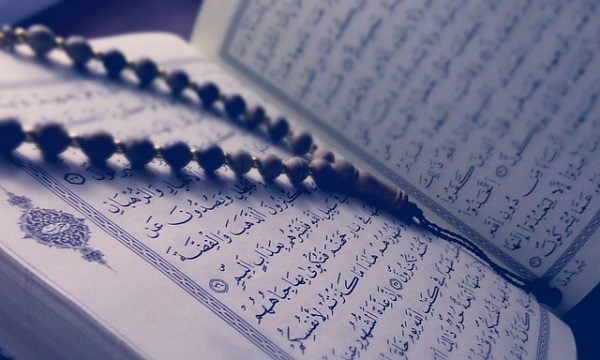
Image source: Pixabay
This is Day 14 of the 2018 #30Days30Writers Ramadan series.
The story of the Quran begins in Ramadan, 610 AD. Muhammad, who was not yet the Prophet Muhammad, was in the habit of meditating in a cave high on the hillsides surrounding Mecca. On one such occasion, the angel Gabriel (Jibril) came to him and told him to read – iqra.
Muhammad replied that he could not read. Gabriel pressed him tightly and then commanded him again to read, and Muhammad again said that he could not read. Gabriel pressed him again and said:
1 Read! In the name of your Lord who created:
2 He created man from a clinging drop.
3 Read! Your Lord is the Most Generous
4 Who taught by the pen,
5 Taught man what he did not know.
These verses marked the beginning of revelation. Muhammad didn’t know what to make of what was happening to him. He ran down the mountain, his heart beating wildly. He was so terrified of the experience that he asked his wife Khadijah to cover him up. After he calmed down, he told her what had happened and confided that he was afraid for himself, unsure whether his experience was true or if he was going mad.
Khadijah reassured him that nothing ill could come to him, as he was a good man, known for upholding the ties of kinship, speaking truthfully, helping the poor and destitute, serving his guests generously and assisting those who were stricken by calamity. She also took him to her uncle Waraqa, a Christian monk, who agreed that Muhammad was indeed to become a Prophet.
The second revelation came a few weeks later:
1 You, wrapped in your cloak,
2 Arise and give warning!
3 Proclaim the greatness of your Lord;
4 Purify yourself;
5 Keep away from all defilement;
6 Do not be overwhelmed and weaken;
7 But be steadfast in your Lord’s cause.
These verses may refer to what happened after the first revelation or they may refer to the fact that when Muhammad saw the angel Gabriel again, he ran home frightened and once more begged Khadijah to cover him up.
Either way, practically from the beginning of revelation we see that the Quran is a book rooted in history, responding to the Prophet’s thoughts and actions and reacting to happenings in his life. While it presents many eternal lessons, it is also speaking into a context, directed at a particular culture and addressing the events occurring at the time.
Time and again, as we read through the Quran we are reminded of this fact. The beginning of Chapter 80 scolds the Prophet Muhammad for paying attention to important people and rebuffing a blind old man who wanted to learn more about the religion he had recently embraced. Chapter 3 discusses the believers’ behavior during the battles of Badr and Uhud. Chapter 24 addresses those who slandered Aisha with accusations of adultery.
The commentary and explanations of the Quran that are currently popular almost exclusively focus on the eternal nature of the holy book, proclaiming that not only is its wisdom and spiritual guidance intended to uplift mankind forever, but that the individual rulings pertaining to the specific circumstances Prophet Muhammad encounter are also universal.
As a progressive Muslim, I question that approach to the Quran, since the book is so clearly addressing a specific community in a specific historical context. I can’t help but think that God would have given different advice and different rules if the Quran were being revealed today.
I mean, surely if the Quran came to today’s society, with our understanding of domestic violence, God wouldn’t advise spouses who aren’t getting along so well to resort to physical retaliation? Surely in a society where familial bonds don’t extend much beyond the nuclear family, and men and women are both expected to be breadwinners, inheritance would be divided up more equally?
And, how about those draconian punishments for petty crimes? I must think that things would be very different.
Ramadan brings this belief into sterling clarity for me. The verses about fasting are unambiguous: “Eat and drink until you can discern the white streak of dawn against the blackness of night.” (Surah Baqara, verse 160) Clearly, this verse is not universal. It does not take into consideration Muslims who live above the Arctic Circle where for several months of the year the sun never comes completely over the horizon. Nor does it consider the impracticality of refraining from food and water when daytime last 18, 19 or more hours.
The only conclusion I see is that the injunctions about fasting talk specifically to the people of Mecca and Madinah, to their circumstances and situation, and was never intended to be rules for all places and times.
So, what’s a modern Muslim to do? How do we know what is universal and good for all times and what applies specifically to Muhammad’s era? For starters, there are values in the Quran that are clearly universal: Be mindful of God through worship, be charitable, be patient in the fact of difficulties, speak honestly and bear true witness, uphold contracts and oaths faithfully, keep family ties, be kind to strangers and travelers, speak kindly to others, don’t lord your wealth or power over those who lack them, count your blessings, use your brain to gain wisdom from the world around you and seek education, be modest in dress and speech, etc.
There are prohibitions that are also clearly universal: Don’t steal, especially not from orphans, don’t kill innocent people, don’t engage in casual or nonconsensual sex, don’t bear false witness, don’t cut off your family, don’t lie, especially about other people, don’t try to catch people out doing terrible things, don’t spread slander, don’t try to bribe people or take bribery, etc.
That leaves the rest of the Quran’s teachings. As a progressive Muslim, I believe we need to understand the Quran and its teaching through the lens of the history in which it was revealed into. We may come away with the same understanding we have always have, or we may come up with something new.
We may continue to believe particular verses are applicable universally. Or we may decide that God would want something different from us today than what was applicable in the seventh century.
For instance, verses that advise Muslims not to take non-Muslims as friends over fellow Muslims mean something quite different when you understand that the non-Muslims at the time had banished the Muslims from Mecca, confiscating their homes and possessions, and were actively working to eradicate the entire Muslim community, which was maybe a few thousand souls. Of course, you wouldn’t extend your trust to people who were trying to eradicate your entire community!
Compare that with today where multiculturalism is celebrated across the globe, and Muslims, Jews, Christians, Hindus, atheist, etc. in the west come together to feed poor people and build houses for the homeless, to support civil rights for all and struggle for a kinder, more just civilization. If the Quran had been revealed today, the injunction might be, would you take bigots for friends over those who love all, who believe and do good works?
While this may seem like a huge departure from traditional theology and jurisprudence, the companions of the Prophet clearly saw the Quran and its teachings in this manner. For instance, Omar suspended punishments for theft mentioned in the Quran during a famine. Clearly, he understood that as circumstances change, so too should our understanding of the Quran.
Progressive Muslims are suggesting nothing more and nothing less.

About Pamela Taylor
Pamela Taylor is an author and blogger at Patheos Muslim and has been published in numerous publications. You can read more about the author here.
Previous Post
May 28, 2018
Make Ramadan be About the Quran and Generosity of Spirit
Next Post

May 30, 2018 Why Do We Fast in Ramadan? What is the Foundation of Our Worship?
Browse Our Archives
Select a Category 2012 Elections 30 Dayd 30 Writers (2017) 30 Days 30 Writers 30 Days 30 Writers (2015) 30 Days 30 Writers (2016) 30 Days 30 Writers (2018) 30 Days 30 Writers 2017 Ali Asadullah Ali Eteraz Alper Bilgili Arthur Richards Asides Asma Uddin Black History Month Briefings Charles Turner Commentary Cyrus McGoldrick Eman H Aly Fatimah Popal Hajj Hajj and Dhul Hijjah Hesham Hassaballa Hisham Hellyer Ibrahim Abusharif Inas Younis Irfan Yusuf Jalal Baig Junaid Afeef Laila Alawa Laila Alwala Mas'ood Cajee Muqtedar Khan Nakia Jackson Newsmakers Parvez Ahmed Podcasts Rabia Chaudry Rafia Zakaria Ramadan Reviews Safiyyah Ally Saud Inam Shahed Amanullah Svend White The Opinionated Oncologist Visions Wajahat Ali Zahed Amanullah Zahir Janmohamed Zainab Khan
Select a Month November 2018 October 2018 September 2018 August 2018 July 2018 June 2018 May 2018 April 2018 March 2018 February 2018 January 2018 December 2017 November 2017 October 2017 September 2017 August 2017 July 2017 June 2017 May 2017 April 2017 March 2017 February 2017 January 2017 December 2016 November 2016 October 2016 September 2016 August 2016 July 2016 June 2016 May 2016 April 2016 March 2016 February 2016 January 2016 December 2015 November 2015 October 2015 September 2015 August 2015 July 2015 June 2015 May 2015 April 2015 March 2015 February 2015 January 2015 December 2014 November 2014 October 2014 September 2014 August 2014 July 2014 June 2014 May 2014 April 2014 March 2014 February 2014 January 2014 December 2013 November 2013 October 2013 September 2013 August 2013 July 2013 June 2013 May 2013 April 2013 March 2013 February 2013 January 2013 December 2012 November 2012 October 2012 September 2012 August 2012 July 2012 June 2012 May 2012 April 2012 March 2012 February 2012 January 2012 December 2011 November 2011 October 2011 September 2011 August 2011 July 2011 June 2011 May 2011 April 2011 March 2011 February 2011 January 2011 December 2010 November 2010 October 2010 September 2010 August 2010 July 2010 June 2010 May 2010 April 2010 March 2010 February 2010 January 2010 December 2009 November 2009 October 2009 September 2009 August 2009 July 2009 June 2009 May 2009 April 2009 March 2009 February 2009 January 2009 December 2008 November 2008 October 2008 September 2008 August 2008 July 2008 June 2008 May 2008 April 2008 March 2008 February 2008 January 2008 December 2007 November 2007 October 2007 September 2007 August 2007 July 2007 June 2007 May 2007 April 2007 March 2007 February 2007 January 2007 December 2006 November 2006 October 2006 September 2006 August 2006 July 2006 June 2006 May 2006 April 2006 March 2006 February 2006 January 2006 December 2005 November 2005 October 2005 September 2005 August 2005 July 2005 June 2005 May 2005 April 2005 March 2005 February 2005 January 2005 December 2004 November 2004 October 2004 September 2004 August 2004 July 2004 June 2004 May 2004 April 2004 March 2004 February 2004 January 2004 December 2003 November 2003 October 2003 September 2003 August 2003 July 2003 June 2003 May 2003 April 2003 March 2003 February 2003 January 2003 December 2002 November 2002 October 2002 September 2002 August 2002 July 2002 June 2002 May 2002 April 2002 March 2002
Follow Us!
TAKE THE
Religious Wisdom Quiz
In the beginning was the Word, and the Word was with God, and the Word was what?
Select your answer to see how you score.
The Spirit Good God Logos
Related posts from altmuslim

Mawlid 2018: Praise Songs from Around the World

On Rape/Sexual Assault Tropes in Muslim Communities -...
Are Muslims Willing to Travel the Road to...

The Trifecta of Rape Culture, Sexual Abuse and...
TRENDING AT PATHEOS Muslim

25 Years Later: How Much Has Changed for...
As we approach the 25th anniversary of September 11th, I’ve found myself...

Podcast: Third Spaces & The Rise of Yemeni...
In the latest episode of The Artistic Foodies Podcast, hosts Abbas...

HalalFest Picks: Best 60 Halal Spots for Super...
Back in 2016, I came up with a list of 29...

Unity Is America’s Strength — Division Is Its...
by Hidayatullah Ahsan When Valentina Gomez, a Republican candidate for Congress in...

Zohran Mamdani and New York’s Fight Against Islamophobia
This past June, against all odds, Zohran Mamdani won the Democratic primary...

What the Fourth of July Means to a...
As we mark another Fourth of July, millions of Americans will celebrate...
view all Muslim blogs
Ad-Free & Subscriber Log-In Subscription Support
- About Us
- 2026 Calendar
- Videos
- Podcasts
- Library of World Religions
- Faith In Media Tracker
- Advertise With Us
- Write for Us
- Privacy Policy
- Terms of Service
- Do Not Sell My Data
- Contact Us
- Radiant Digital
- Manage Newsletter Subscriptions
- Unsubscribe From Notifications
- Sitemap
Copyright 2008-2026, Patheos. All rights reserved.
Subscription Support Ad-Free & Subscriber Log-In
Follow Patheos