
BuddhistCatholicContemplativeEvangelicalGeneral ChristianHinduJewishLatter-day SaintMuslimNew VisionsProgressive Christian
Beliefs
- Buddhist
- Catholic
- Contemplative
- Evangelical
- General Christian
- Hindu
- Jewish
- Latter-day Saint
- More Voices
- Muslim
- New Visions
- Pagan
- Progressive Christian
Topics
- Religion News
- Food and Religion
- Sports and Religion
- Religious Art
- Religious Music and Entertainment
- Religious Events
- History and Religion
- Style and Religion
- Politics and Religion
- Women in Religion
- Recreation Outdoors and Religion
- Business Finance and Religion
- Careers Workplace and Religion
- Education and Religion
- Family Parenting and Religion
- Health Fitness and Religion
- Home and Religion
- Relationships and Religion
- Technology and Religion
- Travel and Religion
Columnists
- Buddhist Columnists
- Business Finance and Religion Columnists
- Careers Workplace and Religion Columnists
- Catholic Columnists
- Contemplative Columnists
- Education and Religion Columnists
- Evangelists Columnists
- Family Parenting and Religion Columnists
- General Christian Columnists
- Health Fitness and Religion Columnists
- Hindu Columnists
- History and Religion Columnists
- Home and Religion Columnists
- Jewish Columnists
- More Voices Columnists
- Latter Day Columnists
- Muslim Columnists
- New Visions Columnists
- Nonreligious Columnists
- Pagan Columnists
- Politics and Religion Columnists
- Progressive Columnists
- Recreation Outdoors and Religion Columnists
- Relationships and Religion Columnists
- Religion News Columnists
- Religious Art Columnists
- Religious Events Columnists
- Religious Music and Entertainment Columnists
- Sports and Religion Columnists
- Style and Religion Columnists
- Technology and Religion Columnists
- Travel and Religion Columnists
- Women in Religion Columnists
Resource Library
- 2026 Calendar
- Library of World Religions
- The 100 Most Holy Places on Earth
- Patheos Answers
- Podcasts
- Videos
- Faith Leaders Database
- Anglican Episcopalian
- Bahai
- Baptist
- Buddhism
- Christianity
- Confucianism
- Eastern Orthodoxy
- Hinduism
- Holiness and Pentecostal
- ISKCON
- Islam
- Judaism
- Lutheran
- Methodist
- The Church of Jesus Christ of Latter-day Saints
- New Age
- Paganism
- Presbytarian and Reformed
- Protestantism
- Religion Behind the Scenes
- Roman Catholic
- Scientology
- Shia Islam
- Sikhism
- Sufism
- Sunni Islam
- Taoism
- Zen
- See all religions
Research Tools
 Ad-Free & Subscriber Log-In Subscription Support
Ad-Free & Subscriber Log-In Subscription Support
Follow Patheos 

- Trending:
- Forgiveness
- |
- Marriage
- |
- Consciousness
- |
- Death Penalty
- |
- Election
- |
- Halloween
 altmuslim
- Home
- Muslim
- Night and Day: Elie Wiesel and a Muslim Writer
Night and Day: Elie Wiesel and a Muslim Writer
Last updated on: July 13, 2016 at 4:27 pm by Guest Contributor
Night and Day: Elie Wiesel and a Muslim Writer 2016-07-13T16:27:46-04:00 Guest Contributor
Patheos Explore the world's faith through different perspectives on religion and spirituality! Patheos has the views of the prevalent religions and spiritualities of the world.
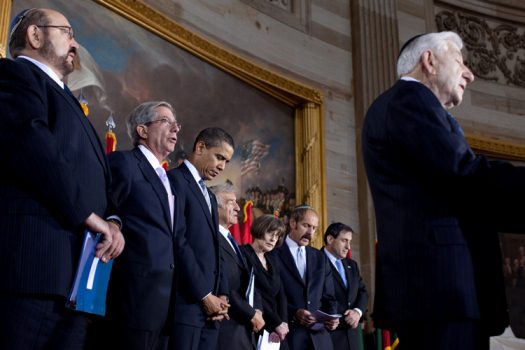
Elie Wiesel speaking at Holocaust Day of Remembrance at the U.S. Capitol, April 23, 2009 http://www.whitehouse.gov/blog/09/04/23/Watch-the-President-Speak-at-the-Holocaust-Days-of-Remembrance-Ceremony/, Public Domain, https://commons.wikimedia.org/w/index.php?curid=6611559
By Jillian Pikora
The world recently lost an amazing man (among many great losses this year), who has influenced the lives of many. I never thought an old Jewish man would be so influential to this Muslim woman’s life, especially since I first learned about him when I was a Catholic girl.
Before I stumbled upon Elie Wiesel’s books on my mother’s shelves, my picture of World War II was a weird amalgamation of Schindler’s List, South Pacific, The Sound of Music and about a dozen other Hollywood movies that skewed my view to be one of war heroes and USO musical numbers.
I knew I had gaps in my knowledge because The Von Trapps and Mr. Schindler were telling me two different stories that resounded with the same theme of Nazis are bad and everyone else is good and innocent — or perhaps that was how my juvenile view formed (looking back, I realized the shades of grey both figuratively and literally are lining each frame in Schindler’s List).
When I began trying to fill those gaps, I felt as though I was reaching for something in utter darkness and was unable to grab on to it, as I searched the children section of my public library to try and discern the truth among the musical numbers in my mind.
Then I discovered a light appearing in that darkness when I first picked up one of his books. He was the same age as I was when I first read his book, Night — a mere 12 years of age when he first encountered the Nazis. Our lives could not be more different, but by reading that book at such a young age my views on both Judaism and WWII were forever tinged with Wiesel’s view of the world.
When my seventh grade teacher assigned The Diary of Anne Frank, it paled in comparison. But my heart sank when I mentioned Night to my teacher — she had never heard of it! My dislike for the teacher and my enjoyment of the way Wiesel conveyed the facts of life in a concentration camp only made me relish breaking the rules and writing my final report on Night instead of the assigned reading.
As mentioned in the books Night and Memoirs, Wiesel was 15 when he first arrived in Auschwitz. When I was 15 the worst thing that had happened to me was that I had moved from New Hampshire to Seattle, shortly after which my most beloved grandmother died. For some reason I reread Night, then Dawn, Day, and Twilight. They gave me perspective on the trivialities of my complaints.
I wasn’t forced to move, and Seattle was heaven compared to what he went through. Yet my teenage mind thought my problems mattered so much that I filled angst-ridden journals with poems and songs about all my woes. Suddenly I stopped this pointless scribble. Because the more I read his work, I couldn’t help but wonder what his journals would have been filled with had he kept journals while in Auschwitz or Buchenwald.
Yes, I was sad about my grandmother passing, but she was in her late seventies, and it was part of life — not like that of a person having their family entirely wiped out by force. This idea literally gave me pause. I put down my notebooks, looked at the world around me and begin to see both the beauty and injustices.
Later on my interest in Wiesel shifted from reading his books to trying to understand exactly who he was as a person. He struggled to become a writer, working first as a reporter. This is something I can relate to, as I too am writing books at night and reporting at work during the day on a below living wage.
I also started my writing career by writing at the United Nations and later writing for magazines in the Middle East. The difference being that I typical wrote for some of the UN websites, for Muslim magazines and about Cairo; while Wiesel reported on the UN, wrote for Jewish magazines and about Jerusalem.
Reporting isn’t enough to earn a the coveted attention of the Nobel Prize Committee, something Wiesel did twice, being considered for both the Nobel Prize for Literature and the Nobel Peace Prize. After more than a decade of silence on the Holocaust, in 1960 he began to write about his experiences. And, although it took years for his books to gain popularity, he continued to tell his stories.
When he was awarded the Nobel Peace Prize in 1986, the committee’s statement gave a vague description of his achievements, merely citing, “with his message and through his practical work in the cause of peace, [Wiesel] is a convincing spokesman for the view of mankind and for the unlimited humanitarianism, which are at all times necessary for a lasting and just peace.”
I find that to simply be a euphemism for using your writing, teaching and activism to give a voice to the millions who have and are suffering.
At the time of his Nobel Peace Prize, it had been more than two decades since his most noted book, Night, had been published. He had gone on to be a professor at Boston University and became a popular speaker on the Holocaust. His subject matter was vast, not only focusing on Jewish people in the USSR, Ethiopia and Israel, but the Desaparecidos in Argentina, native tribes such as the Nicaragua Miskito, the Bosnian genocide, Rwanda genocide, South African apartheid and the plight of the Kurdish people.
It was during one of his many speaking tours my mother first learned his story.
He was his visiting the University of Massachusetts Amherst where my mother was studying, affording her the opportunity to hear him speak. She had never read his books or even heard of him before. As a Catholic engineering student from a small town, why would she have? But her Jewish classmates insisted that she go with them to hear him speak because “this man will change how you see the world.”
They were right. His oratory skills went beyond a good presentation because the clear truths he told were so vivid that the audience felt what he felt — if only for an instant they caught a glimpse of the “kingdom of night” he so often said he resided in. That’s how her shelves became lined with his books.
Wiesel and his wife turned the ideas he discussed into actions. Using his money from his Nobel Peace Prize they started the Elie Wiesel Foundation for Humanity with the goal of combating “indifference, intolerance and injustice through international dialogue and youth-focused programs that promote acceptance, understanding and equality.”
Again, he was reaching out beyond his religious and cultural communities to encourage humanitarian aid in all aspects.
In my lifetime his foundation has continued to help people and encourage activists worldwide. As an individual he went on to write a dozen more books, teach at many institutions, earn seemingly endless awards, become a member of the Knighthood and work with world leaders and celebrities fighting to protect mankind.
He was not without controversy, I discovered his side of him at a turning point in my life. As I entered my twenties, I was trying to deepen my Catholic faith, but ended up in a conversation with my priest on faith that ended with both of us deciding to become Muslims. I did not consider how my friends or the greater world would look at this, because it was between me, God and my now former priest.
I soon found that my knowledge of the history of Israel and Palestine, gained through copious reading and friends I had made with from both countries, were now under a microscope. People around me began to judge my neutral view harshly. Wiesel was a proud Zionist. In his 1986 Nobel Peace Prize speech he stated, “There are the Palestinians to whose plight I am sensitive but whose methods I deplore. Violence and terrorism are not the answer. Something must be done about their suffering, and soon.”
I felt the same way and continued to look into insider’s views on the conflict. Although I’m not a cheerleader for either government and will never feel kinship with Benjamin Netanyahu like Wiesel did; I cannot help but agree with his condemnation of the “use of children as human shields.”
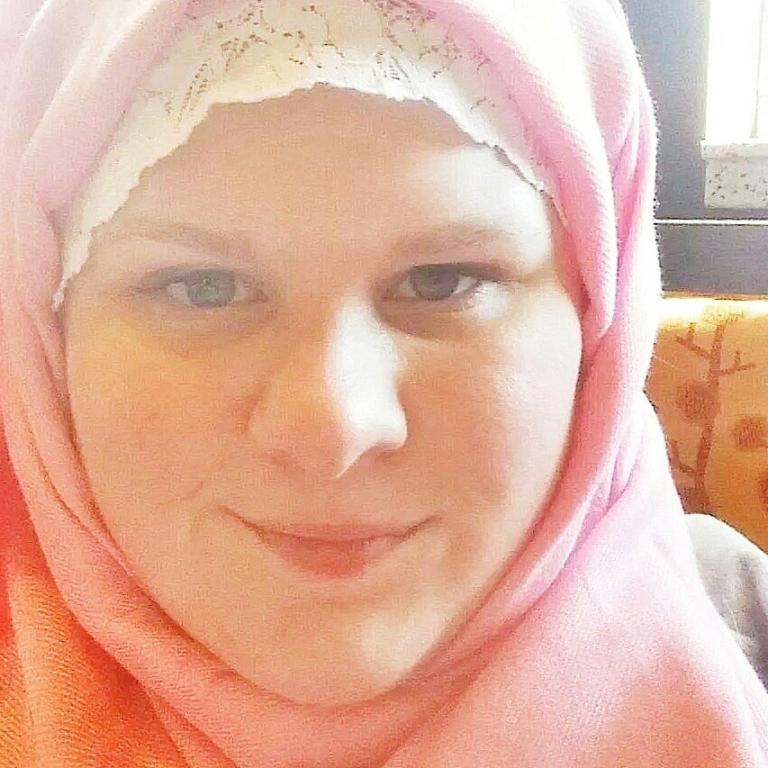
The author.
Despite many of my new Muslim friends vowing that Israel was “more wrong” — to me that statement is an oxymoron, because wrong is just wrong. It is as clear to me as thinking that the dancing Nazis were bad in those musicals of my youth.
As I forge ahead I hope my actions, teaching, writing and what I make of my life can create a positive change, no matter how small. For when I turn on the news each morning, the words Wiesel spoke before I was born somehow ring in my ears. “The opposite of love is not hate, but indifference.”
Jillian Pikora is a writer who has contributed to many magazines and news sites including but not limited to; Azizah Magazine, Huffington Post, Coming of Faith, Sisters Magazine, New York Times, The Atlantic, and The Guardian. Jillian has made appearances on CNN, Fox News, CSPAN, and Al Jazeera. She currently is a writer at CairoScene. Learn more about her at: http://jillianpikora.com/
Next Post

July 15, 2016 Ten Self-Care Tips for Faith-Based Activists
Browse Our Archives
Select a Category 2012 Elections 30 Dayd 30 Writers (2017) 30 Days 30 Writers 30 Days 30 Writers (2015) 30 Days 30 Writers (2016) 30 Days 30 Writers (2018) 30 Days 30 Writers 2017 Ali Asadullah Ali Eteraz Alper Bilgili Arthur Richards Asides Asma Uddin Black History Month Briefings Charles Turner Commentary Cyrus McGoldrick Eman H Aly Fatimah Popal Hajj Hajj and Dhul Hijjah Hesham Hassaballa Hisham Hellyer Ibrahim Abusharif Inas Younis Irfan Yusuf Jalal Baig Junaid Afeef Laila Alawa Laila Alwala Mas'ood Cajee Muqtedar Khan Nakia Jackson Newsmakers Parvez Ahmed Podcasts Rabia Chaudry Rafia Zakaria Ramadan Reviews Safiyyah Ally Saud Inam Shahed Amanullah Svend White The Opinionated Oncologist Visions Wajahat Ali Zahed Amanullah Zahir Janmohamed Zainab Khan
Select a Month November 2018 October 2018 September 2018 August 2018 July 2018 June 2018 May 2018 April 2018 March 2018 February 2018 January 2018 December 2017 November 2017 October 2017 September 2017 August 2017 July 2017 June 2017 May 2017 April 2017 March 2017 February 2017 January 2017 December 2016 November 2016 October 2016 September 2016 August 2016 July 2016 June 2016 May 2016 April 2016 March 2016 February 2016 January 2016 December 2015 November 2015 October 2015 September 2015 August 2015 July 2015 June 2015 May 2015 April 2015 March 2015 February 2015 January 2015 December 2014 November 2014 October 2014 September 2014 August 2014 July 2014 June 2014 May 2014 April 2014 March 2014 February 2014 January 2014 December 2013 November 2013 October 2013 September 2013 August 2013 July 2013 June 2013 May 2013 April 2013 March 2013 February 2013 January 2013 December 2012 November 2012 October 2012 September 2012 August 2012 July 2012 June 2012 May 2012 April 2012 March 2012 February 2012 January 2012 December 2011 November 2011 October 2011 September 2011 August 2011 July 2011 June 2011 May 2011 April 2011 March 2011 February 2011 January 2011 December 2010 November 2010 October 2010 September 2010 August 2010 July 2010 June 2010 May 2010 April 2010 March 2010 February 2010 January 2010 December 2009 November 2009 October 2009 September 2009 August 2009 July 2009 June 2009 May 2009 April 2009 March 2009 February 2009 January 2009 December 2008 November 2008 October 2008 September 2008 August 2008 July 2008 June 2008 May 2008 April 2008 March 2008 February 2008 January 2008 December 2007 November 2007 October 2007 September 2007 August 2007 July 2007 June 2007 May 2007 April 2007 March 2007 February 2007 January 2007 December 2006 November 2006 October 2006 September 2006 August 2006 July 2006 June 2006 May 2006 April 2006 March 2006 February 2006 January 2006 December 2005 November 2005 October 2005 September 2005 August 2005 July 2005 June 2005 May 2005 April 2005 March 2005 February 2005 January 2005 December 2004 November 2004 October 2004 September 2004 August 2004 July 2004 June 2004 May 2004 April 2004 March 2004 February 2004 January 2004 December 2003 November 2003 October 2003 September 2003 August 2003 July 2003 June 2003 May 2003 April 2003 March 2003 February 2003 January 2003 December 2002 November 2002 October 2002 September 2002 August 2002 July 2002 June 2002 May 2002 April 2002 March 2002
Follow Us!
TAKE THE
Religious Wisdom Quiz
Who said: "Therefore, since we have a great high priest who has ascended into heaven, Jesus the Son of God, let us hold firmly to the faith"?
Select your answer to see how you score.
Peter Paul James John
Related posts from altmuslim

Mawlid 2018: Praise Songs from Around the World

Gaslighting, Anti-Jewish and Anti-Muslim Rhetoric: What to Know

How One Ottoman Reconciled Islamic Teachings with Darwin's...

As #TreeofLife Shows, Trump's Mainstreaming of Hate Puts...
TRENDING AT PATHEOS Muslim

25 Years Later: How Much Has Changed for...
As we approach the 25th anniversary of September 11th, I’ve found myself...

Podcast: Third Spaces & The Rise of Yemeni...
In the latest episode of The Artistic Foodies Podcast, hosts Abbas...

HalalFest Picks: Best 60 Halal Spots for Super...
Back in 2016, I came up with a list of 29...

Unity Is America’s Strength — Division Is Its...
by Hidayatullah Ahsan When Valentina Gomez, a Republican candidate for Congress in...

Zohran Mamdani and New York’s Fight Against Islamophobia
This past June, against all odds, Zohran Mamdani won the Democratic primary...

What the Fourth of July Means to a...
As we mark another Fourth of July, millions of Americans will celebrate...
view all Muslim blogs
Ad-Free & Subscriber Log-In Subscription Support
- About Us
- 2026 Calendar
- Videos
- Podcasts
- Library of World Religions
- Faith In Media Tracker
- Advertise With Us
- Write for Us
- Privacy Policy
- Terms of Service
- Do Not Sell My Data
- Contact Us
- Radiant Digital
- Manage Newsletter Subscriptions
- Unsubscribe From Notifications
- Sitemap
Copyright 2008-2026, Patheos. All rights reserved.
Subscription Support Ad-Free & Subscriber Log-In
Follow Patheos